


Proper entrance matting does more than keep floors clean. Proper matting reduces cleaning costs by 60-70% and slip incidents by 25-30%, yet most facility managers underestimate how much the wrong mat choice costs them each year. Selecting the right mat for a high-traffic area affects worker safety, janitorial budgets, and the first impression your facility makes. This guide walks you through mat types, performance specs, safety certifications, smart selection criteria, and zone-based placement strategies so you can make a confident, cost-effective decision.
Table of Contents
- Understanding high-traffic areas and entryway risks
- High-traffic mat material types: Performance differences
- Key mat types for high-traffic areas: Pros, cons, and certifications
- How to build a zone-based matting system for maximum effectiveness
- Maintenance best practices and mistakes to avoid
- Find the perfect high-traffic mat solution with Mats4U
- Frequently asked questions
Key Takeaways
| Point | Details |
|---|---|
| Mat system length matters | Extending entrance matting to 12-15 feet traps up to 90% of dirt and moisture. |
| Certification boosts safety | Choose mats with NFSI or DIN 51130 certification for proven slip resistance. |
| Material fit is crucial | Rubber and PVC excel at scraping; nylon and polypropylene provide absorption and longevity. |
| Maintenance extends life | Consistent cleaning and periodic rotation maximize a mat’s lifespan and performance. |
| Zone layering works best | Combining scraper and wiper mats in zones offers the highest protection for busy facilities. |
Understanding high-traffic areas and entryway risks
Not every doorway qualifies as high-traffic, but the ones that do carry serious risk. High-traffic zones include building lobbies, hospital corridors, school entryways, airport terminals, and retail vestibules. These areas see hundreds or thousands of foot contacts per hour, and each contact brings in dirt, moisture, and debris from outside.
The risks are specific and measurable. Moisture on hard floors is the leading cause of slip-and-fall incidents in commercial facilities. Dirt tracked inside accelerates floor finish wear, increases cleaning labor, and creates liability exposure. Without adequate matting, these costs compound quickly.
Research shows that the first 8-10 steps capture 74% of incoming dirt, while only 3-5 steps capture 42%. An optimal mat run of 6 or more footsteps (roughly 3 meters or more) is needed to reach 85-90% capture efficiency, which translates to a recommended 12-15 feet of combined matting at each entrance.
For a detailed breakdown of what separates effective entrance matting from inadequate coverage, the high-traffic entrance mats guide covers zone sizing and product selection in depth.
Key risks in high-traffic entryways include:
- Slip and fall hazards from wet or debris-covered floors
- Accelerated floor finish wear from abrasive grit tracked inside
- Increased cleaning frequency and labor costs
- Reduced mat effectiveness when coverage area is too short
- Liability exposure from inadequate safety measures at entry points
High-traffic mat material types: Performance differences
Recognizing the risks, the next step is picking the right materials. Not all mats perform the same, and the wrong material in the wrong location will fail faster and protect less.
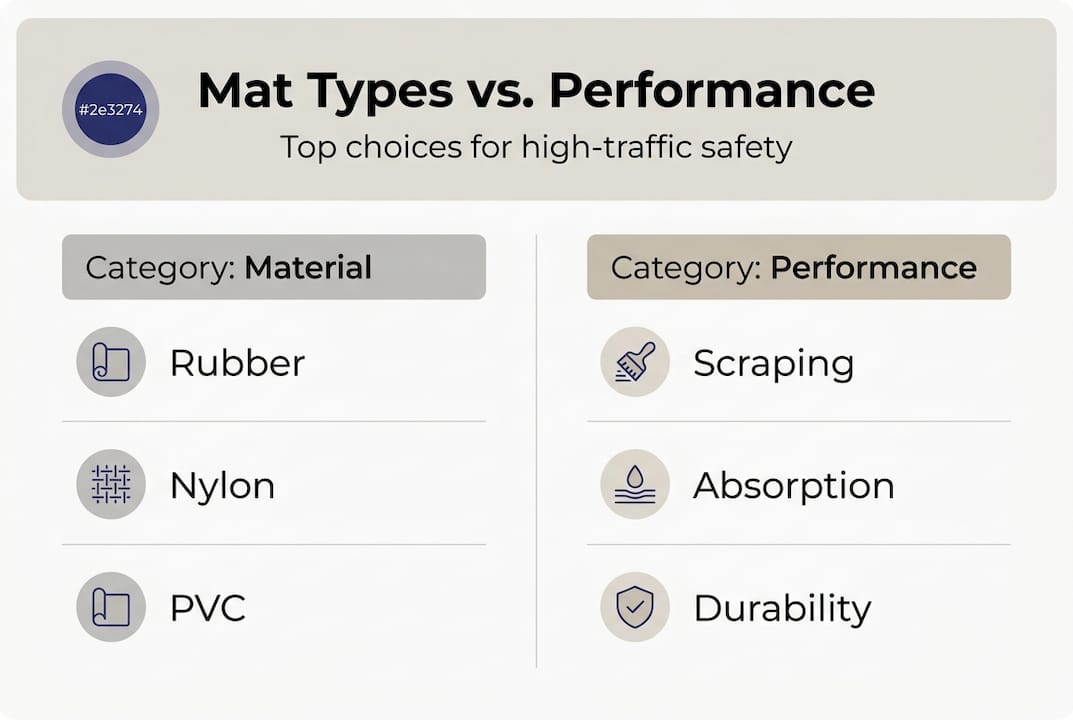
Rubber and PVC mats are built for scraping. They remove heavy debris, mud, and gravel from boot soles before it enters the building. These materials handle outdoor conditions, UV exposure, and wet environments well. They are the standard choice for Zone 1 placement directly outside the door.
Nylon and polypropylene mats are designed for wiping. They absorb fine dust, moisture, and residual dirt after the initial scraping stage. Nylon outperforms polypropylene in both durability and slip resistance. Nylon brush rugs last 25% longer than polypropylene alternatives, and rubber backing on these mats provides a coefficient of friction (COF) of 0.65, which exceeds the OSHA minimum of 0.5 and reduces slip incidents by 25%.
For wheeled traffic such as carts, dollies, or wheelchairs, standard fiber mats can buckle or degrade quickly. Wheeled traffic needs wheel-proof PVC like Frontrunner roll mats. Chemical exposure environments favor nitrile rubber backing. Outdoor installations require solution-dyed fibers for UV stability.
Pro Tip: Always specify nylon over polypropylene for high-traffic indoor wiping zones. The longer service life and higher slip resistance rating deliver better value over a 3-5 year replacement cycle.
| Material | Best use | Scraping | Absorption | Durability |
|---|---|---|---|---|
| Rubber | Outdoor, heavy debris | Excellent | Low | High |
| PVC | Industrial, wheeled traffic | Excellent | Low | Very High |
| Nylon | Indoor wiping, fine dust | Good | High | High |
| Polypropylene | Light indoor use | Moderate | Moderate | Moderate |
For a full comparison of commercial door mats by material and application, and to review specific product specs for Waterhog mat features, both resources provide detailed guidance.
Key mat types for high-traffic areas: Pros, cons, and certifications
After choosing the right material, it is time to look at specific mat types and how they stack up in performance and compliance.
WaterHog mats are among the most widely specified commercial entrance mats. WaterHog mats use bi-level construction with rubber-reinforced nubs for superior scraping, hold up to 1.5 gallons of water per square yard, and carry NFSI certification for slip resistance. The bi-level surface traps dirt below foot level so it does not get tracked back onto shoes.
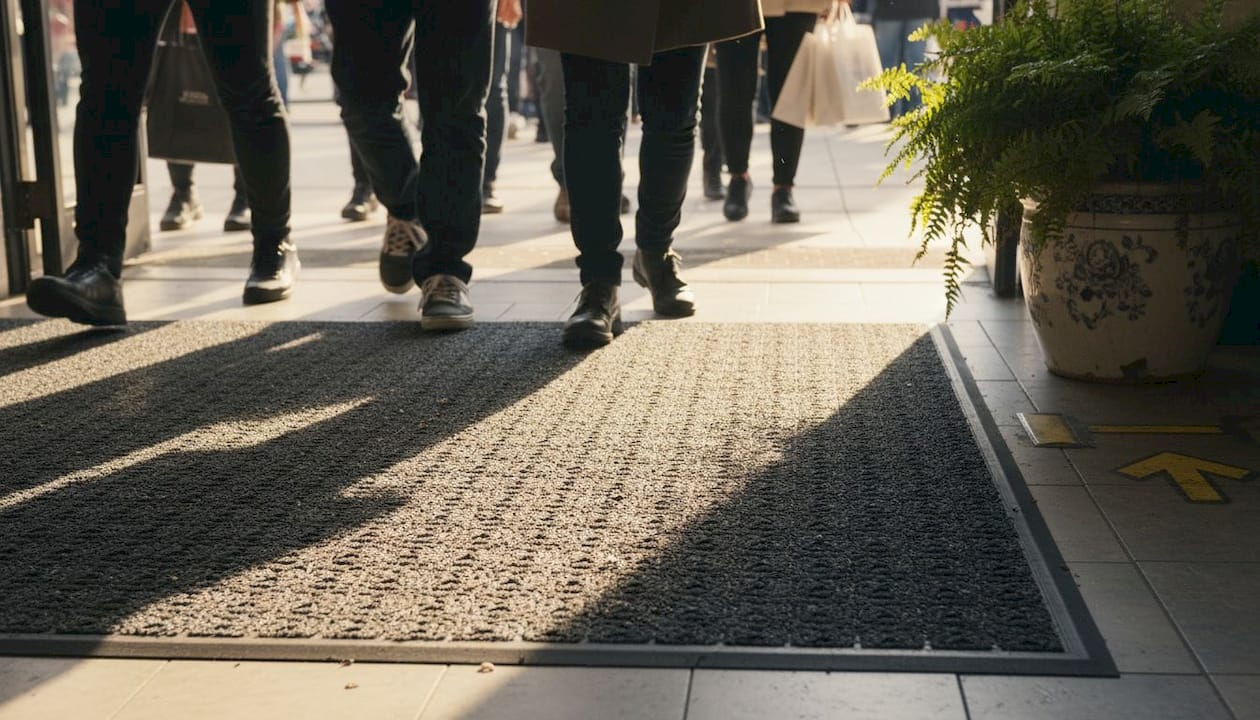
Frontrunner Roll Mats serve industrial and high-load environments. Frontrunner mats are heavy-duty PVC with deep-etched tread, are wheel-proof, and carry a 10-15 year service life. The open grid design allows drainage in wet industrial settings.
Premium Plush and Brush Hog mats target interior zones where moisture absorption and appearance matter. These mats use dense fiber construction for high dirt retention.
NFSI certification verifies high-traction slip resistance through independent lab testing. DIN 51130 R12 rating applies to some PVC mats and confirms anti-slip performance under industrial conditions. OSHA requires a minimum 0.5 COF on walking surfaces, and certified mats document compliance.
Pro Tip: For maximum safety and longevity, select mats that carry both material-based performance specs and independent lab certifications like NFSI. Certification documentation also supports liability defense if an incident occurs.
| Mat type | Scraping | Water capacity | Lifespan | Certification |
|---|---|---|---|---|
| WaterHog | Excellent | 1.5 gal/sq yd | 5-10 years | NFSI |
| Frontrunner PVC | Excellent | Drainage only | 10-15 years | DIN 51130 R12 |
| Premium Plush | Good | High absorption | 5-7 years | NFSI eligible |
| Brush Hog | Very Good | Moderate | 5-8 years | NFSI eligible |
For more on compliance and product selection, the commercial entrance matting guide and non-slip industrial flooring resources provide additional specification detail.
How to build a zone-based matting system for maximum effectiveness
Now that individual mat types are clear, let’s look at how best to combine them using proven layout strategies.
A zone-based matting system layers different mat types across the entry path to maximize dirt and moisture capture at each stage. The industry standard is a three-zone approach.
- Zone 1: Scraper zone (3-5 feet). Place a rubber or heavy-duty PVC mat directly outside or just inside the exterior door. This zone removes heavy debris, mud, and coarse grit from boot soles before anything else.
- Zone 2: Scraper/wiper zone (6-10 feet). Follow with a combination mat that continues scraping while beginning to absorb moisture. WaterHog mats are a strong fit here because they handle both functions.
- Zone 3: Wiper zone (5-8 feet). Place a high-absorption nylon mat in the interior zone to capture residual moisture and fine dust. This is the last line of defense before foot traffic reaches finished flooring.
A 3-zone matting system with 15 feet of total coverage captures 85% of incoming dirt and moisture. The Carpet and Rug Institute recommends 12-15 feet of combined matting to achieve 85-90% capture efficiency at commercial entrances.
This layout reduces cleaning labor because less dirt reaches interior floors. It also cuts slip incidents by keeping moisture contained in the mat zones rather than spreading across hard flooring. For specific product pairings and layout diagrams, zone-based matting strategies and choosing commercial mats both offer practical configuration examples.
Maintenance best practices and mistakes to avoid
Even the best mats cannot protect your floors and people if they are neglected. Maintenance directly affects mat lifespan, appearance, and slip resistance.
Routine vacuuming removes surface debris before it compacts into mat fibers. For high-traffic mats, daily vacuuming during peak seasons is standard practice. Periodic extraction cleaning removes embedded dirt that vacuuming misses. Premium Plush mats feature 36 oz/sq yd solution-dyed nylon with 90-mil nitrile backing, absorbing 50% more moisture than standard mats, with a 5-7 year lifespan in heavy traffic when properly maintained.
Common maintenance mistakes that reduce mat performance and safety:
- Cleaning too infrequently: Compacted dirt reduces fiber height and absorption capacity, cutting effectiveness by up to 40%
- Using harsh chemicals: Bleach and solvent-based cleaners degrade rubber and nitrile backings, causing curling and slip hazards
- Misaligned mat placement: Mats that shift or curl at edges create trip hazards; use recessed frames or solvent-free mat adhesives to secure placement
- Not rotating mats: Heavy wear concentrates in the center; rotating mats 180 degrees extends even wear across the surface
- Ignoring seasonal demand: Rain and snow seasons require more frequent cleaning cycles and potentially higher-capacity mats
Pro Tip: Schedule quarterly deep-cleaning for plush and brush mats during peak seasons. This maintains fiber loft, preserves absorption capacity, and keeps slip resistance ratings accurate. Tracking cleaning dates also supports facility safety documentation.
For a full breakdown of how proper mat care connects to long-term cost savings, save costs with proper floor mats covers the financial case in detail.
Find the perfect high-traffic mat solution with Mats4U
Mats4U stocks a wide range of certified, industrial-grade entrance mats built for the demands you face every day. Whether you need a WaterHog system for a hospital lobby, a Frontrunner PVC mat for a loading dock, or a custom-branded mat for a corporate entrance, the product catalog covers every application. The WaterHog Max Grand mat delivers NFSI-certified performance in a heavy-duty format suited for high-volume entryways. For facilities that want to combine safety with branding, custom logo floor mats are available in solution-dyed nylon with nitrile backing, matching the durability specs of standard commercial mats. Free delivery applies on orders over $100, and all products are Made in the USA. Contact the Mats4U team to match the right mat spec to your facility’s exact traffic volume, zone layout, and compliance requirements.
Frequently asked questions
What’s the ideal mat length for high-traffic entrances?
A 12-15 foot combined matting system is optimal. 3-zone matting captures 85% of incoming dirt and moisture with 15 feet of total coverage, per Carpet and Rug Institute benchmarks.
How do I know if a mat is truly slip-resistant?
Look for NFSI certification or a DIN 51130 R12 rating. NFSI certification verifies high-traction slip resistance through independent lab testing, providing documented compliance with OSHA COF requirements.
Are rubber-backed or PVC mats better for heavy debris?
Both perform well in Zone 1 scraper applications. Rubber and PVC scrapers excel at removing heavy debris and handling wet outdoor conditions, though they offer limited moisture absorption compared to fiber mats.
Do branded or logo mats hold up in high-traffic areas?
Yes, when built with the right materials. Premium Plush mats feature 36 oz/sq yd solution-dyed nylon with 90-mil nitrile backing, absorbing 50% more moisture than standard mats and lasting 5-7 years under heavy traffic conditions.


