


TL;DR:
- Selecting cold-weather mats with specific material properties and design features is essential for safety and durability in freezing conditions. High-quality mats with PVC/EVA tri-layer construction and deep channels effectively trap moisture while resisting cracks, extending their lifespan across multiple winters. Proper maintenance, site-specific selection, and performance-based specifications are crucial for maximizing safety and cost-efficiency in cold environment facilities.
Selecting the right floor mats for cold environments is one of the most underrated decisions a facilities manager makes heading into winter. Most people assume any rubber mat will hold up, but standard rubber becomes brittle and cracks below -20°F, turning a safety solution into a slip hazard. The industry term for what you actually need is “cold-weather matting,” a category defined by specific materials, geometries, and temperature ratings. This guide covers what separates a mat that lasts three seasons from one that fails after the first hard freeze.
Table of Contents
- Key takeaways
- Floor mats for cold environments: what materials actually work
- Design features that perform in winter conditions
- How cold-environment mats protect safety and reduce costs
- Selecting and maintaining cold-environment mats in commercial facilities
- My take on what facilities managers consistently get wrong
- Cold-environment mat solutions from Mats4u
- FAQ
Key takeaways
| Point | Details |
|---|---|
| Material choice is critical | Standard rubber fails below -20°F; prioritize PVC/EVA tri-layer or TPE designs rated to -40°F. |
| Mat geometry prevents accidents | Deep channel grooves and raised perimeter edges trap slush and salt before it reaches your floor. |
| Custom fit beats universal | Edge-to-edge coverage eliminates the gaps where moisture and salt reach carpet or subfloor. |
| Maintenance costs drop significantly | Non-porous mat surfaces resist salt absorption, requiring only a rinse to clean rather than scrubbing. |
| Longevity drives ROI | Mats built for cold environments outlast multiple winters, reducing replacement cycles and total spend. |
Floor mats for cold environments: what materials actually work
Not all matting is cold-weather matting. This distinction matters the moment temperatures drop below freezing and stay there. Cheap rubber mats crack at temperatures below -20°F, becoming rigid, brittle, and prone to splitting along the edges and channels where stress is highest. Once a mat cracks, it no longer functions as a contaminant barrier. It becomes a trip hazard with gaps that let salt water seep directly to your subfloor.
The solution is construction, not just category. Multi-layer designs that combine a PVC vinyl top surface, an EVA foam core, and a durable backing perform fundamentally differently. The EVA core provides both cushioning and thermal flexibility. It stays pliable when temperatures are extreme. Quality commercial mats in this category carry explicit flexibility ratings, and you should treat a mat rated to -40°F flexibility as a minimum specification for facilities in cold climates.
TPE versus rubber: the material comparison
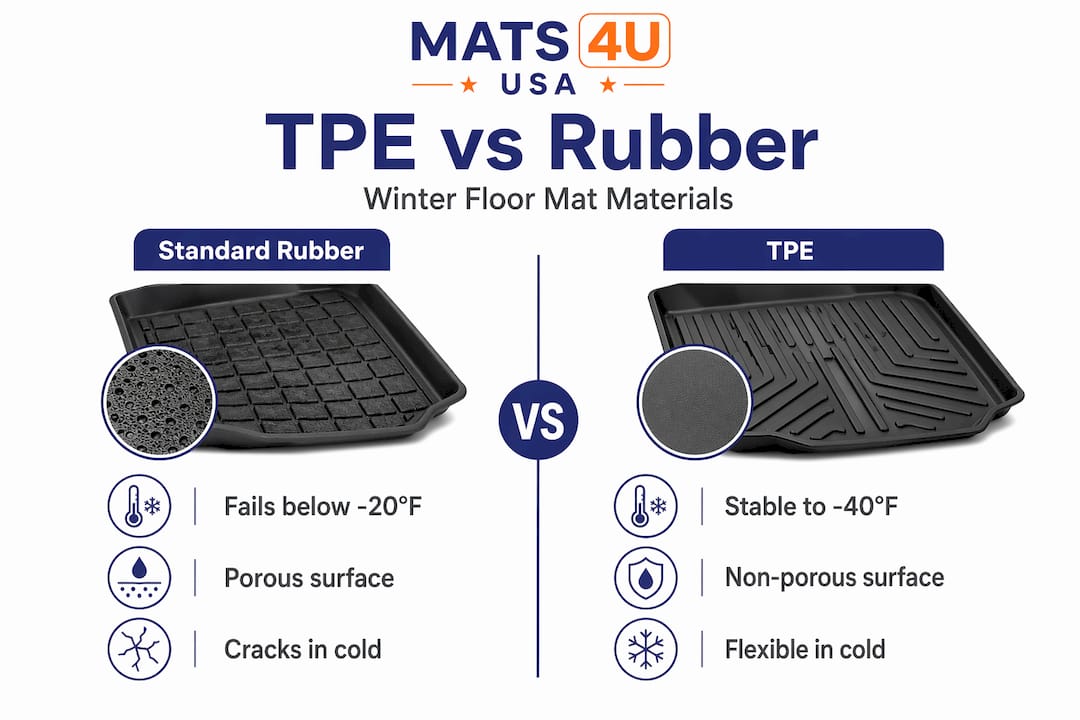
Thermoplastic elastomer (TPE) has emerged as the strongest alternative to traditional rubber for cold environment applications. TPE mats stay flexible and non-brittle at subzero temperatures, often performing reliably down to approximately -4°F. Standard rubber mats, even commercial-grade ones, start losing flexibility well above that threshold.
| Property | Standard Rubber | TPE |
|---|---|---|
| Cold flexibility rating | Fails below -20°F | Stable to approximately -4°F |
| Salt absorption | Porous, absorbs residue | Non-porous surface |
| Cleaning effort | Requires scrubbing | Rinse-only in most cases |
| Crack resistance | Low in extreme cold | High |
| Typical lifespan in winter use | 1 to 2 seasons | Multiple seasons |
TPE also carries a non-porous surface, which matters more than most facilities managers realize. Mats with non-porous surfaces resist salt absorption and prevent corrosive residue from building up inside the mat structure. Salt-saturated rubber deteriorates from the inside out. You may not see the failure until the mat tears or loses grip.
Pro Tip: Ask suppliers for the specific flexibility temperature rating on any mat you are evaluating. A listed rating signals the manufacturer tested for cold performance. No rating listed typically means the mat was not designed for it.
Design features that perform in winter conditions
Material is necessary but not sufficient. A mat made from the right material can still fail operationally if the geometry is wrong. Cold weather matting performs at its best when the physical design actively traps contaminants before they reach the walking surface or the floor beneath.
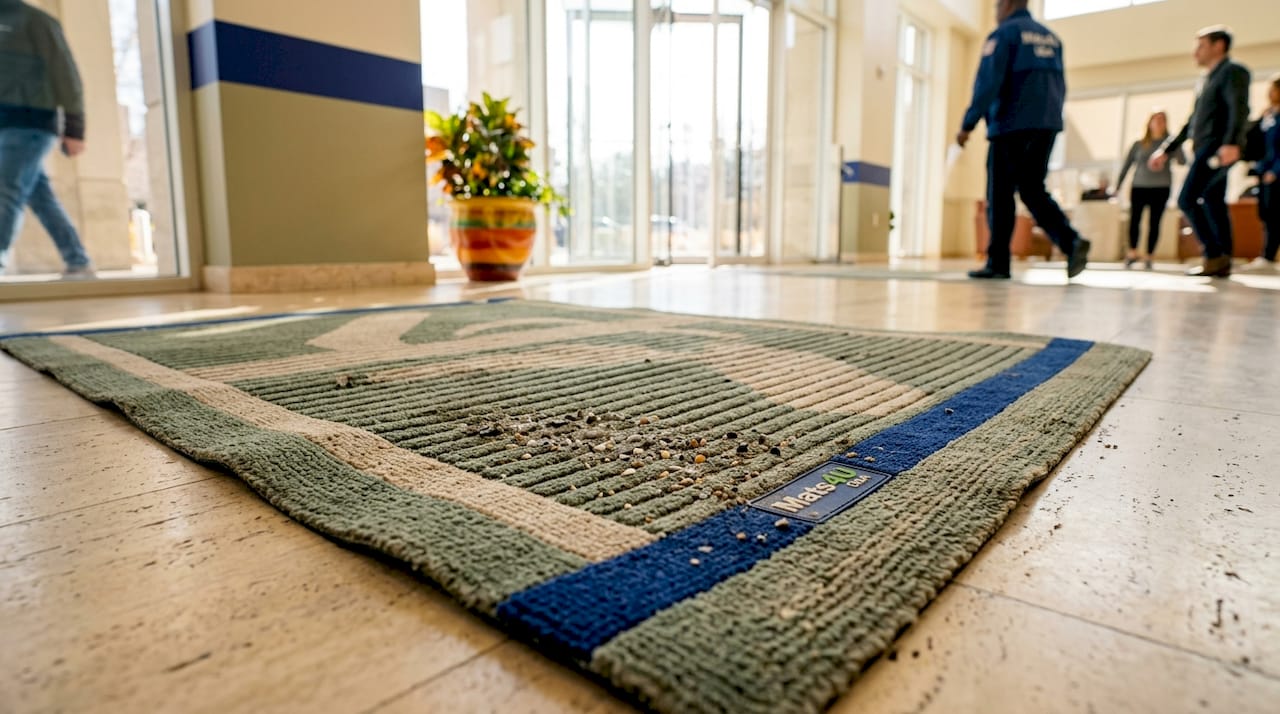
Deep channel grooves approximately 1 to 1.5 cm deep are the baseline requirement. These channels collect liquid, slush, and granular debris as foot traffic moves across the mat. Shallow channels fill up fast in high-traffic areas and begin pushing slush back onto the walking surface. For a facility receiving 200 or more people per hour during a winter storm, shallow channels become a liability within the first 30 minutes of a snow event.
Perimeter edge height is just as important. Raised edges of 2 to 3 inches contain slush and salt overflow that would otherwise creep under the mat or onto exposed flooring at the mat’s border. In facilities with hard flooring, that overflow causes corrosion and staining. In carpeted facilities, it saturates the carpet edge, which is both a damage and a hygiene problem.
Here is what to evaluate when assessing design performance for a cold-environment installation:
- Channel depth. Aim for at least 1 cm, with 1.5 cm preferred for very high-traffic entrances.
- Perimeter edge height. A minimum 2-inch raised edge for covered outdoor entries; 3 inches for uncovered exterior positions.
- Surface texture. Raised cleats, ridges, or nubs on the walking surface provide traction and help mechanically scrape slush off boot soles.
- Anti-slip backing. Nitrile rubber or similar grip materials on the underside prevent mat migration on both hard floors and carpeted surfaces.
- Custom versus universal fit. Custom-fit mats with precision sizing provide complete floor coverage that universal mats cannot match. Gaps at the perimeter are exactly where salt spray and moisture reach subfloors and carpets.
For the differences between indoor and outdoor mat requirements, the same principle holds. Outdoor positions need maximum edge height and aggressive scraping texture. Indoor walk-off zones prioritize absorption and anti-fatigue properties once the bulk of the contaminants have been removed.
Pro Tip: For uncovered building entrances, install a boot-scraper mat as the first contact point, then follow it with a deep-channel collection mat. You reduce the total contaminant volume entering the facility by roughly half, which extends the cleaning interval on your interior mats.
How cold-environment mats protect safety and reduce costs
Slip-and-fall incidents spike in winter, and the cause is almost always tracked-in moisture combined with inadequate matting at entry points. Slush and salt tracked indoors create slip hazards and corrode floors at a rate that facilities managers consistently underestimate until they see the repair invoice.
Road salt is particularly aggressive. It leaves behind crystalline deposits that scratch and etch hard flooring finishes. On concrete, salt accelerates surface degradation through a freeze-thaw cycle that widens microcracks. Preventing that exposure begins at the mat.
The operational maintenance argument for quality cold weather matting follows a clear sequence:
- Contaminant capture. Properly designed entrance mats capture the bulk of slush, sand, and salt at the door, preventing distribution across the facility floor.
- Surface protection. Floors shielded from salt contact avoid the corrosion and etching that require refinishing or tile replacement.
- Reduced cleaning labor. Concentrated contaminants on a removable mat take less time to address than salt deposits spread across 2,000 square feet of corridor.
- Lower incident liability. Dry walking surfaces after the entrance zone reduce slip incidents. Fewer incidents mean fewer workers’ compensation claims and reduced liability exposure.
- Extended mat lifespan. Cold-resistant mats built with non-porous materials do not absorb salt, which means they clean easily and maintain structural integrity across multiple seasons rather than requiring annual replacement.
The economics are direct. A premium heavy-duty winter mat costs more upfront. But a mat that survives three to four winters without cracking, delaminating, or losing anti-slip performance costs less per season than replacing a cheap mat every year, and it does a better job protecting the floor and the people using it. Routine rinse-only cleaning on quality mats keeps maintenance labor minimal without sacrificing hygiene.
Selecting and maintaining cold-environment mats in commercial facilities
The selection process works best when you start with a site-by-site assessment rather than a blanket order. Different zones in a commercial facility have different exposure levels and traffic profiles, and the mat spec should reflect that.
Use the following criteria to match mat type to location:
- Traffic volume. Entry points receiving over 100 people per hour need heavy-duty winter mats with deeper channels and greater contaminant capacity. Lower-traffic interior zones can use lighter-weight walk-off or insulated floor mats.
- Environmental exposure. Uncovered outdoor entries experience direct precipitation and freeze-thaw cycles. These positions require temperature-resistant floor mats with the highest edge height and most aggressive backing grip.
- Floor substrate. Concrete tolerates more weight and texture than polished tile. Match mat backing material to the floor type to prevent scratching and ensure grip.
- Custom versus stock sizing. When possible, order custom-fit mats for primary entry points. The cost difference over a standard mat is offset in the first winter by the floor protection and reduced cleaning.
- Seasonal layering. Pair exterior scraper mats with interior absorbent walk-off mats for a two-stage system. The scraper removes bulk debris; the absorbent mat captures residual moisture before it reaches the main floor.
On maintenance, the rule is simple: inspect weekly during winter, not monthly. Check for mat shifting, curling edges, and channel saturation. A saturated mat is no longer capturing contaminants. It is redistributing them. High-quality mats clean efficiently with a simple rinse, so a mid-week rinse during peak winter weeks is fast and effective. At season’s end, do a full inspection for cracks, delamination, or backing deterioration before deciding whether to store or replace.
My take on what facilities managers consistently get wrong
I have seen the same pattern across facilities of every size. The procurement decision defaults to the lowest-cost rubber mat, the mat gets installed at the entrance, and by January it is cracked, curled at the edges, and doing essentially nothing except creating a new trip hazard.
The mistake is not choosing rubber. The mistake is choosing a mat with no cold-temperature specification at all. Facilities managers frequently underestimate cold-temperature flexibility requirements, and the consequences show up fast. A cracked mat at a commercial entrance is a liability exposure, a floor damage accelerator, and a signal to every person walking in that the facility is not well managed.
What I have found actually works is treating mat selection the way you treat any other specification-driven procurement: require documented performance ratings, not just marketing descriptions. Ask for flexibility ratings, salt resistance specs, and warranty terms that cover commercial use in cold climates.
The best facilities I have worked with also build mat maintenance into their standard winter operations checklist alongside snow removal and HVAC transitions. Mats that get inspected and cleaned consistently last significantly longer and perform at specification throughout the season. The total cost of ownership drops. The safety record improves. That connection between mat quality, maintenance discipline, and outcome is not complicated, but it requires treating floor protection as infrastructure rather than an afterthought.
— Werner
Cold-environment mat solutions from Mats4u
Mats4u offers several options built specifically for the demands of winter and cold-weather facilities. The WaterHog Max Herringbone Mat delivers heavy-duty moisture control and durable construction for high-traffic winter entrances, with a surface designed to scrape and absorb in one step. For outdoor-to-indoor transitions, the WaterHog Drainable Border Mat handles slush volume with its drainable design, keeping contaminants from pooling beneath the mat surface.
For facilities where workers stand for extended periods in cold workspaces, the Comfort Premier anti-fatigue mat combines thermal resistance with cushioning to reduce fatigue in cold standing environments. Custom sizing is available across the product range. Mats4u ships free on orders over $100, with Made in the USA construction on core commercial products. Browse the full selection at mats4u.com to find the right specification for your facility.
FAQ
What makes a floor mat suitable for cold environments?
Cold-environment mats use materials like TPE or PVC/EVA tri-layer construction that stay flexible at subzero temperatures, preventing the cracking and brittleness that standard rubber mats develop below -20°F.
How deep should mat channels be for winter use?
Channel grooves of 1 to 1.5 cm depth are the recommended standard for winter floor mats, providing enough capacity to hold slush and debris in high-traffic conditions without overflow onto the walking surface.
Are custom-fit mats worth the extra cost for cold climates?
Yes. Custom-fit mats eliminate the perimeter gaps that allow salt and moisture to reach subfloors and carpets, providing protection that universal mats structurally cannot match.
How often should cold-environment mats be cleaned in winter?
Inspect and rinse mats at least weekly during active winter conditions. High-quality non-porous mats clean efficiently with a rinse, making mid-week maintenance fast even in high-traffic facilities.
Can anti-fatigue mats be used in cold work environments?
Yes. Some commercial anti-fatigue mats combine cold-temperature resistance with cushioning, making them suitable for workers who stand for long periods in cold facilities like warehouses, loading docks, and refrigerated spaces.


