


TL;DR:
- Durability in commercial mats depends on material construction, backing quality, and maintenance discipline rather than price. Polyurethane mats last over 20 years, while foam mats typically fail within 18 months under heavy use. Proper installation, cleaning, and inspection extend mat lifespan and ensure safety in high-traffic environments.
Durability in commercial mats is defined as a mat’s capacity to withstand heavy foot traffic, mechanical stress, and environmental exposure without significant degradation in safety performance or structural integrity. For facility managers, this translates directly into two measurable outcomes: reduced slip-and-fall liability and lower total replacement costs over a mat’s service life. Commercial rubber mats last 2 to 7 years depending on quality and thickness, while polyurethane options can exceed two decades. The gap between those figures is not luck. It is material science, construction quality, and maintenance discipline.
What are the primary material types and their durability characteristics?
The three dominant materials in commercial mat construction are foam, rubber, and polyurethane. Each carries distinct durability trade-offs that directly affect how long a mat performs safely in a high-traffic setting.
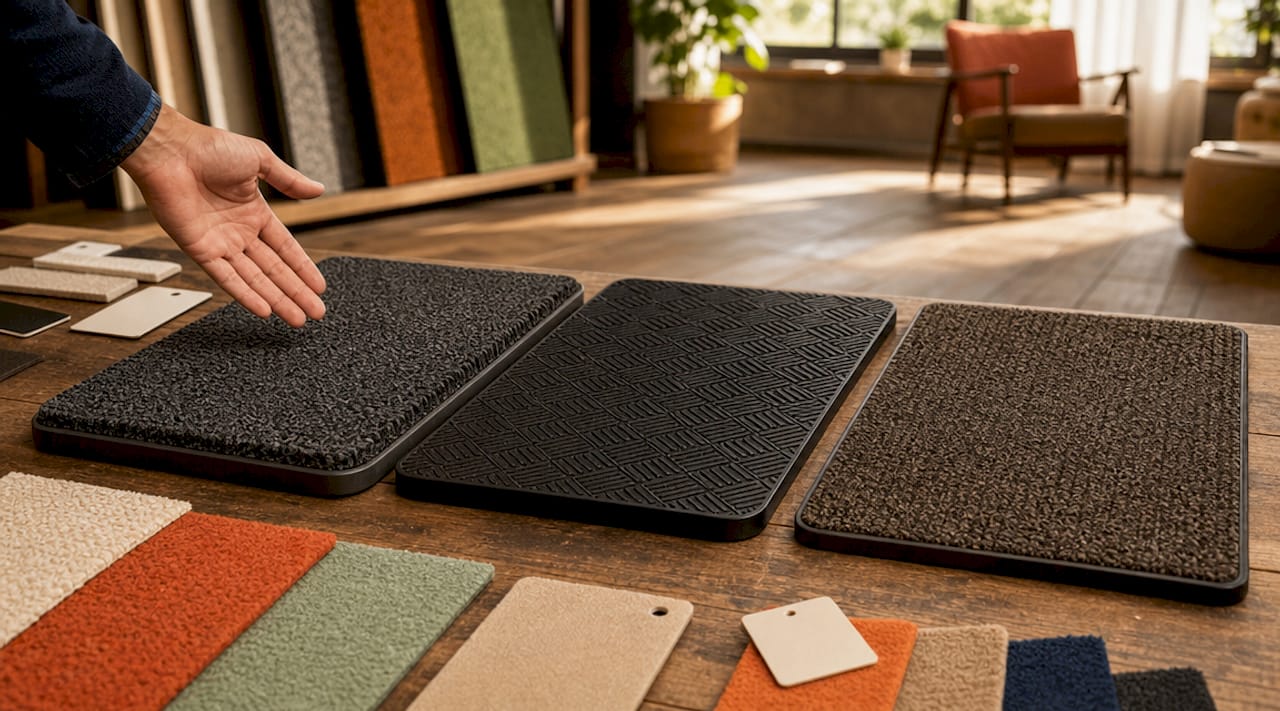
Foam mats are the lowest-cost entry point, but they carry a structural liability. Foam mats lose ergonomic cushioning due to irreversible cell compression within 12 to 18 months. That means a mat purchased for worker comfort can actively increase lower-limb fatigue within a year and a half, even when it still looks intact from above. For light-duty or temporary use, foam is acceptable. For permanent commercial installations, it is a short-term solution with a long-term cost.
Rubber mats offer significantly better abrasion resistance and chemical tolerance. They resist oils, grease, and cleaning agents that would degrade foam rapidly. The risk with rubber is delamination, particularly in layered constructions where the top surface separates from the backing under repeated mechanical stress or improper cleaning. Thickness and compound quality determine where a rubber mat falls within that 2 to 7 year range.
Polyurethane mats represent the highest durability tier. Polyurethane mats poured as a single piece eliminate the delamination risk entirely and maintain cushioning for 20 or more years. The single-piece construction means there are no bonded layers to separate, no seams to fail, and no foam core to compress irreversibly. The upfront cost is higher, but the lifecycle cost per year of service is typically lower than foam or entry-level rubber.
| Material | Typical Lifespan | Primary Failure Mode | Best Use Case |
|---|---|---|---|
| Foam | 12 to 18 months | Irreversible cell compression | Light-duty, temporary use |
| Rubber | 2 to 7 years | Delamination, surface abrasion | General commercial, industrial |
| Polyurethane | 20+ years | Minimal under normal use | High-traffic, long-term installations |
Pro Tip: When comparing mat options at similar price points, ask the supplier for the construction method, not just the material. A rubber mat with a bonded foam core behaves more like foam than rubber under sustained load.
How do construction features influence the durability of commercial mats?
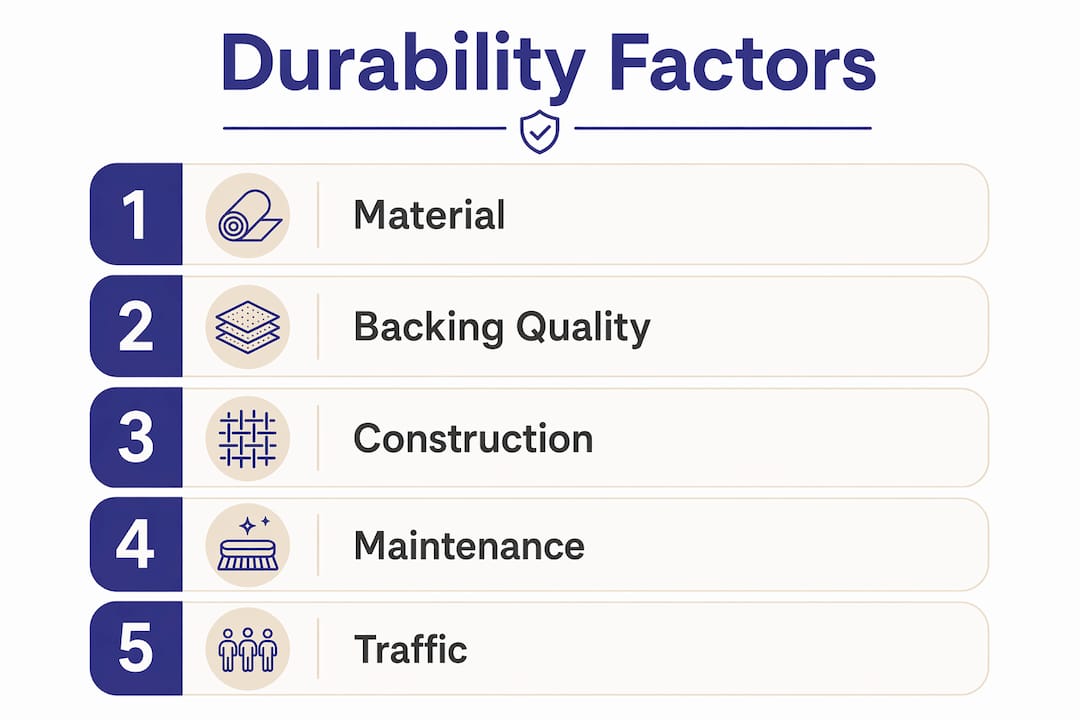
Material choice sets the ceiling for durability. Construction quality determines whether a mat reaches that ceiling or fails well short of it. Four construction features separate long-lasting commercial mats from those that fail within six months.
- Backing type. Nitrile rubber backing stays flexible under temperature variation, resists oil and grease, and prevents mat migration better than PVC backing. PVC backing hardens and cracks in cold environments, losing grip and creating a trip hazard. In kitchens, loading docks, or any area with temperature swings, nitrile backing is the correct specification.
- Yarn construction. Heat-set, twisted yarns in entrance mats resist fiber splaying and matting under foot traffic. Looped or cut-pile constructions without heat-setting flatten quickly, reducing both scraping performance and surface appearance. For Waterhog and Berber-style mats, yarn resilience directly determines how long the mat continues to trap dirt and moisture effectively.
- Mat weight. Heavier mats resist shifting and wear better due to distributed pressure and reduced movement under traffic. A mat that migrates under foot traffic wears unevenly and creates edge-lifting hazards faster than a stable, weighted mat.
- Edge design. Beveled edges and molded borders prevent curling and reduce trip hazards. A stable nitrile backing and molded beveled edges are critical to preventing mat migration and lifting, which are two of the most common contributors to early failure and OSHA-reportable incidents.
Pro Tip: Request the mat’s weight per square foot from the supplier before purchasing. For high-traffic corridors, prioritize mats above 60 oz per square yard. Lighter mats in those zones will migrate and wear unevenly within months.
For a detailed breakdown of how these factors interact across specific product categories, the durability factors for mats guide from Mats4u covers each specification with commercial use cases.
What external factors most affect commercial mat durability during use?
Even the best-constructed mat degrades faster than its rated lifespan when external conditions are not managed. The four primary external factors are usage load, cleaning practices, environmental exposure, and subfloor conditions.
- Usage load. Users over 90 kg compress budget foam mats 20 to 30% faster, and mats used four hours daily last roughly half as long as those used two hours. This means a mat specified for a low-traffic reception area will fail prematurely if deployed in a production floor where workers stand on it for full shifts. Match the mat specification to the actual usage profile, not the lowest-cost option that fits the space.
- Cleaning chemicals. Incompatible cleaning agents accelerate surface degradation, backing separation, and fiber breakdown. Alkaline degreasers used on rubber mats without rinsing leave residue that softens the backing compound over time. Always verify that the cleaning agents used in your facility are compatible with the mat’s material specification before purchasing.
- Environmental exposure. UV exposure fades and embrittles surface fibers in entrance mats placed near glass facades or covered walkways with indirect sunlight. Temperature cycling in loading docks and cold storage entries causes PVC-backed mats to harden and crack. Moisture accumulation under mats that are not lifted and dried regularly creates mold and accelerates backing degradation.
- Subfloor conditions. Premature mat failure often relates more to incorrect installation and maintenance than to traffic volume. Uneven floors concentrate pressure on specific mat zones, causing localized wear. Moisture pooling beneath a mat that sits on a slightly recessed floor section accelerates backing failure regardless of material quality.
How to assess mat durability and predict lifespan before purchase
Purchasing decisions based on price and appearance alone produce the most expensive outcomes over a three to five year budget cycle. Three practical methods give you reliable durability data before committing to a specification.
- Wyzenbeek abrasion rating. Wyzenbeek class 4 or higher is recommended for heavy commercial mats, with class 5 indicating an abrasion-proof surface. This test measures pilling and color change over 10,000 cycles and reliably predicts surface lifespan and delamination risk. Ask suppliers for the Wyzenbeek rating on any mat you are evaluating for a high-traffic zone.
- The thumb drag field test. Dragging a thumb 20 times across a mat surface can predict durability before commercial use. Material transfer or surface whitening after 20 passes indicates surface degradation will occur within a year under real traffic. This test takes 30 seconds and can be performed on any sample before purchase.
- Manufacturer warranty terms. A warranty that covers delamination, backing failure, and surface wear under commercial use is a meaningful signal of construction confidence. Warranties that exclude commercial use or limit coverage to manufacturing defects only tell you the manufacturer does not expect the mat to perform under the conditions you need.
Signs that a mat in service needs replacement include visible fiber matting that does not recover after cleaning, edge curling that cannot be flattened, backing that has hardened or cracked, and surface compression that does not rebound when foot pressure is removed.
For practical guidance on choosing durable mats for specific commercial environments, Mats4u provides a selection guide organized by traffic volume and use case.
What maintenance and replacement strategies maximize mat longevity?
Correct maintenance extends mat service life and reduces the frequency of replacement cycles. The following practices apply across rubber, foam, and polyurethane mat types in commercial settings.
- Substrate preparation. Install mats on clean, level, dry subfloors. Debris under a mat creates pressure points that accelerate localized wear. Moisture trapped beneath a mat degrades backing compounds regardless of material quality.
- Cleaning frequency and agents. Vacuum entrance mats daily in high-traffic zones and deep-clean weekly with pH-neutral detergents. Avoid bleach-based or strongly alkaline cleaners on rubber-backed mats unless the manufacturer explicitly approves them. Rinse thoroughly after any chemical cleaning to prevent residue buildup.
- Rotation schedules. Rotate mats between high-traffic and lower-traffic positions every 30 to 60 days. This distributes wear evenly across your mat inventory and extends the total service life of each unit.
- Inspection intervals. Conduct a visual and tactile inspection monthly. Check for edge lifting, backing separation, surface compression that does not rebound, and any discoloration that indicates chemical damage.
Pro Tip: Build a simple mat log that records purchase date, placement location, cleaning history, and inspection notes for each mat. Facilities that track this data replace mats on schedule rather than after a slip incident, which is always the more expensive outcome.
Facility experts recommend prioritizing installation quality and compatible cleaning practices over material choice alone to avoid premature failure. A premium polyurethane mat installed on a damp, uneven subfloor and cleaned with incompatible chemicals will fail faster than a mid-grade rubber mat installed and maintained correctly.
Key takeaways
Durability in commercial mats is determined by material construction, backing quality, and maintenance discipline, not by price or appearance alone.
| Point | Details |
|---|---|
| Material choice sets the lifespan ceiling | Polyurethane lasts 20+ years; rubber lasts 2 to 7; foam fails within 18 months under commercial load. |
| Construction quality closes the gap | Nitrile rubber backing, heat-set yarns, and beveled edges prevent the most common failure modes. |
| Usage load accelerates degradation | Users over 90 kg and four-hour daily use cut foam mat lifespan by up to 50%. |
| Wyzenbeek class 4+ is the specification floor | Require abrasion test data from suppliers before purchasing mats for heavy-use zones. |
| Maintenance errors cause premature failure | Incompatible cleaners and uneven subfloors reduce even high-quality mat lifespans by up to two years. |
What facility managers consistently get wrong about mat durability
After working with commercial mat specifications across a range of facility types, the pattern I see most often is this: buyers optimize for purchase price and ignore total cost of ownership. A foam anti-fatigue mat at half the price of a polyurethane unit looks like a budget win on a purchase order. It looks very different after 18 months when you are replacing it for the second time and filing an incident report because a worker’s lower-limb fatigue contributed to a near-miss.
The second consistent mistake is treating mat maintenance as a janitorial afterthought rather than a facility management responsibility. Mats that look similar on the surface may differ drastically beneath. Backing quality, fiber construction, and edge design influence durability far more than surface appearance. A mat that passes the thumb drag test and carries a Wyzenbeek class 4 rating will outlast a visually identical mat that fails both by years.
The trend worth watching is single-piece polyurethane construction moving into mid-market price points. As that happens, the cost argument for foam in permanent commercial installations will disappear entirely. Facilities that have already built mat inspection and rotation programs into their maintenance schedules will be positioned to get full value from that shift. Those still replacing mats reactively will keep paying the premium for emergency procurement.
— Werner
Explore durable commercial mat options at Mats4u
Mats4u stocks a full range of commercial mat solutions built for high-traffic performance, from premium custom logo mats with high-definition print clarity and durable construction to the Cushion Select anti-fatigue mat designed for sustained industrial use. Every product in the catalog is selected for commercial-grade durability, with specifications that include backing type, abrasion ratings, and warranty coverage. Free delivery applies to orders over $100, and all products are Made in the USA. If you are evaluating mat options for a specific facility environment, Mats4u’s product selection tools and category browsing make it straightforward to match the right mat to your traffic volume and use case.
FAQ
What is the average lifespan of a commercial mat?
Commercial rubber mats last 2 to 7 years depending on quality and thickness, while polyurethane mats can exceed 20 years. Foam-based mats typically degrade within 12 to 18 months under commercial load.
What makes a mat durable enough for heavy commercial use?
Single-piece construction, nitrile rubber backing, heat-set yarn, and a Wyzenbeek abrasion rating of class 4 or higher are the primary indicators of durability for heavy commercial environments.
How does maintenance affect commercial mat longevity?
Incorrect installation and incompatible cleaning agents can reduce a high-quality mat’s lifespan by up to two years. pH-neutral cleaners, level subfloors, and regular rotation schedules are the most effective maintenance practices.
How do I test a mat’s durability before purchasing?
Drag your thumb firmly across the surface 20 times. Material transfer or surface whitening indicates the mat will degrade within a year under real commercial traffic. Request the Wyzenbeek abrasion rating from the supplier as a second check.
When should a commercial mat be replaced?
Replace a mat when surface fibers no longer recover after cleaning, edges curl and cannot be flattened, the backing has hardened or cracked, or compressed zones do not rebound under foot pressure.


