


TL;DR:
- Effective winter entryway matting involves a two-stage system combining exterior scraping and interior absorption to control snow, ice, salt, and moisture. Proper sizing, material selection, and regular cleaning schedules are essential to prevent slip hazards and floor damage during winter months. Continuous maintenance, including cleaning, rotation, and verifying slip resistance ratings, ensures mats remain effective barriers against winter contamination.
Winter entryway matting is defined as a multi-layered floor protection system designed to capture snow, ice, salt, and moisture before they reach interior floors. For facility managers and property owners, the stakes are concrete: slip-and-fall incidents spike in winter months, and salt tracked indoors degrades flooring finishes at measurable cost. A layered matting system combining exterior scraping and interior absorption is the single most effective strategy for controlling winter contamination. The following guide covers system design, material selection, maintenance scheduling, and common operational failures that undermine even well-specified mat programs.
What are the components of an effective winter entryway matting system?
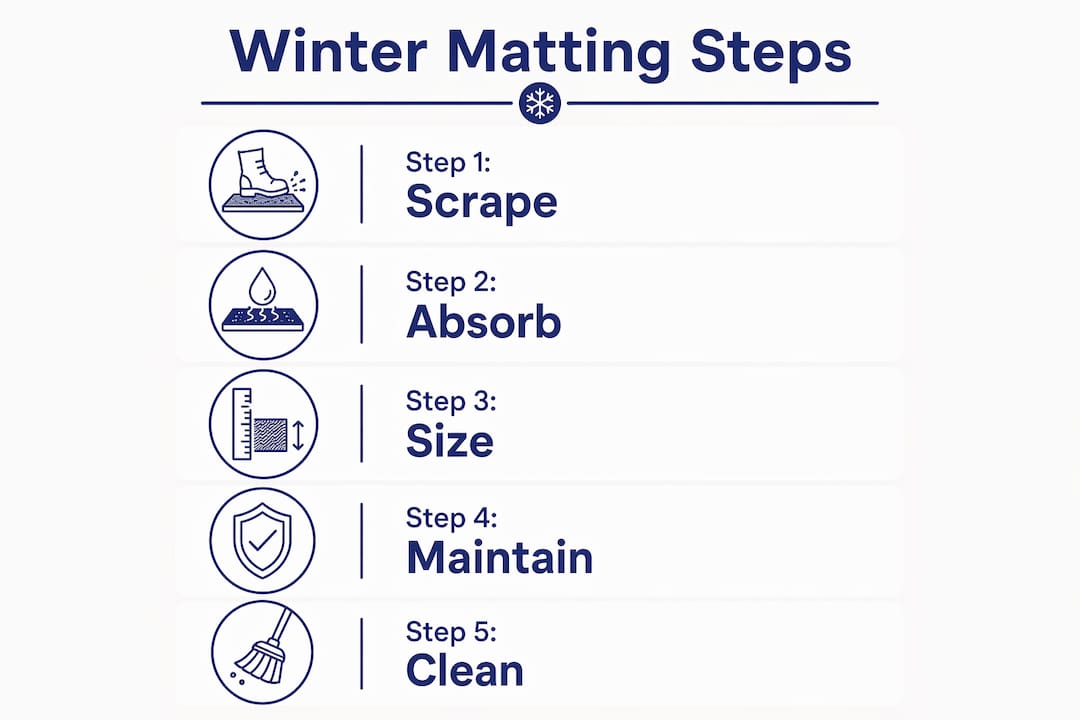
An effective entrance matting system for winter operates in two distinct stages: scrape first, absorb second. Each stage requires a different mat type, placed in sequence, to function as a decontamination zone rather than a decorative threshold.
Stage 1: The exterior scraper mat
The exterior mat handles the heaviest contamination load. It must use coarse, rigid materials such as rubber, nylon, or polypropylene bristles capable of dislodging compacted snow, ice chunks, and grit from boot soles. Rubber-backed scraper mats with raised cleats or waffled surfaces perform best here because they physically dislodge debris rather than simply absorbing it. Drainage channels in the mat body prevent pooling, which would otherwise refreeze and create a slip hazard directly at the entrance.
Stage 2: The interior absorbent mat
Once occupants step inside, the interior mat captures residual moisture and fine salt particles. Thick nylon or microfiber loop pile mats excel at this task because their fiber structure wicks moisture away from boot surfaces. The indoor mat must allow at least two full steps for effective snow and salt shedding before occupants reach unprotected flooring. Undersizing this mat is the most common specification error in commercial facilities.
Sizing and coverage requirements
Facilities with heavy winter contamination should target a combined matting coverage of 15 to 20 feet across both mat zones. That figure accounts for the average number of steps needed to shed the majority of tracked-in material. Smaller mats saturate faster and lose effectiveness within hours during heavy snowfall events, directly increasing slip risk and contamination spread.
Key design requirements for any winter matting system:
- Non-slip rubber or vinyl backing on all mats to prevent mat migration under foot traffic
- Beveled or tapered edges to eliminate trip hazards at mat perimeters
- Drainage channels or raised surfaces on exterior mats to prevent water pooling
- Sufficient pile depth on interior mats to trap fine salt particles, not just surface moisture
Pro Tip: Size your interior absorbent mat to match the full width of the doorway opening, not just the center traffic path. Salt and moisture track in across the full door width, and a narrow mat leaves unprotected floor on both sides.
Which materials and features make mats suitable for harsh winter conditions?
Material selection determines whether a mat performs for weeks or fails within days under winter conditions. Each material category offers a distinct performance profile across scraping ability, moisture absorption, durability, and ease of cleaning.
| Mat Material | Primary Function | Winter Strength | Limitation | Best Placement |
|---|---|---|---|---|
| Rubber | Scraping, drainage | Resists freezing, easy to clean | Low absorption | Exterior entrance |
| Coir (coconut fiber) | Scraping | Strong bristle action | Degrades with heavy moisture | Covered exterior only |
| Nylon loop pile | Absorption | High moisture capacity, durable | Requires frequent cleaning | Interior zone |
| Polypropylene | Scraping and light absorption | Salt-resistant, fast-drying | Lower absorption than nylon | Transition zones |
| Microfiber | Absorption | Highest moisture capture per square foot | Higher cost, slower drying | Interior high-traffic zone |
Rubber mats are the standard choice for exterior placement because they do not degrade when exposed to freeze-thaw cycles, road salt, or de-icing chemicals. Coir mats offer aggressive scraping action but break down rapidly when saturated, making them unsuitable for uncovered entrances in heavy snowfall regions. Nylon and microfiber mats dominate interior applications because their fiber structure retains moisture rather than releasing it back onto boot soles.
Slip resistance: the specification detail most facilities overlook
Slip resistance testing under wet and contaminated conditions is the only reliable method for verifying mat safety in winter entrances. The pendulum test, which produces a Pendulum Test Value (PTV), is the recognized standard: PTV values above 36 generally indicate lower slip risk under wet conditions. Procurement teams should request documented wet-condition test results from suppliers, not just dry-surface ratings, since the performance gap between the two is substantial in winter environments.
Additional features to specify when sourcing durable winter mats:
- Rubber or vinyl non-slip backing with suction-cup or cleated surface for hard floors
- ASTM or PTV wet-condition certification documentation from the manufacturer
- UV-stabilized materials for exterior mats exposed to sunlight and temperature cycling
- Fiber treatments that resist mold and mildew growth from prolonged moisture exposure
How to maintain and clean winter entryway mats effectively?
Mat maintenance is where most winter matting programs fail. A well-specified mat that is not cleaned on schedule becomes a contamination source rather than a contamination barrier. Saturated mats release salt and moisture back onto floors, raising slip risk and accelerating floor finish degradation.
Follow this cleaning sequence during active winter months:
- Daily shaking or beating for exterior scraper mats during periods of active snowfall or heavy foot traffic. This dislodges accumulated grit and prevents compaction that reduces scraping effectiveness.
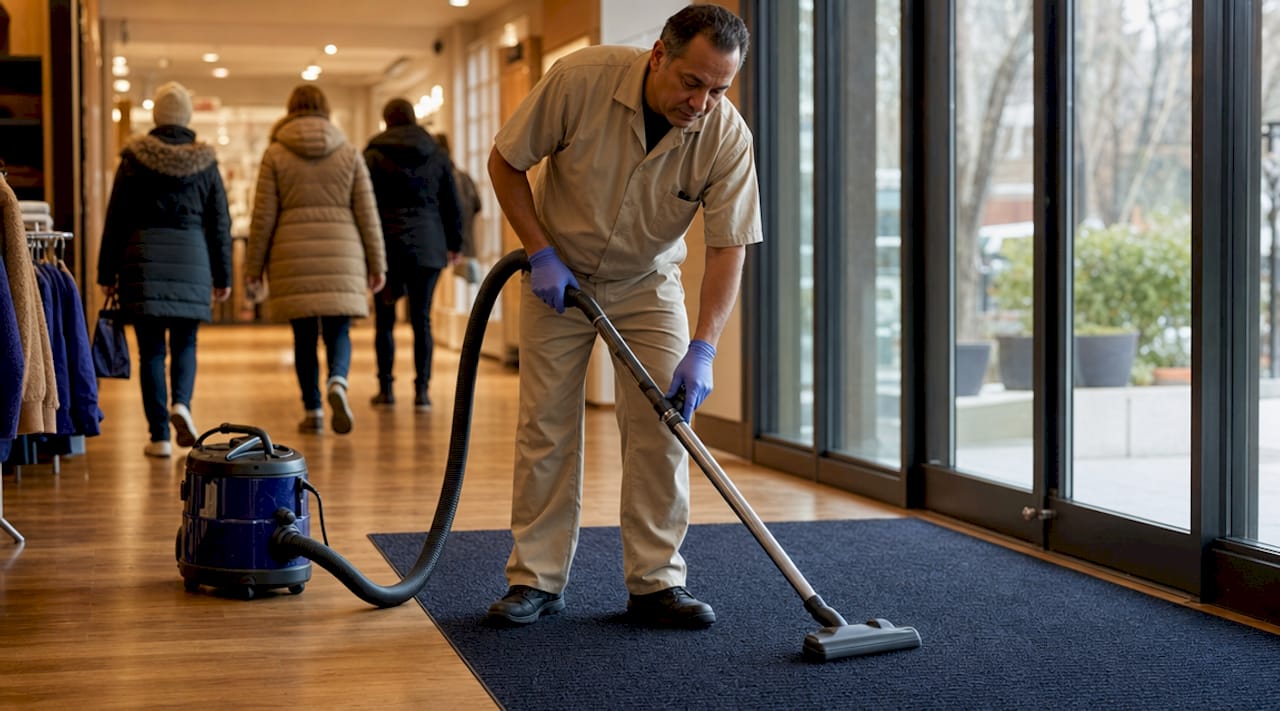
- Vacuuming interior mats at least twice per week to remove dry salt crystals before they dissolve into the pile and become harder to extract. A standard upright vacuum with a beater bar works for nylon loop pile; a wet-dry vacuum handles saturated mats more effectively.
- Deep cleaning every one to two weeks during winter, compared to every three weeks in lower-traffic seasons. Winter cleaning schedules require compression because salt and moisture loads saturate mats faster than in other seasons.
- Mat rotation every two to four weeks in high-traffic facilities. Rotating mats allows each unit to dry fully between deployments, which restores absorbency and prevents odor buildup from prolonged moisture retention.
- Inspection after major weather events. Following heavy snowfall or ice events, check mat saturation by pressing firmly on the pile surface. If moisture releases immediately, the mat requires cleaning or rotation before the next business day.
Pro Tip: Schedule mat cleaning at the end of the business day rather than the morning. Morning cleaning removes contamination after it has already been tracked inside overnight. End-of-day cleaning means mats are dry and fully functional when foot traffic peaks the following morning.
The operational discipline behind this schedule matters as much as the schedule itself. Facility mat failure most often stems from under-cleaning after saturation, not from poor initial mat selection. A $50 mat cleaned on schedule outperforms a $300 mat cleaned monthly.
What are common mistakes in winter matting implementation?
The most costly winter matting errors are operational, not procurement-related. Understanding where systems fail helps you correct problems before they produce slip incidents or floor damage.
- Undersized mats. A mat that covers only the center of a doorway opening leaves salt and moisture tracking in along both sides. The mat specification must account for the full width of foot traffic, not just the direct path from door to interior.
- Ignoring slip ratings. Purchasing mats based on appearance or price without verifying wet-condition PTV scores is a liability risk. A mat that performs well on dry floors may offer minimal slip resistance when wet, which is precisely the condition it faces all winter.
- Skipping mat drying between cleanings. A mat returned to service while still damp from cleaning contributes moisture to the floor rather than removing it. Always allow mats to dry completely before redeployment, or maintain a rotation stock large enough to swap units without gaps in coverage.
- Single-mat systems. One mat at the door cannot perform both scraping and absorption functions effectively. The two-stage system is not optional in high-traffic winter environments; it is the minimum viable configuration.
- No footwear policy coordination. Mat systems work best when building occupants understand their role. Signage at entrances reminding occupants to wipe boots thoroughly on exterior mats reduces the load on interior mats and extends cleaning intervals.
“Treat your entryway as a decontamination zone. The goal is removal, not decoration. Every design and operational decision should serve that single function.” Source: Amazing Maids
When troubleshooting a mat system that is not performing, start with saturation frequency. If interior floors show salt residue within hours of mat cleaning, the exterior mat is either undersized, improperly specified, or not being cleaned frequently enough. Adjust the exterior mat cleaning schedule before replacing equipment.
Key takeaways
Effective winter entryway matting requires a two-stage system, correctly sized and maintained on a compressed cleaning schedule that matches the contamination load of winter conditions.
| Point | Details |
|---|---|
| Two-stage system is mandatory | Pair a coarse exterior scraper mat with a thick interior absorbent mat for full contamination control. |
| Size to 15 to 20 feet combined | Combined mat coverage of 15 to 20 feet captures the majority of tracked-in salt and moisture before it reaches floors. |
| Verify wet-condition slip ratings | Request PTV documentation above 36 for wet conditions; dry-surface ratings do not reflect winter performance. |
| Compress cleaning to every 1 to 2 weeks | Winter salt loads saturate mats faster; weekly or biweekly deep cleaning prevents mats from becoming contamination sources. |
| Rotate mats to restore absorbency | Maintaining a rotation stock allows each mat to dry fully, restoring performance and preventing odor buildup. |
What I’ve learned from watching winter mat programs succeed and fail
Most facility managers I’ve worked with treat mat procurement as a one-time decision. They specify a mat, install it, and move on. The programs that consistently perform well do the opposite: they treat mats as infrastructure with a defined maintenance cycle, a rotation schedule, and a replacement trigger based on observed saturation performance rather than calendar date.
The counterintuitive insight is that cleaning frequency matters more than mat quality above a baseline specification threshold. A mid-grade nylon mat cleaned twice a week during a heavy snow week will outperform a premium WaterHog® mat cleaned once a month. The mat is only as effective as the last time it was serviced.
I’d also push back on the common assumption that slip resistance is a procurement checkbox. The entrance floor mat selection process should include a direct request for wet-condition PTV test data from every supplier. Most will provide it if asked. Those who cannot should be disqualified, because a mat without documented wet-condition performance is an unverified safety claim in the environment where it matters most.
Finally, footwear policies are underused. Signage asking occupants to wipe boots on exterior mats costs nothing and measurably reduces the contamination load reaching interior mats. The best mat system is one that receives less contamination to begin with.
— Werner
Upgrade your winter entryway protection with Mats4u
Mats4u supplies commercial and industrial facilities with mat solutions engineered for winter performance. The WaterHog® Max Grand Half Oval Mat delivers heavy-duty moisture absorption and scraping in a single unit, making it a proven choice for high-traffic winter entrances. For facilities that want functional protection combined with brand presence, Mats4u’s custom logo mats provide both. All orders over $100 ship free, and the full product catalog covers every layer of a two-stage winter matting system. Contact Mats4u directly for specification support tailored to your facility’s traffic volume and entrance configuration.
FAQ
What is the recommended mat size for a winter commercial entrance?
Facilities with heavy winter foot traffic should target a combined mat coverage of 15 to 20 feet across exterior and interior zones. This length provides enough steps for occupants to shed the majority of snow, salt, and moisture before reaching unprotected flooring.
How often should entryway mats be cleaned in winter?
During winter months, high-traffic entrance mats require deep cleaning every one to two weeks, compared to every three weeks in lower-traffic seasons. Daily shaking and twice-weekly vacuuming should supplement scheduled deep cleaning during active snowfall periods.
What slip resistance rating should winter mats have?
Mats used in winter entrances should carry a Pendulum Test Value (PTV) above 36 under wet conditions. Always request wet-condition test documentation from suppliers, since dry-surface ratings do not reflect real-world winter performance.
Why do my floors still show salt residue after installing entrance mats?
Salt residue on interior floors after mat installation typically indicates mat saturation, undersizing, or insufficient cleaning frequency. Check whether the mat is receiving full-width foot traffic coverage and whether the cleaning schedule matches the contamination load of current weather conditions.
What is the difference between a scraper mat and an absorbent mat?
A scraper mat uses coarse rubber or bristle surfaces to physically dislodge snow, ice, and grit from boot soles and is placed at the exterior entrance. An absorbent mat uses dense nylon or microfiber pile to capture residual moisture and fine salt particles and is placed immediately inside the door.


