


TL;DR:
- Fire safety regulations require floor mats in high-traffic areas to meet specific fire resistance standards such as ASTM E648 Class I or EN 13501-1 Bfl-s1 to ensure compliance and occupant safety. Selecting the correct, fully tested mats, installing them according to tested configurations, and maintaining thorough documentation are critical to avoid regulatory liabilities during inspections. Regular inspections, precise record-keeping, and integrating mats into fire risk assessments help sustain fire-safe environments and prevent costly their non-compliance.
Fire safety and floor mats are directly linked through regulatory standards that govern every commercial egress corridor, lobby, and high-traffic zone in your facility. The industry term for this discipline is “reaction-to-fire classification,” and it determines whether a mat slows flame spread or accelerates it during an emergency. Standards like ASTM E648 and EN 13501-1 set the legal threshold for what qualifies as compliant flooring in commercial settings. For safety managers and compliance officers, selecting the wrong mat is not a minor procurement error. It is a documented liability that can fail a fire inspection, obstruct evacuation, and expose your organization to serious regulatory consequences.
What are the key fire resistance standards for commercial floor mats?
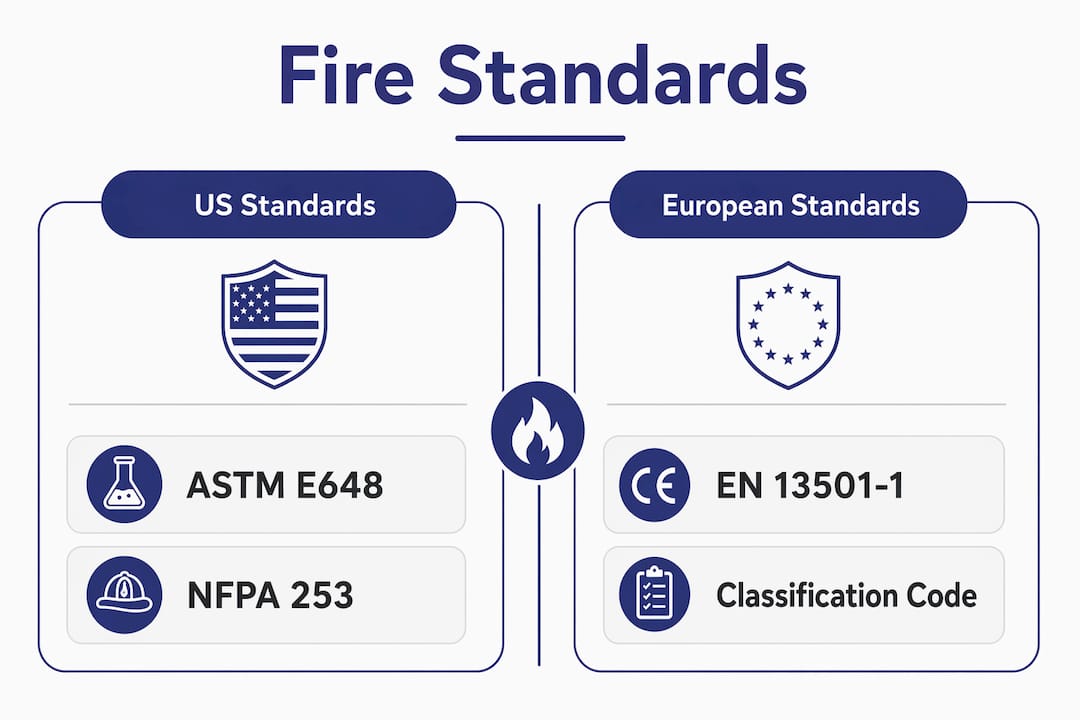
ASTM E648, also published as NFPA 253, is the primary fire test for floor coverings used in commercial facilities. It measures critical radiant flux, which is the minimum heat energy required to sustain flame spread across a floor surface. Class I certification requires a critical radiant flux of at least 0.45 W/cm² and applies to exit corridors and areas with high occupant loads. Class II requires at least 0.22 W/cm² and is acceptable for lower-risk zones. The distinction matters because specifying a Class II mat in a required Class I corridor is a direct compliance failure.
One of the most common and costly errors in commercial mat procurement is confusing ASTM E84 with ASTM E648. ASTM E84 is a tunnel test designed for wall and ceiling materials. It does not simulate floor-level fire conditions and is not an acceptable substitute for floor mat fire certification. Suppliers occasionally present E84 documentation for floor products, and accepting it as valid will not hold up under audit.
The European equivalent, EN 13501-1, classifies floor coverings using a combined code that addresses both flame contribution and smoke production separately. A rating of Bfl-s1 indicates low flame contribution and minimal smoke output. Cfl-s2 indicates moderate flame contribution with higher smoke production. Smoke ratings carry particular weight in evacuation planning because dense smoke incapacitates occupants before flames reach them.
Pro Tip: Always request the full test report, not just the certificate. The report specifies the exact installation configuration tested, including adhesive type and underlayment. If your installation differs from that configuration, the rating does not legally apply to your facility.
A critical and frequently overlooked detail: fire performance ratings apply to the entire floor assembly, not just the mat surface. Changing the adhesive, adding a rubber underlayment, or switching the substrate can invalidate the tested fire resistance result. Procurement teams must specify and install mats exactly as they were tested.
| Standard | Jurisdiction | What It Measures | Key Classifications |
|---|---|---|---|
| ASTM E648 / NFPA 253 | United States | Critical radiant flux (floor fire spread) | Class I (≥0.45 W/cm²), Class II (≥0.22 W/cm²) |
| EN 13501-1 | UK / Europe | Flame contribution + smoke production | Bfl-s1, Cfl-s2, and related codes |
| ASTM E84 | United States | Wall/ceiling flame spread (NOT for floors) | Not applicable to floor mats |
How do fire safety regulations impact floor mat selection?
In the United States, the International Fire Code and NFPA 101 (Life Safety Code) both require that floor coverings in exit access corridors meet Class I ASTM E648 ratings. These are not recommendations. They are enforceable code requirements that apply to hospitals, office buildings, hotels, schools, and any other assembly or institutional occupancy. Local authorities having jurisdiction (AHJs) can and do cite facilities for non-compliant flooring during inspections.
In England and Wales, the Regulatory Reform (Fire Safety) Order 2005 places the compliance burden directly on the “responsible person,” typically the building owner or employer. This regulation requires that fire risk assessments explicitly include floor mats as part of hazard identification and evacuation planning. Mats that shift, curl, or degrade over time must be identified and addressed. Non-compliance carries serious legal consequences, including prosecution.
The practical difference between US and UK regulatory approaches is worth noting. US codes are largely prescriptive: they specify the exact test standard and minimum rating required for a given location. The UK approach is more risk-based: the responsible person must demonstrate through documented assessment that every element of the floor, including mats, does not contribute unacceptably to fire hazard or obstruct evacuation. Both systems require documentation, but the UK system demands ongoing narrative justification rather than a single product specification.
Here is a structured approach to regulatory compliance for floor mat selection:
- Map your facility by occupancy zone. Identify which corridors, lobbies, and work areas are classified as exit access routes under your applicable fire code.
- Assign the required fire rating to each zone. Exit corridors in US facilities generally require Class I ASTM E648. Lower-risk areas may accept Class II.
- Collect full test documentation from suppliers. Request the complete test report, not just a certificate, and verify the installation configuration matches your planned installation.
- Integrate mats into your fire risk assessment. For UK facilities, this is a legal requirement under the Fire Safety Order. For US facilities, it is best practice that protects you during AHJ inspections.
- Schedule routine mat inspections. Quarterly at minimum, with documented records showing mat condition, placement, and any corrective actions taken.
Pro Tip: Ask your supplier to confirm in writing that the mat’s fire rating was tested with the same backing and adhesive system you plan to use. A verbal assurance is not defensible during an audit.
What mat materials perform best for commercial fire safety?
Not all mat materials carry equal fire risk. The choice of rubber, vinyl, carpet fiber, or foam determines both the ignition threshold and the volume of smoke produced during a fire event. Safety managers selecting fire resistant floor mats for commercial settings need to evaluate each material against the specific demands of their facility.
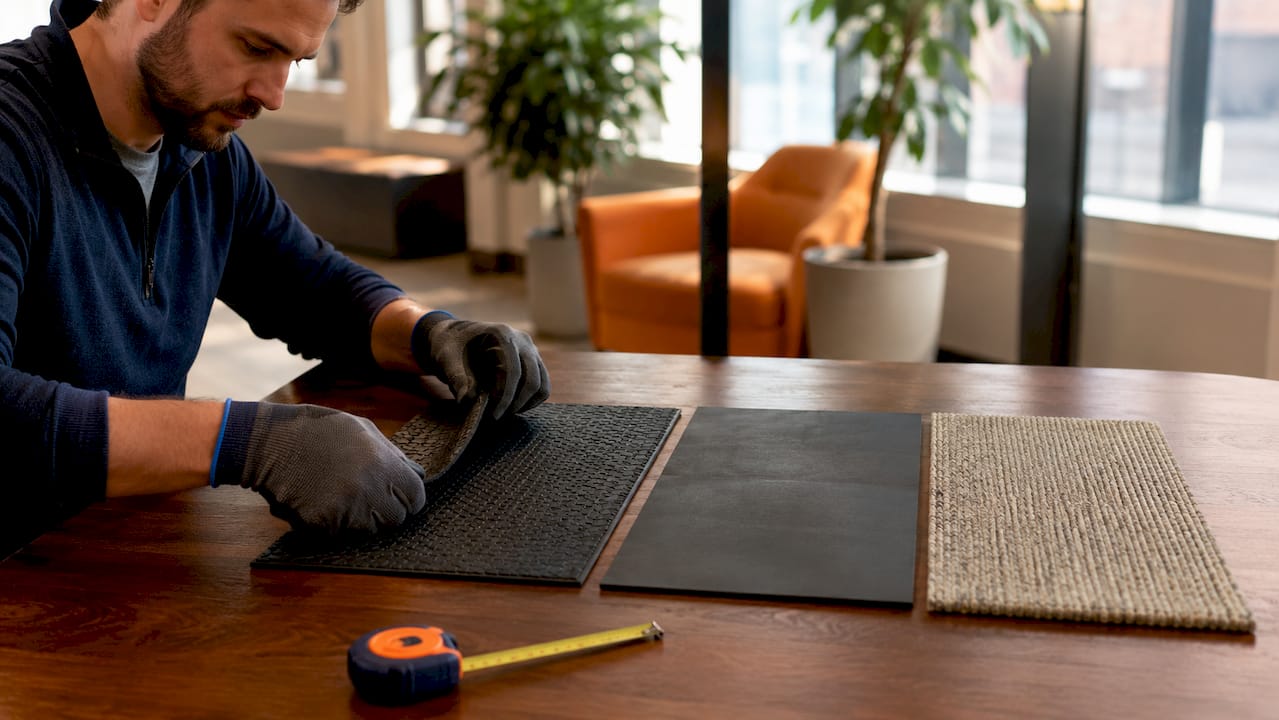
Rubber mats are among the most fire-resistant options available without specialty treatment. Natural and synthetic rubber both have relatively high ignition temperatures and produce moderate smoke. Rubber mats are well-suited for industrial environments, kitchens, and wet areas where durability and slip resistance are priorities alongside fire performance.
Vinyl and PVC mats present a more complex profile. They resist ignition reasonably well but produce dense, toxic smoke when they do burn. In facilities where occupant evacuation time is a critical variable, such as hospitals or high-rise offices, the smoke production of vinyl mats warrants careful review against EN 13501-1 smoke ratings or equivalent US documentation.
Carpet-fiber mats, including nylon and polypropylene constructions, vary widely by fiber type and backing. Nylon generally outperforms polypropylene on fire resistance. Waterhog-style mats with rubber backing and nylon or polypropylene fiber are common in commercial lobbies and can achieve Class I ratings when tested as an assembly.
EVA and TPE foam mats are the category where performance diverges most sharply from assumption. Standard foam mats are often assumed to be high fire risk, but Class I ASTM E648 certified EVA foam mats can achieve critical radiant flux values of 1.09 W/cm², more than double the Class I threshold. This makes certified EVA foam a viable option for anti-fatigue applications in exit corridors, provided the certification covers the specific installation configuration.
- Rubber: High ignition threshold, moderate smoke, excellent durability. Best for industrial and wet zones.
- Nylon carpet fiber: Good fire resistance with proper backing. Common in lobbies and corridors.
- Vinyl/PVC: Moderate ignition resistance, high toxic smoke output. Review smoke ratings carefully.
- Certified EVA foam: Can exceed Class I thresholds. Verify full assembly certification before specifying.
- Uncertified foam (standard EVA, polyurethane): High fire risk. Not appropriate for exit corridors without testing.
For a detailed breakdown of mat types by application and safety profile, the facility manager’s mat guide from Mats4u covers the full range of commercial options with compliance context.
What steps should safety managers take to maintain fire-safe mats?
Procurement is only the first step. Unmanaged mats that shift out of position, curl at the edges, or accumulate damage become both a trip hazard and a potential ignition source. The following protocol addresses the full lifecycle of fire-safe mat management.
- Verify documentation before purchase. Obtain the third-party test report showing ASTM E648 or EN 13501-1 results for the exact product and installation configuration you plan to deploy. File this with your facility’s fire safety records.
- Register mat locations in your fire risk assessment. Every mat in an exit corridor or high-occupancy zone should appear in your facility’s fire safety plan with its rated classification documented.
- Conduct quarterly physical inspections. Check for curling edges, surface damage, adhesive failure, and any displacement from the tested installation position. Document findings and corrective actions.
- Train facility staff on mat-related fire risks. Staff should know not to substitute uncertified mats in rated locations, not to place additional mats on top of certified ones, and how to report mat damage through the correct channel.
- Audit your documentation annually. UK regulations impose ongoing record-keeping duties. US facilities benefit from the same discipline because AHJs increasingly request installation records, not just product certificates, during inspections.
Pro Tip: Create a simple mat register: a spreadsheet listing each mat location, its fire rating, the date of last inspection, and the supplier test report reference number. Auditors respond well to organized documentation, and it takes less than an hour to build.
For facilities that use anti-fatigue mats in production areas or near workstations, the guidance on fire-resistant anti-fatigue mats from Mats4u addresses the specific certification requirements for those environments.
Key takeaways
Fire safety compliance for commercial floor mats requires verified ASTM E648 or EN 13501-1 certification, correct installation configuration, and documented ongoing inspection to remain defensible under audit.
| Point | Details |
|---|---|
| Use the correct test standard | ASTM E648 applies to floors; ASTM E84 does not. Accepting E84 documentation for floor mats creates a compliance gap. |
| Rate by location, not by product alone | Exit corridors require Class I (≥0.45 W/cm²). Confirm the rating applies to your exact installation assembly. |
| Smoke production matters | EN 13501-1 rates smoke separately from flame. High smoke output can incapacitate occupants before flames arrive. |
| Document everything | Maintain a mat register with test report references, installation dates, and inspection records for every rated location. |
| Inspect and replace proactively | Curling, damaged, or displaced mats lose their fire safety function and create evacuation hazards. |
What I’ve learned from watching facilities get this wrong
I’ve reviewed fire inspection reports from commercial facilities across multiple sectors, and the same failure pattern appears repeatedly. The facility purchased a mat with a fire rating certificate. The certificate referenced a test configuration that did not match the actual installation. The AHJ or auditor requested the full test report, found the discrepancy, and issued a non-compliance notice. The facility then had to replace mats across multiple locations under time pressure, at significantly higher cost than if the documentation had been verified at procurement.
The second pattern is subtler. Facilities that manage fire safety rigorously for fixed flooring often treat mats as a separate, lower-priority category. Mats get swapped out by facilities staff without reference to the fire safety plan. A certified mat gets replaced with an uncertified one because it was cheaper or available faster. Nobody updates the fire risk assessment. This is exactly the scenario that the UK’s Fire Safety Order targets, and it is the kind of gap that creates serious liability exposure.
My recommendation is to treat mat procurement as a sub-process of your fire safety management system, not as a facilities purchasing decision. That means the safety manager or compliance officer signs off on any mat specified for a rated location, the test documentation is filed before the mat is installed, and the mat register is reviewed as part of every fire risk assessment cycle. This is not bureaucratic overhead. It is the minimum standard that protects your organization when an inspection or incident occurs.
— Werner
Fire-resistant commercial mats from Mats4u
Mats4u supplies commercial and industrial floor mats built to meet the demands of high-traffic, compliance-sensitive environments. The product range includes certified fire-resistant options with ASTM E648 Class I documentation, suitable for exit corridors, lobbies, and production areas where fire safety matting standards apply. For facilities that need custom branding alongside compliance, Mats4u’s premium custom floor mats combine logo clarity with fire-resistant construction. All products ship free on orders over $100, and the catalog covers rubber, anti-fatigue, Waterhog, and Berber mat types. Contact Mats4u directly to request product documentation and verify that the mat you select matches your facility’s specific installation and rating requirements.
FAQ
What is ASTM E648 and why does it matter for floor mats?
ASTM E648, also known as NFPA 253, measures the critical radiant flux of floor coverings to determine their fire resistance under egress conditions. Class I certification (≥0.45 W/cm²) is required for exit corridors in most US commercial occupancies under the International Fire Code and NFPA 101.
Can I use any fire-rated mat in an exit corridor?
No. The fire rating must match the specific installation configuration tested, including the backing, adhesive, and substrate. A mat rated in one assembly configuration is not automatically compliant when installed differently.
What is the difference between ASTM E648 and EN 13501-1?
ASTM E648 is the US standard measuring critical radiant flux for floor coverings. EN 13501-1 is the European classification system that rates both flame contribution and smoke production separately, using codes like Bfl-s1. Facilities operating in the UK must comply with EN 13501-1 requirements under the Regulatory Reform (Fire Safety) Order 2005.
Do fire safety regulations require mats to be included in risk assessments?
In England and Wales, the Regulatory Reform (Fire Safety) Order 2005 explicitly requires that floor mats be included in fire risk assessments as part of hazard identification and evacuation planning. US facilities are not always subject to the same explicit requirement, but AHJs increasingly expect mat documentation during inspections.
How often should commercial floor mats be inspected for fire safety compliance?
Quarterly inspections are the standard practice, with documented records of mat condition, placement, and any corrective actions. Annual documentation audits should verify that test reports on file still match the installed configuration for every rated location.


