


TL;DR:
- ADA compliant entrance mats must have firm, stable, slip-resistant surfaces with beveled edges no higher than 1/2 inch, as specified in the 2010 ADA Standards. Proper installation, securement, and routine maintenance of mats on accessible routes are essential to sustain compliance and prevent liability issues. Regular measurements, inspections, and documentation are critical for ensuring ongoing adherence to ADA requirements.
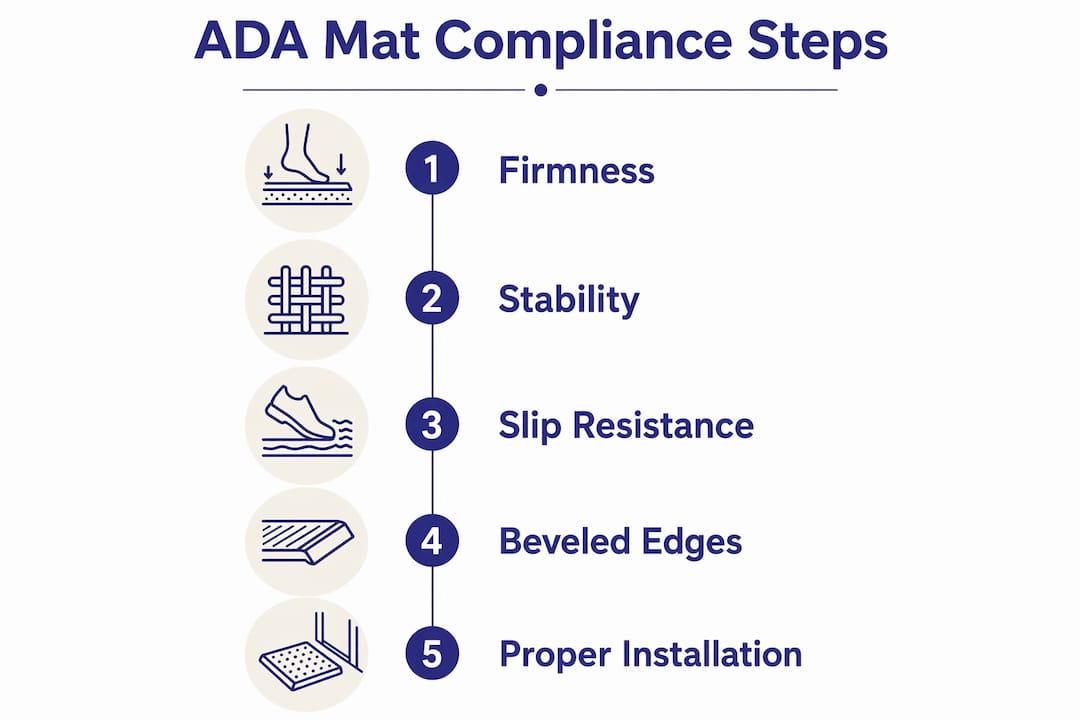
ADA compliant entrance mats are defined by four non-negotiable criteria: firmness, stability, slip resistance, and compliant beveled edge transitions that keep accessible routes free of tripping hazards. These requirements originate from the 2010 ADA Standards for Accessible Design, enforced by the U.S. Department of Justice, and apply to any mat placed on an accessible route in a public or commercial facility. Selecting the right mat is not a matter of preference. It is a legal obligation with direct liability implications for facility managers and business owners.
What technical standards define ADA compliance for entrance mats?
The 2010 ADA Standards, specifically Sections 302 and 303, establish the floor surface and change-in-level rules that govern every mat on an accessible route. Accessible route surfaces must be firm, stable, and slip resistant, which eliminates soft, compressible, or unstabilized materials that compress under wheelchair wheels or shift underfoot.
Firmness and stability are distinct requirements. A firm surface resists deformation under load. A stable surface does not shift or move when a wheelchair, walker, or cane applies lateral force. Many mats marketed as “entrance mats” fail one or both criteria because their backing allows movement or their pile height creates resistance that impedes wheelchair propulsion.
Slip resistance is measured against ASTM International test methods, particularly ASTM C1028 and ASTM F1679, which assess static coefficient of friction. The ADA does not specify a numeric threshold, but the U.S. Access Board recommends a minimum coefficient of 0.6 for accessible routes. Mats with wet or worn surfaces that fall below this threshold create both a compliance failure and a liability exposure.
The change-in-level rules under Section 303 are precise:
- Vertical changes up to 1/4 inch require no treatment and are permitted as-is.
- Changes between 1/4 and 1/2 inch must be beveled at a slope no steeper than 1:2, meaning for every 1/2 inch of rise, the bevel must extend at least 1 inch horizontally.
- Changes exceeding 1/2 inch are classified as ramps and must comply with full ramp specifications, including handrails if the rise exceeds 6 inches.
Mat thickness is therefore a direct compliance variable. A mat that measures 5/8 inch at its thickest point without a compliant bevel fails Section 303 outright. Surface opening size also matters: mat openings must be less than 1/2 inch in any direction, which disqualifies certain open-grid rubber mats with 1-inch holes from use on accessible routes.
Pro Tip: Measure your mat’s actual installed edge height with a ruler before purchase. Manufacturer spec sheets often list nominal thickness, not the compressed installed height, and the difference can push a mat out of compliance.
How do installation and location impact accessibility compliance?
An accessible route is any continuous, unobstructed path connecting accessible elements within a facility, including entrances, parking areas, restrooms, and service counters. Any mat placed on that path is subject to ADA floor surface requirements. A mat placed off the accessible route, such as in a non-public storage corridor, carries no ADA obligation. Location is the first compliance question to answer.
Removable mats can meet ADA standards when properly secured, but unsecured mats are among the most common compliance failures inspectors cite. Edge lift, curling corners, and lateral shifting all create vertical changes and tripping hazards that violate Sections 302 and 303. Securing methods include recessed mat frames, adhesive anchoring, and heavy-duty gripper backing systems.
Follow this installation sequence to confirm compliance before opening a space to the public:
- Identify every accessible route segment where a mat will be placed and document the location.
- Measure the floor surface at the mat placement zone for levelness and existing vertical changes.
- Confirm the mat’s installed thickness and bevel slope meet Section 303 limits using a physical measurement, not the product label.
- Secure the mat using a recessed frame, approved adhesive, or gripper backing rated for the expected foot and wheel traffic volume.
- Walk and wheel-test the mat after installation, applying lateral force to confirm it does not shift.
- Document the installation with photographs and measurements for your compliance file.
Accessibility specialists confirm that mat location on accessible routes is the primary ADA concern, not brand claims. A premium mat installed off-route needs no ADA documentation. The same mat installed across a wheelchair ramp landing requires full compliance verification.
Pro Tip: Use a formal ADA inspection checklist that includes mat edge height, bevel condition, and securement status. Relying on product packaging alone leaves you exposed during a compliance audit.

What solutions exist for managing threshold and door sill elevation changes?
Door sills and raised thresholds are the most common source of ADA entry compliance failures in existing buildings. Many commercial buildings, especially those constructed before 1992, have door sills that rise 3/4 inch or more above the floor surface. That height exceeds the 1/2-inch ramp threshold under Section 303 and requires a compliant transition solution.
The table below outlines the primary product categories used to address threshold elevation changes:
| Vertical Rise | Product Type | ADA Compliance Approach |
|---|---|---|
| Up to 1/4 inch | Standard beveled entrance mat | No bevel required; mat lies flat |
| 1/4 to 1/2 inch | Beveled-edge entrance mat | Bevel at max 1:2 slope on leading edge |
| 1/2 inch to 1 inch | Threshold ramp or modular entry mat | Treated as ramp; slope must comply |
| Over 1 inch | Full threshold ramp with ADA ramp specs | May require handrails if rise exceeds 6 inches |
The TRANSITIONS® modular entry mat by EZ-Access is a widely specified product for raised threshold scenarios. It provides a smooth ground-to-sill transition for wheelchairs and scooters, comes with optional risers to match varying sill heights, and uses a slip-resistant surface for both indoor and outdoor commercial entrances. The key specification advantage is its modular design, which allows height adjustment without structural modification to the door frame.
Threshold ramps must span the full door width and coordinate with door sweeps and fire-door hardware to maintain both accessibility and code compliance. Interlocking ramp sections improve stability and weather sealing at exterior doors, which matters in climates with freeze-thaw cycles that can shift lightweight threshold products.
Before specifying any threshold product, measure the actual sill height at three points across the door width. Sills are rarely uniform, and a product sized for the center measurement may create a non-compliant edge condition at the jamb. Modular mats and threshold ramps must be matched precisely to the threshold height and slope using ADA change-in-level rules to avoid compliance failures, particularly in building renovation projects where existing conditions vary.
What are best practices for maintaining ADA compliance over time?
Product selection establishes compliance at installation. Maintenance sustains it. Routine maintenance is critical because mats shift, curl, and wear unevenly over time, creating hazards in mats that passed inspection on day one. A mat that was compliant at installation can become a liability within weeks if maintenance protocols are absent.
Core maintenance practices for ADA compliant matting include:
- Weekly edge inspection: Check all four edges for lift, curl, or separation from the floor. Any edge exceeding 1/4 inch vertical change requires immediate correction.
- Surface wear assessment: Inspect pile height and surface texture monthly. Worn pile reduces slip resistance and may compress below the firmness threshold under wheelchair load.
- Securement check: Test gripper backing, adhesive bonds, and frame anchors by applying lateral force. Replace or re-secure any mat that moves.
- Replacement scheduling: Track mat age and traffic volume. High-traffic commercial entrance mats in facilities with 500 or more daily users typically require replacement every 12 to 18 months.
- Documentation: Record every inspection with date, findings, and corrective actions taken. This file is your primary defense in an ADA complaint or slip-and-fall litigation.
Mat maintenance programs that focus on securing and inspecting removable mats prevent the most common compliance failures and reduce liability exposure. The documentation component is frequently overlooked. Facility managers who can produce a dated inspection log demonstrating proactive maintenance are in a substantially stronger legal position than those who cannot.
Pro Tip: Schedule mat inspections on the same calendar cycle as your fire extinguisher checks. Both are safety-critical, both are easy to defer, and both carry liability consequences if neglected. Pairing them makes neither fall through the cracks.
For a broader view of mat safety regulations that apply to commercial facilities, including OSHA overlap with ADA requirements, Mats4u has published a detailed facility manager’s reference.
Key takeaways
ADA compliance for entrance mats requires verified firmness, stable installation, slip-resistant surfaces, and beveled edges under 1/2 inch, sustained through documented routine maintenance.
| Point | Details |
|---|---|
| Technical standards are specific | Sections 302 and 303 of the 2010 ADA Standards set exact thickness, bevel slope, and surface opening limits. |
| Location determines obligation | Only mats on accessible routes require ADA compliance; document placement before specifying products. |
| Measure, do not assume | Installed edge height and bevel slope must be physically measured; product labels are not sufficient verification. |
| Threshold solutions vary by rise | Use beveled mats up to 1/2 inch, modular entry mats or threshold ramps for greater rises. |
| Maintenance is a compliance act | Weekly edge and securement checks, with dated documentation, sustain compliance and reduce liability. |
Why most ADA mat failures happen after installation, not before
After years of reviewing compliance documentation and facility inspection reports, the pattern is consistent: most ADA mat failures are maintenance failures, not product failures. A facility purchases a mat that meets every specification on paper, installs it correctly, and then never inspects it again. Six months later, a corner has lifted 3/8 inch, the backing has separated from the floor, and the mat that passed day-one inspection is now a Section 303 violation and a trip hazard.
The second most common failure is over-reliance on marketing language. “ADA compliant” printed on a product box is a manufacturer’s claim, not a certification. The actual measurement of installed edge thickness and bevel slope is what matters during an inspection. I have seen facilities purchase products explicitly labeled as ADA compliant that measured 9/16 inch at the installed edge with no bevel, a clear Section 303 failure.
The practical fix is straightforward: treat mat compliance as an ongoing operational task, not a one-time procurement decision. Build inspection into your facility maintenance schedule, keep a physical measurement log, and replace mats on a defined cycle tied to traffic volume. The entrance mat safety practices that protect your facility are not complicated. They just require consistent execution.
— Werner
ADA compliant entrance mats and custom solutions at Mats4u
Mats4u stocks commercial entrance mats built to meet the firmness, stability, slip resistance, and beveled edge criteria that ADA compliance requires. The WaterHog Max Herringbone Mat delivers the dense, stable surface construction that resists compression under wheelchair loads and maintains slip resistance in wet entry conditions, making it a reliable choice for high-traffic accessible routes. For facilities that need branded entry solutions without sacrificing compliance, the premium custom logo mat combines HD printing with compliant mat construction. Free delivery applies to orders over $100, and all products ship from U.S. manufacturing facilities.
FAQ
What makes an entrance mat ADA compliant?
An ADA compliant entrance mat must have a firm, stable, slip-resistant surface and comply with Section 303 change-in-level rules, meaning edges over 1/4 inch must be beveled at a maximum 1:2 slope and total thickness must not exceed 1/2 inch without ramp treatment.
Can removable mats be used on accessible routes?
Yes. Removable mats meet ADA standards when properly secured to prevent edge lift and shifting. Unsecured removable mats are one of the most frequently cited compliance failures during ADA inspections.
What is the maximum mat thickness allowed under ADA rules?
Mats up to 1/4 inch thick require no edge treatment. Mats between 1/4 and 1/2 inch require a beveled edge at no steeper than a 1:2 slope. Any mat exceeding 1/2 inch in vertical rise must be treated as a ramp under the 2010 ADA Standards.
How often should entrance mats be inspected for compliance?
Weekly edge and securement inspections are the standard for high-traffic commercial entrances. Each inspection should be documented with date, findings, and any corrective actions to support compliance verification during audits or legal proceedings.
Do mat surface openings affect ADA compliance?
Yes. Mat openings must be less than 1/2 inch in any direction on accessible routes. Open-grid mats with holes larger than 1/2 inch do not meet ADA floor surface requirements and cannot be used on accessible route segments.


