


TL;DR:
- Many facility managers believe that simply placing mats on high-traffic floors suffices for protection, but proper selection, placement, and maintenance are essential. Mats prevent damage through shock absorption, grit filtration, moisture control, and chemical barriers, with material and backing choices affecting their effectiveness on different floors. Regular inspection, cleaning, and proactive replacement of mats ensure long-term floor preservation and cost savings.
Most facility managers assume that placing mats on high-traffic floors is enough to protect them. Drop a mat at the entrance, maybe one near the coffee station, and call it done. That assumption is what leads to refinished hardwood every three years and vinyl that looks five years older than it is. Understanding how mats protect flooring requires more than knowing they exist. It requires knowing which mat, with which backing, placed where, maintained how. This article gives you that framework, grounded in material science and facility management practice.
Table of Contents
- Key Takeaways
- How mats protect flooring: mechanisms and damage types
- Choosing the right mat for each facility zone
- Mat maintenance and lifecycle management
- Specialized mats for specific facility environments
- My take on where mat programs actually fail
- Protect your floors with the right mats from Mats4u
- FAQ
Key Takeaways
| Point | Details |
|---|---|
| Mats block multiple damage types | Quality mats stop grit, moisture, impact, and chemical transfer before they reach floor surfaces. |
| Backing material matters on delicate floors | Rubber and foam backings can discolor hardwood finishes if left in place too long without ventilation. |
| Strategic placement beats full coverage | Targeting high-risk zones like entrances and workstation areas delivers more protection than covering corridors indiscriminately. |
| Maintenance determines long-term results | A neglected mat accumulates grit underneath, turning a protective layer into an abrasive one. |
| Match mat type to environment | Anti-fatigue, entrance, and heavy-duty mats each serve distinct protective functions across facility zones. |
How mats protect flooring: mechanisms and damage types
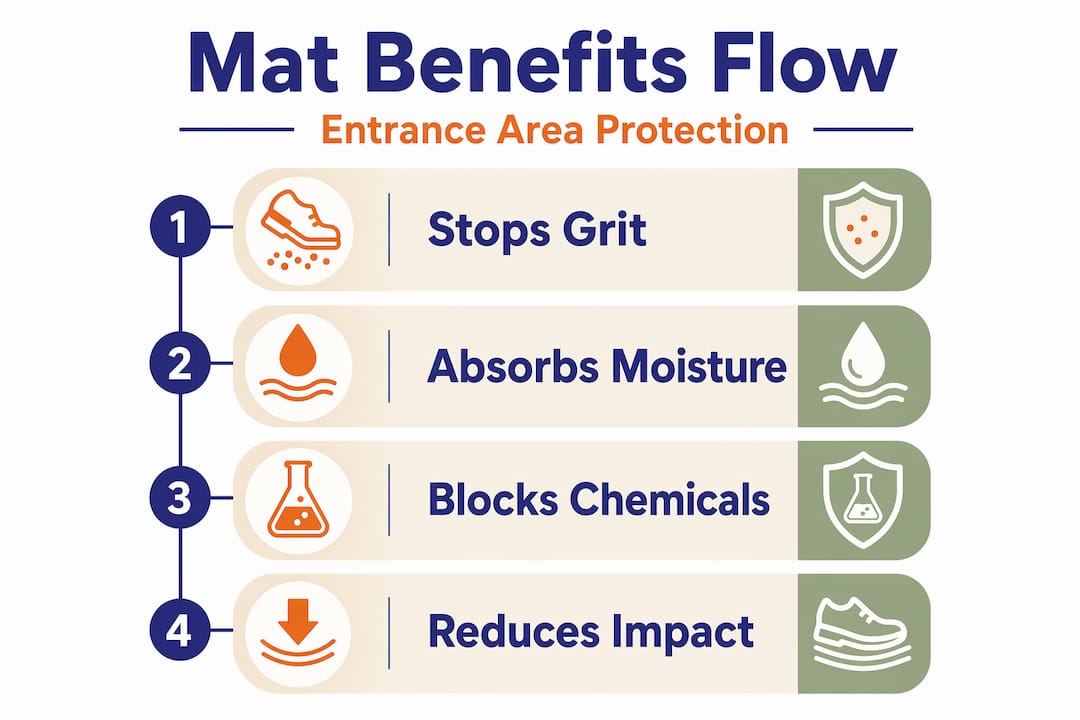
Mats protect floors through four distinct physical mechanisms. Each one addresses a different source of damage, and understanding all four helps you make better purchasing and placement decisions.
Shock absorption is the first mechanism. Every footstep, cart wheel, and dropped item transfers kinetic energy directly to the floor surface. Over time, that impact compresses carpet fibers, dents vinyl, and scratches hardwood. A mat with sufficient density absorbs that energy before it reaches the substrate. Foam-core and rubber-base mats do this most effectively in standing and equipment areas.
Dirt and grit filtration is the second mechanism, and arguably the one with the largest cumulative effect. Grit tracked in on shoe soles acts like sandpaper under foot traffic. Even a thin layer of fine particles can dull and scratch hard floor finishes within weeks. Entrance mats with deep fiber systems scrape and trap that material before it spreads. This is why entrance mat placement has such an outsized return compared to mats placed anywhere else in a facility.
Moisture containment is the third mechanism. Water and cleaning solution residue degrade adhesives under tile, cause wood to swell and cup, and accelerate vinyl wear. WaterHog entrance mats are engineered specifically for this, with a capacity to hold 1.5 gallons of liquid per square yard before moisture migrates past the mat perimeter.
Chemical barrier is the fourth mechanism. In industrial and food service facilities, floor mats for flooring protection also block oils, solvents, and cleaning agents from direct floor contact. Composite and rubber mats with sealed surfaces perform this function in kitchen, manufacturing, and loading dock environments.
Here is how common mat materials compare across these four functions:
| Mat material | Shock absorption | Grit filtration | Moisture control | Chemical resistance |
|---|---|---|---|---|
| Rubber | High | Moderate | Moderate | High |
| Fabric/Berber | Low | High | Moderate | Low |
| WaterHog (polypropylene) | Moderate | High | Very high | Moderate |
| Anti-fatigue foam/composite | Very high | Low | Low | Moderate |
| Vinyl/PVC | Moderate | Low | Moderate | High |
Choosing the right mat for each facility zone
The wrong mat in the wrong location does not just underperform. It can actively cause the damage you are trying to prevent.
The clearest example is backing material on hardwood and luxury vinyl floors. Rubber and foam backings can chemically interact with floor finishes, producing discoloration or permanent staining when left in place for extended periods. If you are asking whether mats protect hardwood floors, the answer is yes, but only when you select a mat with a compatible backing. On hardwood, natural fiber or breathable synthetic backings are the safer choice. On polished concrete or ceramic tile, rubber backing is generally fine.
Non-breathable mat backings trap moisture between the mat and the floor surface, which causes finish degradation, staining, and in the case of solid hardwood, rot at the subfloor level. This is a slow failure mode, which is exactly why so many facilities miss it until the damage is already done.
Mat geometry also matters more than most purchasing decisions account for. Beveled edges prevent chair wheels from catching on mat boundaries, which reduces both trip hazards and the concentrated stress that tears up flooring at transition points. A mat with a square-cut edge in an office environment is a liability, not just a performance issue.
For high-risk zone placement, use this as your baseline framework:
- Building entrances: Deploy your deepest, highest-capacity mats here. A minimum of ten linear feet of matting from entry points captures the majority of tracked-in debris and moisture before it reaches interior flooring.
- Workstations and desk areas: Chair mats protect against fiber compression and surface scratching from caster wheels. Rigid mats distribute weight evenly and hold up to rolling loads better than flexible options.
- Under appliances and equipment: These areas accumulate moisture and vibration. A mat with a sealed chemical-resistant surface prevents finish penetration and makes cleaning practical.
- Corridor placement: Placing mats indiscriminately in deep corridors with low foot traffic provides minimal return. Allocate mat resources to documented high-wear zones.
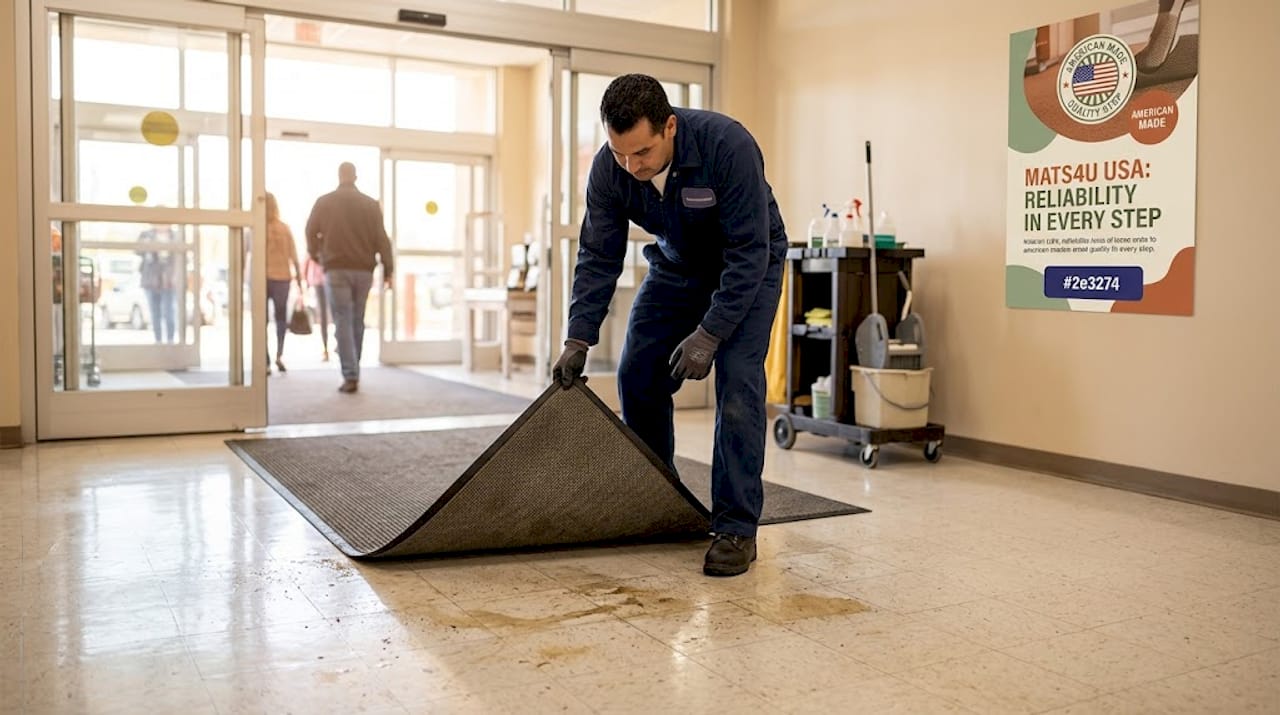
Pro Tip: Lift and inspect mats at least once a week in high-traffic areas. Check the floor surface underneath for moisture accumulation, grit deposits, or finish discoloration. Early detection of backing incompatibility or moisture trapping prevents repairs that cost far more than a mat replacement.
Mat maintenance and lifecycle management
A mat that is never cleaned stops protecting and starts causing damage. This is the part of the mat program that most facilities underinvest in.
When a mat accumulates grit on its surface and underside, foot traffic grinds that debris directly against the floor. The mat has effectively become an abrasive pad. Proper care including cleaning and timely replacement is what separates a mat program that extends flooring life from one that accelerates its decline.
Follow this maintenance sequence for maximum floor protection:
- Shake or vacuum mats daily in entrance zones and any area with documented debris accumulation. Surface grit does not need to reach saturation levels before it causes damage.
- Wash fabric and polypropylene mats weekly in high-traffic commercial settings. Monthly cleaning is adequate for lower-traffic interior zones.
- Lift mats every three to five days in any area where moisture exposure is possible. Allow the floor surface to fully dry before repositioning the mat. This step is non-negotiable on hardwood, bamboo, and laminate floors.
- Inspect backing condition every two to three months. Backing that has hardened, cracked, or developed an odor is trapping chemicals and moisture. Replace the mat before it causes floor damage.
- Replace mats on a scheduled cycle, not just when they visibly fail. A mat that looks usable may have lost structural integrity, fiber depth, and moisture capacity well before it shows obvious wear.
Pro Tip: Track mat replacement dates in your facility maintenance log the same way you track HVAC filter changes. A mat program with no replacement schedule is not a program. It is a random collection of mats.
Embedding mats in key zones with documented maintenance cycles significantly reduces the frequency and cost of floor refinishing, resurfacing, and replacement. The upfront investment in a structured mat program consistently outperforms the reactive cost of repairing floors that were “protected” by neglected mats.
Specialized mats for specific facility environments
Not every mat serves every purpose. Matching mat type to facility environment is where a mat program moves from adequate to genuinely effective.
Anti-fatigue mats for standing workstations
Anti-fatigue mats serve two functions simultaneously. They reduce physical strain on workers who stand for extended periods, and they protect the floor underneath from sustained static load and foot traffic abrasion. These mats typically use a multi-layer foam or gel core with a durable top surface and a non-slip base. In food service, manufacturing, and healthcare environments, the floor protection benefit is secondary to worker comfort but still measurable.
Key features to look for:
- Grease-resistant and chemical-resistant top surface for kitchens and labs
- Beveled perimeter edges to prevent trip hazards and edge-related floor damage
- Non-porous top layer for easy sanitizing
- Sufficient density to maintain thickness under sustained load over years of use
Entrance mats for moisture and dirt control
WaterHog-style polypropylene mats are the standard for entrance zones in commercial facilities. Their bi-level construction traps dirt and water in the channels between fiber ridges, keeping debris away from shoe soles on the next step. They are designed to be laundered, to resist fading and fiber collapse, and to retain their moisture capacity over thousands of uses. For facilities managing high pedestrian volume, these are the best mats for flooring protection at the perimeter.
Heavy-duty mats for equipment and gym areas
Rubber and composite mats in these environments absorb impact, prevent equipment feet from gouging or scratching hard floors, and provide slip resistance on smooth surfaces. The floor protection function here is primarily mechanical. Weight, drop impact, and vibration from machines would otherwise cause micro-fractures and surface damage to concrete, tile, or wood gym floors.
| Mat type | Primary protection | Best environment | Key spec to check |
|---|---|---|---|
| Anti-fatigue | Sustained load, abrasion | Kitchen, lab, assembly line | Density and thickness under load |
| WaterHog/entrance | Moisture, grit filtration | Building entrances, lobbies | Liquid capacity per square yard |
| Heavy-duty rubber | Impact, vibration | Gyms, loading docks, warehouses | Thickness and tensile strength |
| Chair mat (rigid) | Carpet compression, caster wear | Office workstations | Rigidity rating, edge design |
My take on where mat programs actually fail
I’ve reviewed mat programs in facilities that look thorough on paper and fail completely in practice. The pattern is consistent. Mats get installed at entrances, the facility manager checks the box, and nobody touches the program again until the floor needs replacing.
The backing material issue is the one I see causing the most avoidable damage. A rubber-backed mat on an unsealed hardwood floor, left in place for six months without being lifted, will leave a stain or finish alteration that no cleaning contractor can reverse. The mat looked like it was doing its job the entire time. The damage was happening underneath.
I’ve also found that facilities focus mat placement almost entirely on entrances and ignore workstation areas, appliance zones, and under-sink locations. Those secondary zones generate consistent localized damage that compounds over time. A chair rolling on unprotected carpet eight hours a day will rut that carpet in under a year.
The best mat programs I’ve seen treat floor protection strategies as part of the overall floor care program, not a separate purchasing decision. Mat condition is reviewed on the same schedule as floor cleaning and inspection. Replacement is budgeted, not reactive. And mat selection is made with floor type compatibility as the first filter, not price.
If you take nothing else from this article, take this: lift your mats. Check underneath them. What you find will tell you more about your floor’s condition than any surface inspection will.
— Werner
Protect your floors with the right mats from Mats4u
Mats4u carries commercial and industrial mat solutions built for the demands facility managers actually face. The WaterHog Max Herringbone Mat is engineered for high-volume entrance zones, with moisture and grit capacity that holds up through years of daily use. For standing workstations, the Comfort Premier Anti-Fatigue Mat combines worker comfort with durable floor protection. Facilities looking to combine function with branding can specify a custom logo floor mat that delivers both high-definition graphics and protective performance at the entrance. All products ship free on orders over $100, and the full catalog is available with detailed specs to support purchasing decisions across every facility zone.
FAQ
How do mats protect flooring from wear?
Mats create a physical barrier that absorbs impact, traps grit, and blocks moisture before they contact the floor surface. In high-traffic areas, this barrier prevents the cumulative abrasion and compression that degrade hard and soft floor finishes over time.
Do mats protect hardwood floors?
Yes, but only when the mat has a compatible backing material. Rubber and foam backings can chemically react with hardwood finishes and trap moisture, causing staining or finish degradation. Breathable backings or natural fiber mats are the safer choice for wood floors.
How often should floor mats be cleaned in commercial facilities?
Entrance mats in high-traffic commercial settings should be vacuumed or shaken daily and washed at least weekly. Interior mats in lower-traffic zones require monthly cleaning. Mats should also be lifted every three to five days to allow the floor surface to dry and to check for moisture or grit buildup underneath.
What type of mat is best for entrance areas?
WaterHog-style polypropylene mats are the standard recommendation for commercial entrance zones. Their bi-level fiber construction holds up to 1.5 gallons of liquid per square yard and traps grit effectively, preventing both moisture and debris from spreading to interior flooring.
Can mats cause floor damage if not maintained?
Yes. A mat that accumulates grit on its underside becomes an abrasive surface under foot traffic. Non-breathable backings that trap moisture can cause finish degradation, staining, and in the case of hardwood, subfloor damage. Routine mat maintenance and scheduled replacement are required for mats to deliver net protection rather than net damage.


