


The risk of slips and falls can disrupt even the most organized American commercial kitchen. Wet floors, grease spills, and food residue create hazards that threaten worker safety every shift. Facility managers know that durable non-slip mats are more than just a practical upgrade; they serve as a frontline defense to reduce injuries and keep operations running smoothly. Discover how targeted mat solutions address real-world challenges, from minimizing accident risks to supporting staff comfort and compliance.
Table of Contents
- Core Role of Non Slip Kitchen Mats
- Types of Commercial Kitchen Mats Explained
- Key Features and Safety Benefits
- OSHA Standards and Compliance Requirements
- Cost Factors and Common Selection Mistakes
Key Takeaways
| Point | Details |
|---|---|
| Importance of Non-Slip Mats | Non-slip kitchen mats significantly reduce slip-related injuries and enhance operational efficiency in commercial kitchens. |
| Mat Selection | Choose mats tailored for specific kitchen zones to maximize safety and comfort for workers. |
| Maintenance and Compliance | Regular inspection and maintenance of mats are critical to meet OSHA standards and prevent liability. |
| Cost Considerations | Investing in quality mats pays off by reducing injury-related costs and ensuring longer-lasting safety solutions. |
Core Role of Non Slip Kitchen Mats
Non-slip kitchen mats are your frontline defense against one of the most common workplace hazards in commercial kitchens. They directly address the friction problem that wet, greasy floors create—a problem that costs your facility time, money, and worker confidence.
When grease, water, or food residue accumulate on kitchen flooring, employees lose traction instantly. Slips, trips, and falls rank among the top causes of workplace injuries in food service environments. A single fall can sideline a team member for weeks, disrupt your kitchen’s rhythm, and trigger workers’ compensation claims that spike your insurance costs.
Non-slip mats work by creating adequate friction between footwear and the floor surface. This prevents the sudden loss of footing that happens when someone steps on a slick spot during rush service. Employees can move confidently, knowing their feet won’t slide out from under them.
Here’s what these mats accomplish:
- Reduce slip-related injuries by improving traction on wet and oily surfaces
- Delineate safe walkways, helping staff navigate high-traffic areas with clarity
- Decrease fatigue during long shifts by providing cushioning for extended standing
- Lower healthcare costs and workers’ compensation expenses tied to fall-related incidents
- Minimize lost productivity from injury-related absences or light-duty restrictions
Beyond injury prevention, non-slip mats support operational efficiency. When workers feel safe, they move faster and focus on their tasks rather than worrying about their footing. Greasy floors lead to insufficient friction and cause accidents, but the right mat system eliminates that hazard entirely.
Your mats also protect your liability exposure. Should an accident occur on an uncovered or inadequate floor, you face questions about negligence and duty of care. Documented mat placement demonstrates your commitment to worker safety.
Mats do more than prevent falls—they show your team that their safety matters to you, which builds trust and retention.
The most effective installations use mats in high-risk zones: fryer stations, dish pits, food prep areas, and walk-in coolers. These are the spots where moisture and oils accumulate fastest, making them slip hazards during peak service.
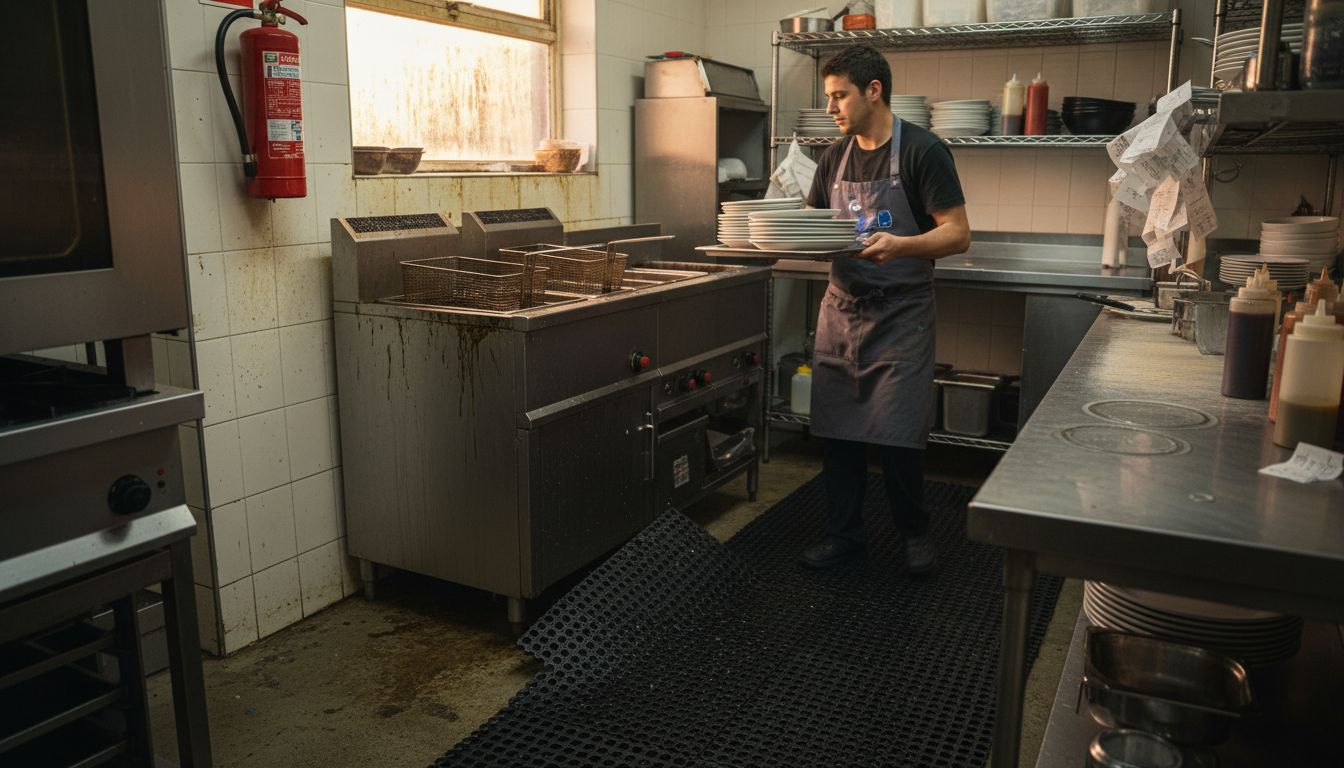
Pro tip: Measure your high-traffic zones carefully, then select mats with anti-fatigue properties to address both safety and worker comfort during long shifts.
Types of Commercial Kitchen Mats Explained
Commercial kitchens aren’t one-size-fits-all environments, so neither are their mats. Different zones create different hazards, and selecting the right mat type for each area directly impacts safety outcomes and worker comfort.
Mat selection depends on what your kitchen actually faces. A fryer station deals with constant oil splashes and heat. A dish pit floods with water and detergent. Walk-in coolers present cold, slippery surfaces. Each zone needs a mat engineered for those specific conditions.
Here are the main types you’ll encounter:
- Anti-fatigue mats: Cushioned surfaces that reduce leg and foot strain during long standing shifts, improving comfort without sacrificing grip
- Slip-resistant mats: Textured surfaces designed to enhance traction on wet or greasy floors, preventing the foot slide that causes falls
- Drainage mats: Perforated or slotted designs that allow liquids to drain through rather than pooling on top, keeping surfaces drier
- Cushioned mats: Combined protection offering both comfort padding and safety grip for high-traffic areas
Different mat types address specific kitchen functions like grease resistance, cleaning ease, and durability. Material matters too—rubber-backed mats prevent shifting, interlocking tiles allow customized coverage, and drainage designs work best near sinks or prep stations.
Consider your kitchen’s actual workflow. Fryer stations benefit from heat-resistant, oil-resistant materials. Dish pits need maximum drainage capability. Food prep areas require anti-fatigue support plus slip resistance. Cold storage requires mats that stay flexible in freezing temperatures.
Your mat choice should match your specific kitchen hazard, not just your budget.
Most professional kitchens use a combination approach. You might install drainage mats near the dish pit, anti-fatigue mats at prep stations, and slip-resistant surfaces in high-traffic walkways. This targeted strategy maximizes both safety and worker endurance.
Mat thickness, surface texture, and backing material all influence performance. Thicker isn’t always better—it depends on your floor type and the specific hazard you’re addressing.
Here’s how common kitchen zones match with ideal mat features:
| Kitchen Zone | Key Hazard | Recommended Mat Type | Benefit Gained |
|---|---|---|---|
| Fryer Station | Hot oil and grease | Heat/oil resistant mat | Enhanced grip, withstands spills |
| Dish Pit | Standing water & soap | Drainage mat | Drains liquid, reduces slips |
| Food Prep Area | Extended standing/fatigue | Anti-fatigue mat | Boosts comfort, prevents strain |
| Walk-in Cooler | Cold, slick floors | Flexible slip mat | Stays grippy in low temps |
Pro tip: Walk your kitchen during peak service and identify where staff slip or where fatigue slows them down, then match those specific zones to the mat type that addresses that exact problem.
Key Features and Safety Benefits
The best commercial kitchen mats share specific design features engineered for your environment. Understanding what makes them effective helps you choose mats that actually solve your facility’s problems.
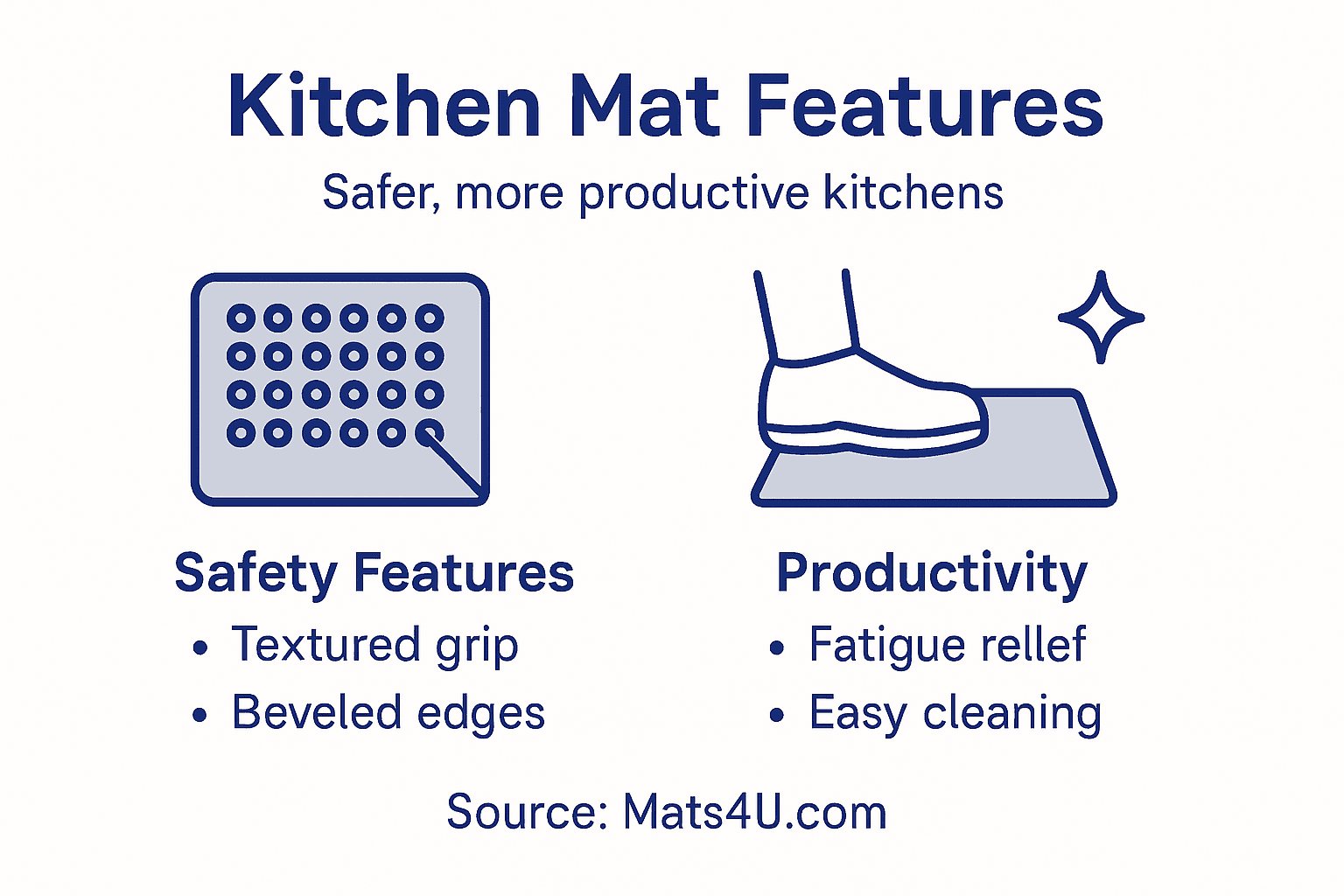
Start with the surface. Textured surfaces create grip where smooth floors create danger. That pattern catches shoe treads and prevents the micro-slip that happens when moisture meets a slick floor. The texture needs to be aggressive enough to work with wet feet but not so rough it damages footwear or skin.
Drainage capability matters enormously. Perforated or slotted designs let water, oil, and food debris drain through rather than pooling on top. This keeps your walking surface drier and safer throughout service. Water sitting on a mat becomes as hazardous as water on bare floors.
Key features that make kitchen mats perform include:
- Textured grip surfaces that enhance traction on wet and greasy floors
- Water drainage holes to reduce standing liquids and keep surfaces dry
- Beveled edges preventing tripping hazards at mat borders
- Interlocking edges that prevent mat movement and shifting during service
- Chemical resistance to withstand commercial cleaners and sanitizers
- Durable materials that resist wear, stains, and kitchen contaminants
Mats formulated from durable materials ensure long-term resistance to wear and chemicals that would degrade lesser products. Your mat needs to survive daily cleaning with harsh detergents, exposure to grease, salt, and food acids.
Beveled edges deserve attention. A sharp mat edge becomes a tripping hazard itself. Beveled or cushioned edges let staff’s feet transition smoothly, reducing ankle twists and falls caused by catching the mat.
Cushioning support reduces fatigue during twelve-hour shifts. Employees standing on hard concrete all day experience leg pain, foot soreness, and back strain. Cushioned mats absorb impact and support proper posture, keeping workers fresher and more productive.
The right mat features work together to prevent falls while keeping your team comfortable enough to maintain speed and focus.
Chemical resistance protects your investment. Mats that degrade under sanitizer or grease absorb liquids, trap bacteria, and become safety hazards themselves.
Pro tip: Check if your selected mat resists the specific cleaning agents your kitchen actually uses, not just generic detergents.
OSHA Standards and Compliance Requirements
OSHA doesn’t leave slip-and-fall prevention to guesswork. The agency has specific regulations your kitchen must follow, and understanding them protects both your workers and your facility from liability.
OSHA Standard 1910.22 requires that walking and working surfaces be maintained in clean, dry, and orderly condition. That means slip and trip hazards must be eliminated promptly. You can’t just accept wet floors as “part of the job.”
Your legal obligation breaks down into three components. First, identify slippery conditions. Second, eliminate them or provide protection. Third, maintain whatever solution you choose through regular inspection and prompt correction.
Non-slip mats satisfy the second requirement—they provide the slip-resistant surface OSHA mandates. But installation and maintenance matter as much as the mat itself. A mat that shifts, bunches, or degrades becomes a hazard rather than protection.
OSHA requires:
- Clean, dry, orderly surfaces maintained throughout each shift
- Slip-resistant flooring or footwear to protect employees from slips
- Regular inspection of mats and floors for damage or hazards
- Prompt correction of wet spots, spills, or deteriorating mats
- Proper mat installation preventing movement that creates tripping hazards
Walking-working surfaces must be maintained free from slip and trip hazards according to OSHA standards. This means your mat isn’t a set-it-and-forget-it solution. Daily maintenance, regular replacement when worn, and immediate cleanup of spills remain your responsibility.
Mats alone don’t guarantee compliance. OSHA evaluates whether your chosen safety measure—in this case, non-slip mats—actually prevents injury. Your mats must be durable, genuinely slip-resistant, properly installed, and actively maintained.
Document your compliance. Keep records of mat installation dates, inspection schedules, and any incidents or near-misses. If an accident occurs, OSHA investigators will review whether you maintained adequate slip-resistant surfaces.
OSHA compliance isn’t about having mats; it’s about proving your mats work and are properly maintained.
Your workers’ compensation insurance carrier may also impose requirements. Some insurers mandate specific mat types or installation standards. Check your policy requirements alongside OSHA standards.
Violations carry real consequences. OSHA penalties for slip-and-fall hazards can reach thousands of dollars, and that’s before workers’ compensation claims or potential lawsuits.
Pro tip: Create a mat maintenance log documenting weekly inspections, cleaning frequency, and replacement dates to demonstrate OSHA compliance and protect your facility if an incident occurs.
Cost Factors and Common Selection Mistakes
Cheap mats feel like budget victories until they fail six months later. Understanding what actually drives mat costs helps you invest wisely rather than waste money on poor choices.
Upfront price is only one piece. A $200 mat that lasts three years costs less per month than a $80 mat that deteriorates in eight months. Factor in replacement frequency, maintenance demands, and labor costs for installation and removal.
Material quality directly impacts longevity. Rubber-backed mats resist shifting better than mats with cheap adhesive. Textured surfaces that withstand months of cleaning outlast thin veneers that peel away. Drainage systems that don’t clog extend useful life significantly.
Common cost mistakes include:
- Buying too-thin mats that fold, buckle, or create tripping hazards requiring early replacement
- Choosing mats without adequate drainage that trap water and become breeding grounds for bacteria
- Skipping interlocking edges that prevent movement, leading to wrinkles and foot catches
- Ignoring grip specifications and selecting mats that don’t actually prevent slips in your environment
- Underestimating maintenance costs by choosing mats requiring frequent deep cleaning
Improper installation or choosing mats that are too thin causes folding and overlapping hazards that lead to injuries. A mat that shifts during service becomes liability rather than protection.
Budget considerations extend beyond purchase price. Installation labor costs vary based on floor preparation needed. Some kitchens require adhesive removal, floor leveling, or electrical outlet modifications. These hidden costs add up fast.
Maintenance expenses differ dramatically. Some mat materials withstand harsh sanitizers; others degrade quickly. Drainage capability determines cleaning frequency and time investment. Calculate total cost of ownership, not just sticker price.
Another mistake is choosing mats based on price per square foot without considering durability ratings. A seemingly expensive mat might outlast three cheaper alternatives, making it the actual bargain.
Below is a quick reference for kitchen mat cost drivers versus common purchasing mistakes:
| Cost Driver | Bad Purchasing Practice | Long-Term Impact |
|---|---|---|
| Mat thickness | Choosing mats too thin | Increased replacements, trip hazards |
| Material quality | Opting for cheap adhesives | Early wear, needed replacements |
| Drainage design | Ignoring drainage capability | Water pooling, bacterial growth |
| Backing type | Skipping interlocking edges | Mat movement, safety risks |
The cheapest mat is rarely the most affordable when you factor in replacement, maintenance, and injury prevention costs.
Workers’ compensation savings also factor into true cost. Preventing even one slip-and-fall injury pays for years of quality mats. One workplace accident can cost $20,000 to $50,000 in medical expenses and lost productivity.
Pro tip: Request mat samples from vendors, install them in your highest-traffic zones for two weeks, then evaluate actual durability, grip performance, and drainage before committing to a full kitchen installation.
Protect Your Kitchen Team with the Right Mats from Mats4U
Slips and falls in commercial kitchens are a serious threat to safety and productivity. This article highlights how non-slip mats prevent injuries by improving traction on wet and greasy floors and reduce fatigue during long shifts. At Mats4U, we understand how crucial it is to equip your kitchen with the right mats designed for high-traffic, oily, and wet environments to safeguard your staff and maintain smooth operations.
Explore our wide range of durable options including specialized Anti-Fatigue Mats that provide comfort and support for workers who stand for hours. If your kitchen faces constant moisture from spills, our Waterhog Mats offer superior drainage and slip resistance for safer walkways. Invest in mats built for lasting performance and OSHA compliance that will lower your injury risks and boost team confidence.
Don’t wait until an accident happens. Visit Mats4U.com now to find the perfect commercial kitchen mats that deliver safety and comfort. Protect your workforce and increase productivity today.
Frequently Asked Questions
What are the main benefits of using non-slip kitchen mats in commercial kitchens?
Non-slip kitchen mats significantly reduce slip-related injuries, provide cushioning to decrease fatigue during long shifts, delineate safe walkways, and contribute to lower healthcare costs and workers’ compensation expenses.
How do I choose the right type of mat for specific areas in my kitchen?
Select mats based on the specific hazards of each zone: use heat/oil resistant mats at fryer stations, drainage mats in dish pits, anti-fatigue mats in food prep areas, and flexible slip mats in walk-in coolers to match each environment’s conditions.
What safety features should I look for in commercial kitchen mats?
Key features include textured grip surfaces to enhance traction, water drainage holes to keep surfaces dry, beveled edges to prevent tripping hazards, interlocking edges to avoid mat movement, and chemical resistance for durability against cleaning agents.
How does OSHA regulate the use of mats in commercial kitchens?
OSHA requires that walking and working surfaces be clean, dry, and orderly. This means mats must eliminate slip and trip hazards, be regularly inspected for damage, and be properly maintained to satisfy safety standards.
Recommended
- Non Slip Kitchen Rugs – Boosting Safety in Busy Workspaces – Mats4U USA
- Anti Slip Kitchen Mats: Enhancing Safety and Efficiency – Mats4U USA
- Best Non Slip Kitchen Mats: Ensuring Commercial Safety – Mats4U USA
- Non Slip Kitchen Floor Mats: Safer Workspaces, Lower Risks – Mats4U USA
- Warehouse Safety Best Practices for Accident Prevention - ORNER


