


Wet area mats can reduce slip and fall incidents by up to 90% in commercial environments such as kitchens and factories. For facility managers and procurement officers, selecting the right wet mat goes beyond aesthetics. It directly impacts worker safety, floor protection, and operational efficiency. This guide walks you through wet mat materials, design features, safety benefits, and practical selection strategies to help you make informed decisions that protect your team and your bottom line.
Table of Contents
- Introduction To Wet Mats: Definition And Core Functions
- Materials And Design Features Of Wet Mats
- Safety And Ergonomic Benefits Of Wet Mats
- Comparison Of Wet Mat Types And Their Best-Use Cases
- Practical Application And Maintenance Of Wet Mats
- Common Misconceptions About Wet Mats
- Explore Premium Wet Mat Solutions For Your Facility
Key takeaways
| Point | Details |
|---|---|
| Slip reduction | Wet mats can reduce slip and fall incidents by up to 90% in wet commercial environments. |
| Material matters | Nitrile rubber and SBR offer superior chemical resistance and durability compared to standard options. |
| Drainage design | Proper drainage features prevent dangerous water pooling and maximize traction. |
| Anti-fatigue benefits | Ergonomic wet mats reduce worker muscle strain and improve productivity during long standing shifts. |
| Selection criteria | Match mat type to environment moisture levels, chemical exposure, and traffic intensity for optimal performance. |
Introduction to wet mats: definition and core functions
Wet mats are specialized floor coverings engineered to manage moisture, prevent slips, and protect floors in commercial spaces where water, oils, or other liquids are present. Unlike standard mats, they feature drainage systems, slip-resistant surfaces, and materials built to withstand harsh wet conditions. Their primary safety function addresses a critical workplace hazard: wet area mats can reduce slip and fall incidents by up to 90% in commercial environments.
Beyond preventing accidents, wet mats protect floor surfaces from water damage, chemical corrosion, and contamination that compromise hygiene standards. In food service, manufacturing, and healthcare facilities, this protection maintains compliance with health and safety regulations while extending floor lifespan. The right mat acts as a barrier between destructive moisture and expensive flooring investments.
Wet mats also deliver operational benefits by improving worker comfort in environments where employees stand for extended periods. Anti-fatigue properties reduce muscle strain and joint stress, directly impacting productivity and reducing fatigue-related errors. When workers feel less physical discomfort, they maintain better focus and efficiency throughout their shifts.
“Proper wet mats function as a critical safety system, not just a floor accessory. They prevent accidents, protect infrastructure, and support worker wellbeing simultaneously.”
Not all mats perform equally in wet conditions. Design and material quality separate effective solutions from liability risks. Standard mats without proper drainage or chemical resistance can actually increase slip hazards by trapping water and degrading quickly. Understanding what makes a wet mat effective helps you avoid costly mistakes that put workers at risk and floors in jeopardy.
Key wet mat functions include:
- Providing high-traction surfaces that maintain grip when wet
- Channeling water away from walking surfaces through drainage systems
- Resisting chemical breakdown from cleaners, oils, and industrial fluids
- Cushioning feet and legs to reduce standing fatigue
- Creating hygienic barriers that prevent floor contamination
Materials and design features of wet mats
Material selection determines how well a wet mat performs under harsh industrial conditions. Nitrile rubber stands out for its exceptional chemical and grease resistance, making it ideal for commercial kitchens and manufacturing facilities where oils and harsh cleaners are common. SBR rubber offers excellent durability and slip resistance at a moderate price point, balancing performance with budget considerations. PVC provides a lightweight, cost-effective option for areas with light moisture exposure but lacks the chemical resistance needed for demanding environments.
Drainage design separates functional wet mats from safety hazards. Mats lacking proper drainage and chemical resistance dramatically underperform and increase slip risk by allowing water to pool on surfaces. Open grid patterns, drainage holes, and raised surfaces channel liquids away from foot traffic zones, maintaining traction even during heavy use. This architectural feature proves critical in food processing plants, car washes, and any facility where liquids constantly contact floor surfaces.
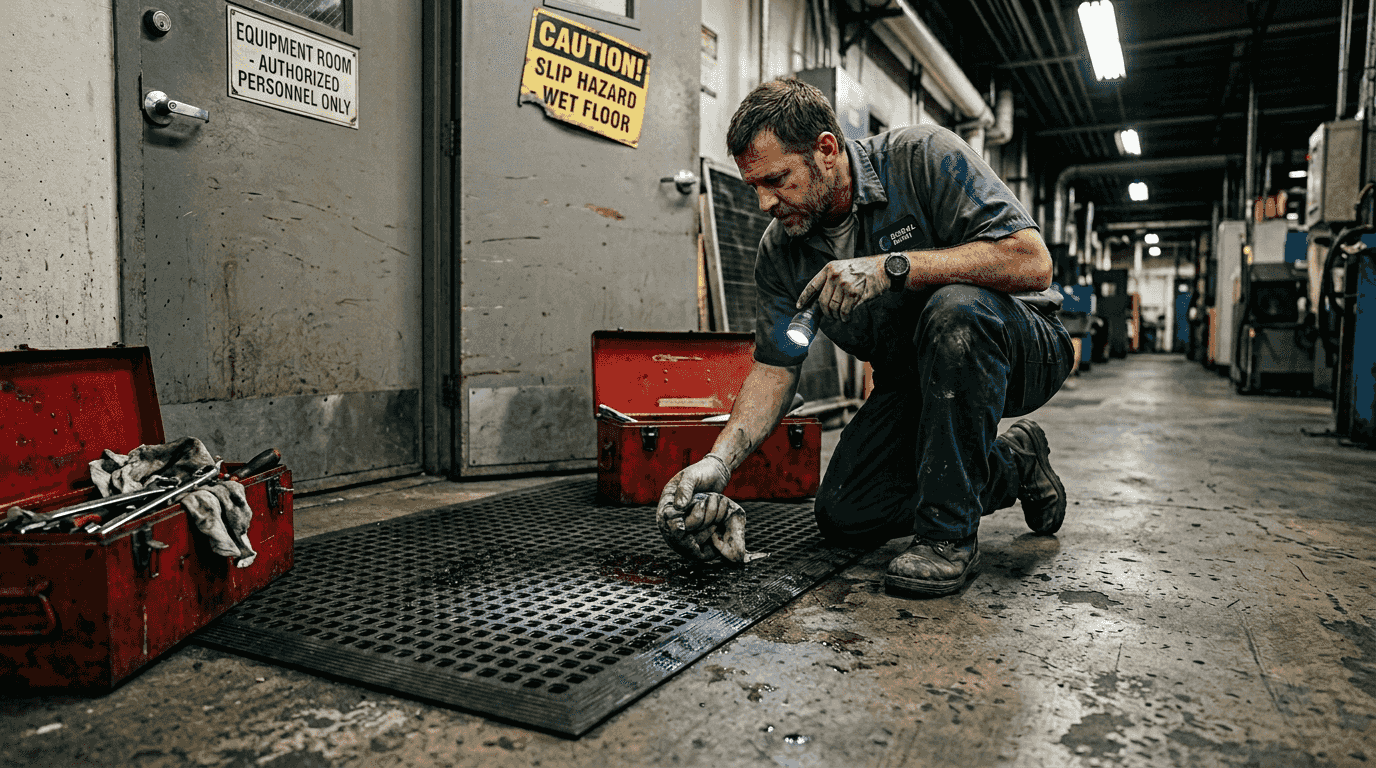
Textured anti-slip surfaces work in tandem with drainage systems to maximize safety. Raised patterns, ridges, or diamond plate designs create multiple contact points that grip footwear even when wet. These surface treatments maintain effectiveness across temperature ranges and remain stable under heavy foot traffic. Combined with moisture resistant materials, textured surfaces provide redundant safety features that protect workers in unpredictable conditions.
Chemical resistance coatings extend mat lifespan in industrial settings where aggressive substances would quickly degrade standard materials. Food-grade oils, industrial degreasers, and sanitizing chemicals all accelerate wear on unprotected mats. Specialized coatings or inherently resistant materials maintain structural integrity and slip resistance throughout years of exposure, delivering better long-term value despite higher upfront costs.
| Material Type | Chemical Resistance | Durability | Comfort Level | Best Use Case |
|---|---|---|---|---|
| Nitrile Rubber | Excellent | High | Good | Commercial kitchens, auto shops |
| SBR Rubber | Good | High | Moderate | Manufacturing floors, warehouses |
| PVC | Fair | Moderate | Low | Light moisture areas, entries |
| Vinyl with Foam | Poor | Low | Excellent | Indoor service counters, retail |
Pro Tip: Match material chemical resistance to your specific cleaning products and operational fluids. Test a sample mat with your actual chemicals before large-scale purchase to ensure compatibility and longevity.
Edge design affects both safety and maintenance efficiency. Beveled or ramped edges prevent trip hazards where mats meet bare floor, while also allowing carts and equipment to roll smoothly across transitions. Sealed edges prevent liquid infiltration that causes mat delamination and creates hidden mold growth. These details matter for chemical resistant mats durability in real-world conditions where repeated cleaning and heavy use test every design element.
Safety and ergonomic benefits of wet mats
Slip resistance remains the primary safety benefit driving wet mat adoption in commercial facilities. High-traction surfaces combined with effective drainage maintain grip coefficients that meet or exceed OSHA recommendations for wet walking surfaces. This performance directly translates to fewer workers’ compensation claims, reduced insurance premiums, and improved facility safety records. The investment in quality wet mats pays for itself through avoided accident costs and liability exposure.
Anti-fatigue properties address the hidden cost of prolonged standing on hard wet floors. When workers stand for hours on concrete or tile, blood circulation decreases and muscle fatigue accelerates, reducing alertness and increasing error rates. Cushioned wet mats encourage subtle muscle movements that promote circulation, reducing the physical strain that leads to chronic pain and decreased productivity. Studies on workplace injury reduction show measurable decreases in musculoskeletal complaints when ergonomic mats replace hard standing surfaces.
Properly designed wet mats help facilities meet multiple safety standards simultaneously. OSHA regulations for walking and working surfaces require slip-resistant flooring in areas exposed to moisture. Health department codes mandate cleanable, non-absorbent surfaces in food preparation zones. The right wet mat satisfies both requirements while providing the ergonomic support that reduces repetitive strain injuries covered under workplace safety regulations.
The combined impact of slip resistance and ergonomic support extends beyond immediate safety metrics. Workers who feel physically comfortable and secure maintain better focus on their tasks, leading to higher quality output and fewer costly mistakes. Reduced fatigue means employees sustain peak performance throughout entire shifts rather than declining as physical discomfort builds. These productivity gains often exceed the direct safety cost savings, making wet mats a strategic operational investment.
Pro Tip: Calculate your facility’s current slip and fall incident costs including workers’ comp, lost time, and insurance impacts. Compare this annual figure to wet mat investment costs to quantify ROI and justify budget allocation.
Key safety and ergonomic advantages include:
- Maintaining traction coefficients above 0.5 even when saturated with water
- Reducing lower back and leg strain by up to 50% compared to hard floors
- Meeting ADA accessibility requirements for stable walking surfaces
- Preventing cross-contamination through antimicrobial material treatments
- Supporting OSHA compliance for wet area safety benefits in commercial facilities
Facility managers should evaluate wet mats not just as safety equipment but as performance tools that enhance worker capability. The anti-fatigue mat benefits extend throughout operations, affecting everything from product quality to employee retention. When workers experience less physical stress, they demonstrate greater job satisfaction and lower turnover rates. The comprehensive value proposition makes anti slip mats safety investments among the highest-return facility improvements available.
Comparison of wet mat types and their best-use cases
Rubber nitrile anti-fatigue mats excel in commercial kitchens and automotive facilities where grease, oils, and harsh chemicals create challenging conditions. Their exceptional chemical resistance prevents material breakdown while cushioned construction reduces worker fatigue during long prep or service shifts. These mats typically feature drainage holes that prevent grease pooling, maintaining safety even during the busiest service periods. The premium price point reflects superior performance and extended lifespan in demanding environments.
Open grid drainage mats prioritize liquid management in manufacturing and food processing facilities where constant water flow or spills occur. Large openings allow liquids to pass through immediately, preventing any surface accumulation that could cause slips. Their rigid structure supports heavy cart traffic while maintaining drainage efficiency. These mats work best in areas with proper floor drainage systems that handle the water flowing through the mat structure.
Standard rubber mats offer budget-conscious solutions for areas with moderate moisture exposure. Solid construction provides basic slip resistance and floor protection without advanced drainage or chemical resistance features. These work well in locker rooms, pool areas, or facility entrances where water exposure is intermittent rather than constant. Limited chemical resistance makes them unsuitable for industrial applications involving harsh substances.
Modular mat systems deliver flexibility for facilities with irregular floor layouts or evolving traffic patterns. Individual tiles connect to create custom coverage that adapts to equipment placement changes or seasonal workflow variations. This configurability comes with higher per-square-foot costs but eliminates waste from oversized mats and allows targeted replacement of worn sections. Modular systems particularly benefit facilities undergoing expansion or layout optimization.
| Mat Type | Drainage Capability | Chemical Resistance | Anti-Fatigue | Traffic Capacity | Ideal Environment |
|---|---|---|---|---|---|
| Nitrile Anti-Fatigue | Good | Excellent | High | Moderate | Commercial kitchens, labs |
| Open Grid | Excellent | Moderate | Low | High | Manufacturing, food processing |
| Standard Rubber | Fair | Poor | Moderate | Moderate | Locker rooms, entries |
| Modular Interlocking | Good | Varies | Varies | High | Custom layouts, temporary zones |
Pro Tip: Audit your facility zone by zone, categorizing areas by moisture level, chemical exposure, traffic intensity, and standing duration requirements. This systematic approach ensures you select the optimal mat type for each specific application rather than applying a one-size-fits-all solution.
Selecting the right wet mat requires matching product capabilities to environmental demands. A mat that performs excellently in a restaurant prep area might fail quickly on a factory floor exposed to industrial solvents. Understanding these distinctions prevents expensive mistakes and safety gaps. Non slip floor mats designed for wet areas incorporate features specific to moisture management that general-purpose mats lack.
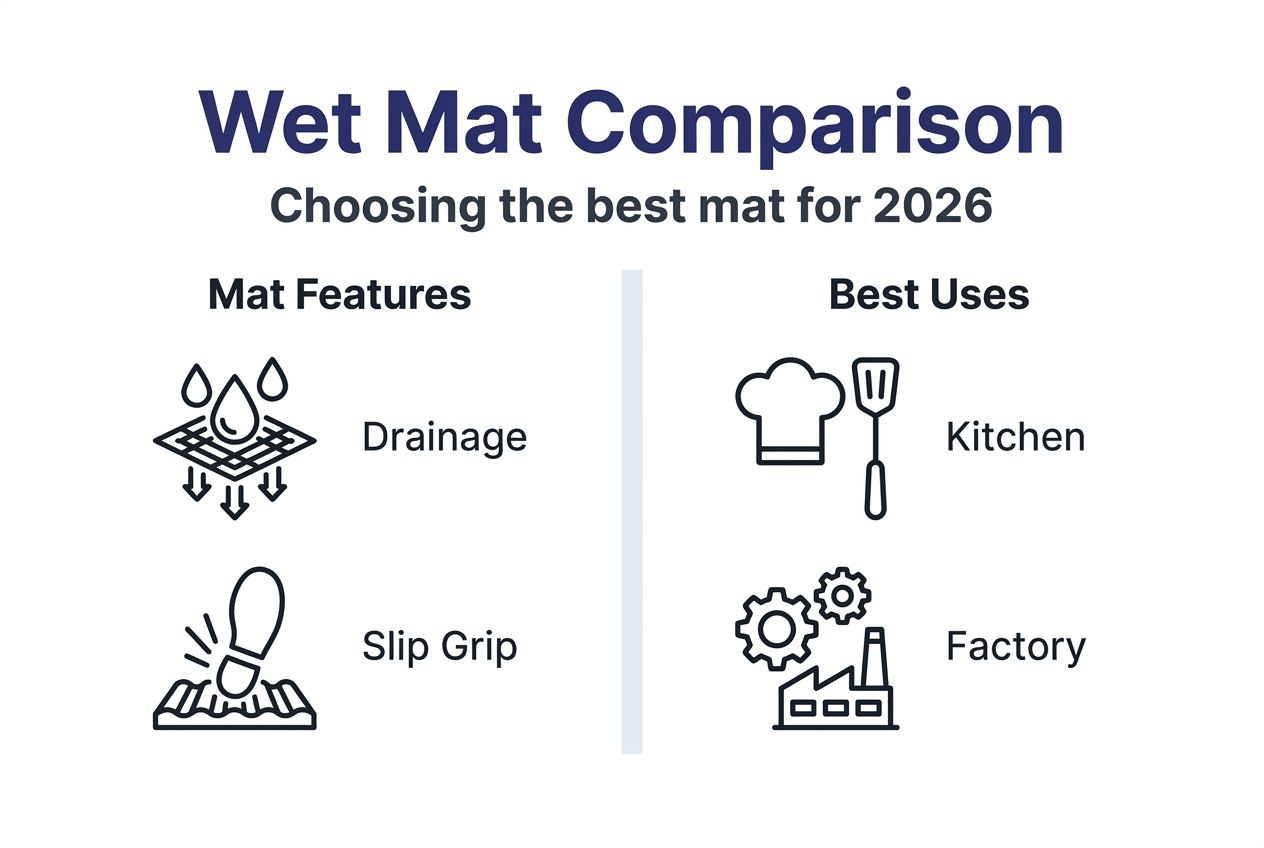
Consider total cost of ownership rather than just purchase price when comparing options. A premium nitrile mat costing three times more than a standard rubber mat but lasting five times longer while preventing costly slip incidents represents far better value. Factor in replacement frequency, cleaning requirements, and safety incident costs to calculate true economic impact. The floor safety mats guide helps facility managers navigate these tradeoffs and identify solutions that deliver optimal long-term value.
Practical application and maintenance of wet mats
Selecting appropriate wet mats starts with thorough environment assessment. Document moisture sources, chemical exposures, and foot traffic patterns for each facility zone. High-traffic pathways require more durable materials and aggressive drainage features than occasional-use areas. Food preparation zones demand FDA-compliant materials and antimicrobial properties that storage areas don’t need. This systematic evaluation prevents under-specification that leads to premature failure or over-specification that wastes budget.
Mat thickness and cushioning should align with standing duration requirements. Workers spending entire shifts at wet stations need substantial anti-fatigue properties that short-duration tasks don’t require. Measure typical standing periods and match mat specifications to provide adequate support without excessive cost. Balance comfort benefits against drainage efficiency, as thicker mats sometimes compromise liquid flow.
Installation best practices maximize mat effectiveness and lifespan:
- Clean and dry floor surfaces completely before mat placement to prevent mold growth underneath
- Ensure adequate coverage extends beyond immediate wet zones to catch splash and tracked moisture
- Position mats to avoid creating trip hazards at transitions or doorways
- Secure mats properly in high-traffic areas to prevent shifting that exposes bare floor
- Post appropriate signage indicating wet floor conditions even with mats in place for liability protection
Regular cleaning preserves slip resistance and extends mat life significantly. Remove debris daily using stiff brushes or pressure washing depending on mat material and contamination level. Trapped particles reduce drainage efficiency and accelerate material wear. Schedule deep cleaning weekly or more frequently in food service and healthcare environments where sanitation standards are stringent. Use cleaning products compatible with mat materials to avoid slippery floor with mats becoming slip hazards themselves due to chemical degradation.
Pro Tip: Create a mat maintenance schedule integrated with your facility’s overall cleaning program. Assign specific responsibility for daily debris removal and weekly deep cleaning to ensure consistency. Track mat condition during cleaning to identify wear patterns that indicate replacement needs before safety is compromised.
Proactive maintenance reduces total cost of ownership while maintaining safety performance:
- Inspect mats monthly for wear patterns, material breakdown, or drainage blockages
- Rotate mats between high and lower traffic areas to equalize wear
- Replace individual damaged sections in modular systems rather than entire installations
- Document mat performance and replacement cycles to optimize future purchasing decisions
- Train staff on proper mat handling during cleaning to prevent damage
Implementing structured mat programs demonstrates commitment to enhancing workplace safety and comfort while maximizing equipment investment returns. Facilities that treat mats as critical safety infrastructure rather than disposable accessories achieve better safety outcomes and lower long-term costs. The discipline of regular assessment and maintenance separates facilities with excellent safety records from those constantly reacting to incidents and premature mat failures.
Common misconceptions about wet mats
Many facility managers assume all mats perform adequately in wet conditions, leading to poor purchasing decisions and unnecessary safety risks. The reality is that mats lacking proper drainage and chemical resistance dramatically underperform and increase slip risk rather than reducing it. Standard mats designed for dry areas actually create hazards when used in wet environments by trapping water on their surfaces and degrading quickly under moisture exposure. This misconception costs facilities money through frequent replacements and potential liability from preventable accidents.
Another prevalent myth suggests wet mats provide no meaningful ergonomic benefits since they’re designed primarily for safety. In reality, anti-fatigue wet mats deliver substantial comfort improvements that directly impact worker productivity and wellbeing. The cushioning properties reduce muscle strain and joint stress just as effectively as dry area anti-fatigue mats while maintaining the drainage and slip resistance wet environments require. Dismissing these dual benefits means missing opportunities to improve both safety and operational efficiency simultaneously.
Cost-focused procurement officers often believe cheaper mats adequately serve wet area needs, viewing premium options as unnecessary expense. This thinking ignores the total cost equation where budget mats fail prematurely, require frequent replacement, and increase incident risk that far exceeds initial savings. Quality wet mats designed for commercial use deliver multi-year service life and prevent costly accidents that budget options cannot. The false economy of cheap wet mats becomes apparent only after safety incidents or rapid deterioration force expensive emergency replacements.
“The misconception that all wet mats are equivalent leads facilities to select products based solely on price, ignoring performance factors that determine actual safety and value. This purchasing approach consistently delivers poor outcomes.”
Some facility managers believe wet mats are only necessary in obviously wet areas like kitchens or bathrooms, underestimating moisture risks in other zones. Condensation, tracked moisture, and incidental spills create slip hazards throughout facilities, not just in designated wet areas. Comprehensive mat programs that address these transition zones and moderate moisture areas prevent accidents that concentrated coverage misses. Understanding anti slip mats insights helps identify all locations where appropriate matting improves safety.
Key misconceptions to avoid:
- Believing wet conditions don’t require specialized mat features beyond basic slip resistance
- Assuming ergonomic benefits are incompatible with effective moisture management
- Selecting mats based solely on lowest purchase price without considering lifespan and performance
- Limiting mat coverage to obviously wet zones while ignoring moisture transfer areas
- Expecting all rubber or vinyl mats to provide adequate chemical and moisture resistance
Educating procurement teams and facility managers about these common mistakes prevents costly errors and creates safer work environments. Access to accurate information about wet mat misconceptions enables better decision-making that balances budget constraints with safety requirements. Facilities that invest time in understanding wet mat technology consistently achieve better safety outcomes and lower total costs than those making uninformed purchasing decisions.
Explore premium wet mat solutions for your facility
Mats4U offers commercial-grade wet mats engineered for the demanding conditions facility managers face daily. Our selection includes chemical-resistant materials, advanced drainage designs, and anti-fatigue construction that addresses both safety and comfort requirements. Whether you need coverage for commercial kitchens, manufacturing floors, or high-traffic entryways, our products deliver the performance and durability your operations demand.
Explore our durable anti-fatigue mat options that combine ergonomic support with moisture management for optimal worker comfort. For facilities seeking brand visibility alongside functionality, our custom logo floor mats deliver professional appearance with wet area capabilities. The anti-fatigue comfort mats in our catalog provide premium cushioning without compromising drainage efficiency or chemical resistance.
Investing in quality wet mats from Mats4U supports long-term facility safety, reduces maintenance costs, and demonstrates commitment to worker wellbeing. Our products meet commercial standards for wet environments while offering the customization options that align mat solutions with your specific operational needs.
FAQ
What materials are best for wet mats in industrial environments?
Nitrile rubber and SBR rubber are preferred for their chemical and grease resistance, durability, and slip resistance in wet industrial settings. These materials withstand harsh cleaners, oils, and constant moisture exposure without degrading. PVC suits less demanding environments but lacks the chemical resistance needed for heavy industrial use.
How do anti-fatigue wet mats improve worker productivity?
Anti-fatigue mats reduce muscle strain and improve blood flow, decreasing discomfort and fatigue during prolonged standing. This ergonomic support enhances worker focus and efficiency throughout shifts. The physical comfort translates directly to better task performance and fewer fatigue-related errors.
What maintenance practices extend the life of wet mats?
Regular cleaning removes debris and contaminants that reduce grip and accelerate wear. Prompt drying and monthly inspection prevent mold growth and material breakdown. Avoid harsh chemicals unless mats are specifically rated for them. Proper storage of seasonal mats and immediate repair of damaged sections maximize usability and maintain safety performance.
Which types of wet mats are recommended for different industries?
Industrial kitchens benefit from nitrile rubber anti-fatigue mats for grease resistance and worker comfort during long shifts. Manufacturing facilities with frequent spills should use open grid drainage mats to prevent dangerous fluid accumulation. Reception areas and moderate moisture zones can rely on standard rubber mats with textured slip-resistant surfaces for basic protection.
Recommended
- Outdoor Mats for Wet Areas: Boosting Workplace Safety – Mats4U USA
- Mats4EU | 8 things to consider when selecting Anti-Fatigue standing mats – Mats4U USA
- Anti Fatigue Mats for Wet Areas: Enhancing Safety and Comfort – Mats4U USA
- Non-Slip Kitchen Mats: 50% Fewer Slips in 2026 – Mats4U USA
- Reducing Workplace Injuries: Essential Steps for 2025


