


TL;DR:
- Hall mat prices depend mainly on material type, size, and order volume, ranging from under $15 for basic doormats to several hundred dollars for custom logo mats. Bulk purchasing and choosing appropriate materials for indoor or outdoor use can significantly lower per-unit costs and increase durability, while custom branding adds upfront expenses but enhances brand visibility. Proper product selection tailored to environment and traffic reduces replacement frequency and total costs over time for property managers.
Hall mat price is defined as the total purchase cost of an entrance or corridor mat, determined primarily by material type, dimensions, and order volume. For property managers and businesses, this cost ranges from under $15 for basic themed doormats to several hundred dollars for large custom logo mats in high-traffic commercial corridors. Materials like rubber, coir coconut fiber, and synthetic blends each carry distinct price points and performance profiles. Balancing upfront hall mat cost against durability and brand presentation is the central purchasing decision for any commercial buyer.
1. Hall mat price ranges by material type
The material is the single largest driver of entrance mat pricing. Each category serves a different commercial need, and understanding those differences prevents costly mismatches between mat performance and environment.
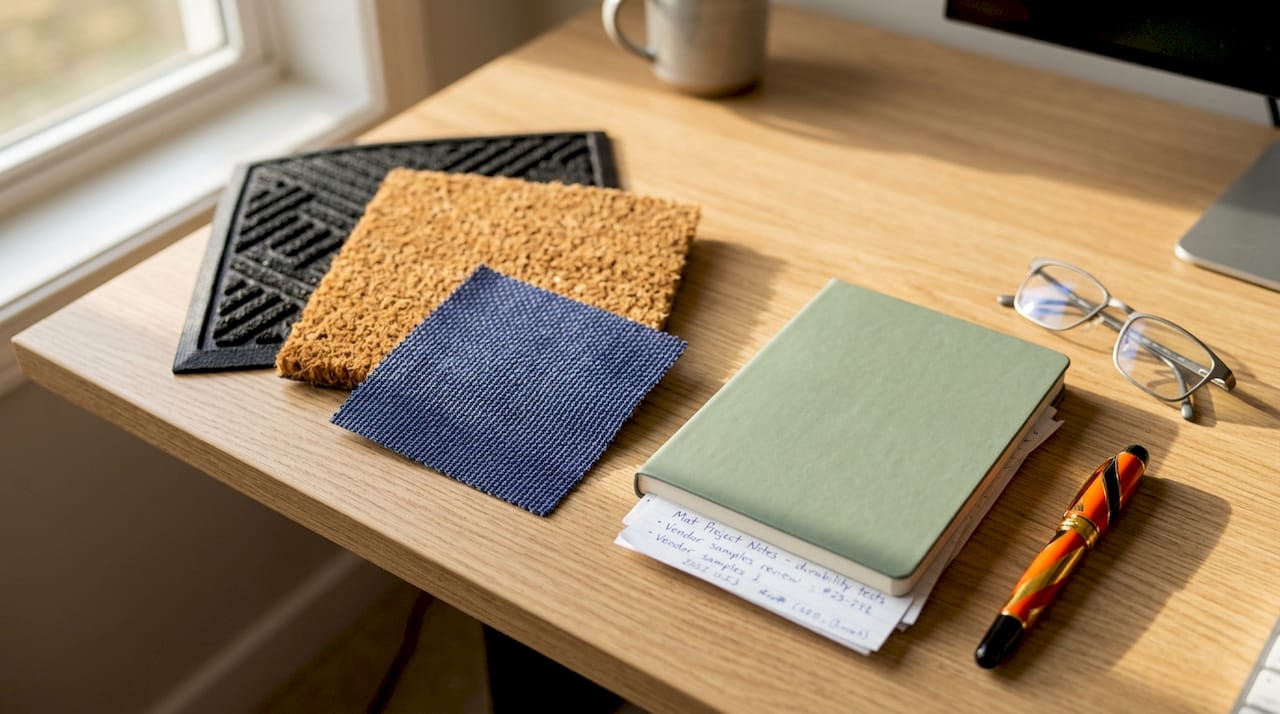
Rubber mats are the workhorses of commercial corridors. They handle heavy foot traffic, resist moisture, and require minimal maintenance. Standard commercial rubber entrance mats typically range from $30 to $150 depending on size, with heavy-duty options running higher. For a detailed breakdown of rubber options in retail settings, rubber hall mat costs vary by thickness and surface texture.
Coir coconut fiber mats offer a natural aesthetic with strong scraping performance at the door. Coir entrance mats from Barriers Direct range from £21.50 for a 1m x 0.5m unit to £357.84 for a 1m x 12.5m runner. That price spread illustrates how size alone can multiply cost by a factor of 16. Coir works well at exterior thresholds but degrades faster in wet indoor environments.
Synthetic fiber mats, including nylon and polypropylene blends, sit in the mid-range. They offer color variety, moisture wicking, and longer indoor lifespans than coir. These are the standard choice for lobbies, hotel corridors, and office buildings where aesthetics matter alongside function.
Custom logo mats carry the highest price per unit. Premium HD printed mats combine functionality with direct brand exposure at every entrance. The added cost reflects setup, print quality, and custom sizing. For businesses where first impressions drive revenue, this category delivers measurable return.
Pro Tip: Custom logo mats justify their higher price point when placed at customer-facing entrances. A branded mat at a hotel lobby or retail storefront functions as a 24/7 marketing asset, not just a floor covering.
2. How size and bulk purchasing affect hall mat pricing
Larger mats cost more in total, but the cost per square foot typically drops as dimensions increase. This relationship is predictable across most commercial mat suppliers and should inform how you structure purchase orders.
Bulk buying hall mats can save between 2.5% and 5% per unit when ordering three or more mats. That figure may seem modest on a single order, but for a property manager outfitting 20 locations, it translates directly to budget efficiency. Tiered pricing structures are standard across commercial mat suppliers.
The table below illustrates how unit price shifts with quantity for a standard commercial entrance mat:
| Order quantity | Estimated unit price | Approximate savings |
|---|---|---|
| 1 mat | $85.00 | Baseline |
| 3 mats | $82.88 | 2.5% per unit |
| 5+ mats | $80.75 | 5% per unit |
Runners and hall runner price points follow the same logic. A 2.5 x 7 foot runner costs more than a 2 x 3 doormat, but the price per square foot is often lower. Ruggable offers washable runners in sizes from small doormats to full hallway runners, demonstrating how the market segments by both size and use case.
Pro Tip: When managing multiple properties, consolidate mat orders across locations into a single purchase. The volume discount on five locations buying together beats five separate orders every time.
3. Comparing indoor vs. outdoor hall mat prices and features
Indoor and outdoor commercial mats are engineered for different conditions, and that engineering difference shows up directly in hall mat pricing.
| Feature | Outdoor mats | Indoor mats |
|---|---|---|
| Primary function | Heavy debris removal, water drainage | Moisture absorption, aesthetics |
| Material | Rubber, coir, polypropylene | Nylon, Berber, synthetic blends |
| Typical price range | $40 to $200+ | $25 to $150+ |
| Durability | High (UV and weather resistant) | Moderate to high (interior wear) |
| Branding options | Limited | Extensive (logo printing available) |
| Best use case | Building entrances, loading docks | Lobbies, corridors, reception areas |
Outdoor mats must withstand UV exposure, rain, freeze-thaw cycles, and heavy scraping loads. The WaterHog® Max Grand Half Oval Mat is a recognized example in this category. It combines a high-traffic rubber border with a fiber surface engineered to trap water and debris before it enters the building. The price reflects both material quality and the brand’s commercial performance reputation.
Indoor mats prioritize appearance and moisture management. Nylon and Berber options in this category support custom printing, making them the preferred choice for branded lobbies. Outdoor mat prices tend to run 15% to 25% higher than comparable indoor mats at the same size, reflecting the added material requirements for weather resistance.
4. Custom logo mats and how branding affects cost
Custom printing adds a fixed setup cost plus a per-unit premium to any mat order. The result is a higher upfront hall mat cost that delivers ongoing brand value at every customer touchpoint.
Key cost factors for custom logo mats include:
- Print resolution: High-definition printing requires more precise manufacturing, which increases unit cost.
- Number of colors: More colors in a logo design typically raise production cost.
- Mat size: Larger print areas cost more to produce than standard doormat dimensions.
- Order volume: Setup costs spread across larger orders, reducing the per-unit premium significantly.
- Material base: Nylon bases hold color better than rubber or coir, and they cost more per square foot.
Custom printed logo mats from Mats4u combine functional entrance protection with professional brand presentation. For businesses in hospitality, retail, or healthcare, the mat at the front door is the first physical brand interaction a visitor has. That context makes the price premium defensible.
Pro Tip: Calculate the cost per day over a mat’s expected lifespan rather than comparing sticker prices. A $200 logo mat lasting three years costs less per day than a $60 generic mat replaced every eight months.
5. Anti-fatigue mats and their price premium
Anti-fatigue mats occupy a separate pricing tier from entrance mats. They are designed for employees who stand for extended periods, not for debris capture or moisture management at building thresholds.
Anti-fatigue mats like the Cushion Complete from Mats4u reduce physical fatigue in standing work areas. The ergonomic foam or gel construction that makes them effective also makes them more expensive than flat entrance mats of comparable size. A standard anti-fatigue mat for a commercial kitchen or assembly station typically costs $60 to $180 depending on size and cushion density.
The business case for this price premium is direct. Reduced fatigue correlates with lower error rates, fewer injury claims, and higher employee retention in physically demanding roles. Property managers overseeing manufacturing facilities, commercial kitchens, or retail checkout areas should factor anti-fatigue mat costs into their total floor mat budget as a separate line item from entrance mats.
6. Installation and additional service costs
The purchase price of a commercial hall mat is not always the total cost. Several secondary factors can increase total expenditure, particularly for large-scale or custom installations.
Installation services apply primarily to recessed mat systems, where a mat well is cut into the floor and the mat sits flush with the surrounding surface. This approach is common in high-end commercial lobbies and requires professional installation. The cost of cutting a mat well adds $150 to $400 or more to the project, depending on floor material and mat dimensions. For a practical overview of these costs, rubber flooring installation costs vary by floor type and project scope.
Additional cost factors include:
- Mat rental programs: Some suppliers offer rental and laundering services for entrance mats. Monthly costs are predictable, but long-term rental often exceeds the purchase price of owned mats.
- Replacement frequency: Lower-priced mats in high-traffic areas may require replacement two to three times more often than premium options.
- Shipping costs: Large or heavy mats carry significant freight charges. Mats4u offers free delivery on orders over $100, which reduces total cost for standard commercial orders.
- Custom sizing fees: Non-standard dimensions typically carry a cutting or setup fee beyond the base mat price.
Understanding total entrance mat costs requires accounting for all these variables, not just the unit price shown in a product listing.
7. Regional pricing and international purchasing considerations
Regional pricing differences are a real factor when comparing hall mat costs across suppliers. UK pricing includes VAT, which makes direct dollar-to-pound comparisons misleading without adjusting for tax treatment. A mat listed at £21.50 including VAT is not equivalent to a $21.50 price in the US market once currency conversion, import duties, and shipping are factored in.
For US-based property managers, sourcing from domestic suppliers eliminates import complexity and reduces lead times. Made-in-the-USA products also carry predictable quality standards and warranty terms. When evaluating outdoor mat prices from international suppliers, always calculate the total landed cost rather than comparing catalog prices directly.
Key takeaways
Hall mat price is determined by material, size, order volume, and added features like custom printing or anti-fatigue construction. Buying on unit price alone consistently produces higher total costs over time.
| Point | Details |
|---|---|
| Material drives base price | Rubber, coir, and synthetic fiber mats each carry distinct price ranges and performance profiles. |
| Bulk orders reduce unit cost | Ordering three or more mats saves 2.5% to 5% per unit, which adds up across multiple locations. |
| Custom mats cost more upfront | Logo mats carry setup and print premiums but deliver ongoing brand value at every entrance. |
| Indoor vs. outdoor pricing differs | Outdoor mats run 15% to 25% higher than indoor equivalents due to weather-resistant construction. |
| Total cost includes more than price | Installation, replacement frequency, and shipping all affect the real cost of a commercial mat purchase. |
What I’ve learned about buying hall mats for commercial spaces
The most consistent mistake I see property managers make is treating hall mat purchases as a commodity buy. They sort by price, pick the lowest number, and move on. Six months later, they are reordering because the mat has compressed, faded, or started curling at the edges in a high-traffic corridor.
The mat type has to match the traffic volume and environment. A coir mat at a coastal hotel entrance will deteriorate in weeks from salt air and wet foot traffic. A thin nylon mat at a manufacturing facility entrance will compress flat within a month. These are not edge cases. They are predictable outcomes when the wrong product is selected on price alone.
Bulk purchasing across multiple locations is the most underused cost lever I see. A regional property management company with 15 buildings buying mats individually is leaving real money on the table. Consolidating those orders into a single annual purchase, even across different mat types, typically qualifies for volume pricing and reduces per-unit cost meaningfully.
Custom logo mats deserve more consideration than most buyers give them. The hesitation is always the price. But a branded mat at a client-facing entrance is a functional product and a brand asset simultaneously. For businesses in hospitality or professional services, that combination is worth the premium. The math on cost per day over a three-year lifespan almost always favors the better mat.
— Werner
Find the right commercial hall mat at Mats4u
Mats4u stocks a full range of commercial entrance and corridor mats across every major category discussed in this article. The product line includes premium custom logo mats with high-definition printing for branded entrances, the WaterHog® Max for durable outdoor entryways, and anti-fatigue options for standing work areas. All products are Made in the USA, and orders over $100 ship free. Volume pricing is available for multi-location orders. Browse the full catalog at Mats4u to get specifications and pricing matched to your specific commercial requirements.
FAQ
What is the average hall mat price for commercial use?
Commercial hall mat pricing typically ranges from $30 for basic rubber entrance mats to over $200 for large custom logo or heavy-duty outdoor mats. The final cost depends on material, size, and whether custom printing or anti-fatigue construction is required.
Does buying hall mats in bulk reduce the cost?
Yes. Bulk purchasing saves between 2.5% and 5% per unit when ordering three or more mats, making volume purchasing a practical strategy for property managers with multiple locations.
Are custom logo mats worth the higher price?
Custom logo mats cost more upfront due to print setup and material requirements, but they function as both entrance protection and brand marketing. For customer-facing businesses, the per-day cost over a three-year lifespan is often lower than replacing cheaper mats more frequently.
What is the difference between indoor and outdoor hall mat prices?
Outdoor commercial mats typically cost 15% to 25% more than indoor mats of the same size because they require weather-resistant materials and UV-stable construction. Indoor mats prioritize aesthetics and moisture absorption, which allows for more affordable material options.
Where can I buy hall mats with competitive pricing and fast delivery?
Mats4u offers a full range of commercial entrance mats with free shipping on orders over $100 and Made-in-the-USA quality standards. The site supports volume orders and custom configurations for businesses and property managers.


