


TL;DR:
- Choosing the appropriate commercial floor mats enhances safety, reduces liability, and extends their service life.
- Matching mat types to specific zones, traffic levels, and environmental conditions ensures compliance with slip resistance standards and optimal performance.
Commercial floor mats are purpose-built floor coverings designed to control debris, moisture, slip hazards, and worker fatigue in business environments. Selecting the wrong type costs facilities more than replacement expenses. It creates liability exposure, accelerates floor damage, and undermines the safety protocols you already have in place. This guide breaks down every major category of commercial floor mat types, the materials behind them, the safety standards that govern them, and the decision framework that matches each mat to its correct zone.
What are the main types of commercial floor mats?
Commercial mats are categorized by function: scraper mats, wiper mats, bi-level mats, anti-fatigue mats, drainage mats, and specialty hygiene mats. Each category solves a distinct problem. Treating them as interchangeable is the most common and costly mistake facility managers make.
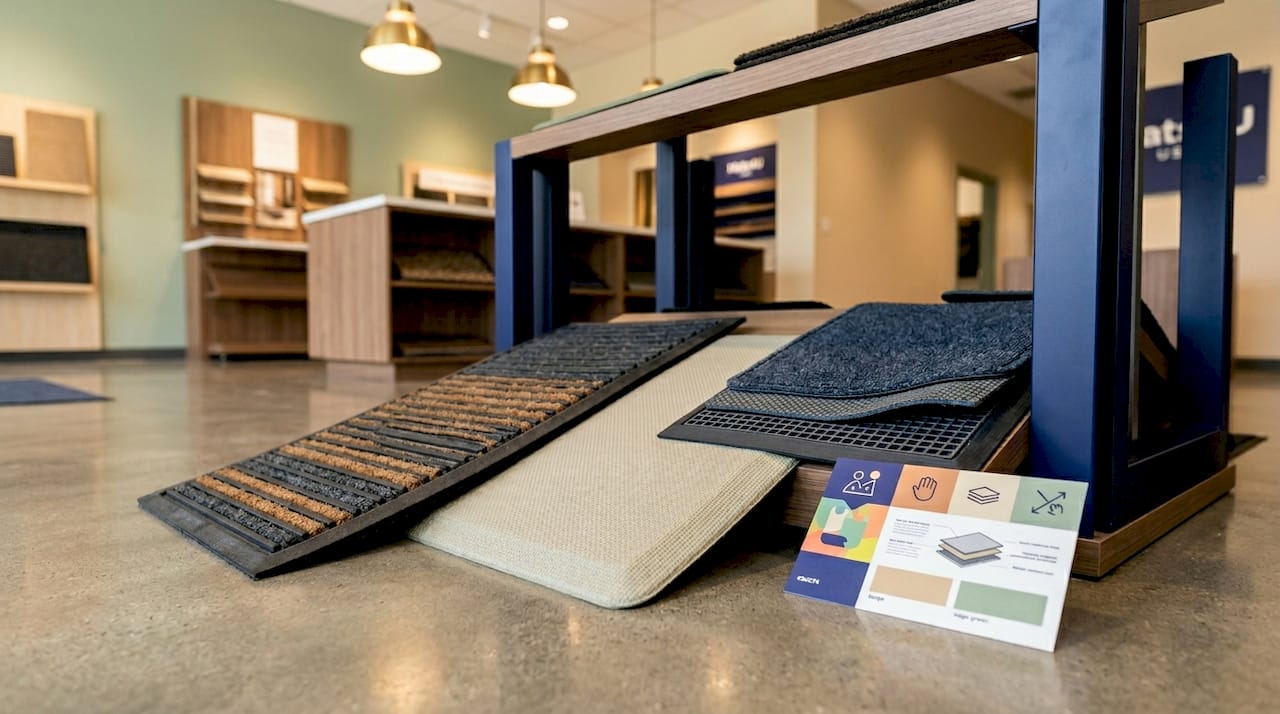
Scraper mats sit at exterior entry points and remove heavy debris, gravel, mud, and coarse dirt from shoe soles before anyone crosses the threshold. They are typically constructed from rigid rubber, aluminum, or coarse synthetic fibers. The WaterHog line from Mats4u is a well-known example of a high-performance scraper-wiper hybrid built for high-traffic commercial entrances.
Wiper mats handle the second stage of entry protection. After a scraper mat removes coarse debris, a wiper mat absorbs residual moisture and fine dust. Carpeted Berber mats and polypropylene fiber mats fall into this category. They work best in dry-to-moderate traffic zones directly inside the entrance.
Bi-level mats combine scraping and wiping in a single product. The raised surface scrapes debris while the lower channels trap and hold it below foot level. These are practical for facilities with limited floor space at entry points.
Anti-fatigue mats reduce leg and back stress during all-day standing and often feature cushioned cores and beveled edges to improve safety and comfort in wet or greasy industrial environments. They are standard in commercial kitchens, assembly lines, and retail checkout counters.
Drainage mats, also called flow-through mats, allow liquids to pass through an open grid structure to the floor below. They keep workers elevated above standing water in wet processing areas, commercial dishwashing stations, and pool decks.
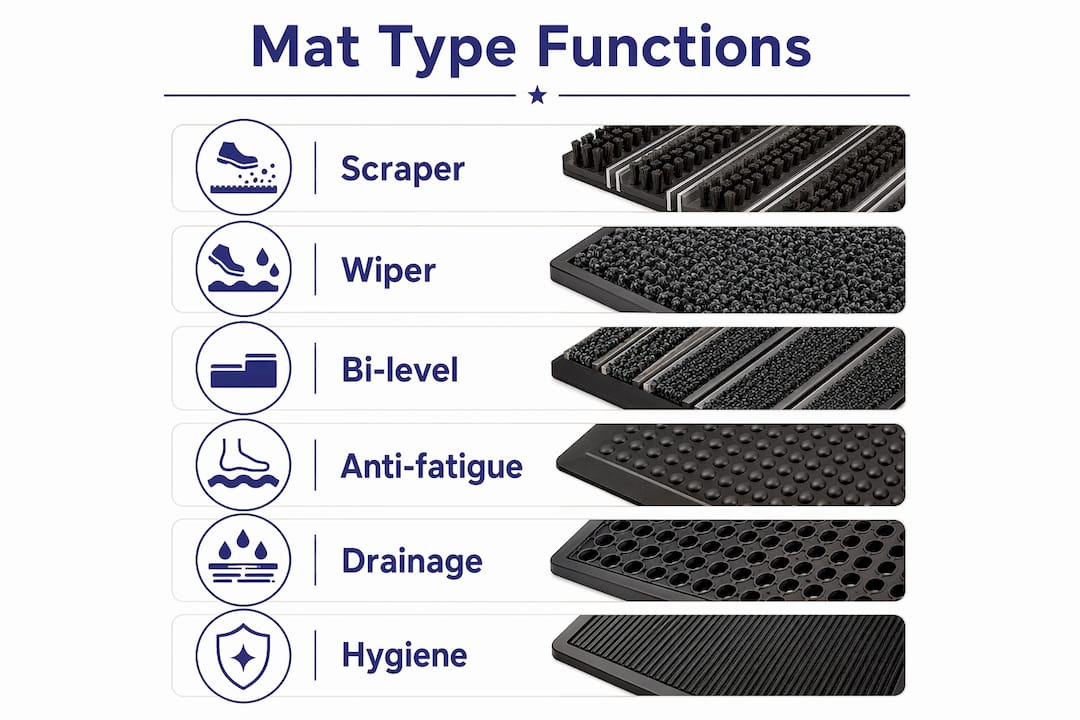
Hygiene mats are a specialized category used in healthcare, food processing, and cleanroom environments. ERGOMAT Hygiene Nitrile Floor Mats are made from nonporous synthetic EPDM rubber and withstand caustic disinfectants and steam cleaning, with color-coded options to separate zones and prevent cross-contamination.
Pro Tip: Never use a standard anti-fatigue mat in a wet commercial kitchen. Without drainage holes, the mat surface becomes saturated and creates a slip hazard that defeats its own purpose.
How do commercial floor mats meet slip resistance standards?
Slip resistance is the most regulated performance attribute in commercial matting, and the governing standard is ANSI A326.3. ANSI A326.3 requires a minimum DCOF of 0.42 for level interior surfaces when wet, measured using the BOT-3000E tribometer. For ramps and sloped surfaces, the threshold rises to 0.50 DCOF. These numbers are not suggestions. They are the compliance floor for any mat or hard surface flooring installed in a commercial space.
DCOF stands for Dynamic Coefficient of Friction. It measures the resistance between a moving foot and a surface under wet conditions. A mat that scores below 0.42 DCOF wet is a documented liability in any slip-and-fall claim. Specifying mats by slip resistance measured with recognized standards prevents relying solely on marketing claims, which directly reduces facility liability.
Beveled edges are the second safety variable most managers overlook. A mat with a high DCOF score but abrupt vertical edges still creates a tripping hazard at the perimeter. Certified commercial mats include tapered bevels, typically at a 20-degree angle, to transition smoothly from mat surface to floor level.
“Selecting a mat based on DCOF test data rather than product descriptions is the difference between documented compliance and assumed safety.” — Walkway Management Group
Comfort Flow mats, for example, are ASTM tested with a dry COF of 1.00 and wet COF of 0.91, which significantly exceeds the ANSI A326.3 minimum. That margin matters in foodservice and industrial environments where floors are routinely wet with oils and cleaning chemicals.
How to choose the right commercial floor mats for your facility
Selecting the correct mat starts with four variables: traffic volume, surface type, environmental conditions, and zone-specific hazards. Work through each one before specifying a product.
-
Assess traffic volume. High-traffic entrances, such as hospital lobbies or retail stores with over 500 daily visitors, require mats with dense fiber construction or rigid rubber surfaces that hold up to continuous compression. Lighter office environments can use standard Berber or carpeted wiper mats without accelerated wear.
-
Identify the surface type. Smooth polished concrete and vinyl composition tile (VCT) require mats with non-slip rubber backing to prevent migration. Textured concrete or epoxy floors may allow lighter backing options. A mat that slides on your floor is more dangerous than no mat at all.
-
Map environmental conditions. Wet zones, including commercial kitchens, restrooms, and loading docks exposed to rain, require mats with drainage capability or materials that resist moisture saturation. Anti-fatigue mats designed for wet environments must integrate flow-through drainage to remain safe during standing workflows.
-
Match mat type to facility zone. Exterior entries need scraper mats. Interior vestibules need wiper or bi-level mats. Workstations where employees stand for extended periods need anti-fatigue mats. Restrooms and wet processing areas need drainage mats. Healthcare and food prep zones need hygiene-rated mats with chemical resistance.
Pro Tip: Walk your facility with a zone map and assign a mat category to each area before purchasing. Buying mats by zone rather than by product line prevents mismatches and reduces total cost.
For industrial settings, understanding where anti-fatigue mats can be used across different workplace zones helps managers avoid placing comfort-only mats in areas that require drainage capability.
Chemical resistance is a non-negotiable specification in food processing, pharmaceutical, and janitorial supply areas. Rubber mats degrade when exposed to petroleum-based solvents. Nitrile rubber mats resist oils and most cleaning chemicals. Vinyl mats handle mild chemical exposure but are not rated for heavy industrial use.
Comparing commercial floor mat materials
The material determines durability, maintenance requirements, and suitability for specific environments. The table below summarizes the five most common commercial mat materials.
| Material | Best use case | Key advantage | Key limitation |
|---|---|---|---|
| Natural rubber | Exterior and heavy-traffic entrances | Excellent traction, resists UV and temperature extremes | Degrades with petroleum-based chemicals |
| Nitrile rubber | Kitchens, labs, industrial workstations | Chemical and oil resistance, anti-fatigue capable | Higher cost than standard rubber |
| Polypropylene | Interior wiper mats, office entrances | Moisture absorption, easy to clean | Not suitable for heavy outdoor use |
| Vinyl (PVC) | Drainage mats, wet areas | Lightweight, open-grid drainage | Lower durability under heavy compression |
| Coir (natural fiber) | Low-traffic exterior entries | Biodegradable, effective coarse scraping | Absorbs moisture, degrades faster outdoors |
Rubber molded mats resist moisture, chemicals, UV, and temperature extremes and are easy to clean by hosing down, making them the default choice for harsh commercial environments. They do not degrade in deicing chemicals or road salt, which is a critical factor for northern climates with winter entry traffic.
Nitrile rubber is the premium option for any zone where oils, greases, or industrial cleaning agents are present. Comfort Flow mats use a closed-cell nitrile rubber foam core with drainage holes and beveled edges, combining anti-fatigue cushioning with wet-area safety in a single product. They are also launderable for oil and grease removal, which extends service life significantly.
Coir mats are the one natural fiber option with genuine commercial application. Their coarse texture scrapes heavy debris effectively at low-traffic exterior entries, such as side doors or employee entrances. Their limitation is moisture retention. A saturated coir mat becomes a slip hazard and a mold risk, so they require more frequent replacement in high-rainfall climates.
In hygiene-critical environments, mat selection includes chemical resistance and ease of cleaning as part of infection control alongside slip resistance and comfort. ERGOMAT mats, for instance, resist disinfectants across a pH range of 1 to 13.5, covering virtually every hospital-grade cleaning agent in use today.
Key takeaways
Matching commercial floor mat types to specific facility zones, traffic levels, and environmental conditions is the single most effective way to reduce slip liability and extend mat service life.
| Point | Details |
|---|---|
| Function drives selection | Choose mat type by zone function first: scraper, wiper, anti-fatigue, drainage, or hygiene. |
| ANSI A326.3 is the compliance standard | Require a minimum 0.42 DCOF wet rating for all interior commercial mats. |
| Material determines durability | Nitrile rubber handles chemicals and wet areas; polypropylene suits dry interior zones. |
| Wet zones need drainage, not just cushioning | Anti-fatigue mats without drainage holes create slip risks in kitchens and industrial floors. |
| Hygiene mats are infection control tools | In healthcare and food processing, mats must resist high-pH disinfectants and steam cleaning. |
What facility managers consistently get wrong about mat selection
Most mat purchasing decisions I see are driven by price per unit and visual appearance. Both are the wrong starting criteria. A mat that looks good in a lobby but lacks a certified DCOF rating is a liability document waiting to be filed. A cheap anti-fatigue mat placed in a commercial kitchen without drainage holes will cause a slip incident within months.
The more useful framework is to treat each facility zone as a distinct safety specification. A hospital entrance, a restaurant prep line, and a manufacturing workstation each require a different mat type, a different material, and a different maintenance schedule. Combining mat types across zones is not over-engineering. It is the standard practice in any facility that has done a proper safety audit.
Maintenance is the variable that most managers underestimate. A high-quality rubber entrance mat that is never cleaned accumulates compacted debris in its surface channels and loses scraping effectiveness within a season. Nitrile mats that are launderable, like the Comfort Flow line, hold their performance longer because the cleaning method matches the material. Specifying a mat without specifying its cleaning protocol is an incomplete decision.
The other overlooked factor is color coding in multi-zone facilities. Color-coded hygiene mats manage infection control workflows by limiting cross-contamination between zones. This practice, standard in hospital and food processing environments, is directly transferable to any facility where different zones carry different contamination risks.
— Werner
Find the right commercial mats at Mats4u
Mats4u carries the full range of commercial mat types covered in this guide, from high-traffic entrance mats to specialty anti-fatigue and drainage solutions. The WaterHog Max Herringbone Mat delivers superior debris scraping and moisture control for demanding entry points. For workstations in wet or greasy environments, the Comfort Flow drainage mat combines nitrile rubber cushioning with flow-through drainage to meet both comfort and safety requirements. Facilities looking to reinforce branding at entry points can configure a custom logo mat with HD printing and commercial-grade construction. Free delivery applies to orders over $100, and all products are Made in the USA.
FAQ
What are the main commercial floor mat types?
The main types are scraper mats, wiper mats, bi-level mats, anti-fatigue mats, drainage mats, and hygiene mats. Each is designed for a specific zone and function within a commercial facility.
What slip resistance rating should commercial mats meet?
ANSI A326.3 requires a minimum DCOF of 0.42 for level interior surfaces when wet and 0.50 for ramps. Any mat specified for a wet commercial area should meet or exceed these thresholds.
Can anti-fatigue mats be used in commercial kitchens?
Standard anti-fatigue mats without drainage holes are not safe for commercial kitchens. Wet-area anti-fatigue mats must include flow-through drainage to prevent liquid accumulation and slip risk on the mat surface.
What mat material works best for chemical-heavy environments?
Nitrile rubber is the standard material for zones with oils, greases, and industrial cleaning agents. ERGOMAT and Comfort Flow nitrile mats are rated for chemical resistance and withstand steam cleaning and high-pH disinfectants.
How often should commercial floor mats be replaced?
Replacement frequency depends on traffic volume, material, and maintenance. Rubber and nitrile mats cleaned on a regular schedule typically last several years in heavy-traffic environments. Coir and polypropylene mats in high-moisture zones require more frequent replacement due to fiber degradation.


