


TL;DR:
- Most procurement officers assume thicker mats are more durable, but factors like fiber density and construction quality truly determine longevity. Proper maintenance, moisture control, and certification standards are essential for extending mat service life in high-traffic environments. Selecting mats based on detailed specifications improves performance, safety, and cost-efficiency over their full service life.
Most procurement officers assume a thicker mat is a more durable mat. That assumption is costing facilities real money. The actual durability factors for mats run deeper than thickness or face weight. They include fiber density, construction method, backing material, environmental exposure, and maintenance discipline. Get any one of these wrong in a high-traffic commercial setting, and you are replacing mats far sooner than budgeted. This guide breaks down what genuinely drives mat longevity, so you can specify, purchase, and maintain mats that perform across their full service life.
Key takeaways
| Point | Details |
|---|---|
| Fiber density beats face weight | Dense fibers resist crushing and matting in heavy-use areas far better than raw weight alone. |
| Subfloor moisture is a hidden threat | Saturated mats degrade slip resistance and accelerate structural failure if the surface beneath is not dried first. |
| Material choice drives lifespan | Rubber, nylon, and EVA each carry different wear profiles suited to specific commercial applications. |
| Maintenance is a durability factor | Regular cleaning, drying cycles, and timely replacement directly extend functional mat life. |
| Certifications and testing matter | ANSI/NFSI and ASTM standards confirm whether a mat actually performs under real commercial conditions. |
Core durability factors for mats: materials and construction
The foundation of any durability discussion is material selection and how a mat is built. These two variables determine everything that follows. The industry term for evaluating long-term performance is mat serviceability, and it encompasses both the raw material’s wear profile and the construction method used to assemble it.
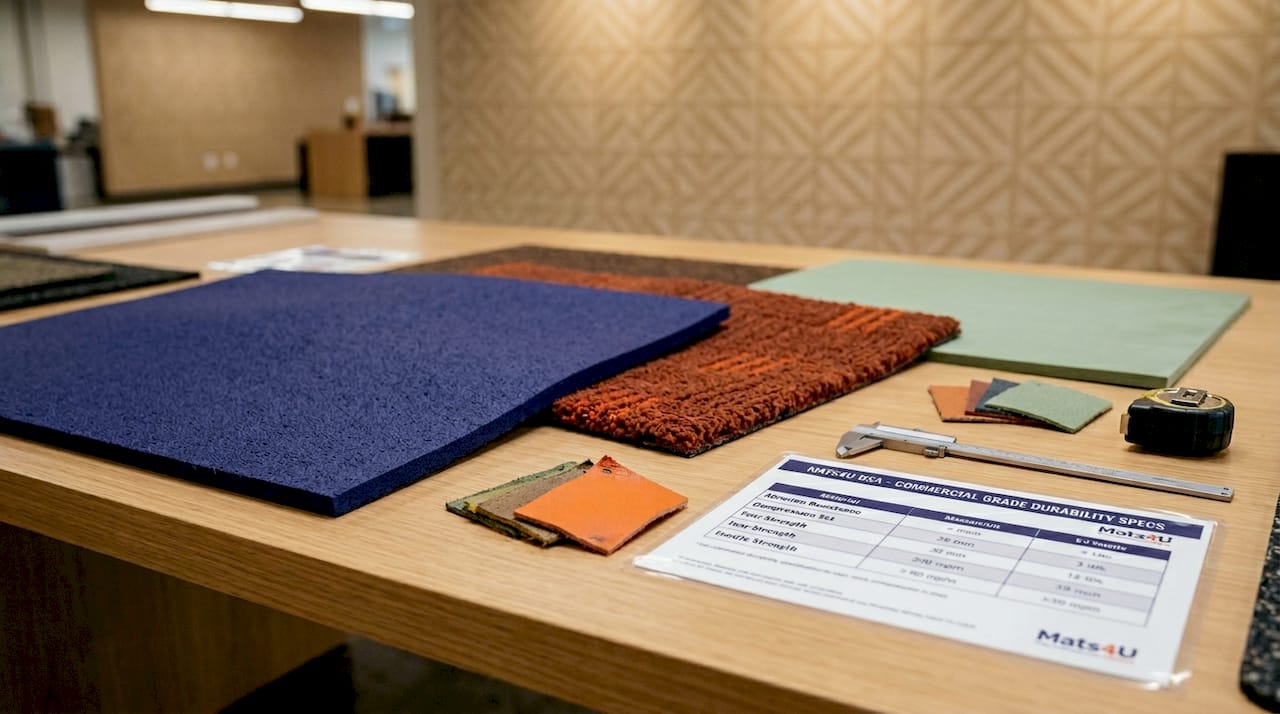
Material types and their wear profiles
Rubber mats are the workhorses of commercial environments. They resist abrasion, handle moisture, and hold their form under sustained foot traffic. Solid rubber and recycled rubber compounds differ in density and chemical resistance, but both outperform foam-based alternatives in sheer longevity for entrance and industrial applications.
Nylon fiber mats used in carpet-style entrance matting carry their own durability logic. Fiber density is the most critical factor for performance in high-traffic areas. Dense fibers support each other laterally, which prevents the crushing and matting that renders a carpet mat visually and functionally degraded within months of installation. Face weight, the metric most often cited in product specs, tells you how much fiber is present by weight. It does not tell you how tightly packed those fibers are. Two mats can share identical face weights but differ dramatically in density, and the denser one will outlast the other significantly.
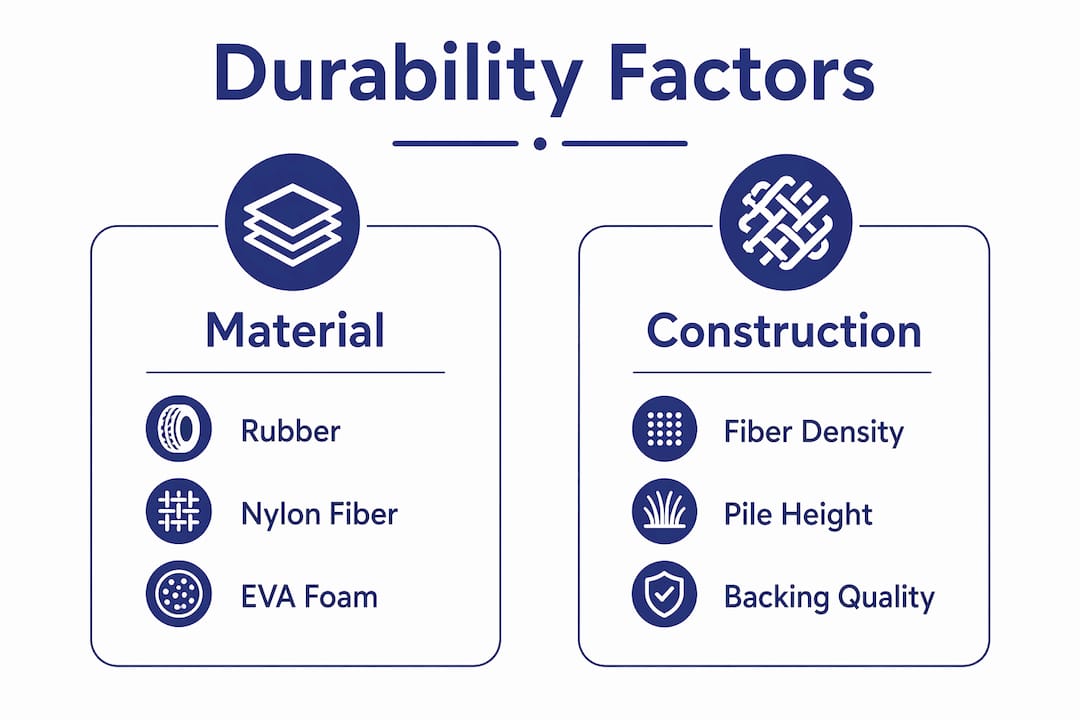
EVA (ethylene-vinyl acetate) mats are increasingly common in commercial gyms, sports facilities, and industrial workstations. High-density EVA mats offer enhanced elasticity and shock absorption for high-intensity commercial use, with advanced compound foaming technology improving both lifespan and safety ratings.
Construction quality: twist, pile height, and backing
For textile mats, two construction details matter more than most buyers realize. First, fiber twist. High twist levels in carpet fibers resist what manufacturers call “blossoming,” where individual fiber strands separate and fray under foot traffic. Heat-setting locks the twist at a molecular level, locking in that structural resistance for the mat’s full service life.
Second, pile height interacts with density to determine how a mat handles abrasion over time. A taller pile with low density compresses and stays compressed. A shorter, denser pile rebounds. For commercial entrances and corridors, a shorter pile height combined with high density is almost always the better specification.
Pro Tip: When reviewing product specs, ask suppliers for the stitch count or tuft density per square inch alongside the face weight. That single number tells you more about long-term wear resistance than any marketing claim.
| Material | Wear resistance | Moisture handling | Best application |
|---|---|---|---|
| Solid rubber | High | Excellent | Entrances, industrial floors |
| Nylon fiber | Medium to high | Good with drainage backing | Lobbies, corridors |
| EVA foam | Medium | Moderate | Gyms, workstations |
| Berber carpet | Medium | Low without treatment | Low-traffic interior areas |
| Recycled rubber | Medium to high | Good | Service areas, outdoor transitions |
Environmental and usage factors that shorten mat life
Even the best-constructed mat fails early when deployed in the wrong conditions or managed poorly. Understanding mat longevity factors means accounting for what happens after installation.
Foot traffic intensity is the most obvious variable. Abrasion from grit and debris tracked onto a mat acts like sandpaper on fiber and surface coatings. Entrances near parking lots or construction zones see significantly higher abrasive load than interior corridors. Mats in those positions need more aggressive fiber density and more frequent cleaning intervals to maintain mats wear resistance over time.
Moisture is the factor most facilities underestimate. A mat saturated from heavy rain or spills does not just become a slip hazard. It becomes a subfloor problem. Wet-through saturation causes subfloor moisture that accelerates loss of slip resistance and triggers structural failure in the mat’s backing and fiber system. The correct protocol is to remove the mat, dry the floor surface completely, and then reinstall or replace the mat. Skipping the drying step and placing a dry mat over a wet floor simply delays the same failure.
Beyond moisture, environmental exposure to heat, UV radiation, and chemicals degrades mat materials and shortens functional lifespan. This applies to outdoor transition mats and any mat near loading docks, chemical storage, or cleaning stations.
Common causes of premature environmental damage:
- Inadequate mat length for the traffic volume at an entrance, causing dirt saturation too quickly
- Mats placed directly over wet or uneven subfloors without drying
- Chemical cleaning agents incompatible with the mat’s fiber or backing material
- Direct UV exposure for mats not rated for outdoor or near-window placement
- Insufficient drying time between cleaning cycles, especially in humid facility zones
Pro Tip: Schedule mat rotation and deep cleaning based on seasonal traffic peaks, not fixed calendar dates. A building entrance in a northern climate during winter needs a two-week cleaning cycle, not a monthly one.
How to evaluate and choose durable mats for commercial spaces
Knowing the technical factors is one thing. Translating them into a procurement decision is another. Here is a structured approach for specifying mats by durability when the stakes are high.
-
Define the traffic load category. Classify each mat location as light (under 500 people per day), medium (500 to 2,000), or heavy (over 2,000). This immediately narrows your material options and rules out underspec’d products.
-
Specify density, not just weight. For textile mats, request tuft density per square inch or ounces per square yard alongside face weight. Prioritize density for any location with sustained directional traffic like corridors or entry vestibules.
-
Evaluate backing materials. Rubber backing resists curling and provides anti-slip performance on hard floors. Vinyl backing offers moisture resistance but can degrade faster under thermal cycling. Specify the backing type based on subfloor material and expected moisture exposure.
-
Check anti-slip certification. ANSI/NFSI and ASTM standards confirm contamination removal performance and surface friction ratings. A mat without third-party test data is an assumption, not a specification.
-
Request warranty terms in writing. A five-year warranty against delamination or backing failure signals the manufacturer has confidence in the construction. Warranty exclusions often reveal exactly which conditions will kill the mat early.
-
Calculate total cost of ownership. A mat priced 40 percent lower that needs replacement twice as often is not a saving. Factor in labor for removal, cleaning, and reinstallation. The impact on mat lifespan from a higher upfront cost is often recovered within the first replacement cycle.
-
Ask about application-specific options. Kitchen mats need grease resistance. Gym mats need shock absorption and rebound. Entrance mats need aggressive water and dirt capture. A mat optimized for one environment will underperform in another.
For facilities with complex procurement requirements, the resource on how to choose durable mats for high-traffic areas provides additional specification guidance organized by mat category.
Mat type comparison: durability features by application
Not all mat types age at the same rate or in the same way. Understanding the durability profile of each category helps match the right product to the right environment.
Durability failures commonly include abrasion wear at the surface, edge tearing, and compression-set flattening in foam layers. These failure modes vary by material and are directly tied to use intensity, cleaning method, and storage conditions. Rubber mats fail primarily through surface abrasion and chemical degradation. Carpet-style mats fail through fiber crushing and backing delamination. EVA mats fail through compression set, where the foam loses its ability to rebound.
One underutilized feature worth specifying in high-use zones: reversible mat designs. Reversible mat designs can effectively double mat service life by distributing wear evenly across both surfaces. Commercial EVA mats frequently offer this feature with dual-color or dual-texture configurations.
| Mat type | Primary failure mode | Average commercial lifespan | Reversible option | Chemical resistance |
|---|---|---|---|---|
| Solid rubber | Surface abrasion | 5 to 10 years | No | High |
| Nylon carpet | Fiber crushing, delamination | 3 to 7 years | No | Low to medium |
| EVA foam | Compression set | 2 to 5 years | Yes | Medium |
| Waterhog (polypropylene) | Edge wear | 4 to 8 years | No | Medium to high |
| Berber carpet | Fiber matting | 2 to 4 years | No | Low |
Safety and compliance considerations run parallel to durability. A mat that has worn past its slip-resistance threshold is a liability, not just an aesthetic issue. Build replacement triggers into your facility maintenance schedule based on measured friction performance, not appearance alone.
What I have learned about mat longevity after years in the field
I have reviewed a lot of mat specifications and seen a lot of premature failures. The pattern is consistent. Facilities focus on price and visual thickness during procurement, then wonder why mats are failing at 18 months in locations that should support five years of use.
The single most underestimated durability variable in my experience is subfloor moisture management. Facilities will spend money on a quality mat and then place it directly over a wet entrance floor after a cleaning cycle. Within weeks, the backing begins to degrade, slip resistance drops, and the mat edges curl. The fix is simple but rarely practiced: dry the floor before reinstalling the mat every single time.
I have also seen facilities over-rely on face weight as a purchasing shortcut. Marketing materials push that number because it sounds like a quality indicator. In practice, fiber density and twist count matter far more for actual wear performance. A mat with high face weight and low density will look good in a catalog and disappoint in a corridor.
My practical advice: build a mat specification sheet for your facility that includes density, backing type, tested friction rating, and a cleaning protocol tied to that specific mat type. Treat mat replacement as a scheduled maintenance event, not a reactive one. Facilities that do this extend mat service life significantly and reduce total annual matting costs.
— Werner
Mats4U: durable mats built for commercial demands
When the procurement decision is ready, Mats4U offers commercial-grade matting that aligns directly with the durability specifications covered here. The premium custom floor mats combine high-definition branding with construction built for heavy daily use, including dense fiber surfaces and rubber backing rated for commercial entrances. For workstations where standing time is extended, the Cushion Complete anti-fatigue mat delivers long-lasting comfort with a surface engineered to resist compression set over years of use. For building entrances, the WaterHog Max Grand handles aggressive moisture and dirt capture with polypropylene fibers designed for extended commercial service. All products ship free on orders over $100, and Made in the USA construction means consistent quality control from material to finished product.
FAQ
What is the most important durability factor in commercial mats?
Fiber density is the most critical construction variable for textile mats, as dense fibers resist crushing under sustained foot traffic. For rubber and EVA mats, compound density and backing integrity determine how long the mat holds its structure.
How often should commercial mats be replaced?
Replacement intervals depend on traffic load and mat type. High-traffic entrances may need replacement every two to four years, while lower-traffic interior mats can last five to seven years with proper cleaning and maintenance.
Does mat thickness equal mat durability?
No. Thickness indicates cushion depth but does not predict wear resistance or lifespan. A thinner mat with high fiber density and quality backing will typically outlast a thicker mat with loose fiber construction.
How does moisture affect mat lifespan?
Moisture saturation beneath a mat accelerates backing degradation and reduces slip resistance, leading to premature structural failure. Removing mats and drying the subfloor before reinstallation is necessary to preserve both safety and mat longevity.
What certifications should I look for when buying commercial mats?
Look for mats tested to ANSI/NFSI and ASTM standards, which verify slip resistance and contamination removal performance under real-use conditions. These certifications confirm the mat meets defined safety and durability thresholds, not just manufacturer claims.


