


TL;DR:
- Waterhog mats have a bi-level surface and water dam border to trap debris and moisture effectively.
- They last up to five years, reducing replacement costs and maintenance efforts.
- Proper placement and routine cleaning maximize safety and contamination control in high-traffic facilities.
Floor cleanliness in commercial facilities is a bigger operational challenge than most managers expect. A single busy entryway can track in pounds of dirt and moisture every hour, overwhelming standard mats within minutes. Basic entry mats absorb surface moisture but lack the structural capacity to hold debris below foot level, spreading contamination further into the building. Waterhog mats capture more dirt and water than traditional mats due to their advanced surface design, making them the preferred choice for facility managers who need reliable, measurable results at every entry point. This article covers construction, key features, maintenance, and deployment strategy.
Table of Contents
- The anatomy of Waterhog mats: Materials and design explained
- Key features: How Waterhog mats trap moisture and dirt
- Durability and maintenance: Long-term value in high-traffic areas
- Practical deployment: Maximizing safety and cleanliness in commercial facilities
- Our take: Why Waterhog mats really matter for facility managers
- Discover Waterhog solutions for your facility
- Frequently asked questions
Key Takeaways
| Point | Details |
|---|---|
| Superior debris control | Waterhog mats use innovative bi-level surfaces to capture dirt and water before they reach facility floors. |
| Lasting durability | With robust PET and rubber construction, these mats can outperform and outlast generics by several years. |
| Lower maintenance costs | Properly deployed Waterhog mats reduce slip risk and cleaning time, improving overall ROI. |
| Strategic deployment matters | Using Waterhog mats within a three-zone entrance system removes up to 90% of dirt and moisture. |
The anatomy of Waterhog mats: Materials and design explained
Now that we’ve set the context for the challenge of high-traffic entryways, let’s break down what makes Waterhog mats effective from the inside out.
The performance of a Waterhog mat starts with its construction. Every component serves a specific function, and understanding each one helps you make a more informed purchasing decision for your facility.
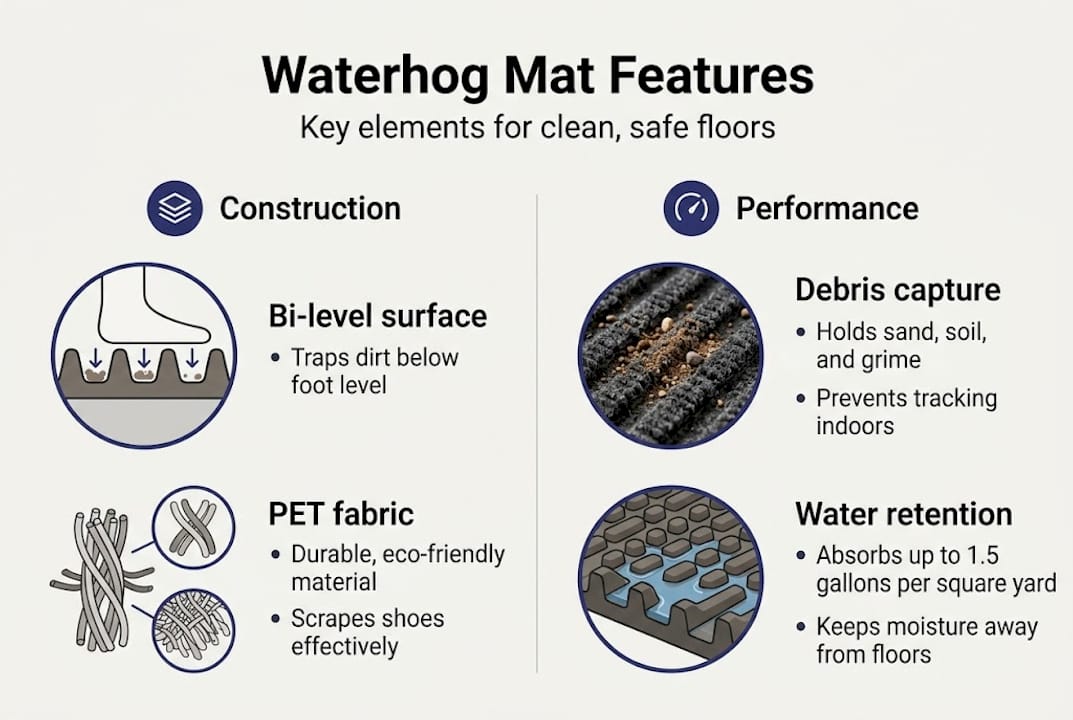
Waterhog mats feature a bi-level surface with PET fabric and rubber nubs that capture debris below shoe level. This means dirt and grit fall into the channels between raised nubs rather than sitting on the surface where foot traffic can spread it. The result is a mat that actively removes contaminants from shoe soles rather than simply covering the floor beneath them.
The fabric itself is a critical component. Solution-dyed PET fabric is hydrophobic, fade-resistant, and contains recycled content, making it both durable and environmentally responsible. Solution dyeing means color is locked into the fiber during production, not applied afterward, so the mat resists fading even under heavy UV exposure or repeated washing.
Here is a breakdown of the core material components:
| Component | Material | Primary function |
|---|---|---|
| Surface fabric | Solution-dyed PET | Scrapes and wicks moisture |
| Raised nubs | Rubber | Traps debris below shoe level |
| Backing | Rubber | Prevents slipping and moisture seepage |
| Border | Rubber dam | Contains water runoff |
Key design advantages include:
- Bi-level surface scrapes debris from shoe soles on contact
- Deep channels between nubs hold captured dirt and water
- Rubber nubs keep debris below foot level, preventing redistribution
- Rubber backing is impermeable, stopping moisture from reaching the subfloor
- Tested construction is rated for crush, burn, and stretch resistance
“The bi-level design is what separates Waterhog mats from flat-surface alternatives. Debris has nowhere to go but down into the channels, away from foot traffic.”
For facilities already using heavy duty rubber mats, Waterhog mats complement that infrastructure by adding a scraping and wicking layer at the entry point. The combination addresses both surface contamination and moisture penetration in a single product.
Key features: How Waterhog mats trap moisture and dirt
Understanding materials is just the first step. Let’s see how these elements actually function in busy environments.
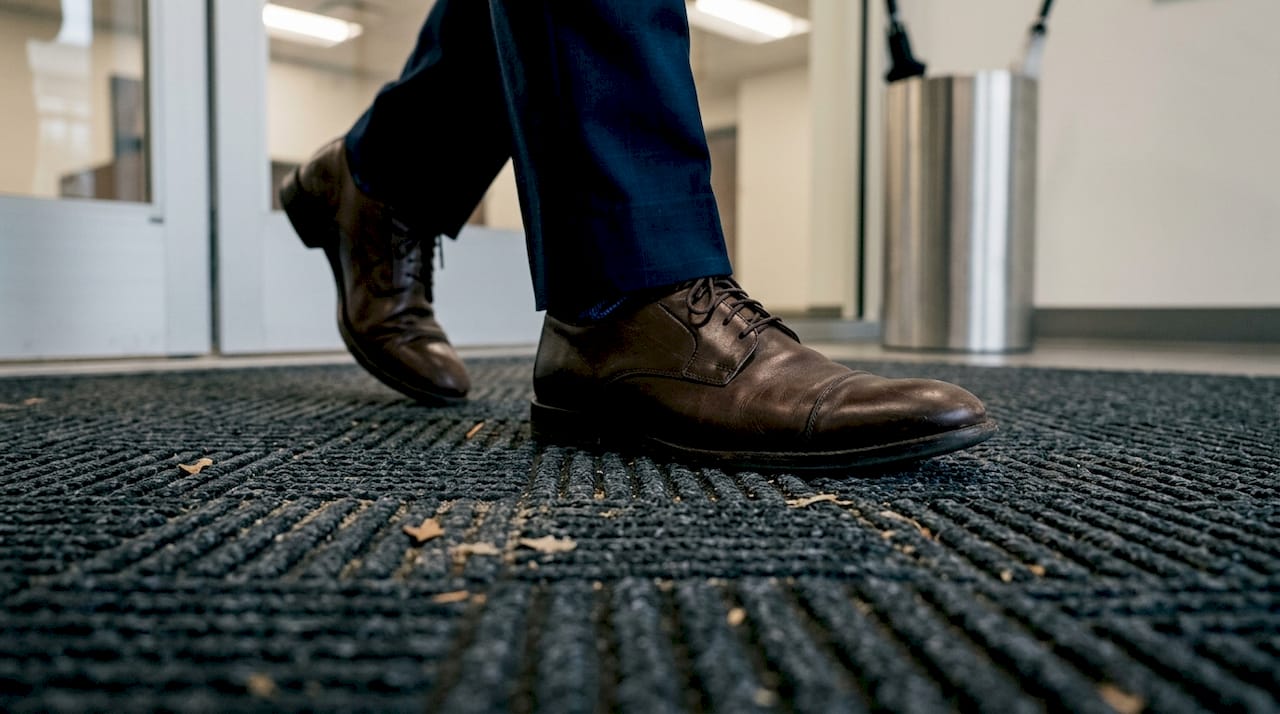
The bi-level scraping action is the first line of defense. As a person walks across the mat, the raised nubs create friction against the shoe sole, dislodging dirt, grit, and moisture. Those particles fall into the deep channels and stay there, held below the surface where they cannot be tracked further into the building.
The water dam border is one of the most operationally significant features. The raised water dam border holds 1 to 1.5 gallons per square yard, blocking runoff from reaching surrounding flooring. In a rainy or snowy season, this feature alone can prevent significant floor damage and reduce slip incidents near entry points.
| Feature | Waterhog mat | Standard entry mat |
|---|---|---|
| Water retention | 1 to 1.5 gal/sq yd | Minimal |
| Debris capture | Below shoe level | Surface only |
| Traction certification | NFSI high-traction | Varies |
| Backing | Impermeable rubber | Often fabric or thin foam |
| Lifespan | Up to 5 years | 12 to 18 months |
Rubber backing prevents mat creep and the mat is NFSI certified for high-traction performance. NFSI stands for the National Floor Safety Institute, and their certification confirms the mat meets measurable standards for slip resistance in wet conditions. This is a direct liability consideration for any facility manager responsible for visitor safety.
Pro Tip: Place your Waterhog mat so the water dam border faces the direction of incoming foot traffic. This positions the highest containment zone at the point of first contact, maximizing moisture capture before it reaches your interior flooring.
For a broader view of how mats fit into your overall flooring options for commercial spaces, or if you need guidance on choosing the best floor mat for a specific zone, those resources provide additional context for building a complete entry system.
“NFSI certification is not a marketing label. It is a third-party verified measurement of traction performance under wet conditions, directly relevant to slip-and-fall liability.”
Durability and maintenance: Long-term value in high-traffic areas
Effective mat performance is only as good as the routine put in place. Let’s turn to durability and practical upkeep.
Waterhog mats last up to 5 years with proper maintenance, compared to generic mats that typically require replacement every 12 to 18 months. That difference compounds quickly across a multi-entry facility. If you are replacing cheap mats three times over five years, you are spending more in total cost than a single Waterhog mat would have required.
The performance gap is measurable. Waterhog mats capture 30% more dirt and have 40% greater lifespan than major competitors, while retaining over a gallon of water per square yard. Those numbers translate directly into reduced cleaning labor, fewer floor refinishing cycles, and lower slip-and-fall incident rates.
A practical maintenance routine for high-traffic facilities:
- Vacuum daily to clear accumulated debris from the channels before it compacts
- Rotate mats at regular intervals to distribute wear evenly across the surface
- Shake or hose down the mat weekly to flush out fine particles from the bi-level channels
- Machine wash or pressure wash monthly depending on traffic volume
- Inspect the backing quarterly for signs of cracking or separation
- Replace when fibers flatten and no longer provide effective scraping action
Pro Tip: Keep a spare mat in rotation. While one mat is being cleaned, the replacement goes down immediately. Leaving an entry point unprotected, even for a few hours during peak traffic, can undo days of floor maintenance.
For detailed guidance, the mat maintenance tips resource covers commercial-specific schedules, and the mat maintenance best practices guide addresses safety and longevity considerations together. Both are useful references for building a formal maintenance protocol.
Reduced slip-and-fall liability is another measurable benefit. Facilities with properly maintained, NFSI-certified entry matting demonstrate due diligence in floor safety, which matters in insurance assessments and incident documentation.
Practical deployment: Maximizing safety and cleanliness in commercial facilities
With a maintenance plan in place, let’s see how you can combine strategic mat placement and product selection to maximize safety and return on investment.
The most effective entry systems use a three-zone approach. Deploy in 3-zone systems covering 15 feet, using a scraper zone, a wiper zone, and a dry zone, to remove 80 to 90 percent of dirt and moisture before it reaches interior flooring. Waterhog mats are best suited for the scraper and wiper zones, where their bi-level surface and water dam border deliver the most impact.
Here is how to structure the three zones:
- Zone 1 (scraper): Coarse outdoor mat positioned at the exterior entry to remove heavy debris and mud
- Zone 2 (wiper/absorber): Waterhog mat positioned at the interior threshold to capture remaining moisture and fine particles
- Zone 3 (dry): Interior mat or carpet zone to catch any residual moisture before it reaches the main floor
Vacuuming daily and rotating mats within this system keeps each zone performing at capacity. A zone that is saturated or compacted with debris stops functioning as a barrier and starts functioning as a contamination source.
Waterhog mats excel in extreme weather conditions but are less suitable for very low-traffic spaces where budget options may suffice. If your facility sees fewer than 50 people per day through a given entrance, a standard mat may be adequate. For anything above that threshold, especially in climates with heavy rain, snow, or road salt, Waterhog mats are the operationally sound choice.
For facilities in cold climates, road salt and ice melt chemicals are a specific concern. Standard mat materials degrade quickly under salt exposure. Waterhog’s rubber construction and solution-dyed PET fabric resist chemical breakdown, maintaining structural integrity through winter seasons. When selecting the right mat for your business, factor in your local climate and peak traffic periods to determine the correct mat size and zone configuration.
Our take: Why Waterhog mats really matter for facility managers
Having covered the details and practical applications, here is our candid perspective for facilities teams considering Waterhog mats.
The most common mistake we see is treating entry matting as a commodity purchase. Managers compare price per unit and choose the lowest number. That approach ignores total cost of ownership, cleaning labor, floor refinishing, and slip-and-fall incidents, all of which are directly affected by mat quality.
Waterhog mats are not expensive mats. They are mats with a lower total cost when measured over a realistic operational period. A facility that replaces generic mats twice a year is spending more than one that purchases a Waterhog mat and maintains it properly for five years.
The sustainability factor also matters. Solution-dyed PET with recycled content aligns with procurement policies that many commercial facilities now follow. When selecting entryway mats, the combination of reliability, verified traction certification, and recyclable materials makes Waterhog a defensible choice from both an operational and compliance standpoint. Generic mats offer none of those verified performance metrics.
Discover Waterhog solutions for your facility
Ready to see how Waterhog mats can equip your business? Explore these proven solutions for every entry, exit, and workspace.
Mats4U.com stocks a full range of commercial Waterhog options designed for specific facility needs. The Waterhog Max Herringbone delivers heavy-duty performance with a distinctive pattern suited for professional environments. For facilities that want branded entry points, premium custom floor mats combine Waterhog-grade durability with custom logo printing. The Waterhog drainable border mat is built for environments where water accumulation is a primary concern. Free delivery on orders over $100 applies across the catalog, and all products are Made in the USA.
Frequently asked questions
What makes Waterhog mats different from regular entry mats?
Waterhog mats feature a bi-level surface that outperforms standard mats in dirt capture, combined with a water dam border that contains runoff rather than letting it spread. This structural difference makes them significantly more effective in high-traffic settings.
How much water can a Waterhog mat hold?
The raised water dam border contains 1 to 1.5 gallons per square yard, keeping surrounding floors dry even during heavy rain or snow tracked in by foot traffic.
How long do Waterhog mats typically last in a busy facility?
With routine maintenance, Waterhog mats last up to 5 years, which is significantly longer than generic mats that typically need replacement every 12 to 18 months.
Do Waterhog mats require special cleaning procedures?
No special equipment is needed. Routine rotation and vacuuming maximize performance and safety, with periodic washing recommended based on traffic volume and seasonal conditions.
Recommended
- Waterhog mat features: guide for high-traffic areas – Mats4U USA
- How to Clean Waterhog Mats for Businesses and Facilities – Mats4U USA
- How to Wash Waterhog Mat for Commercial Spaces – Mats4U USA
- What is a Waterhog Mat? Understanding Its Benefits – Mats4U USA
- How to install herringbone flooring for a flawless finish


