


Wet pool decks and busy locker rooms often turn into accident zones when water spreads faster than your staff can clean. For American facility managers, keeping these high-traffic areas safe and clean is a daily challenge that impacts guest satisfaction and your bottom line. Choosing the right pool floor mats means more than just protecting against slips and falls—it supports slip-resistant walking surfaces and easier maintenance for your entire operation.
Table of Contents
- What Is a Floor Mat for Pool Areas?
- Types and Materials for Pool Floor Mats
- Key Safety and Performance Features
- Regulations and Compliance in Commercial Pools
- Cost Considerations and Common Pitfalls
Key Takeaways
| Point | Details |
|---|---|
| Safety Compliance | Floor mats are essential for preventing slips and falls in wet environments, thus protecting guests and staff from injuries. |
| Material Selection | Choosing the right mat material based on specific area needs ensures durability, comfort, and slip resistance for optimal performance. |
| Regulatory Requirements | Compliance with safety standards is critical to avoid liabilities and maintain operational licenses in commercial pool facilities. |
| Cost Management | Investing in high-quality mats saves costs over time through lower maintenance needs and reduced slip-and-fall incidents. |
What Is a Floor Mat for Pool Areas?
Pool floor mats are specialized surfaces designed to prevent slips and falls in wet environments around swimming facilities. They create traction where water, chlorine, and moisture constantly threaten worker and guest safety.
At their core, these mats serve multiple critical functions for commercial leisure facilities. Slip-resistant walking surfaces protect staff and visitors from dangerous falls in high-traffic zones like pool decks, locker rooms, and shower areas.
The primary purposes include:
- Preventing slips and falls on wet, slippery surfaces
- Containing moisture and water runoff to reduce spreading
- Capturing debris, dirt, and chlorine residue before they spread indoors
- Reducing fatigue for staff standing for extended periods
- Maintaining cleanliness across your facility
Why this matters for your operation is straightforward. One slip injury can trigger liability claims, worker compensation expenses, and damage to your facility’s reputation. A single guest fall creates potential lawsuits and negative online reviews that hurt bookings.
Effective pool mats absorb and contain moisture rather than allowing water to spread across floors. This keeps surrounding areas drier and safer for foot traffic. They’re engineered from materials like closed-cell rubber, cushioned polymers, or specialized absorbent blends that resist deterioration from chlorine and UV exposure.
Unlike decorative floor coverings, commercial-grade pool mats prioritize durability and safety performance. They withstand constant foot traffic, regular hosing, chemical exposure, and harsh weather conditions without breaking down or becoming slippery themselves.
These mats also reduce your cleaning burden significantly. Instead of constantly mopping pool deck areas, mats trap moisture and particles, meaning less water and debris migrate to interior spaces. This translates to fewer cleaning hours and lower maintenance costs.
Facility managers choose pool floor mats because they address three business-critical challenges simultaneously: safety compliance, operational efficiency, and asset protection. When properly selected and positioned, they become an invisible but essential part of your risk management strategy.
Quality pool mats pay for themselves through reduced slip-and-fall incidents, lower cleaning demands, and extended floor lifespan.
Pro tip: Position mats at pool entry points, shower exits, and changing areas—these are your highest-risk zones where water concentration peaks and foot traffic is heaviest.
Types and Materials for Pool Floor Mats
Pool floor mats aren’t one-size-fits-all. Different materials serve different purposes depending on your facility’s specific needs, traffic patterns, and environmental conditions.
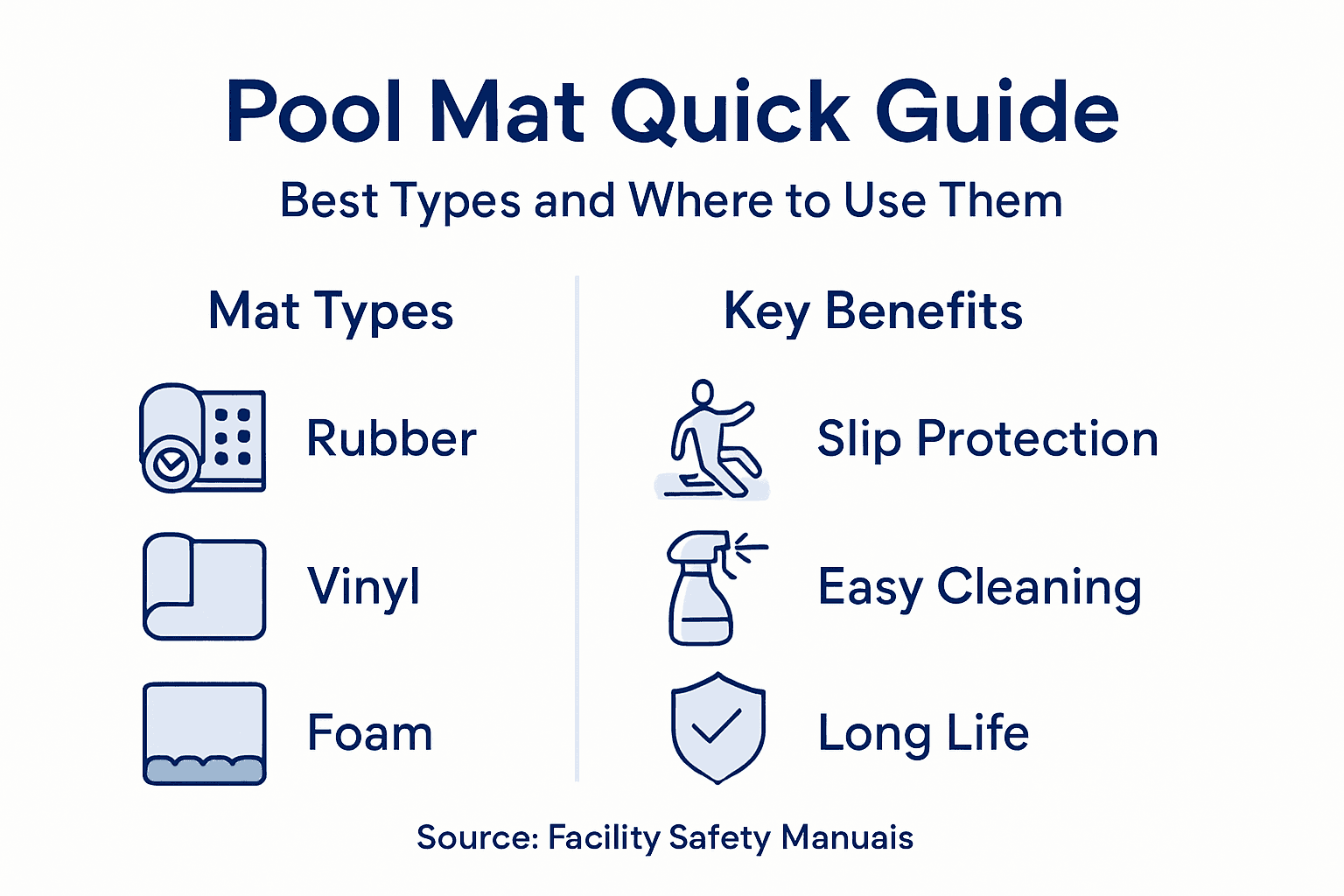
Rubber mats are the workhorse of pool environments. They deliver exceptional durability, strong slip resistance even when saturated, and simple cleaning routines. Rubber withstands constant foot traffic, chlorine exposure, and UV radiation without degrading. This makes them ideal for high-traffic pool decks where safety and longevity matter most.
Vinyl mats offer waterproof qualities that make them excellent for shower stalls and changing areas. They resist moisture penetration better than some alternatives and provide reliable traction control. Vinyl is also straightforward to sanitize and maintain.

Foam composites combine cushioning with water resistance. These specialized composite materials reduce fatigue for staff standing during extended shifts while still delivering slip prevention. They’re lighter than solid rubber, making them easier to reposition or replace.
Here’s how these materials stack up against your key priorities:
- Rubber: Maximum durability, excellent slip resistance, easiest cleaning
- Vinyl: Waterproof performance, good traction, moderate durability
- Foam composite: Superior comfort and fatigue relief, moderate durability, good slip resistance
- Hybrid blends: Combine properties like rubber base with foam cushioning for balanced performance
Material choice affects three critical factors for facility managers. First, slip resistance performance determines whether your mat prevents falls effectively. Second, durability and maintenance impact replacement frequency and operating costs. Third, comfort and ergonomics influence staff retention and productivity.
Consider your facility’s specific conditions carefully. Pool decks with intense foot traffic demand heavy-duty rubber or reinforced composites. Locker rooms benefit from cushioned vinyl or foam options. Entrance areas need maximum water absorption capacity.
Select materials based on traffic intensity, water exposure level, and specific zone purpose rather than choosing one type for your entire facility.
Many facilities use a layered approach: rubber for main deck areas, foam composites for staff zones where standing endurance matters, and vinyl for wet rooms requiring maximum waterproofing.
Pro tip: Test material samples in your actual pool environment for 2-3 weeks before committing to large orders, as chlorine levels and sun exposure vary significantly between facilities.
Below is a comparison of pool floor mat materials and their practical impacts for different pool facility zones:
| Material Type | Best Use Area | Key Advantage | Maintenance Needs |
|---|---|---|---|
| Rubber | Pool deck, entrances | High durability, slip resistance | Hose off, quick dry |
| Vinyl | Locker rooms, showers | Superior waterproof barrier | Easy sanitation |
| Foam Composite | Staff zones | Excellent comfort, fatigue relief | Wipe clean, reposition |
| Hybrid Blends | Multi-purpose zones | Balanced performance features | Moderate upkeep |
Key Safety and Performance Features
The best pool floor mats share critical safety characteristics that directly impact injury prevention and facility compliance. Understanding these features helps you make informed purchasing decisions that protect both guests and staff.
Slip resistance is non-negotiable. Mats must maintain traction even when completely saturated with water. Textured surfaces and specialized compounds grip wet shoes and bare feet, preventing dangerous slides on pool decks and in shower areas. This single feature prevents the majority of slip-and-fall incidents.
Quick-drying capabilities matter more than you might think. Mats that stay wet longer create standing water pools that become slipping hazards themselves. Quality mats drain water rapidly, reducing moisture spread to surrounding areas and minimizing mold and mildew growth.
Chemical resistance protects your investment. Pool water contains chlorine, pH adjusters, and sanitizers that degrade inferior materials. Mats engineered to withstand chemical exposure from pool disinfectants maintain performance across seasons without deteriorating or becoming slippery.
Here’s what separates quality mats from budget alternatives:
- Superior slip resistance that performs in all wet conditions
- Durable construction withstanding constant foot traffic without wearing thin
- Antimicrobial properties preventing mold, mildew, and bacterial growth
- Quick drainage keeping surfaces dry and safe
- Chemical stability resisting chlorine and sanitizer damage
- Ergonomic cushioning reducing fatigue for standing staff
Proper placement and maintenance are equally important as material quality. Even the best mat becomes a tripping hazard if edges curl or if it shifts under foot traffic. Regular cleaning prevents debris accumulation that reduces grip effectiveness.
These features work together. A mat with excellent slip resistance but poor drainage becomes ineffective when water pools on top. A durable mat that lacks antimicrobial properties develops slippery algae growth. You need all these characteristics working in combination.
Mats meeting all five performance standards deliver measurable safety improvements and longer service life, reducing your replacement costs significantly.
Pro tip: Inspect mats monthly for edge curling, drainage slowdown, or slickness buildup; replace or refresh any showing performance decline before incidents occur.
Regulations and Compliance in Commercial Pools
Commercial pool operations aren’t optional when it comes to safety standards. Federal and state regulations establish specific requirements that directly impact your facility’s licensing, insurance coverage, and legal liability.
The International Swimming Pool and Spa Code (ISPSC) sets the baseline for pool design and operations across most American jurisdictions. Safe surfaces in pool areas are explicitly required to prevent slips and maintain hygiene. This includes the strategic placement and maintenance of floor mats in high-risk zones.
State regulations build on these national standards. Most states adopt requirements from the CDC’s Model Aquatic Health Code, which specifies detailed safety expectations. Rhode Island, California, Florida, and Texas—major hospitality markets—enforce particularly strict compliance standards.
Your facility must meet these regulatory requirements:
- Maintain slip-resistant flooring throughout pool decks
- Keep all walking surfaces free from hazards that cause falls
- Ensure easy cleaning and sanitization of floor surfaces
- Document regular inspections and maintenance activities
- Meet antimicrobial standards for wet areas
- Provide adequate drainage to prevent standing water accumulation
Non-compliance carries real consequences. Operating without proper floor mats violates code requirements and voids insurance coverage during incidents. A single injury lawsuit becomes exponentially more expensive when regulators discover your facility knowingly failed to meet safety standards. Inspectors look specifically for slip hazards and documented maintenance protocols.
Regulatory agencies conduct unannounced inspections quarterly or semi-annually depending on your jurisdiction. They document floor conditions, mat placement, drainage effectiveness, and cleaning schedules. Poor mat performance or improper placement results in citations that require corrective action within specified timeframes.
Licensing boards can suspend operating permits if serious violations occur. This translates to closure orders and immediate revenue loss. One documented slip-and-fall accident combined with compliance violations creates compounding liability exposure.
Meeting regulatory standards isn’t burden—it’s your foundation for safe operations and legal protection against injury claims.
Proactive compliance requires documenting everything. Maintain records of mat inspections, replacements, chemical resistance testing, and drainage performance. This documentation demonstrates good faith compliance efforts if incidents occur.
Pro tip: Schedule quarterly compliance audits using your state’s specific pool code checklist, document all findings, and correct deficiencies immediately to stay ahead of regulatory inspections.
Use this summary to guide safe and compliant pool mat management:
| Compliance Area | Facility Action Required | Impact of Non-Compliance |
|---|---|---|
| Slip-resistant surfaces | Regular inspection, upgrades | Increased injury and liability |
| Drainage effectiveness | Maintain clear pathways | Standing water, citations |
| Antimicrobial control | Sanitize and test regularly | Bacterial growth risk |
| Documentation | Log all inspections/actions | Fines, insurance denial |
Cost Considerations and Common Pitfalls
Pool floor mats represent an investment, not an expense. The difference matters when calculating your total cost of ownership over three to five years.
Most facility managers make the mistake of comparing only initial purchase prices. A cheap mat costs less upfront but fails faster, requiring frequent replacement. Quality mats cost more initially but deliver substantially lower lifetime costs through durability and minimal maintenance demands.
Total cost estimation requires accounting for capital costs, installation, cleaning requirements, and replacement intervals. A budget mat might cost $2 per square foot but need replacement annually. A premium mat at $5 per square foot might last four years, reducing your per-year cost dramatically.
Here’s what actually impacts your bottom line:
- Initial purchase price sets your upfront capital requirement
- Installation labor costs for proper positioning and securing
- Cleaning and maintenance expenses over the mat’s lifespan
- Replacement frequency based on material durability
- Slip-and-fall insurance claims prevented through quality mats
- Worker compensation costs avoided by reducing workplace injuries
Common pitfalls that drain budgets include underestimating wear and tear in high-traffic zones. Pool deck areas experience constant moisture, chemical exposure, and foot traffic that degrades inferior materials rapidly. Mats positioned in peak-traffic areas deteriorate three times faster than those in moderate-use zones.
Another frequent mistake is ignoring ergonomic benefits. Cheaper mats lack cushioning, causing staff fatigue and turnover. When you factor in training costs and lost productivity from tired workers, budget mat “savings” vanish quickly.
Undersizing mat coverage also creates hidden costs. Minimal mat placement leaves surrounding areas slippery, increasing injury risk and liability exposure. One serious slip-and-fall incident costs thousands in medical expenses, legal fees, and insurance increases.
Durable, easy-to-maintain materials reduce lifecycle costs more effectively than choosing the lowest purchase price.
Calculate realistic replacement timelines. Quality rubber mats last four to six years in high-traffic pool areas. Foam composites typically last three to four years. Vinyl mats manage four to five years before degradation. Budget accordingly into annual maintenance allocations.
Pro tip: Request five-year cost projections from mat suppliers showing purchase price, annual maintenance costs, and replacement timelines so you compare total ownership cost rather than sticker price alone.
Enhance Pool Safety and Cleanliness with Durable Floor Mats
Preventing slips and falls around pool areas is a critical challenge for facility managers. With constant moisture, chemical exposure, and heavy foot traffic, selecting mats that offer strong slip resistance, quick drying, and lasting durability is essential to protect your guests and staff from injury. The right floor mat also reduces cleaning demands and helps maintain a hygienic, safe environment — vital goals highlighted in the article.
Explore our range of premium mats like the Waterhog Diamond collection designed specifically to withstand wet, high-traffic commercial settings while providing exceptional grip and drainage. For multi-purpose areas that require a balance of performance and comfort, consider our Waterhog Oval Shaped mats engineered to deliver all-around safety without sacrificing durability. With competitive pricing and free delivery on orders over $100, now is the perfect time to invest in flooring solutions that safeguard your facility and reduce maintenance costs.
Visit Mats4U.com today to find your ideal pool floor mats and make your environment safer starting now. Don’t wait until an accident happens to upgrade your safety measures—take action to protect your business and everyone who uses your pool area.
Frequently Asked Questions
What are the main purposes of pool floor mats?
Pool floor mats primarily prevent slips and falls, contain moisture and water runoff, capture debris, reduce cleaning demands, and maintain cleanliness across pool areas.
What materials are commonly used for pool floor mats and how do they differ?
Common materials include rubber, vinyl, foam composites, and hybrid blends. Rubber mats offer durability and slip resistance, vinyl mats excel in waterproofing, foam composites provide comfort and fatigue relief, and hybrid blends combine benefits for versatile use.
How can I ensure my pool mats remain effective and safe?
To maintain effectiveness, regularly inspect mats for curling edges, drainage issues, and any buildup of slick substances. Clean them as needed and document inspections to ensure compliance with safety standards.
Why is slip resistance important for pool floor mats?
Slip resistance is crucial as it prevents falls in wet environments. Mats must maintain traction even when saturated to minimize injury risks on pool decks and in shower areas.
Recommended
- 7 Smart Tips for Choosing an Outdoor Mat for Pool Areas – Mats4U USA
- Rubber Mat Pool Safety – Boosting Hygiene in Hospitality – Mats4U USA
- Non Slip Poolside Mats: Boosting Facility Safety – Mats4U USA
- Anti Slip Pool Mats: Safer Commercial Pool Decks – Mats4U USA
- Understanding The Safest Drain Cleaning Methods - Legacy Plumbing & Drain - Emergency Plumbers Of Sacramento
- Post Construction Cleaning Guide for Ready-to-Rent Homes


