


Busy entrances during rain or snow can turn any retail floor into a safety hazard within minutes. Facility managers across the United States are all too familiar with the lingering trails of moisture and dirt left behind by constant customer traffic. Choosing the right durable rubber hall mats helps you intercept these problems at the door, maintaining a cleaner, safer space while reducing long-term flooring damage and liability.
Table of Contents
- Rubber Hall Mats Defined and Debunked
- Comparing Rubber Mat Types and Designs
- Key Features for High-Traffic Entrances
- Safety, ADA, and Slip-Resistance Standards
- Care, Costs, and Mistakes to Avoid
Key Takeaways
| Point | Details |
|---|---|
| Moisture Control | Rubber mats are designed to effectively absorb and contain moisture, preventing hazards and floor damage in retail environments. |
| Slip Resistance and Safety | High-quality mats feature slip-resistant surfaces and beveled edges to enhance safety and reduce liability risks related to slips and falls. |
| Durability and Maintenance | Investing in durable rubber mats that withstand heavy foot traffic saves money over time by reducing replacement cycles and maintenance costs. |
| ADA Compliance | Selecting mats that meet ADA standards is crucial to ensure accessibility and prevent legal liabilities for the facility. |
Rubber Hall Mats Defined and Debunked
Rubber hall mats are purpose-built floor coverings designed specifically for entrance areas and high-traffic hallways in retail environments. They’re far more than basic floor protection—they’re strategic assets that tackle the exact problems facility managers face daily.
Here’s what makes them different from generic mats:
- Moisture removal: Rubber doormats remove dirt and moisture from footwear before it reaches sales floors
- Non-porous construction: Water and liquids sit on the surface, making cleanup instant and preventing absorption
- Slip resistance: Textured rubber surfaces grip both shoes and wheels, reducing fall risks in busy entrances
- Durability under constant use: Retail foot traffic wears down cheap mats in weeks; rubber mats handle months of abuse
- Minimal tripping hazards: Beveled edges and low profiles keep customers and staff moving safely
The biggest misconception? That rubber mats are just “entry rugs.” They’re not. They’re protective barriers.
The real purpose is prevention. When customers walk in from parking lots during rain or snow, they track moisture, dirt, and debris onto your sales floor. Within days, that moisture creates slipping hazards. Within weeks, your flooring shows permanent damage. Rubber mats intercept this problem at the source—before it becomes costly.
Retail facility managers often underestimate how much moisture a single rainy day creates. A 4-by-6-foot rubber mat in an entrance can absorb and contain what would otherwise spread across 1,000 square feet of sales floor.
Another key feature: rubber mats maintain their grip regardless of moisture level. Unlike fabric-based alternatives that become slippery when wet, slip-resistant rubber mats actually improve traction when damp—the opposite of what happens with untreated flooring.
Weight and stability matter more than most think. Quality rubber mats weigh enough to stay in place during high foot traffic without being so heavy they create tripping hazards. They won’t shift or bunch up mid-shift, which means consistent protection all day.
The professional-grade versions used in mid-sized retail chains come in multiple thicknesses and densities. Thicker mats (typically 3/8 to 1/2 inch) provide more cushioning and durability. Thinner versions (1/4 inch) work well for transitions between flooring levels.
Pro tip: Measure your entrance width precisely before ordering—mats that are too narrow leave exposed edges where moisture seeps through, defeating the purpose entirely.
Comparing Rubber Mat Types and Designs
Not all rubber mats perform the same way. The material composition and design structure determine how your mats handle moisture, foot traffic, and wear over months of constant use in retail entrances.
Rubber mats fall into two primary material categories, each with distinct advantages for different retail environments.
Natural rubber offers exceptional elasticity and tear resistance. It bounces back after heavy footfall, maintains grip in wet conditions, and resists cracking even in temperature fluctuations. The downside? It costs more and requires maintenance to prevent degradation over time.
Synthetic rubber (including styrene-butadiene and butyl rubber) provides superior heat and chemical resistance. These materials won’t degrade from cleaning agents, oil residue, or temperature swings. Different types of rubber offer varying durability profiles depending on the specific polymer blend used in manufacturing.
Here’s how they stack up for retail use:
Here is a side-by-side comparison of common rubber mat materials and their best retail use cases:
| Material Type | Performance Strength | Ideal Location | Maintenance Need |
|---|---|---|---|
| Natural Rubber | Superior elasticity, wet grip | Entrances with temperature swings | Regular inspection required |
| Styrene-Butadiene | Strong abrasion resistance | High-traffic corridors | Standard cleaning routine |
| Butyl Rubber | Maximum chemical resistance | Near cleaning supply/storage | Minimal upkeep |
| Blended Formulations | Balanced durability and grip | Variable entrance conditions | Custom maintenance as needed |
- Natural rubber: Best elasticity, excellent wet grip, higher cost, needs regular inspection
- Styrene-butadiene: Great durability, mid-range cost, handles abrasion well, good all-around choice
- Butyl rubber: Maximum chemical resistance, ideal near cleaning supply areas, excellent aging resistance
- Blended formulations: Combine benefits of multiple types to optimize performance across different entrance conditions
Design structure matters as much as material type. Most quality retail mats feature surface patterns that trap dirt and moisture while improving slip resistance. Common patterns include waffle-top designs, raised edges, and channel systems that funnel liquids toward mat edges.
Thickness varies based on intended foot traffic. Standard entrance mats run 3/8 to 1/2 inch thick, providing cushioning while staying low-profile. Thinner 1/4-inch versions work for transitions between flooring levels where height is a concern.
ASTM standards specify detailed performance requirements for rubber mats, covering slip resistance, durability, and environmental factors. Mats meeting these specifications ensure consistent performance across your retail locations.
Beveled edges are critical for safety. They prevent tripping hazards while keeping moisture contained within mat boundaries. Facility managers often overlook this detail, but beveled-edge mats prevent the edge-curling that creates dangerous gaps.
Matching mat material and design to your specific entrance conditions prevents replacement cycles every few months and keeps your facility safe.
Consider your entrance environment when selecting. High-moisture entrances (rainy climates) benefit from synthetic rubbers with enhanced drainage patterns. Dry climates allow natural rubber performance benefits to shine through cost savings over time.
Pro tip: Request samples from your supplier and test them in your actual entrance for one week—real-world performance under your specific foot traffic and moisture levels reveals which material and design will last longest.
Key Features for High-Traffic Entrances
Not every rubber mat works equally well in retail entrances. High-traffic locations demand specific features that standard mats simply don’t deliver. Understanding what separates effective mats from underperformers helps you avoid costly replacements.
The most critical feature is slip resistance. Your entrance mats must maintain consistent grip whether they’re dry, wet, or covered in tracked-in debris. Slip-resistant surface texture reduces fall incidents by controlling the friction between footwear and the mat surface, preventing customers from sliding during peak traffic hours.

Beveled edges prevent tripping hazards that occur when mat corners curl or catch on foot traffic. This detail matters more than most facility managers realize—a single tripping incident creates liability exposure and damages customer confidence. Quality mats feature edges cut at precise angles to keep the mat flat and safe.
Proper sizing and coverage directly impact effectiveness. Your mat must be wide enough to catch moisture from both shoe directions. Too-narrow mats leave exposed flooring where moisture spreads onto your sales floor.
Here’s what to prioritize:
- Slip-resistant surface: Textured top prevents slipping in wet conditions
- Beveled edges: Eliminates tripping hazards and prevents edge curl
- Low profile design: Stays under 1/2 inch to avoid obstruction and wheelchair issues
- Durable construction: Withstands thousands of daily foot impacts without flattening
- Easy maintenance: Non-porous surface allows quick cleaning without water absorption
- Moisture containment: Edges or channels keep liquids from spreading beyond mat boundaries
Durability under heavy use separates quality mats from cheap alternatives. Your entrance handles potentially 500+ foot passages daily during busy periods. Lower-grade mats compress and lose effectiveness within weeks. Quality rubber mats maintain their cushioning and surface texture for months.
High-traffic entrance mats require adequate coverage to accommodate the full traffic volume without gaps. Undersized mats create exposed edges where moisture bypasses protection entirely, defeating the purpose of mat installation.
Moisture control is the core function. Your mat must absorb, contain, or redirect water before it reaches your sales floor. Mats with raised channel designs or textured surfaces funnel liquids away from walkway centers.
Cleanability matters for ongoing cost management. Rubber mats clean quickly with a mop or pressure washing—no brushing required. Some inferior mats trap dirt in surface textures, requiring excessive maintenance labor.
Prioritize slip resistance, beveled edges, and proper coverage—these three features eliminate 80% of entrance-related problems in retail facilities.
Pro tip: Measure your entrance width and select a mat that extends 6-12 inches beyond normal foot traffic patterns on each side to prevent moisture from bypassing the mat’s protective zone.
The following table summarizes retail entrance mat features and their direct business impact:
| Feature | Business Impact | Long-Term Benefit |
|---|---|---|
| Slip-Resistant Surface | Reduces customer fall incidents | Lowers liability risk |
| Beveled Edge Design | Minimizes tripping accidents | Maintains ADA compliance |
| Adequate Coverage | Prevents moisture spread | Protects flooring investment |
| Easy Maintenance | Saves staff cleaning time | Extends mat lifespan |
Safety, ADA, and Slip-Resistance Standards
Your rubber hall mats aren’t just convenience items—they’re legally required safety infrastructure. Retail facilities must meet specific standards covering slip resistance, ADA accessibility, and fall prevention. Ignoring these standards creates liability exposure and puts customers at risk.
ADA compliance is non-negotiable. ADA Standards for Accessible Design specify that entrance mats must have firm, stable surfaces with adequate slip resistance. Your mats cannot create barriers for wheelchair users or people with mobility aids. This means selecting mats with low profiles that won’t catch walkers or canes, and surfaces that provide consistent traction.
The ADA requirements focus on three critical areas:
- Surface stability: Mats must stay firmly in place without shifting or bunching
- Firmness: Surfaces cannot be so soft they impede wheelchair movement or cane tips
- Slip resistance: Textured surfaces must maintain friction regardless of moisture level
Slip-resistance standards are grounded in measurable physics. Slip resistance involves specific friction coefficients governing the interaction between footwear and floor surfaces. This measurement ensures consistent traction in wet or contaminated conditions—exactly what happens in retail entrances during rain or snow.
Why does this matter? Because slip-and-fall incidents represent the leading cause of customer injury in retail environments. A single lawsuit can exceed $50,000 in medical costs and liability settlements. Quality rubber mats with documented slip-resistance testing prevent these incidents before they occur.
Your facility should meet these standards:
- Coefficient of friction (COF) ≥ 0.5 on wet surfaces (industry standard for slip resistance)
- Low-profile design (typically ≤ 1/2 inch) to prevent ADA trip hazards
- Beveled edges that comply with ADA transition requirements
- Non-slip backing to prevent mat shifting during foot traffic
- Durability testing verifying performance after months of continuous use
Most insurance providers now require documentation that your entrance mats meet slip-resistance standards. They’re not being cautious—they’re protecting themselves against claims resulting from preventable falls. Your mats should come with slip-resistance testing certifications from independent laboratories.
ADA compliance extends beyond slip resistance. Your mat installation cannot create obstacles for service animals, wheelchairs, or mobility devices. The edges must transition smoothly into surrounding flooring without creating catching points.
Meeting slip-resistance and ADA standards isn’t optional—it’s mandatory protection against liability and customer harm.
Retail facility managers often assume standard mats meet these requirements. They don’t. Budget mats frequently fail slip-resistance testing and create tripping hazards. Investing in certified mats eliminates compliance uncertainty and protects your customers.
Pro tip: Request slip-resistance test certificates from manufacturers before purchasing—look for ASTM D2047 or NFSI testing verification to confirm your mats meet industry safety standards.
Care, Costs, and Mistakes to Avoid
Rubber hall mats are an investment, not a consumable. Proper maintenance extends lifespan from months to years. Most facility managers unknowingly make decisions that destroy mats prematurely, turning a 3-year asset into a 3-month liability.
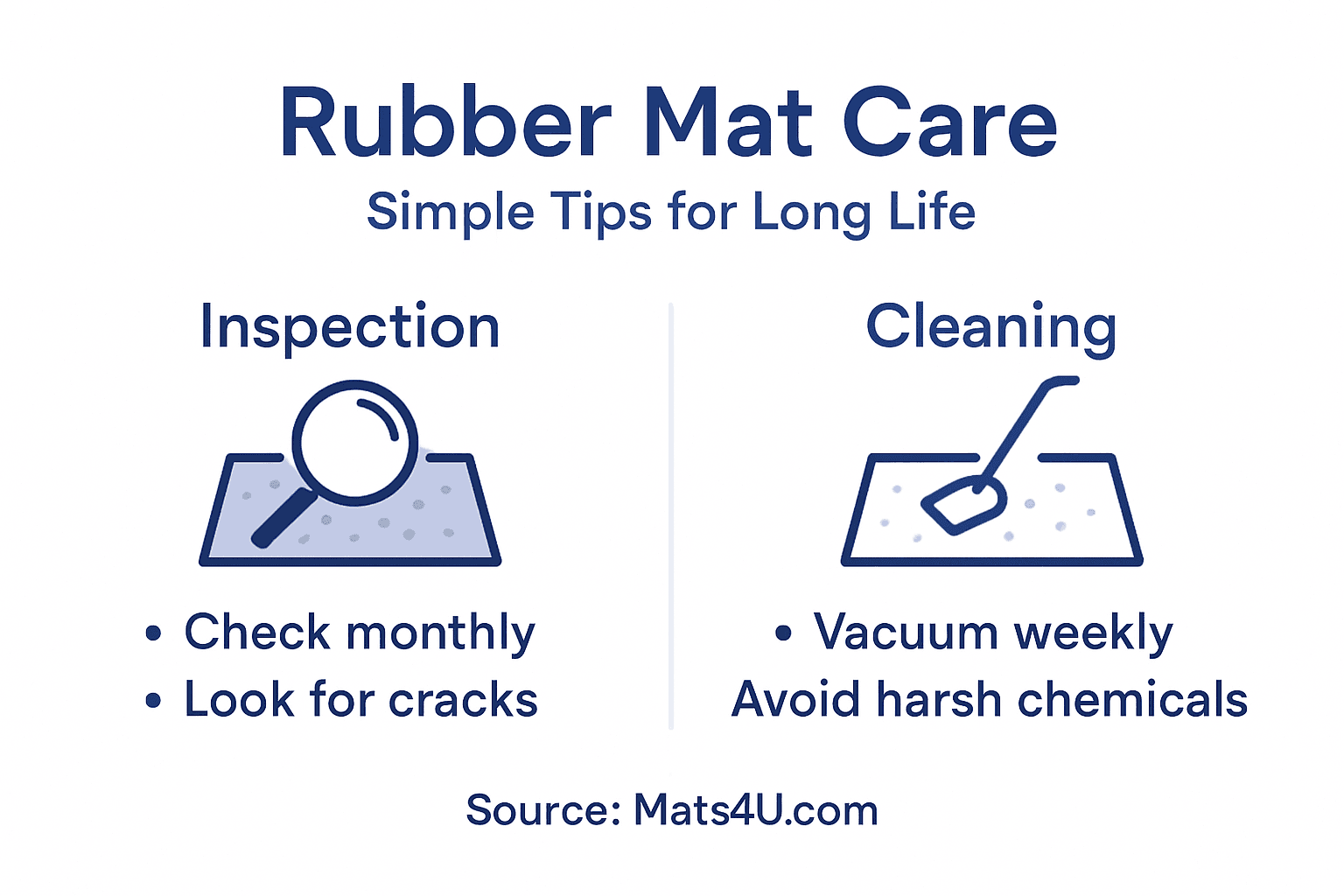
Your first mistake is selecting the wrong cleaning chemicals. Harsh degreasers, bleach, and citrus-based cleaners degrade rubber faster than foot traffic does. Improper cleaning agents cause premature failure in rubber mats by breaking down polymer bonds and causing cracking or loss of elasticity.
Instead, use these approved methods:
- Daily: Sweep or vacuum to remove loose dirt and debris
- Weekly: Damp mop with mild soap and water solution
- Monthly: Light pressure wash on low setting (never high-pressure spray)
- Never: Use bleach, solvents, oil-based cleaners, or acidic products
Environmental factors damage mats faster than most facility managers realize. Direct UV exposure causes fading and brittleness. Extreme heat or cold makes rubber lose elasticity. Near HVAC vents that create rapid temperature changes will age your mats prematurely.
Regular inspections catch degradation before failure occurs. Check monthly for visible cracking, color changes, loss of texture, or unusual softness. These signs indicate rubber degradation from chemical exposure or environmental stress.
Cost mistakes happen at purchase, not replacement. Buying cheap mats seems wise until they flatten after 8 weeks. Then you’re replacing mats four times yearly instead of once every three years. Quality mats cost 2-3 times more upfront but deliver 10-12 times better value over time.
Here’s the math: A $150 quality mat lasting 3 years costs $50 annually. A $50 cheap mat lasting 3 months costs $200 annually. Your facility doesn’t save money buying cheap—it guarantees higher total spending.
Common installation mistakes create premature wear. Mats that shift under foot traffic bunch up and expose edges. Mats placed on uneven flooring rock and stress the surface. Mats too narrow for the entrance create unprotected gaps where moisture spreads.
Wrong rubber type for your environment accelerates failure. Synthetic rubber resists chemicals better than natural rubber. Natural rubber handles temperature swings better than synthetic. Placing a natural rubber mat near a chemical storage area guarantees premature degradation.
Spending 15 minutes monthly on inspection and basic cleaning prevents replacement cycles and extends mat life by 300%.
Staff training prevents damage from excessive force. Pressure-washing mats at high pressure damages surface texture. Dragging heavy equipment across mats creates gouges. Allowing cleaning product spills to sit on mats overnight causes discoloration and degradation.
Pro tip: Create a simple maintenance calendar documenting monthly inspections and weekly cleaning—this single document prevents institutional knowledge loss when staff turnover occurs and ensures consistent care across all locations.
Enhance Safety and Durability with the Right Rubber Hall Mats
Retail facilities face ongoing challenges protecting high-traffic entrances from moisture, dirt, and slip hazards. As highlighted in the article, installing slip-resistant, durable, and properly sized rubber mats is essential to prevent costly floor damage and reduce liability risks from falls. Choosing mats that meet ADA and slip-resistance standards ensures your customers and staff move safely with confidence every day.
At Mats4U.com, we understand these critical needs and offer a wide selection of commercial-grade mats designed specifically for retail entrances. Explore our Shop All Waterhog Mats for superior moisture control and slip resistance or discover cushioned options in our Mats4U | Anti-Fatigue Mats | Collection to enhance standing comfort for staff. Every item in our USA-made inventory delivers the durability and safety your facility demands.
Don’t wait until a hazardous slip or premature mat failure disrupts your operations. Visit Mats4U.com now to find and order the perfect rubber hall mat solution tailored to your retail environment. Protect your investment, safeguard your visitors, and enjoy free delivery on orders over $100.
Frequently Asked Questions
What are rubber hall mats, and how do they benefit retail facilities?
Rubber hall mats are specialized floor coverings designed for entrance areas and high-traffic hallways in retail environments. They help remove moisture and dirt from footwear, provide slip resistance, and protect flooring, ultimately reducing maintenance costs and enhancing safety.
How do I choose the right type of rubber mat for my retail facility?
Selecting the right rubber mat depends on factors such as climate conditions, foot traffic levels, and the specific environment. Natural rubber offers excellent elasticity and grip but requires maintenance, while synthetic rubbers provide better chemical resistance and durability with less upkeep. Assess your needs to determine which type will perform best.
What key features should I look for in high-traffic entrance mats?
When selecting entrance mats, prioritize slip-resistant surfaces, beveled edges to prevent tripping, low-profile designs to avoid obstruction, and durable construction that can withstand heavy use. Additionally, ensure the mat has adequate moisture containment capabilities to keep your sales floor safe and clean.
How can I extend the lifespan of rubber hall mats in my facility?
To extend the lifespan of rubber mats, avoid harsh cleaning chemicals that can degrade the rubber. Regularly inspect the mats for signs of wear, clean them with mild soap and water, and ensure they are installed properly without shifting or bunching underfoot. A maintenance calendar can help keep track of inspections and cleaning schedules.
Recommended
- Mats4EU | The importance of mats in supermarkets – Mats4U USA
- Hog Heaven Mats: The Ultimate Solution for Comfort and Safety in the W – Mats4U USA
- Rubber Mats for Wet Areas: Safety First Solutions – Mats4U USA
- Floor Mat for Hall: Safety and Longevity Impact – Mats4U USA
- Business Floor Graphics: Boost Visibility & Safety UK


