


TL;DR:
- Entrance mats remove dirt and moisture to prevent slip hazards and floor wear.
- Proper selection, placement, and maintenance of mats optimize safety and cleanliness.
- Mats should be part of a comprehensive contamination control system, not a standalone solution.
Entrance mats are often treated as an afterthought, a functional accessory placed at the door with little strategic thought. That perception is costly. Every time a visitor or employee steps into your facility, they carry in moisture, grit, oil, and debris that accelerates floor wear, increases cleaning costs, and creates real slip hazards. Entrance matting is one practical control where contamination transfer is most likely to occur. This article breaks down the mechanics of how entrance mats work, identifies the right mat types for different commercial settings, and delivers actionable guidance for maximizing their safety and cleanliness impact.
Table of Contents
- The science behind entrance mats: How they trap dirt and moisture
- Types of entrance mats and their unique roles
- Key benefits for facilities: Safety, cleanliness, and savings
- Best practices: Maximizing the effectiveness of your entrance mats
- Why relying on mats alone is not enough: Lessons from real facilities
- Find the right matting solution for your facility
- Frequently asked questions
Key Takeaways
| Point | Details |
|---|---|
| Effective dirt and moisture control | Entrance mats trap soil and water that would otherwise be tracked inside, protecting facility cleanliness. |
| Injury risk reduction | Strategic use of entrance mats greatly lowers the chances of slips, trips, and falls at building entrances. |
| Cost and compliance benefits | Mats help cut cleaning costs and support adherence to safety regulations for commercial spaces. |
| Maintenance ensures best results | Regular mat cleaning and routine checks are required to maximize their safety and cleanliness benefits. |
The science behind entrance mats: How they trap dirt and moisture
Entrance mats do more than greet visitors. They perform a specific mechanical function: removing contaminants from footwear before they spread across interior floors. Understanding that process helps you select and position mats more effectively.
When a person walks across an outdoor surface and steps onto a mat, two actions happen simultaneously. The mat’s surface fibers create friction and physical contact with the sole of the shoe, dislodging loose dirt, gravel, and grit. At the same time, absorbent material within or beneath the surface layer pulls moisture away from the shoe and holds it below the walking surface. This dual action is what separates a well-designed commercial mat from a decorative rug.
Most commercial entrance mats are built in layers:
- Top scraping layer: Often made from coarse polypropylene, rubber nubs, or crinkled yarn, this layer physically removes solid particles from shoe soles.
- Absorption layer: Typically a tighter fiber construction or backing material, this layer wicks moisture inward and away from foot traffic.
- Non-slip base: Rubber or vinyl backing grips the floor surface, preventing mat movement and creating a secondary safety measure.
Each layer targets a specific type of contamination. Scraping fibers handle grit and debris. Absorption fibers handle water, mud, and liquid-based soils. The backing prevents the mat itself from becoming a trip hazard.
“Slips are strongly associated with contamination and unsuitable surface conditions.”
This is why placement at the entry point matters so much. By the time foot traffic reaches interior flooring, most contamination should already be captured. Read more about how entrance matting for businesses can be structured for maximum contamination control in commercial settings.
Pro Tip: A single mat at the entrance is rarely enough. Research shows it takes approximately 8 to 12 steps on a mat surface before the majority of tracked-in debris is removed. Size your mat accordingly, or use a zone approach with multiple mats in sequence.
| Contamination type | Primary removal mechanism | Mat layer responsible |
|---|---|---|
| Dry grit and gravel | Physical abrasion | Scraping top layer |
| Mud and wet soil | Fiber absorption | Mid-layer fibers |
| Moisture and rain | Wicking action | Absorption backing |
| Oil-based residue | Fiber entrapment | Dense pile construction |
The table above shows how each type of tracked-in material requires a specific mat response. No single layer handles everything on its own.
Types of entrance mats and their unique roles
Understanding how mats work leads naturally to choosing the right type for your facility’s needs. Commercial entrance mats fall into several distinct categories. Each is engineered for a specific contamination challenge, traffic type, or environment.
Here is a breakdown of the four main commercial mat types:
-
Scraper mats: Built from rigid or semi-rigid materials such as rubber, coarse polypropylene, or metal grating, scraper mats are designed for outdoor placement. Their primary job is removing solid debris before a visitor reaches the building entrance. They are ideal for construction sites, manufacturing facilities, loading docks, and any setting where heavy boots carry significant debris. Scraper mats are not designed for moisture absorption. They function as the first line of contact only.
-
Wiper mats: These mats use dense textile or absorbent fiber construction to capture moisture and fine dirt particles. They belong inside the entrance, positioned after any scraper mat. Wiper mats are the workhorses of most retail, office, and healthcare entrance zones. The fiber pile traps and holds moisture effectively, keeping the interior floor dry.
-
Wiper/scraper combination mats: Products like the Waterhog series combine abrasive surface texture with high-capacity moisture absorption. The ribbed surface scrapes debris while the channel construction holds that debris below the walking surface, preventing re-tracking. These are the most practical choice for a single-mat entrance solution in medium to high-traffic commercial settings.
-
Anti-fatigue mats: While typically associated with workstations and industrial floors, anti-fatigue mats can serve dual roles at entry vestibules where staff stand for extended periods, such as reception desks or security checkpoints. They reduce physical strain while providing a defined transition zone. Explore anti-slip floor mats options when anti-fatigue performance and slip resistance are both priorities.
Floors should be suitable for their use and contamination should not leave people at risk of slipping. That guideline directly supports layering mat types in sequence. A well-designed entry zone uses a scraper mat outdoors, a wiper/scraper combination mat at the threshold, and a wiper mat extending several feet into the interior. This is the zone approach used in high-performing facilities.
| Mat type | Best placement | Primary function | Traffic level suited |
|---|---|---|---|
| Scraper | Exterior, before entrance | Debris removal | Heavy, industrial |
| Wiper | Interior, just past entry | Moisture absorption | Light to medium |
| Wiper/scraper combo | Threshold, indoor/outdoor border | Combined debris and moisture | Medium to heavy |
| Anti-fatigue | Reception, workstation areas | Comfort and slip resistance | Stationary personnel |
For environments with specialized floor safety requirements, a review of industrial matting solutions can help identify the right configuration for each zone.
Key benefits for facilities: Safety, cleanliness, and savings
Now that the types of mats and their technical workings are clear, let’s focus on the tangible benefits for your facility. Entrance mats deliver value on three distinct levels: safety, cleanliness, and cost savings. These are not abstract claims. They are measurable outcomes.
Safety impact
Slip and fall incidents are among the most frequent and costly workplace accidents. Wet floors at entrances, especially during rain or snow season, represent a concentrated risk zone. Properly selected and maintained mats reduce the moisture load on interior surfaces, directly lowering the slip coefficient on adjacent flooring.
Regular cleaning to remove contamination reduces accidents. That principle applies equally to keeping mats clean and functional. A saturated or dirt-packed mat stops performing and can itself become a slip or trip hazard. Choosing the right entrance mats for your specific entry conditions is the first step.
Key safety-related benefits include:
- Reduced moisture transfer from exterior to interior surfaces
- Physical barrier that interrupts contamination pathways
- Anti-slip backing that keeps the mat stationary under foot traffic
- Defined entry zone that signals a transition point to visitors and staff
Cleanliness impact
Studies on commercial building maintenance consistently show that the majority of interior dirt originates from tracked-in outdoor contamination. Effective entrance matting intercepts that contamination at the source. Facilities with properly sized and maintained mat systems report measurable reductions in daily cleaning labor, particularly in high-traffic periods.
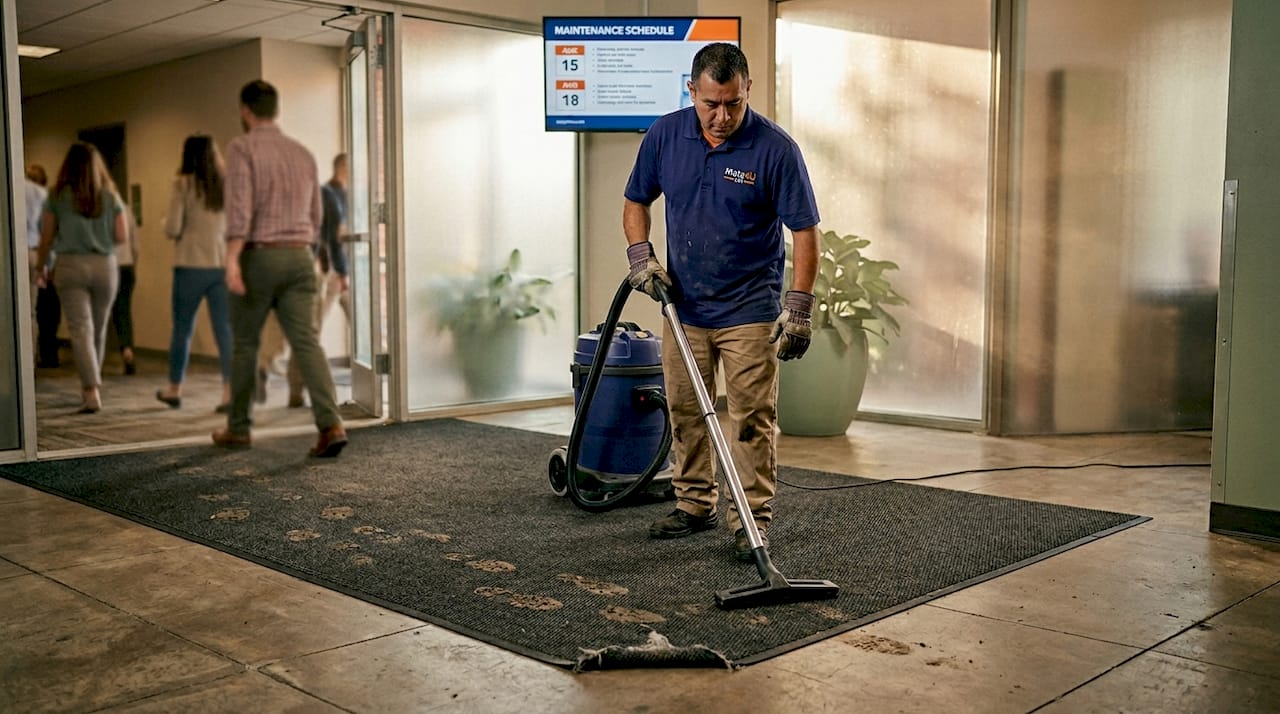
Less dirt tracked onto interior floors means less frequent mopping, reduced floor finish degradation, and longer intervals between deep cleaning cycles. For large retail spaces, hospitals, or office complexes, those savings scale quickly.
Pro Tip: Track cleaning frequency and supply costs for a 30-day period before and after installing a complete entrance mat system. Most facility managers see a measurable reduction within the first month. That data also supports budget justification for mat maintenance programs.
Cost and compliance savings
Floor replacement and refinishing costs are significant. Grit and abrasive particles carried in on shoes act like sandpaper on polished concrete, vinyl tile, and hardwood floors. Entrance mats intercept that abrasion before it reaches the finished floor surface. The result is extended floor life and lower capital expenditure on flooring over a 5 to 10 year horizon.
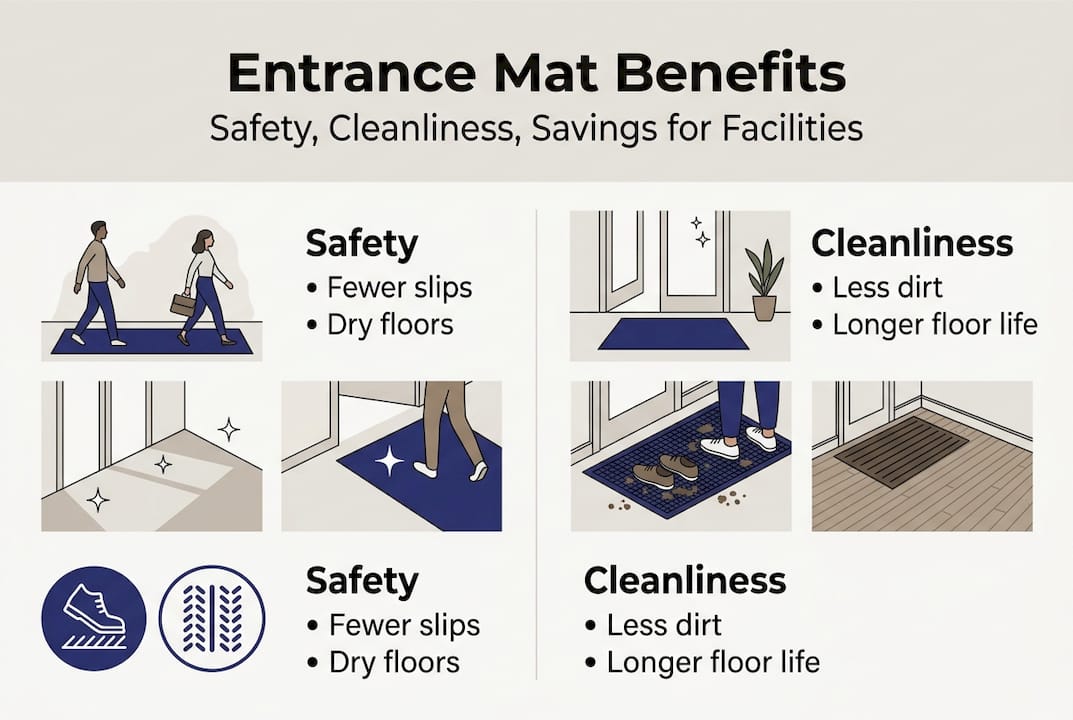
Regulatory compliance is a related benefit. Workplace safety regulations in most jurisdictions require that floors be free from hazards and that employers take reasonable steps to prevent slip and fall incidents. Documented use of quality entrance matting, combined with a cleaning and inspection log, provides evidence of proactive risk management. Information on keeping entrance mats clean is directly relevant to maintaining that compliance record.
Best practices: Maximizing the effectiveness of your entrance mats
To unlock all these benefits, it is crucial to use mats properly and keep them performing at their best. Selecting the right mat is only half the equation. Placement, sizing, cleaning, and inspection determine whether that mat delivers on its potential.
Follow these steps to get consistent performance from your entrance mat system:
-
Size for coverage, not aesthetics. A mat that covers only the immediate door threshold will not capture contamination effectively. The minimum recommended mat length is enough to allow for at least two full steps, which means 72 inches or more for most commercial entries. Wide entries require correspondingly wide mats. Undersized mats are one of the most common and easily corrected mistakes in facility matting.
-
Layer for conditions. Match the outdoor and indoor mat types to your environment. A coastal retail location in a rainy climate needs a higher-capacity moisture absorption system than a dry-climate office building. Assess your worst-case weather conditions and design your mat zone around that scenario.
-
Clean on a scheduled basis. Vacuuming or shaking out entrance mats daily prevents fiber saturation and re-tracking. For high-traffic locations, twice-daily vacuuming during peak seasons keeps fibers open and functional. Deep cleaning, either on-site or via a laundering service, should occur weekly or biweekly depending on traffic volume. Practical entrance mat cleaning tips outline the process step by step.
-
Inspect for wear and hazards. Mats that are curled at the edges, torn, or severely matted down are no longer providing slip protection. They may actually create a trip hazard. Build mat inspection into your regular facility walkthrough. Check backing integrity, fiber height, and edge condition every two weeks.
-
Rotate mats during peak seasons. High-traffic periods such as winter or rainy seasons place extreme demands on entrance mats. Keep a second set of mats on rotation so one set can be cleaned and dried while the other remains in service. This prevents the performance gap that occurs when a saturated mat is left in place too long.
As HSE guidance makes clear, matting should be part of a complete risk-control approach and is not a substitute for good cleaning regimes. That is a critical operational point.
Why relying on mats alone is not enough: Lessons from real facilities
Having outlined best practices, we now take a step back to share a perspective most guides miss. Mats are effective. But they are frequently over-relied on as a standalone solution, and that creates a false sense of security.
Consider a busy grocery store entrance during a wet winter day. The store installs a high-quality wiper/scraper mat at the entry. For the first 30 minutes of the morning rush, that mat performs well. By midmorning, the mat has absorbed significant moisture, its fibers are compressed, and it is tracking rather than trapping. If no one checks or replaces it, the mat transitions from a safety asset to a liability. The floor inside becomes wetter than if no mat had been used at all, because the saturated mat transfers moisture back onto shoes.
Real facilities that manage this well share a common approach: they treat matting as one layer of a broader contamination control system. Mats handle the first contact point. Scheduled staff checks refresh or replace mats before saturation. Wet floor signage goes up during heavy rain or snow. Floor surfaces near the entry are mopped more frequently during high-traffic hours. Drain mats or recessed mat systems are used in particularly high-volume locations.
Matting as part of a complete risk-control approach works precisely because it integrates with other safety measures, not instead of them. A facility manager who thinks of their entrance mat as “the solution” will eventually face an incident that the mat could not prevent alone.
The facilities that perform best pair their matting systems with staff awareness, cleaning schedules, and periodic safety audits. They also choose the right products for the application. Reading about using non-slip mats effectively in industrial and high-traffic settings provides specific guidance on integrating matting into a broader floor safety framework.
Mats are the frontline. They are not the entire defense.
Find the right matting solution for your facility
With a clear understanding of how entrance mats work, which types fit which environments, and how to maintain them, the next step is selecting products built for commercial performance. At Mats4U, the product range is designed for exactly these requirements. Custom logo mat options combine branded appearance with functional dirt and moisture control, giving your entry zone a professional look without sacrificing performance. For high-moisture or heavy-traffic entries, durable entryway mats like the Waterhog Max Grand deliver the scraping and absorption capacity that busy facilities demand. If reception staff or checkpoint personnel need comfort at entry zones, anti-fatigue mats provide the right support. Free delivery on orders over $100 applies sitewide, and all products are Made in the USA.
Frequently asked questions
How do entrance mats actually prevent slips and trips?
Entrance mats trap dirt and moisture from shoes, reducing floor contamination that often causes slips. Slips are strongly associated with contamination and unsuitable surface conditions, making mats a direct countermeasure at the highest-risk entry point.
What is the best way to maintain entrance mats for maximum effectiveness?
Vacuum mats daily and deep clean regularly to ensure they continue capturing dirt and moisture efficiently. Regular cleaning to remove contamination directly reduces accidents, making mat maintenance a safety-critical task, not just a housekeeping one.
How often should entrance mats be replaced?
Replace mats when you notice visible wear, fraying, or reduced dirt pickup, typically every 1 to 2 years in high-traffic areas. Mats that are curled, torn, or heavily compressed at the fiber level are no longer performing their contamination control function.
Can entrance mats help with regulatory compliance?
Yes, using properly maintained mats reduces slip hazards and supports meeting workplace safety requirements. Floors should be suitable and contamination should not leave people at risk, and documented matting programs provide evidence of proactive hazard management.
Do mat size and placement actually matter for performance?
Yes, significantly. A mat that is too small for the entry width or too short for full step coverage will miss a large percentage of tracked-in contamination. Size and placement are as important as mat type when designing an effective entrance zone.


