


TL;DR:
- Relying on generic rubber mats for safety and comfort in high-traffic work areas often leads to premature wear and slip hazards. Proper ergonomic mats with appropriate construction, slip resistance, and edge design significantly reduce staff fatigue, injury, and improve productivity. Continuous assessment, correct installation, and regular maintenance are essential for maximizing the benefits of high-performance ergonomic mats in commercial environments.
Relying on a standard rubber mat to solve comfort and safety issues in high-traffic work areas is one of the most common and costly mistakes facility managers make. Generic mats wear out fast, fail to support standing workers, and can become slip hazards the moment they show signs of age. This guide breaks down exactly what separates a true ergonomic mat from a generic floor covering, which features actually matter for staff wellbeing, and how to match the right mat to each specific work zone in your facility.
Table of Contents
- Why ergonomic mats matter for staff wellbeing
- Essential features of high-performance ergonomic mats
- Choosing the best ergonomic mat for your staff’s work environment
- Installation, maintenance, and lifecycle: Getting the most from staff mats
- A smarter approach to ergonomic mats: What most buyers get wrong
- Upgrade your workplace with superior ergonomic mats
- Frequently asked questions
Key Takeaways
| Point | Details |
|---|---|
| Ergonomic benefits | Specialized mats help reduce staff fatigue and injury from prolonged standing. |
| Critical features | Slip resistance, beveled edges, and durability are must-haves for staff safety. |
| Fit matters | Match mat selection to job tasks, movement needs, and floor conditions for best results. |
| Ongoing care | Regular inspection and scheduled replacement are critical for maintaining mat effectiveness. |
Why ergonomic mats matter for staff wellbeing
Standing on a hard concrete or tile floor for an entire shift causes more physical stress than most managers account for. The body’s natural response to prolonged static standing includes muscle tension in the calves, lower back strain, reduced circulation, and increased fatigue. Over weeks and months, this adds up to increased absenteeism, lower staff productivity, and a measurable rise in workers’ compensation claims.
Ergonomic mats, also known as anti-fatigue mats, work by introducing a slight give under the foot. That cushioned surface encourages micro-movements in the leg and calf muscles, which keeps blood circulating and reduces the buildup of lactic acid. The result is a worker who stays sharper, more comfortable, and less prone to errors caused by physical discomfort. Read more on anti-fatigue mats and your health to understand how this applies across different job types.
The core benefits you can expect from properly selected ergonomic mats include:
- Reduced muscle fatigue in the legs, feet, and lower back
- Lower accident rates from slip-resistant surfaces and safe edge profiles
- Improved staff morale through a visible investment in worker comfort
- Higher productivity as workers maintain focus and physical stamina longer
- Decreased absenteeism linked to chronic standing-related discomfort
The research backing these outcomes is substantial. Anti-fatigue mats reduce staff discomfort and lower back and leg pain in standing jobs, a finding supported across varied industrial and commercial settings.
“The evidence consistently points to anti-fatigue matting as a practical, cost-effective intervention for facilities where workers stand for extended periods. The reduction in reported discomfort is both statistically and operationally significant.”
That outcome doesn’t happen by accident. It requires selecting mats with the right construction, placing them correctly, and maintaining them on a defined schedule. The sections ahead cover all three.
Essential features of high-performance ergonomic mats
With the basics of ergonomic impact covered, choosing the right mat comes down to matching features to your real-world scenarios. Not every mat marketed as “anti-fatigue” delivers measurable results. The physical construction, surface treatment, edge design, and material composition all determine whether a mat performs in a demanding commercial environment or fails within months.
Cushion thickness and density are the first factors to evaluate. A mat that feels soft immediately but collapses under repeated pressure offers little long-term value. Look for closed-cell foam cores or layered rubber and foam constructions that maintain their profile after heavy daily use. The material should compress under load and recover its shape, not flatten permanently.

Slip-resistance is non-negotiable in any commercial or industrial setting. Standards like ASTM E303 (a wet pendulum skid resistance test) and NFSI 101-C (the National Floor Safety Institute’s high traction certification) give you objective benchmarks rather than vague marketing language. Beveled edges and traction-focused designs reduce slips and trips, especially in busy commercial areas, and this is a consistent finding across procurement and mat safety guides.
Edge profile is a detail that gets overlooked until someone trips. Beveled or tapered edges transition carts, foot traffic, and equipment smoothly from the floor surface to the mat and back. A sharp or squared-off edge is a trip hazard waiting to happen, particularly in busy walkways or near assembly stations.
Here is a direct comparison of the core features that separate high-performance ergonomic mats from standard options:
| Feature | High-performance ergonomic mat | Standard rubber or foam mat |
|---|---|---|
| Edge design | Beveled/tapered, trip-resistant | Squared, potential trip hazard |
| Traction surface | Textured, NFSI-certified | Smooth or minimally textured |
| Core material | Layered foam/rubber hybrid | Single-layer foam or thin rubber |
| Warranty | 1 to 5 years commercial use | None or limited residential |
| Typical applications | Assembly lines, kitchens, counters | Light-duty or home use |
| Drainage capability | Perforated or drainage-grid options | Solid surface only |
For high-use standing zones such as production lines or commercial kitchens, review options specifically designed for industrial mats for standing. For longer workstations or aisle-based setups, anti-fatigue runner mats offer continuous coverage that reduces gaps and mat overlap hazards.
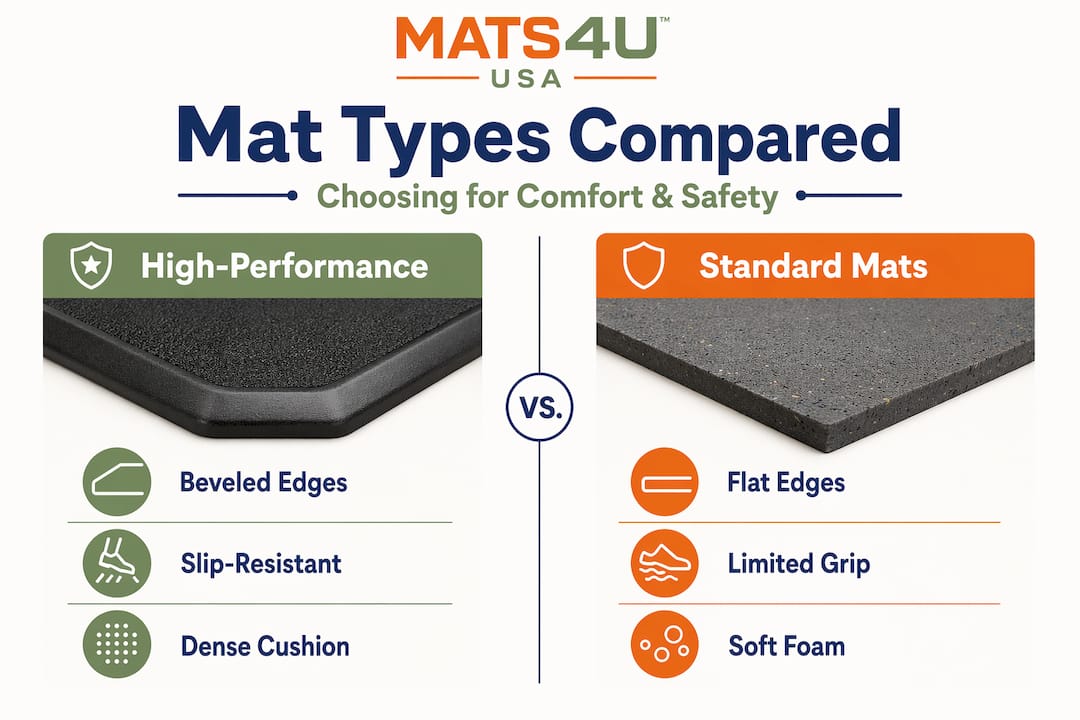
Pro Tip: Always check product specification sheets for documented slip-resistance testing results. If a product page lists no ASTM or NFSI data, ask the supplier directly before purchasing for a commercial environment.
Choosing the best ergonomic mat for your staff’s work environment
After understanding the main features and how they address safety and comfort challenges, the next step is connecting those attributes to your specific workspace needs. This is where many buyers go wrong. They select a mat based on price or appearance without mapping it to the actual demands of the work zone.
Follow this process to make a reliable selection:
- Assess the workspace. Identify the floor material (concrete, tile, vinyl), the presence of moisture or oils, temperature extremes, and foot traffic volume. A food processing area has very different requirements than a retail checkout counter.
- Define the staff role. Workers who stand mostly in one position need maximum cushion density. Workers who move frequently across a zone benefit more from a mat with a flatter profile and high traction to prevent slipping during lateral movement.
- Evaluate wet versus dry conditions. Solid-surface mats trap moisture and become dangerously slick in wet environments. For commercial kitchens, industrial wash areas, or anywhere liquid is present, drainage-style mats with perforated or open-grid surfaces are the correct choice.
- Check chemical exposure requirements. Some industrial environments expose mats to oils, solvents, or cleaning chemicals. Verify that your selected mat material resists degradation from the specific substances in use at your facility.
- Select the correct mat feature set based on the above, then confirm sizing to ensure full coverage of the standing zone without gaps or overlaps that create uneven surfaces.
Procurement best practices consistently recommend matching mat to task, accounting for static standing, frequent movement, wet conditions, and specialty needs such as ESD (electrostatic discharge) or cleanroom requirements, to maximize both comfort and safety.
The following table maps common workplace zones to the most effective mat types:
| Workplace zone | Primary hazard | Recommended mat type |
|---|---|---|
| Commercial kitchen | Wet floors, oils, fatigue | Drainage anti-fatigue rubber mat |
| Assembly line | Long static standing, foot fatigue | High-density foam/rubber hybrid |
| Retail checkout counter | Moderate standing, light traffic | Cushioned anti-fatigue mat with beveled edge |
| Warehouse picking station | Movement, uneven loads | Low-profile traction mat |
| Industrial wash area | Constant moisture, chemical exposure | Chemical-resistant drainage mat |
| Front-of-house entrance | Heavy foot traffic, dirt, moisture | Waterhog or scraper mat with drainage |
For facilities with multiple industrial applications, the selection criteria for anti-fatigue mat industrial environments and anti-fatigue industrial mats covers the full range of use cases in detail.
One clear pattern to avoid: placing a smooth, solid-surface mat in a wet area because it was discounted or already on hand. This is one of the most direct paths to a slip-and-fall incident, a workers’ compensation claim, and potential OSHA scrutiny.
Installation, maintenance, and lifecycle: Getting the most from staff mats
Equipped with these preventive steps, you’re ready to move from selection to implementation. A well-chosen mat that is poorly installed or never inspected will underperform and may actually create new hazards. Facility managers need a maintenance protocol that is documented, assigned to specific staff, and reviewed regularly.
Installation basics start with a clean, dry floor surface. Any debris, moisture, or residue under the mat creates an uneven base that accelerates wear and can cause the mat to shift under load. Use mat tape or anchoring strips in high-traffic zones where mat movement is a risk. Confirm that all edges lie flat against the floor surface, with no lifting at corners or sides.
Top-rated mats can become trip hazards as they age or if installation and placement aren’t routinely checked. Prioritize transition edges and scheduled maintenance to prevent this. Reviewing your current setup against industrial anti-fatigue mats standards gives you a useful benchmark for what proper installation looks like in practice. For a broader grounding in how these products function, what are anti-fatigue mats covers core principles that inform maintenance decisions.
Routine inspection checklist:
- Check all mat edges for curling, lifting, or separation from the floor
- Look for surface wear patterns indicating loss of traction texture
- Squeeze the mat core to test for cushion recovery; a flattened mat no longer provides ergonomic benefit
- Inspect drainage holes or grids for blockage with debris or grease
- Verify mat positioning has not shifted from its original placement
- Confirm cleaning has not left soap residue that reduces grip
Signs it is time to replace a mat:
- Edges curl upward and cannot be corrected by repositioning
- Surface texture is visibly worn smooth
- Core compression is permanent, with no spring-back under pressure
- Traction is noticeably reduced even after thorough cleaning
- Mat has cracked, split, or shows structural degradation from chemical exposure
Do’s and don’ts for ongoing care:
- Do clean mats with a neutral pH cleaner compatible with the mat material
- Do rotate mats in multi-station environments to distribute wear evenly
- Do document inspection dates and findings in your facility maintenance log
- Don’t use high-pressure steam on foam-core mats; it degrades adhesion and cushion structure
- Don’t layer mats on top of each other to compensate for worn cushioning
- Don’t delay replacement because a mat “looks fine”; traction loss is often invisible to casual observation
Pro Tip: Assign mat inspection to a named role, not just “anyone on shift.” When accountability is anonymous, inspections get skipped. A monthly sign-off sheet posted near each mat station takes two minutes and prevents incidents that take months to resolve.
A smarter approach to ergonomic mats: What most buyers get wrong
Most facility managers approach mat procurement as a one-time purchasing decision. They identify a need, research products, place an order, and consider the problem solved. The mats go down, staff notices the improvement, and the task gets closed. Six months later, nobody checks whether those mats are still performing.
This is where the majority of mat-related incidents originate. The product itself is rarely the failure point. The real issues are improper selection for the task, poor initial installation, and the complete absence of a review cycle. A mat that was perfect for your assembly station in year one may be a compression-dead, traction-compromised surface by the end of year two.
The facilities that achieve consistently strong safety outcomes do one thing differently: they treat ergonomic matting as a managed asset, not a consumable. That means named accountability for inspections, defined replacement triggers, and a procurement process tied to actual observed wear rather than a fixed calendar. Reviewing your current options against anti-fatigue mats comparison data helps set realistic performance expectations before you buy.
The single biggest risk factor in floor safety isn’t a product defect. It’s an organization that purchases once, installs once, and never looks again.
Budget matters, but it is secondary to fit. A lower-cost mat matched precisely to the environment and maintained on a documented schedule will outperform a premium mat placed incorrectly and ignored. Build the review cycle into your standard operating procedures before the mats arrive, not after the first incident.
Upgrade your workplace with superior ergonomic mats
Having uncovered what truly drives better outcomes in staff comfort and safety, the next step is selecting products built to meet those standards in commercial and industrial environments. The right mat does more than cushion a floor. It reduces injury risk, supports worker output, and signals a facility that takes operational standards seriously.
At Mats4U.com, the product range is built specifically for commercial buyers who need performance backed by clear specifications. The Comfort Premier™ Mat delivers dense, durable cushioning for static standing workstations such as checkout counters and lab benches. For wet or high-moisture environments, the Comfort Flow™ Drainage Mat combines drainage capability with anti-fatigue support. The Cushion Complete Mat offers a practical, versatile option for general commercial standing zones. All products ship free on orders over $100, and selections are Made in the USA.
Frequently asked questions
How do ergonomic mats reduce staff fatigue?
Ergonomic mats encourage subtle micro-movements in leg and calf muscles, which keeps blood circulating and reduces the buildup of physical tension during long standing periods. Research confirms this mechanism consistently reduces discomfort and lower back and leg fatigue in standing workers.
What is the most important feature for safety in staff matting?
Slip-resistance and beveled edges are the two most critical safety features. Beveled edges and slip-resistant surfaces are documented as essential to minimizing trip and fall risks in busy commercial areas.
How do I know when a staff mat should be replaced?
Replace mats when you observe curled or lifted edges, worn-smooth traction surfaces, flattened cushioning with no spring-back, or reduced grip even after cleaning. Waiting for a visible structural failure is too late.
Can one type of ergonomic mat work for all work areas?
No. Procurement guides recommend matching mat properties to the specific task, floor conditions, and movement patterns of each zone. Using a solid-surface mat in a wet area, for example, creates a direct slip hazard regardless of the mat’s quality.


