


TL;DR:
- Entry mats are an investment in brand visibility and safety that should utilize inlay construction methods for durability. Proper sizing, placement, and regular maintenance are critical for sustaining logo clarity and preventing slip hazards. Strategic planning and cross-departmental collaboration ensure branded mats effectively communicate quality and meet safety standards over their service life.
Entry mats are often treated as a commodity purchase, ordered in bulk and replaced when they fall apart. That approach costs more than you think. A logo applied to the surface of a low-grade mat will start fading within weeks of heavy foot traffic, and every visitor who steps over a worn, illegible brand mark is getting the wrong first impression. Inlay construction embeds the logo physically into the mat structure so it cannot wear off, fade, or peel, which changes the entire calculus of what an entry mat investment looks like for a commercial facility.
Table of Contents
- Why entry mats matter for brand experience
- Critical features for high-traffic branding success
- Safety, compliance, and maintenance: Protecting both brand and people
- Implementing entry mat branding: Step-by-step success framework
- What most brands get wrong about entry mat branding
- Maximize your brand with premium entry mats
- Frequently asked questions
Key Takeaways
| Point | Details |
|---|---|
| Inlay graphics last longer | Inlay or solution-dyed logos resist heavy wear and retain clarity better than surface printing. |
| Prioritize safety standards | Slip resistance, compliant edges, and correct sizing protect both visitors and your brand’s reputation. |
| Coverage is key | Entry mats should fully span doors and extend 10–15 feet to maximize both branding and functional benefits. |
| Maintenance sustains impact | Regular upkeep ensures branding remains vibrant and mats continue to perform. |
Why entry mats matter for brand experience
Your facility’s entry point is not a threshold. It is an active communication channel. Visitors, clients, and employees form immediate quality assessments based on what they see and feel underfoot. A clean, vibrant logo mat signals that standards are high throughout the building. A faded or curling mat sends the opposite message before anyone reaches the reception desk.
Boosting brand visibility through entry matting is not about decoration. It is a deliberate operational decision. The mat’s placement, size, and ongoing visual clarity all communicate brand standards passively but continuously.
Consider what goes wrong without a strategic approach:
- Undersized mats that only cover a fraction of the entry width let most foot traffic bypass the branded surface entirely
- Surface-printed logos that degrade quickly in wet or gritty conditions, leaving a blotchy, unprofessional impression
- Mats placed only at the front entrance, missing secondary entry points used by staff, vendors, and deliveries
- No maintenance schedule, resulting in a mat that functions poorly and looks worse
“A well-placed, properly maintained logo mat is not just a safety tool. It is a repeating brand exposure point that works every hour the facility is open.”
The business case for strategic matting goes beyond aesthetics. According to colorfastness and maintenance standards, mat manufacturers test for color retention under repeated cleaning and traffic cycles, and facilities that follow proper maintenance protocols preserve both the mat’s function and its visual output far longer than those that do not.
A smart floor mats entrance strategy maps every high-traffic entry point, specifies the correct mat dimensions for each zone, and includes a maintenance protocol tied to cleaning schedules. That combination keeps the brand legible and the surface safe.
Critical features for high-traffic branding success
Not every branded mat will hold up in a demanding commercial environment. Facility managers and marketing directors need to evaluate specific technical features before specifying a product. The wrong choice results in early replacement costs and brand degradation between purchase cycles.
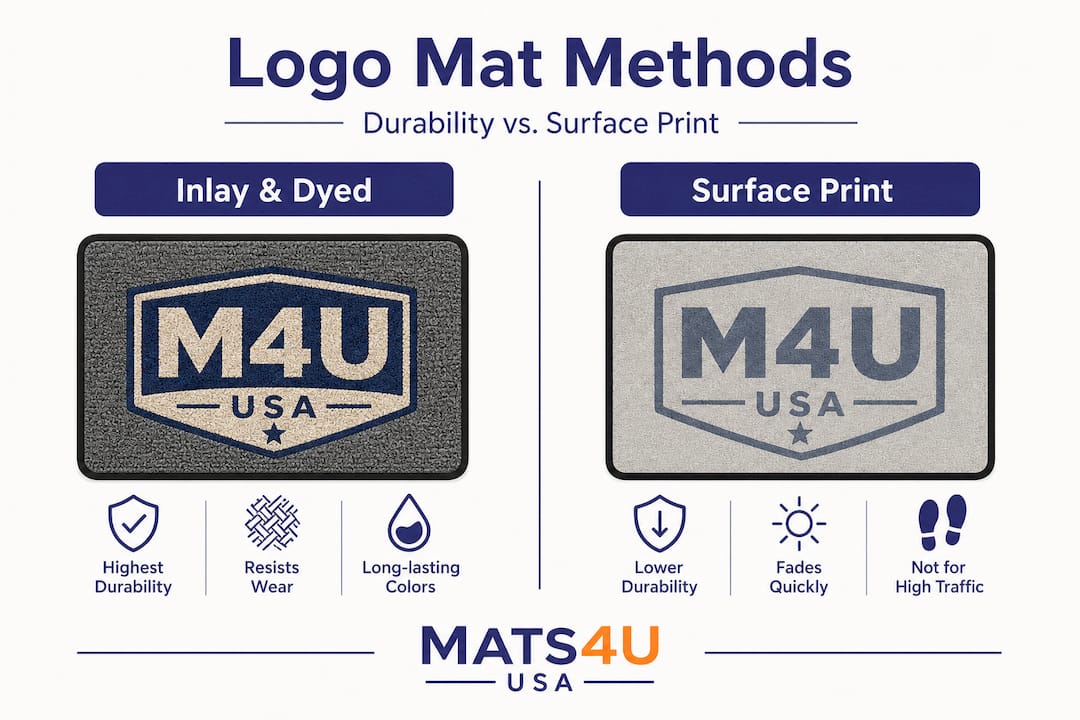
The most important feature distinction in commercial logo mats is construction method. A door mat logo guide will walk you through the three main approaches, but here is a clear comparison:
| Feature | Inlay (cut-and-piece) | Solution-dyed fiber | Surface print |
|---|---|---|---|
| Logo durability | Highest. Logo is part of mat structure. | High. Color is locked into fiber during manufacture. | Lowest. Ink sits on top of fiber surface. |
| Fade resistance | Excellent. No surface coating to wear through. | Excellent. UV and abrasion resistant by nature. | Poor to moderate. Degrades with cleaning and grit. |
| Best environment | Heavy grit, moisture, high traffic | Outdoor and UV-exposed areas | Light-traffic indoor zones only |
| Maintenance impact | Cleaning does not affect logo clarity. | Cleaning does not affect color. | Repeated cleaning accelerates fading. |
| Cost position | Higher upfront, lower long-term replacement | Moderate to higher | Lower upfront, higher long-term replacement |
The WaterHog inlay construction method uses a jigsaw-like cut-and-piece process where each color in the logo is a physically separate section of mat fiber. The logo will not wear off because it is not printed. It is the mat.
Checklist for facility managers before purchase:
- Confirm the logo construction method (inlay or solution-dyed, not surface print for heavy traffic zones)
- Verify the mat covers the full door width at each entry point
- Confirm a minimum mat depth of 10 to 15 feet to ensure adequate steps on the matted surface
- Check the edge profile for beveled or anti-trip design
- Confirm slip resistance rating meets NFSI High-Traction standards
- Request colorfastness documentation from the supplier
- Confirm compatibility with your facility’s cleaning equipment and chemicals
- Establish a replacement trigger point (visual logo degradation below a defined threshold)
Pro Tip: Avoid surface-printed logos for any entrance that receives grit, moisture, or more than 200 daily footfalls. The visual degradation happens fast, and the reorder cycle will quickly exceed the cost savings of the cheaper initial product. Work with your custom logo mats guide to specify inlaid techniques from the start.
Safety, compliance, and maintenance: Protecting both brand and people
Branded entry mats serve two masters simultaneously. They carry your logo, and they protect people. Failing on either front creates liability. Slip and fall incidents at commercial entrances are among the most common causes of workplace injury claims, and a mat that looks great but lacks adequate traction is a legal and operational risk.
The standard benchmarks are clear. NFSI and OSHA traction standards require a minimum Threshold Coefficient of Friction (TCOF) of 0.60 for walking surfaces to be considered safe. NFSI High-Traction certification is the independently tested benchmark that confirms a mat meets or exceeds this threshold under real-world transitional conditions, including wet entry zones.
Edge profile is equally important. A mat with a raised or squared edge creates a trip hazard, particularly in high-traffic areas where people are moving quickly and not looking down. Beveled edges that taper to the floor at 90 degrees or less are the correct specification for commercial use.
The data table below reflects performance expectations across common commercial mat materials:
| Material type | Minimum TCOF (typical) | Logo method compatibility | Cleaning frequency (high traffic) | Color longevity |
|---|---|---|---|---|
| WaterHog (polypropylene) | 0.65 to 0.80 | Inlay, solution-dyed | Weekly | 3 to 7 years |
| Berber (nylon blend) | 0.60 to 0.70 | Solution-dyed, surface print | Weekly | 2 to 5 years |
| Rubber-backed nylon | 0.62 to 0.75 | Inlay, solution-dyed | Bi-weekly | 3 to 6 years |
| Surface-printed mat | 0.60 to 0.65 | Surface print only | Weekly | 6 to 18 months |
Key stat: Slip and fall incidents cost U.S. businesses an estimated $70 billion annually in direct costs. Entry mat compliance is one of the most cost-effective risk mitigation measures available to facility managers.
Maintenance directly affects both safety performance and brand clarity. A mat that traps grit and moisture without being cleaned becomes slippery and visually degraded. The slip-proof mat safety protocols recommend inspecting mats at each cleaning cycle for edge lift, surface compression, and logo visibility.
Pro Tip: Tie mat inspection to your facility’s existing entrance cleaning routine. If the entrance floor is mopped or swept three times per week, mat inspection takes less than two minutes and catches edge problems or backing separation before they become trip hazards. This integration approach reduces cost and improves consistency.
Selecting the right product upfront significantly reduces maintenance burden. Reviewing criteria for choosing entrance floor mats by application zone, traffic volume, and moisture exposure will narrow options to mats engineered to perform in your specific conditions.
Implementing entry mat branding: Step-by-step success framework
Effective branded matting does not happen by accident. It requires coordination between facility management and marketing, clear specifications, and a post-installation protocol that keeps both the safety function and the brand asset performing over time.
Follow this implementation sequence:
- Define branding objectives. Identify which entry points carry the highest visitor volume and prioritize those for branded mats. Secondary and service entrances can use brand-compliant color schemes without full logo treatment.
- Select entry points and measure accurately. Record the exact width of each door or entry zone and the available depth. Target a minimum of 10 to 15 feet in mat depth, as mat coverage standards confirm this depth ensures enough steps on the matted surface to remove moisture and debris effectively.
- Design the logo for inlay or embedded construction. Work with the mat supplier to translate your logo into a format compatible with inlay construction. Logos with more than five distinct colors or very fine detail may require simplification for inlay feasibility.
- Confirm compliance before ordering. Verify NFSI High-Traction rating, TCOF minimum, beveled edge profile, and ADA compatibility for the selected mat.
- Plan and document the maintenance schedule. Assign cleaning frequency by traffic level, specify cleaning method (vacuuming, extraction, or hose-down depending on mat type), and set a visual inspection checklist for logo clarity and edge condition.
A stunning logo floor mat installation can be undermined quickly by avoidable rollout errors. The most common pitfalls to eliminate:
- Ordering mats before measuring entry zone depth accurately
- Selecting a logo design that is too complex for inlay construction without consulting the supplier
- Skipping edge profile specification and receiving a squared-edge mat that creates a trip hazard
- Failing to involve marketing in color approval, resulting in mats that do not match brand standards
- Not training facility staff on the difference between mat types and their specific cleaning requirements
- Treating branded mats as interchangeable with standard utility mats in the maintenance program
Cross-departmental buy-in is not optional. Marketing directors bring brand standards knowledge, and facility managers bring operational realism. When both teams align on the specification, the result is a mat that holds up in the real environment and represents the brand accurately throughout its service life.
What most brands get wrong about entry mat branding
Most branded mat failures are entirely predictable. The pattern is consistent: a marketing team specifies a surface-printed logo because the price looks right and the mock-up looks good on screen. The mat ships, looks excellent on day one, and begins degrading within the first month of real traffic. By month three, the logo is a faint suggestion of its original design. By month six, the mat is a liability on both safety and brand grounds.
Surface-printed mats have a legitimate place in commercial use, but that place is not at a high-traffic entrance with grit and moisture. The mechanism is simple. Ink applied to fiber surfaces cannot bond at the fiber core level. Every footfall, every cleaning cycle, and every grit particle that drags across the surface removes a fraction of the print layer. The process is invisible at first and then suddenly obvious.
What actually works is construction-based branding. Embedded and inlaid logo approaches ensure the logo design is part of the mat’s physical structure. There is no surface layer to erode. The logo you see on day one is the same logo visible after three years of proper maintenance.
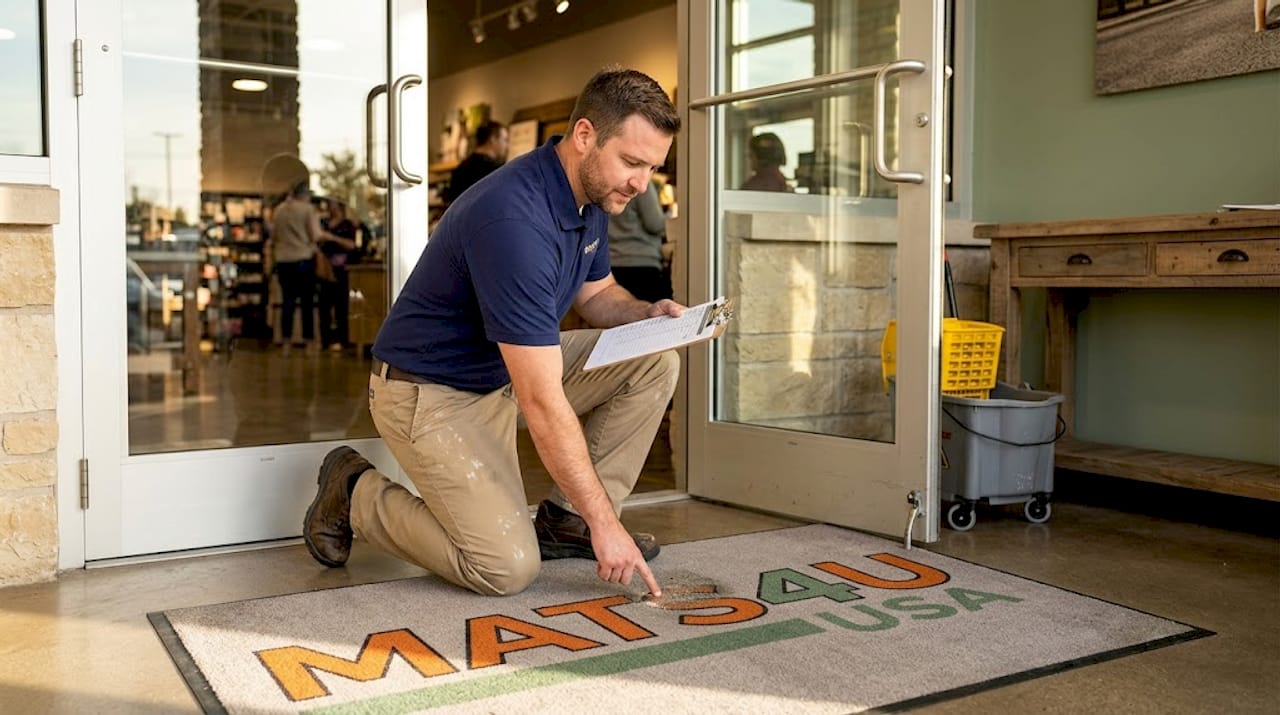
The second most common failure is mat sizing. Teams order mats that fit the door opening visually but do not account for entry depth. A mat that is 3 feet deep at an entrance with a heavy exterior door stops most foot traffic before the mat does its job. The visitor takes one step on the mat and three steps on the bare floor before reaching the interior.
Forward-thinking facility and marketing teams treat branded entry mats as annual branding assets, not one-time supply purchases. They schedule annual mat audits the same way they audit signage or uniform standards. They track logo legibility scores against a defined threshold and replace before degradation becomes visible to visitors. That approach costs less in total than reactive replacement cycles and keeps brand standards consistent year-round. A strong custom logo welcome mat guide will give you the framework to build that audit process into your existing facility management program.
Maximize your brand with premium entry mats
At Mats4U.com, you will find a full range of commercial entry mats built for exactly the conditions described in this guide. From WaterHog inlay logo mats engineered to keep logos legible through years of heavy traffic, to Berber and rubber-backed options for secondary entry zones, every product is specified for commercial and industrial performance. All orders over $100 ship free, and the product catalog includes Made in the USA options for facilities with domestic sourcing requirements. Browse by mat type, entry zone, or logo method to find the right specification for each location in your facility. The selection tools on the site make it straightforward to confirm dimensions, compliance ratings, and construction method before you order.
Frequently asked questions
What is the most durable logo method for entry mats?
Inlay (cut-and-piece) and solution-dyed logo methods are the most durable because they embed the design within the mat, preventing fading or peeling. WaterHog inlay construction physically cuts and pieces each logo color section so the design cannot wear off regardless of traffic volume.
How long should a commercial entry mat be for safety and branding?
A commercial entry mat should cover the full door width and extend a minimum of 10 to 15 feet in depth to ensure enough steps occur on the matted surface for effective moisture and debris removal.
What safety standards should a branded entry mat meet?
Branded entry mats should meet the NFSI High-Traction certification standard and confirm a minimum TCOF of 0.60, which is the OSHA-referenced threshold for safe commercial walking surfaces.
How often should branded entry mats be cleaned or maintained?
Branded entry mats in high-traffic commercial areas should be inspected and cleaned at least weekly, with edge and logo condition checked at each cleaning to catch degradation before it becomes visible to visitors or creates a safety hazard.


