


TL;DR:
- Accurate measurement of floor space ensures custom mats fit properly, enhancing safety and durability. Proper sizing reduces liability, prevents door obstructions, and maintains branding effectiveness in high-traffic areas. Using precise tools, verifying dimensions, and collaborating with suppliers ensures optimal mat performance and long-term operational savings.
A mat that’s two inches too short at your main entrance lets moisture and debris track straight onto your polished floor. A mat that’s too wide catches on a door swing and becomes a trip hazard before the first visitor arrives. Both scenarios cost money, time, and credibility. Getting custom mat measurements right the first time is one of the most practical things a facility manager can do to protect safety, reduce maintenance overhead, and keep branding consistent across every high-traffic zone.
Table of Contents
- Why accurate measurements matter for custom mats
- What you need before you measure
- Step-by-step: Measuring your space for custom mats
- Common mistakes and how to avoid them
- Verifying your measurements before ordering
- A practical perspective: Why precise measurement outperforms guesswork every time
- Ready to order? Get the perfect custom mat for your space
- Frequently asked questions
Key Takeaways
| Point | Details |
|---|---|
| Accurate measurement prevents hazards | Properly sized mats reduce slips, trips, and legal risks in high-traffic areas. |
| Preparation is essential | Gather all tools, plans, and assess site conditions before starting measurements. |
| Measure both length and width precisely | Follow a consistent method and double-check results for each space to avoid ordering mistakes. |
| Verify before you buy | Cross-reference your measurements, involve a second person, and confirm with photos before final ordering. |
| Partner with your supplier | Clear communication of your measurements ensures you get a mat that fits and looks great. |
Why accurate measurements matter for custom mats
Incorrect sizing is not just an inconvenience. It creates real liability. According to the mat size selection guide for high-traffic commercial spaces, accurately sized mats reduce slip and trip risks in high-traffic environments. For facility managers, that matters directly because OSHA expects walkways to be clear and safe. A mat that buckles at the edges or leaves uncovered wet floor sections shifts legal exposure directly onto your facility.
Consider two common failure scenarios. An undersized entryway mat in a busy office lobby covers only the center of a 10-foot-wide entrance, leaving both sides of the doorway unprotected. Employees entering from an angle track moisture around the mat entirely. An oversized mat in a corridor, meanwhile, creeps under a nearby door and stops it from closing fully, creating a fire egress issue.
Well-fitted mats also reinforce cleaning routines. When a mat covers the correct zone, cleaning staff know exactly where to focus vacuuming and extraction. There are no ambiguous “just outside the mat” strips where dirt accumulates unnoticed. Properly sized custom mats also last longer because they lie flat, reducing edge wear caused by constant foot traffic rolling over a buckled corner.
For facilities that use branded or logo mats, sizing is even more critical. A logo mat that’s too small cuts off part of the design. A mat that’s too large pushes the logo off-center relative to the entryway, undermining the brand presentation you paid to create. When you’re choosing anti-fatigue mats for workstations, the same principle applies: coverage gaps leave workers standing on hard flooring and defeat the purpose of the investment.
Key safety and operational impacts of incorrect mat sizing:
- Buckling and curling edges create tripping surfaces
- Gaps between mat coverage and door frames allow moisture ingress
- Oversized mats obstruct door arcs and emergency exits
- Undersized branding mats deliver incomplete logo visibility
- Incorrect mat sizing in recessed wells creates uneven floor surfaces
“A mat that doesn’t fit the space doesn’t protect the space. Sizing is the first decision, not the last.”
What you need before you measure
Gathering accurate floor space information before measuring avoids costly errors, particularly when ordering custom mats that cannot be returned or resized after production. Preparation reduces the risk of a second site visit and prevents ordering delays.
Before you take a single measurement, collect these tools and reference materials:
- Steel tape measure (rigid, not soft fabric): fabric tape stretches and gives inaccurate readings across large floor spans
- Notepad and pen: digital notes are fine as backup, but handwritten sketches avoid the distraction of switching between apps
- Current floor plan or architectural drawing: useful for verifying room dimensions and confirming door positions
- Smartphone or camera: for photographing the space, including door hardware, thresholds, and existing floor conditions
- Obstruction checklist: include furniture, columns, floor drains, transitions between flooring types, and recessed mat wells
When you’re shopping for industrial mats or any custom commercial mat, your supplier will need location-specific details beyond just length and width. Identify what type of space each mat will occupy: a main entryway, an elevator lobby, an anti-fatigue zone at a workstation, or a branding position in a reception area. Each location has different traffic flow patterns and different sizing priorities.
| Location type | Primary sizing concern | Common mistake |
|---|---|---|
| Main entryway | Width matches full door span | Ordering for door width, not traffic width |
| Elevator lobby | Fits inside threshold lines | Ignoring floor transitions |
| Workstation zone | Length covers full standing zone | Using generic sizes instead of measuring |
| Branded reception | Logo centered relative to approach | Not accounting for furniture placement |
| Recessed mat well | Exact well dimensions required | Measuring room, not the well itself |
Check for obstructions before finalizing your measurement plan. A floor drain near the center of a mat zone changes how the mat can be positioned. A column that partially interrupts a wide aisle means the mat width must accommodate the obstruction or work around it. Doors are the most critical obstruction to check: both hinged doors and sliding doors require specific clearances.
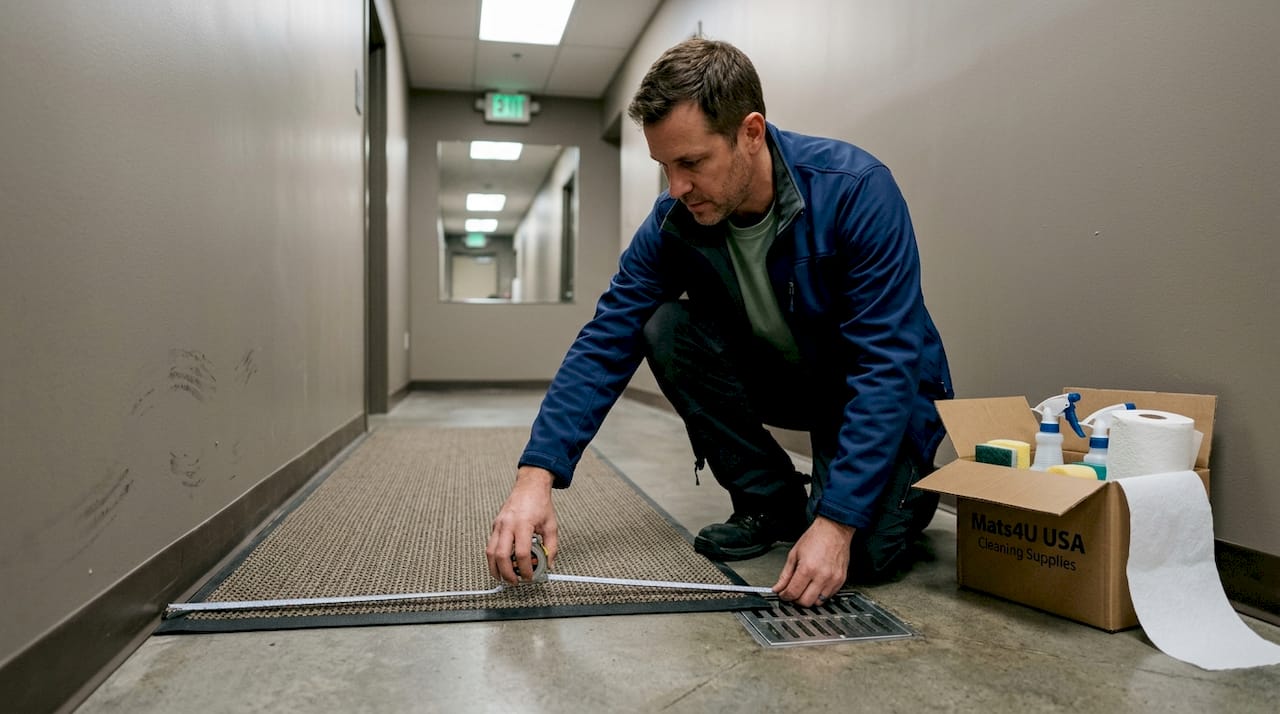
Pro Tip: Always measure twice and record both readings. If they don’t match, measure a third time before accepting either figure. This one habit prevents the most common ordering errors in custom mat procurement.
Traffic flow direction also affects placement. A mat that spans a corridor should be oriented so its longest dimension runs parallel to foot traffic, maximizing contact time between shoes and the mat surface. This is especially important for moisture and debris capture at building entrances.
Step-by-step: Measuring your space for custom mats
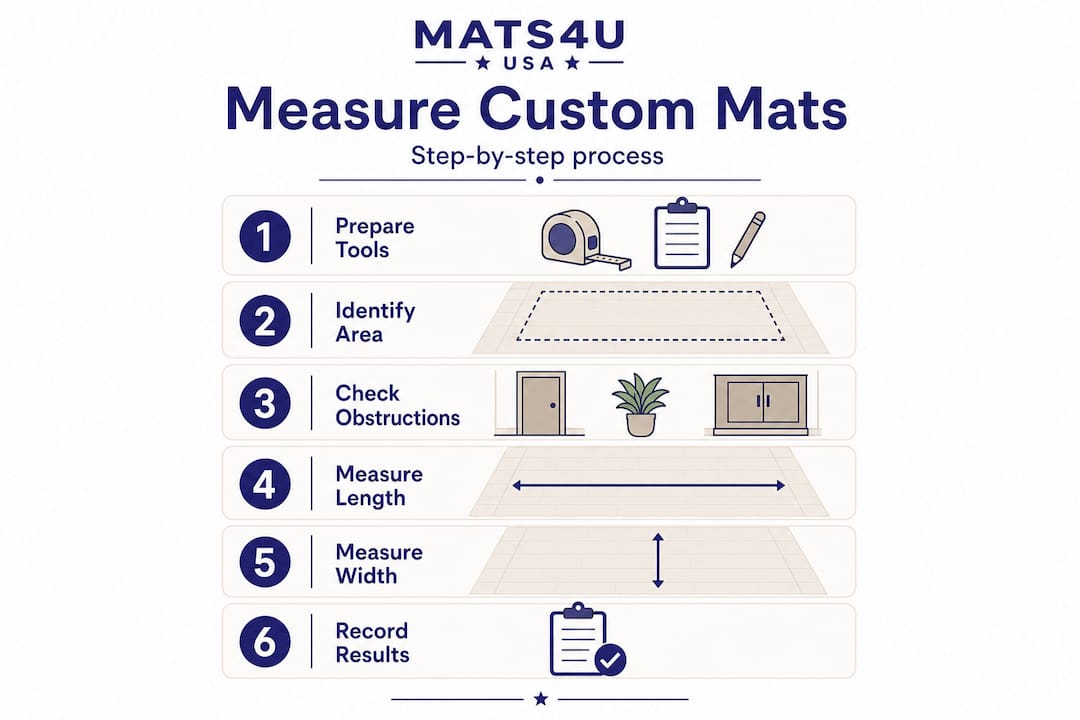
Once your tools are ready and obstructions are documented, follow this sequence to get clean, reliable numbers. The floor mat size chart guidance from industry practice confirms that standardizing your measurement process avoids confusion between mat length and width, which is one of the most frequent causes of incorrect orders.
-
Define the mat zone. Stand at the location and mark the boundaries with painter’s tape or chalk. This makes the physical space visible before you measure it.
-
Identify length vs. width. Length runs parallel to the main direction of foot traffic. Width runs perpendicular to it. For a main entrance where visitors walk straight in, length runs from the door toward the interior. For a mat along a service counter, length runs along the counter face.
-
Measure length. Extend the steel tape from one edge of the mat zone to the other, parallel to traffic flow. Record the number in inches, not feet, to avoid rounding errors. A lobby that measures 8 feet, 3 inches should be recorded as 99 inches, not “about 8 feet.”
-
Measure width. Repeat perpendicular to traffic flow. For a main entrance with a 6-foot-wide door, the mat width may need to extend to 8 or 10 feet to capture the full traffic spread as people fan out after entering.
-
Check door clearance. If a door swings over the mat zone, open the door fully and measure the gap between the floor and the lowest point of the door. Standard clearance for mat thickness is typically half an inch, but verify your specific door hardware. This step applies to custom floor mat tips for any interior location with swinging doors.
-
Measure recessed wells separately. If your facility has recessed mat wells, measure the length, width, and depth of the well itself. Do not measure the surrounding floor and assume the well matches. Wells are often slightly smaller or larger than they appear, and a mat that doesn’t fit flush creates a trip edge.
-
Photograph the space. Take photos from at least three angles: looking toward the main approach, looking back from inside, and a top-down shot if a ladder or elevated position is available. These images are valuable when communicating with your mat supplier.
Pro Tip: Photograph the tape measure in place during each measurement step. This creates a visual record that your supplier can reference if questions arise about dimensions during production.
A practical example: a corporate headquarters lobby requires a mat directly inside the main revolving door. The revolving door opening is 7 feet, 6 inches wide. Traffic fans out to approximately 9 feet within the first 4 feet of walking distance. The correct mat in this case is 10 feet wide by 6 feet long, with length parallel to entry direction. A “standard” 4-foot by 6-foot mat would cover less than half the actual traffic zone.
Common mistakes and how to avoid them
Even careful facility managers make errors when measuring for the first time or under time pressure. These are the three most frequent problems and their direct fixes.
Swapping length and width. When dimensions are recorded as “6 x 4” without specifying which is length and which is width, a square room causes no problem. A rectangular space causes the wrong mat orientation. Always label measurements: “length (parallel to traffic): 72 inches, width (perpendicular): 48 inches.”
Ignoring door clearance. As confirmed in guidance on avoiding anti-fatigue mat mistakes, incorrect door clearance measurement is a top cause of mat ordering errors. A mat that’s 5/8 of an inch too thick catches the door on every opening cycle. Check door clearance before selecting mat thickness, not after.
Measuring the room instead of the zone. For a personalized mat design order, the mat doesn’t cover the entire room. It covers a defined traffic zone. Measuring wall to wall gives you room dimensions, not mat dimensions. Always measure the zone, not the room.
| Common error | Recommended practice |
|---|---|
| Swapping length and width | Label each measurement with orientation to traffic flow |
| Missing door clearance check | Measure clearance first, then select mat thickness |
| Measuring room instead of zone | Use painter’s tape to mark mat zone before measuring |
| Skipping obstruction check | Complete obstruction checklist before measuring |
| Rounding measurements | Record in inches, not feet; avoid rounding |
“Rushing a measurement to meet a procurement deadline is the most expensive time-saving decision you can make. One incorrect custom mat order can delay installation by three to four weeks.”
Verifying your measurements before ordering
Verification catches errors that preparation and good technique miss. Before submitting any custom mat order, run through this final checklist. Confirming accuracy with photos and a second person prevents costly ordering errors, particularly for large or multi-location orders where a single dimension mistake replicates across the entire run.
Steps to verify before you select business floor mats and place the order:
- Cross-check measurements against the floor plan. If your facility has architectural drawings, compare your field measurements to the plan dimensions. Discrepancies greater than 1 inch need a return site visit.
- Have a second person verify. Send a colleague to re-measure at least two critical dimensions independently. If both sets of numbers match, you have confidence. If they don’t, measure again.
- Send photos to your supplier. A photo showing the tape measure in position, the door hardware, and the surrounding floor context gives your supplier the information to flag potential problems before production starts.
- Confirm mat thickness against door clearance. Review your selected mat product’s thickness specification and compare it to your recorded door clearance. This check costs nothing; a mat that can’t be installed costs significantly.
- Document traffic flow direction. Note in writing which direction is the primary approach, especially for logo mats where orientation affects how the design reads to visitors entering the space.
- Review the full order specification. Check mat type, dimensions (length and width labeled), thickness, material, and any branding details before submitting. A final read-through catches transposed numbers.
A practical perspective: Why precise measurement outperforms guesswork every time
Facility managers face real procurement pressure. Deadlines move fast, and ordering a “close enough” standard size feels like a reasonable shortcut. It rarely is. Standard mat sizes exist for general use cases, not for specific doorways, recessed wells, or branded entryways. When a standard 3-by-5 mat lands in a 4-by-6 entryway, you’re not saving time. You’re scheduling a replacement order while managing a safety gap in the meantime.
What experienced facility professionals consistently report is that the measurement stage is where vendor relationships deliver the most value. A supplier who reviews your photos and measurements before production begins can flag a door clearance issue, recommend an appropriate mat thickness, or point out that a recessed well depth requires a specific product profile. That conversation happens before production, not after delivery.
The custom business mat guide approach reinforces this: treat measurement as a collaborative step, not a solo task completed in isolation before calling a supplier. Share your documentation early. Suppliers who specialize in commercial mats have seen thousands of floor configurations and can often identify problems from a photo that would not be obvious to someone measuring a space for the first time.
Precise measurement also has a direct return on investment. Custom mats ordered to exact dimensions last longer because they lie flat. They clean faster because staff know the exact coverage zone. They reduce accident reports because there are no curling edges or uncovered wet patches. That’s not a soft benefit. That’s measurable operational performance.
Ready to order? Get the perfect custom mat for your space
Your measurements are verified, your documentation is complete, and you know exactly what dimensions your facility needs. The next step is selecting a mat that matches those requirements. Mats4U.com stocks a full range of commercial mat options, from premium custom logo mats built to your exact branding specifications to anti-fatigue comfort mats sized precisely for your workstation zones. Every order over $100 ships free, and all products are Made in the USA. Submit your measurements with confidence and get mats that fit correctly the first time.
Frequently asked questions
What kind of measuring tape is best for custom floor mats?
A rigid steel tape measure is most accurate for precise custom mat sizing because it does not flex or stretch across large floor spans the way a soft fabric tape does.
How do I handle measuring for mats in recessed wells?
Measure the length, width, and depth of the well directly, not the surrounding floor, and check for uneven surfaces or floor drains inside the well before placing your order.
Can I use the same measurement technique for both indoor and outdoor mats?
Yes, the length-and-width technique applies to both, but outdoor locations require additional notes about weather exposure, drainage direction, and surface grade that affect mat selection.
What should I do if my space isn’t a perfect rectangle?
Break the area into smaller rectangular sections, measure each one individually, and provide a labeled sketch or diagram to your supplier so the custom mat can be cut to the correct composite shape.
How much extra space should be left around doors for mat clearance?
Allow at least half an inch of clearance between the floor surface and the lowest point of any swinging or sliding door to ensure the mat does not obstruct door operation.


