


TL;DR:
- Facility managers often assume their floors are safe, but slip-and-fall incidents remain a major workplace hazard. Understanding region-specific standards like DCOF and R-class ratings is essential for selecting appropriate slip-resistant flooring solutions. Proper installation, regular maintenance, and thorough documentation are critical to ensuring ongoing safety and compliance.
Many facility managers operate under a dangerous assumption: that their floors are safe enough. In reality, slip-and-fall incidents account for a significant share of workplace injuries every year, and most floors in active commercial or industrial environments were never independently verified against a current safety standard. Slip resistance is measurable, region-specific, and absolutely not guaranteed by the presence of flooring alone. This article covers the standards you need to know, how to match solutions to actual hazards in your facility, and the maintenance practices that keep traction where it belongs.
Table of Contents
- The science behind slip resistance: Standards and measurements
- Matching slip-resistance solutions to real-world hazards
- How to implement and maintain slip-resistant flooring
- Practical examples of slip-resistant solutions: Coatings, mats, and specialty areas
- Why most slip-resistance failures are due to shortcuts, not materials
- Enhance your facility’s safety with proven slip-resistant solutions
- Frequently asked questions
Key Takeaways
| Point | Details |
|---|---|
| Understand slip-resistance metrics | Use industry standards like DCOF and DIN R-class to specify and verify floor safety. |
| Match floors to facility hazards | Choose materials tailored to wet, oily, or chemical-heavy environments for best results. |
| Maintenance impacts safety | Routine maintenance and avoiding improper surface treatments preserve slip-resistance over time. |
| Documentation reduces liability | Track product selection, installation, and ongoing maintenance to meet compliance and defend against liability. |
| Combine solutions for full coverage | Use coatings, mats, and transitions together to tackle different risk areas in a facility. |
The science behind slip resistance: Standards and measurements
To understand how slip-resistant flooring works, it is crucial to look at the standards your facility must meet. Choosing flooring without referencing these benchmarks is guesswork, and guesswork creates liability.
The primary measurement used in the United States is the Dynamic Coefficient of Friction (DCOF). This figure represents the ratio of friction force to the normal force while a person is actively walking across a surface. The higher the DCOF value, the greater the traction. Per ANSI A326.3 slip resistance standards, a minimum DCOF of 0.42 is specified for level interior surfaces expected to be walked on when wet. That threshold is not a guideline. It is the industry baseline for specifying safe flooring in the U.S.
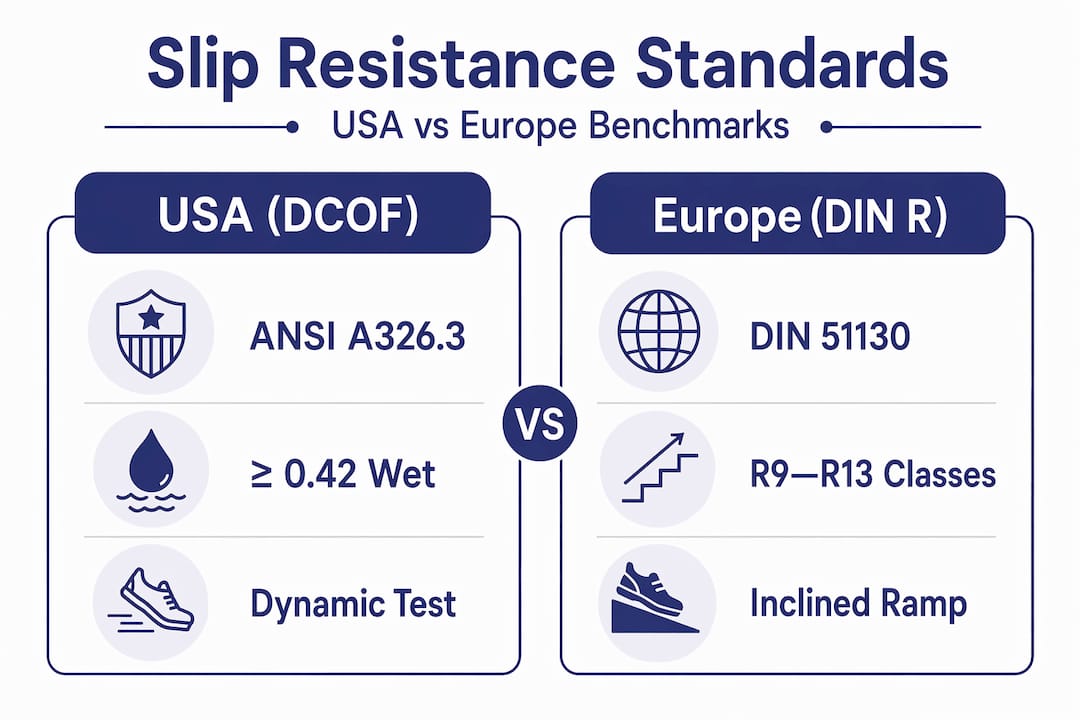
In Europe, particularly in Germany, the standard shifts to DIN 51130, which uses a tilting ramp test with footwear and oil. This method produces R-class ratings from R9 to R13. A higher R-class means higher slip resistance, and R13 represents the highest slip resistance available under that classification. R9 is the lowest rated slip-resistant surface; it handles dry environments but offers minimal protection where liquids or contaminants are present.
The ADA (Americans with Disabilities Act) also sets expectations. Accessible routes must use flooring that is firm, stable, and slip-resistant, which reinforces the DCOF-referenced approach for any commercial building accessible to the public. Referencing slip resistance essentials gives a practical overview of how these measurements apply to everyday purchasing decisions.
“Slip-resistant hard-surface flooring is commonly specified using ANSI A326.3 DCOF dynamic testing. A minimum DCOF of 0.42 is specified for level interior surfaces expected to be walked on when wet.”
| Standard | Region | Method | Minimum Safe Rating |
|---|---|---|---|
| ANSI A326.3 (DCOF) | United States | Dynamic friction test (wet) | 0.42 |
| DIN 51130 | Europe/Germany | Tilting ramp, oil, footwear | R9 (wet); R13 (max) |
| ADA 2010 Standards | United States | Performance-based, DCOF referenced | Stable, firm, slip-resistant |
| AS 4586 | Australia | Pendulum and oil-wet ramp | Class P3+ (high risk wet) |
Understanding where your facility falls on this table is the first step. Buying flooring without knowing which standard applies to your region and risk level is one of the most common, and most costly, mistakes facility managers make.
Matching slip-resistance solutions to real-world hazards
Even with a solid understanding of test standards, your real-world facility risks are more complex than a lab measurement. A production floor exposed to cutting oil presents a completely different challenge than a hospital corridor or a restaurant kitchen.
Start with a risk-factor audit. Identify the primary hazards in each zone of your facility before you specify a product. The main risk categories are:
- Liquid contamination: Water, beverages, condensation, cleaning runoff
- Oil and grease exposure: Machine oil, cooking grease, lubricants, hydraulic fluid
- Chemical exposure: Solvents, acids, cleaning agents, food processing byproducts
- High foot traffic volume: Entrance zones, corridors, loading areas, stairways
- Transition zones: Areas where flooring materials meet, creating uneven surfaces or traction changes
The mistake many buyers make is treating “rubber” as a universal solution. According to UFGS 09 65 00 Resilient Flooring Spec, some rubber flooring is not resistant to oil and grease, and can perform poorly against certain reagents and spills. Specifying rubber in a kitchen or machine shop without checking chemical compatibility could result in a surface that degrades rapidly and loses grip.
| Hazard Type | Flooring Option | Key Specification Need | Avoid |
|---|---|---|---|
| Water/moisture | WaterHog mats, vinyl composite | High DCOF wet rating | Smooth polished tile |
| Oil/grease | Nitrile rubber, drainage mats | Oil-resistant compound | Standard rubber |
| Chemical exposure | PVC/nitrile blend, coated surfaces | Reagent resistance chart | Uncoated rubber, carpet |
| High traffic (dry) | Berber mats, heavy duty rubber | Abrasion resistance | Lightweight foam |
| Stairs/ramps | Anti-slip nosing, textured overlay | DIN R11+ or DCOF 0.50+ | Smooth laminate |
For wet work environments, non slip floor mats for wet areas outlines key selection criteria. Environments with standing workers also benefit significantly from mats that combine slip resistance with ergonomic support. Reviewing the anti-fatigue standing mats selection guide walks through eight specific criteria, including surface texture, mat permeability, and drainage design.
Transition strips between flooring materials also carry hidden risk. Where carpet meets hard floor, or where two different surface levels meet, metal transition strips provide a stable, flush bridge that eliminates a common trip and slip point.
Pro Tip: Map your facility zone by zone on paper before buying a single product. Assign each zone a primary hazard type and match it to the correct product specification. This takes less than an hour and can prevent months of incorrect product use or replacement costs.
How to implement and maintain slip-resistant flooring
Once you have picked the right material for your risk factors, success depends on installing and maintaining it properly. The best-specified product fails if it is installed incorrectly or cleaned with the wrong products.
Follow these core implementation steps:
- Prepare the substrate correctly. Clean and dry the subfloor completely before installation. Adhesive failures and mat curling often trace back to contaminated or damp surfaces. For coatings, apply primers per the manufacturer’s specifications.
- Verify coverage and placement. Mats must cover the full transition or risk zone, not just the center. Exposed edges at doorways or workstations create micro-slip hazards.
- Use correct adhesives or anchoring. For permanent installations, confirm adhesive compatibility with both the mat backing and the subfloor material. Mats used without anchoring in high-traffic zones shift and buckle.
- Establish a cleaning protocol that protects traction. According to safety flooring best practices, floor polishes and waxes can coat safety flooring and reduce slip resistance. Use cleaning products approved for the specific mat or floor material.
- Inspect on a fixed schedule. Walk each zone weekly. Look for mat curling, surface wear, embedded debris, or any visible change in texture. Replace products before they reach failure, not after an incident.
- Document everything. Record the product name, manufacturer, installation date, DCOF or R-class rating, and your maintenance log. This documentation is your first line of defense in any liability claim.
For non slip industrial flooring installations, surface prep standards are especially critical because industrial environments accumulate oils and particulates that interfere with adhesion. The guide on avoiding slippery floors covers the most common errors that reduce the effectiveness of otherwise well-specified products.
Floor transitions and safety is an often undervalued component of the overall floor safety system. Proper edge treatment at every flooring boundary is just as important as the surface material itself.
Pro Tip: Never use a general-purpose floor polish on safety matting or textured anti-slip surfaces. These products fill the texture profile that generates traction, turning a compliant surface into a liability. Always check the product’s technical data sheet before introducing any cleaning chemical into your protocol.
Practical examples of slip-resistant solutions: Coatings, mats, and specialty areas
Theory aside, seeing proven solutions for each hazard area can make the options real. Different areas call for different approaches, and combining solutions is almost always more effective than a single product strategy.
Coatings for concrete and asphalt. Pedestrian areas like pool decks, loading docks, and exterior walkways often cannot use mats due to weather, vehicle traffic, or surface irregularity. In these zones, slip-resistant coatings are the primary tool. Sika’s Sikalastic-658 is an acrylic slip-resistant coating system designed for asphalt and concrete, with silica sand broadcast to enhance traction for pedestrian traffic areas including pool decks, walkways, and stairways. The sand aggregate embeds into the wet coating and creates a micro-textured surface that significantly raises the DCOF rating once cured.
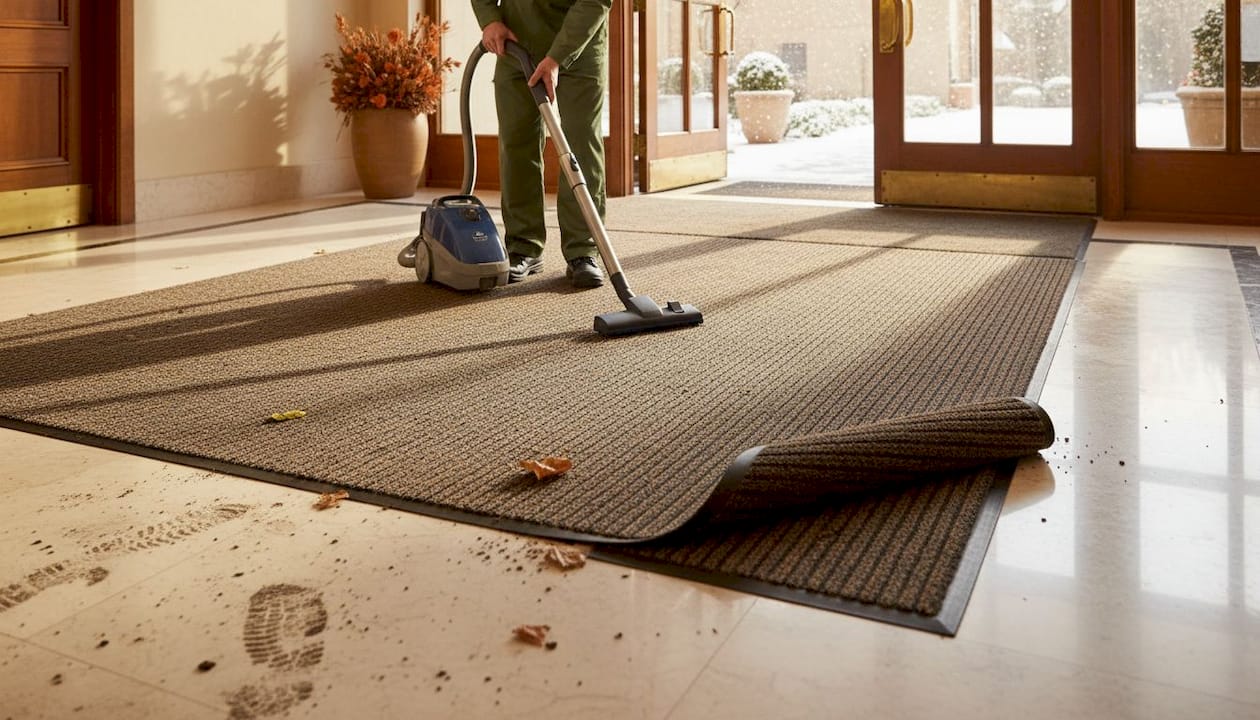
Safety mats for entrances and kitchens. Entrance zones are where the most tracked-in moisture and debris accumulate. A properly selected entrance mat captures water and grit before it spreads into the building interior, protecting both safety and interior flooring. Kitchens and food prep zones require drainage mats with oil-resistant compounds and surfaces that maintain grip even when covered in cooking residue. The anti slip floor mat guide details product categories by use case.
Specialty areas: Stairs, ramps, and thresholds. These locations account for a disproportionate share of serious slip-and-fall injuries. For stairs, anti-slip stair nosing with DIN R11 or higher ratings is standard. Ramps in loading bays require coatings or mats rated for the degree of incline. Where flooring meets a threshold, hardfloor edge strips provide a flush, durable solution that eliminates the raised edge hazard.
Under ADA requirements, accessible routes must use floor and ground surfaces that are stable, firm, and slip-resistant, with DCOF testing as the reference method. This applies to any path of travel accessible to the public or used by employees with disabilities.
Key solution combinations that work in practice:
- Entrance mat plus floor coating at lobby threshold
- Drainage mat plus wall-to-wall anti-fatigue mat in kitchen stations
- Stair nosing plus landing mat at bottom of stair run
- WaterHog mat plus transition strip at exterior-to-interior boundary
The slip proof mat info resource expands on backing materials, surface textures, and what to look for in mat certifications.
Why most slip-resistance failures are due to shortcuts, not materials
Now that you have seen solutions in action, here is a perspective that many overlook but should shape your whole approach. Slip-resistance failures in commercial facilities almost never come from the wrong product choice alone. They come from shortcuts in implementation, cleaning, inspection, and documentation.
A facility can specify a DCOF-compliant mat, have it installed correctly, and still end up with a hazardous surface within 90 days if the maintenance protocol uses incompatible cleaning products or if inspections are skipped. The product did not fail. The system failed.
This is the “set and forget” trap. Flooring products are treated as permanent infrastructure rather than active safety systems that require ongoing management. A DCOF rating on a data sheet reflects the product at the time of manufacture, not after six months of daily cleaning with the wrong mop solution.
The legally defensible approach is to specify using a benchmark standard that matches your region, ANSI A326.3 DCOF in the U.S. or DIN 51130 R-classes in Europe, and then confirm performance over time through maintenance logs and periodic re-testing. OSHA and ADA compliance are performance-oriented, not purely numeric, which means your documentation of what you selected and how you maintained it becomes the core of your defense in any incident investigation.
This also means that skimping on documentation is the single most expensive shortcut you can take. A well-documented safety floor program communicates that you took the hazard seriously, selected the appropriate product for the conditions, and maintained it properly. That record changes the legal and operational outcome dramatically. For high-risk zones like kitchens, kitchen slip safety strategies applies this system-based thinking directly to one of the most challenging environments in any food service or food processing facility.
Real safety is a process. Not a product you purchase once and forget.
Enhance your facility’s safety with proven slip-resistant solutions
Let’s turn these lessons into action with solutions proven in busy facilities like yours. Mats4U.com stocks products built for the exact risk profiles covered in this article: high-traffic entrances, wet production zones, kitchen stations, and everything between. The WaterHog Max mat handles entrance moisture capture at a high-performance level, with a durable face that maintains grip through heavy daily foot traffic. For workers standing at stations in wet or fatiguing environments, the anti-fatigue comfort mat combines ergonomic support with a non-slip backing designed for industrial use. Facilities that want to reinforce safety messaging at entry points can also specify custom logo floor mats that combine branded appearance with practical traction performance. Free delivery on orders over $100 and Made in the USA quality make Mats4U a practical choice for facilities that take floor safety seriously.
Frequently asked questions
What is the minimum slip resistance required for commercial floors in the U.S.?
For most interior wet surfaces, a minimum DCOF of 0.42 is the baseline specified by ANSI A326.3 for level surfaces expected to be walked on while wet.
Can slip resistance change over time after installation?
Yes. Floor polishes and waxes can coat safety flooring and reduce friction, meaning a compliant surface can become non-compliant without any change to the product itself.
Are all rubber floors resistant to oil or chemical spills?
No. Some rubber flooring is not resistant to oil, grease, or certain reagents, so material compatibility with actual site contaminants must be confirmed before specification.
Which areas most often require slip-resistant coatings?
Pool decks, walkways, and stairways are the most common applications, particularly in outdoor or wet-environment settings where mats are not practical.
How do ADA requirements relate to slip-resistant flooring?
ADA 2010 Standards require all accessible route surfaces to be stable, firm, and slip-resistant, with DCOF testing used as the primary reference method for evaluating compliance.


