


TL;DR:
- Restaurant floor mats for commercial kitchens must have appropriate foam density, non-slip surfaces, and resistance to grease and moisture to ensure safety and durability. Choosing zone-specific mats, such as anti-fatigue foam for prep stations and drainage rubber mats for dishwashing areas, optimizes staff comfort and safety. Proper maintenance, including quick spill cleanup and regular cleaning, extends the lifespan and effectiveness of these mats.
Restaurant floor mats designed for commercial kitchens are defined by three non-negotiable criteria: anti-fatigue foam density, non-slip surface texture, and resistance to grease and moisture. When searching for restaurant floor mats on Amazon, you will find options from brands like House of Noa, WellnessMats, and ComfiLife that have been independently tested by Serious Eats in 2026 and verified for performance in real foodservice environments. The right mat reduces staff fatigue, prevents slip-and-fall incidents, and holds up against daily cleaning cycles. This guide covers what to look for, which products deliver, and how to match the right mat to each area of your operation.
What to look for when buying restaurant floor mats on Amazon
The best anti-fatigue mats for commercial kitchens combine firm foam with enough give to relieve pressure on joints during long standing shifts. Foam that is too soft compresses quickly and loses its benefit within weeks. Foam that is too rigid offers no fatigue relief at all. The target is a mat that springs back immediately after weight is removed, which signals adequate density for sustained daily use.
Surface texture is the second critical factor. Lightly pebbled or textured surfaces provide the grip that prevents slips in wet kitchen conditions. Cushioning alone does not make a mat safe. A smooth-topped anti-fatigue mat in a prep station environment is a liability, not an asset.
Key criteria to evaluate before purchasing:
- Foam density and rebound: Press the mat firmly and release. It should return to full height within two seconds.
- Surface texture: Look for pebbled, ribbed, or beveled surfaces that grip shoes even when wet.
- Water and grease resistance: Closed-cell foam construction prevents liquid absorption and bacterial growth.
- Size range: Commercial kitchens need mats in lengths from 24 inches to 72 inches or more to cover prep stations and dishwashing lines.
- Warranty length: Reputable commercial mats carry warranties of five years or longer. WellnessMats offers 20 years.
- Beveled edges: Tapered edges prevent tripping and reduce mat movement under foot traffic.
Pro Tip: Check the mat’s thickness before ordering. Mats thinner than 3/4 inch rarely provide adequate anti-fatigue benefit for staff standing more than four hours per shift. Review the anti-fatigue mat selection guide for wet environments before finalizing your choice.
Top 10 restaurant floor mats on Amazon and their features
1. House of Noa Nama Standing Mat
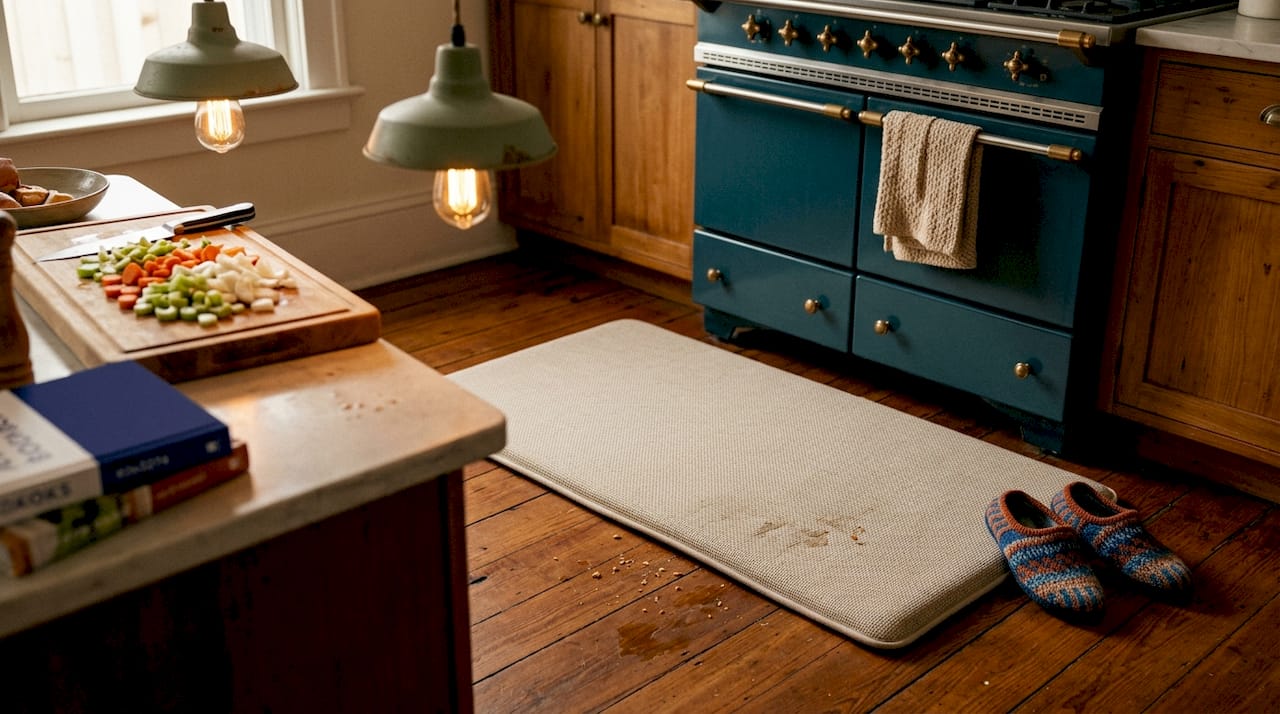
The House of Noa Nama Standing Mat is the top-rated option in Serious Eats 2026 testing for its balance of soft firmness and fast foam rebound. It is available in multiple sizes from 20x32 inches up to 20x72 inches, making it practical for both home kitchens and commercial prep stations. The surface is lightly textured for grip, and the mat lies flat without curling. Price range: $60 to $130 depending on size.
2. WellnessMats Original Anti-Fatigue Floor Mat
The WellnessMats Original is the professional-grade standard in commercial kitchen mats. It carries a 20-year manufacturer’s warranty and is constructed from a single piece of polyurethane that resists stains, punctures, and grease penetration. The surface is smooth but slightly textured, and the mat does not absorb odors. It is the most durable option in this category. Price range: $100 to $200.
3. GelPro NewLife Bio-Foam Professional Mat
The GelPro NewLife Bio-Foam mat is built for cooks who need firm support with low profile clearance, particularly useful near equipment with limited floor clearance. It features a non-slip bottom and fast spring-back after compression. The low profile also reduces tripping risk near steps and transitions. Price range: $70 to $120.
4. ComfiLife Anti-Fatigue Floor Mat
The ComfiLife Anti-Fatigue Floor Mat is the strongest budget option in this category. It offers good foam firmness, a more textured surface than most competitors at its price point, and is available in multiple colors suited to restaurant decor. Cleaning is straightforward with mild soap and water. Price range: $35 to $55.
5. Sky Solutions Sky Mat
The Sky Mat is an inexpensive entry point for restaurant owners testing anti-fatigue mats before committing to premium options. The foam is softer than WellnessMats or House of Noa, which limits its longevity in high-traffic environments. Edge curling has been reported after several months of use. Best suited for low-traffic stations or office areas within the restaurant. Price range: $25 to $45.
6. Topo by Ergodriven
The Topo mat features a contoured, uneven surface designed to encourage subtle foot movement during standing. This design reduces static fatigue better than flat mats in environments where staff stand in one position for extended periods, such as cashier stations or host stands. It is not ideal for wet areas due to its open contour design. Price range: $60 to $90.
7. Kangaroo Original Standing Mat
The Kangaroo Original is a high-volume seller on Amazon with a thick 3/4-inch foam core and a waterproof top surface. It performs well in dry prep areas and is available in a wide range of sizes. The bottom grip layer holds the mat in place on tile floors without adhesive. Price range: $30 to $60.
8. Gorilla Grip Original Thick Foam Mat
The Gorilla Grip mat uses a dual-layer construction with a firm base and softer top layer. This design distributes weight more evenly than single-layer mats. It is machine washable, which is a practical advantage in restaurant environments where hygiene standards require frequent cleaning. Price range: $30 to $50.
9. Apache Mills Cushion Step Mat
The Apache Mills Cushion Step is a rubber-topped mat with a foam core, making it more resistant to grease and chemical cleaners than pure foam options. The rubber surface provides strong slip resistance in wet conditions. It is a practical choice for dishwashing stations and bar areas. Price range: $40 to $75.
10. Rhino Anti-Fatigue Mat
The Rhino mat is constructed from recycled rubber and foam composite, giving it above-average durability for the price. It handles heavy foot traffic and resists compression over time better than foam-only mats. The surface texture is aggressive enough for wet kitchen environments. Commercial anti-fatigue mats like the Rhino are designed specifically for the demands of busy foodservice settings. Price range: $50 to $100.
Comparison of top restaurant floor mats on Amazon
| Brand | Material | Size Range | Thickness | Warranty | Slip Resistance | Price Range |
|---|---|---|---|---|---|---|
| House of Noa Nama | Foam | 20x32 to 20x72 in | 3/4 in | 1 year | Lightly textured | $60 to $130 |
| WellnessMats Original | Polyurethane | 18x24 to 24x72 in | 3/4 in | 20 years | Smooth/textured | $100 to $200 |
| GelPro NewLife | Bio-Foam | 20x32 to 20x48 in | 1/2 in | 1 year | Non-slip bottom | $70 to $120 |
| ComfiLife | Foam | 20x39 to 20x72 in | 3/4 in | 1 year | Pebbled surface | $35 to $55 |
| Sky Solutions Sky Mat | Foam | 20x32 to 20x72 in | 3/4 in | None listed | Smooth | $25 to $45 |
| Rhino Anti-Fatigue | Rubber/foam | 24x36 to 36x60 in | 9/16 in | 1 year | Aggressive texture | $50 to $100 |
| Apache Mills | Rubber/foam | 18x30 to 24x36 in | 5/8 in | 1 year | Rubber surface | $40 to $75 |
The WellnessMats Original stands alone on warranty length. The ComfiLife and Rhino mats offer the strongest value for budget-conscious operators. GelPro NewLife is the right call when low-profile clearance is a physical constraint.
Situational recommendations for different restaurant areas
Matching the mat to the specific work zone is as important as the mat’s overall quality. A mat that performs well at a prep station may be wrong for a dishwashing area. Rubber and drainage mats are the correct choice for wet and greasy zones because they resist liquid absorption and allow drainage through the mat surface.
Recommendations by zone:
- Prep stations and cook lines: Anti-fatigue mats with firm foam and textured surfaces. House of Noa Nama or WellnessMats Original. Staff stand here for four to eight hours continuously.
- Dishwashing areas: Rubber drainage mats or rubber-topped foam mats like the Apache Mills. Water and food debris accumulate constantly in this zone.
- Bar areas: Low-profile rubber mats with drainage holes. Spilled liquids are frequent and the mat must not become a slip hazard.
- Entrances and dining areas: Waterhog-style mats or carpet-topped entrance mats to capture dirt and moisture before it reaches the dining floor.
- Near steps and transitions: Low-profile mats with beveled edges only. Thick mats near elevation changes create tripping hazards.
Pro Tip: For anti-fatigue mat placement in multiple zones, buy one premium mat for your highest-traffic station first. Test it for 30 days before purchasing mats for every station. This prevents a costly mistake if the foam density or size does not match your specific floor and workflow.
Budget operators can use ComfiLife or Kangaroo mats in lower-traffic zones and reserve WellnessMats or House of Noa for the cook line and prep stations where staff fatigue is the highest cost.
How to maintain restaurant floor mats for maximum lifespan
Proper maintenance preserves both the anti-fatigue properties and the slip resistance of commercial kitchen mats. Quick spill cleanup and mild soap cleaning are the two practices that extend mat life the most. Grease left to sit on foam mats degrades the surface layer and reduces grip within weeks.
Follow this maintenance sequence:
- Wipe spills immediately using a dry cloth or paper towel. Do not let liquids pool under or around the mat.
- Daily cleaning: Use mild dish soap and warm water with a soft brush or cloth. Rinse thoroughly and allow the mat to dry completely before placing it back on the floor.
- Weekly deep clean: Remove the mat from the floor and scrub both the top surface and the underside to remove grease and food particles that migrate under the mat.
- Inspect monthly: Check the edges for curling, the surface for worn texture, and the foam for permanent compression. A mat that no longer springs back is no longer providing anti-fatigue benefit.
- Follow manufacturer instructions: WellnessMats prohibits machine washing. GelPro NewLife mats can be wiped clean but should not be soaked. Gorilla Grip mats are machine washable on a gentle cycle.
Pro Tip: Never trap moisture under a mat. Lift mats at the end of each shift and allow the floor beneath to dry. Moisture trapped under closed-cell foam mats creates bacterial growth on the floor surface, which is a health code violation in most jurisdictions. Learn more about mat durability and lifespan to set realistic replacement schedules.
Key takeaways
The most effective restaurant floor mats combine firm anti-fatigue foam, textured non-slip surfaces, and grease-resistant materials matched to the specific demands of each kitchen zone.
| Point | Details |
|---|---|
| Foam density matters most | Choose mats with fast rebound and at least 3/4-inch thickness for cook lines and prep stations. |
| Surface texture prevents slips | Pebbled or ribbed surfaces provide grip in wet conditions where smooth mats become hazards. |
| Match mat to zone | Use drainage rubber mats for dishwashing, anti-fatigue foam for prep, and entrance mats for dining areas. |
| Warranty signals durability | WellnessMats’ 20-year warranty reflects construction quality that lower-cost mats cannot match. |
| Maintenance extends lifespan | Daily soap-and-water cleaning and lifting mats to dry the floor beneath prevents premature failure. |
What I have learned from years of watching restaurants choose the wrong mats
The most common mistake I see restaurant operators make is buying the same mat for every station. A cook line and a dishwashing station have completely different demands. Foam mats in dishwashing areas absorb water and grease, compress within months, and become slip hazards. Rubber drainage mats in prep areas are uncomfortable for staff standing eight-hour shifts. The zone-specific approach is not a luxury. It is the only approach that works.
The second mistake is treating warranty length as a marketing number. WellnessMats’ 20-year warranty is not a gimmick. It reflects a single-piece polyurethane construction that genuinely does not delaminate, crack, or compress the way multi-layer foam mats do. I have seen budget mats replaced three times in the same period a single WellnessMats unit remained in service. The math favors the premium option over a three-year horizon.
The trend worth watching in 2026 is bio-foam construction. GelPro’s NewLife material and similar compounds offer firmer, more consistent support than traditional EVA foam without the weight or cost of rubber. For operators who need restaurant anti-fatigue mat performance without the premium price of polyurethane, bio-foam is the category to watch. Amazon’s selection in this segment has grown significantly and prices are competitive.
— Werner
Find the right commercial floor mat at Mats4u
Mats4u specializes in commercial and industrial floor mats built for the demands of foodservice environments. The Comfort Premier™ Mat is a premium anti-fatigue option designed for cook lines and prep stations, with ergonomic foam construction and a hygienic surface that cleans in minutes. For wet zones like dishwashing stations and bar areas, the Comfort Flow™ Drainage Mat combines anti-fatigue support with drainage channels that remove standing water from the work surface. Mats4u offers free delivery on orders over $100 and carries Made in the USA products built for high-traffic commercial use. Browse the full catalog at Mats4u.com to find the right mat for every station in your restaurant.
FAQ
What are restaurant floor mats?
Restaurant floor mats are commercial-grade mats designed to reduce slip hazards, absorb standing fatigue, and resist grease and moisture in kitchen and dining environments. They differ from residential mats in foam density, surface texture, and material durability.
Are anti-fatigue mats worth it for restaurant kitchens?
Yes. Commercial anti-fatigue mats reduce joint strain for staff standing four or more hours per shift, which lowers fatigue-related errors and injury risk. The cost per mat is recovered quickly through reduced staff turnover and fewer workplace incidents.
What is the best restaurant floor mat on Amazon?
The WellnessMats Original Anti-Fatigue Floor Mat is the top commercial-grade option based on its 20-year warranty, single-piece polyurethane construction, and stain and puncture resistance. The ComfiLife Anti-Fatigue Floor Mat is the strongest budget alternative for lower-traffic stations.
How often should restaurant floor mats be replaced?
Premium mats like WellnessMats can last a decade or more with proper maintenance. Budget foam mats in high-traffic areas typically need replacement every 12 to 24 months. The key indicator is permanent compression: if the mat no longer rebounds after weight is removed, it has lost its anti-fatigue function.
Can restaurant floor mats be used in wet areas?
Rubber drainage mats and rubber-topped foam mats are rated for wet areas. Standard foam anti-fatigue mats absorb moisture and degrade in dishwashing or bar environments. Always verify the mat’s material and drainage design before placing it in a wet zone.


