


TL;DR:
- Choosing the right cheer mats is crucial for athlete safety, skill development, and facility durability. Foam density, thickness, vinyl quality, portability, and warranty significantly impact performance and longevity. Proper evaluation and maintenance ensure optimal safety, making high-quality mats a valuable investment for gyms and training programs.
Selecting the right cheer mats is one of the most consequential decisions a coach or gym owner makes. The wrong mat puts athletes at risk. The right one supports skill progression, absorbs impact, and holds up through thousands of repetitions. Yet most purchasing decisions come down to price and dimensions, leaving out the variables that actually determine performance: foam density, vinyl construction, surface type, and portability. This guide breaks down every factor you need to evaluate before buying, covers the main mat types worth considering, and gives you a direct comparison to match the right mat to your facility.
Table of Contents
- Key takeaways
- 1. Why cheer mats are a safety-critical purchase
- 2. Key factors to evaluate before buying
- 3. Folding panel mats: the most versatile option
- 4. Roll-out cheer mats: fast deployment for large floors
- 5. Inflatable air floors: understand the limitations
- 6. Carpet-bonded stunt mats: built for commercial gyms
- 7. Side-by-side comparison of cheer mat types
- 8. Choosing the right mat for your specific setting
- My take on what coaches consistently get wrong
- Find the right mat solution at Mats4u
- FAQ
Key takeaways
| Point | Details |
|---|---|
| Match thickness to your surface | Use 2-inch mats on hardwood or concrete; 1.375-inch mats work on carpet. |
| Foam type determines safety | Crosslink foam with medium-firm density prevents bottoming out and reduces injury risk. |
| Warranty signals build quality | Commercial mats carry 3-year warranties; home mats average 1 year. |
| Portability requires planning | Foldable cheer mats and roll-out options differ significantly in weight and storage footprint. |
| Maintenance extends mat life | Soap and water cleaning preserves vinyl integrity; bleach-based products degrade surfaces fast. |
1. Why cheer mats are a safety-critical purchase
Not every mat marketed for cheerleading actually protects athletes. A gymnastics crash mat and a cheerleading practice mat serve different functions. Cheer mats must absorb repetitive impact from tumbling passes, support the base during stunts, and provide enough surface grip for clean footwork.
The stakes are real. A mat that is too thin bottoms out on contact, transferring force directly to the floor beneath. A mat that is too soft gives inconsistent feedback, which disrupts skill development and increases ankle and knee strain. You are not just buying flooring. You are buying a training environment.
2. Key factors to evaluate before buying
Getting this decision right starts with a clear evaluation framework. Before comparing models or prices, work through these criteria.
Foam type and density. Crosslink foam offers the best balance of cushioning and firmness for cheerleading. It does not compress unevenly over time the way polyurethane foam does. Experts strongly recommend medium-firm crosslinked foam for optimal safety. Foam that is too soft allows bottoming out; foam that is too hard creates impact injuries on hard landings.
Mat thickness and surface type. 2-inch thick mats are recommended for hard surfaces like hardwood or concrete floors. If your facility has carpeted subfloors, 1.375-inch mats provide adequate protection and cost less to store. Matching thickness to your surface is not optional. It is the single most direct factor in bottoming-out prevention.
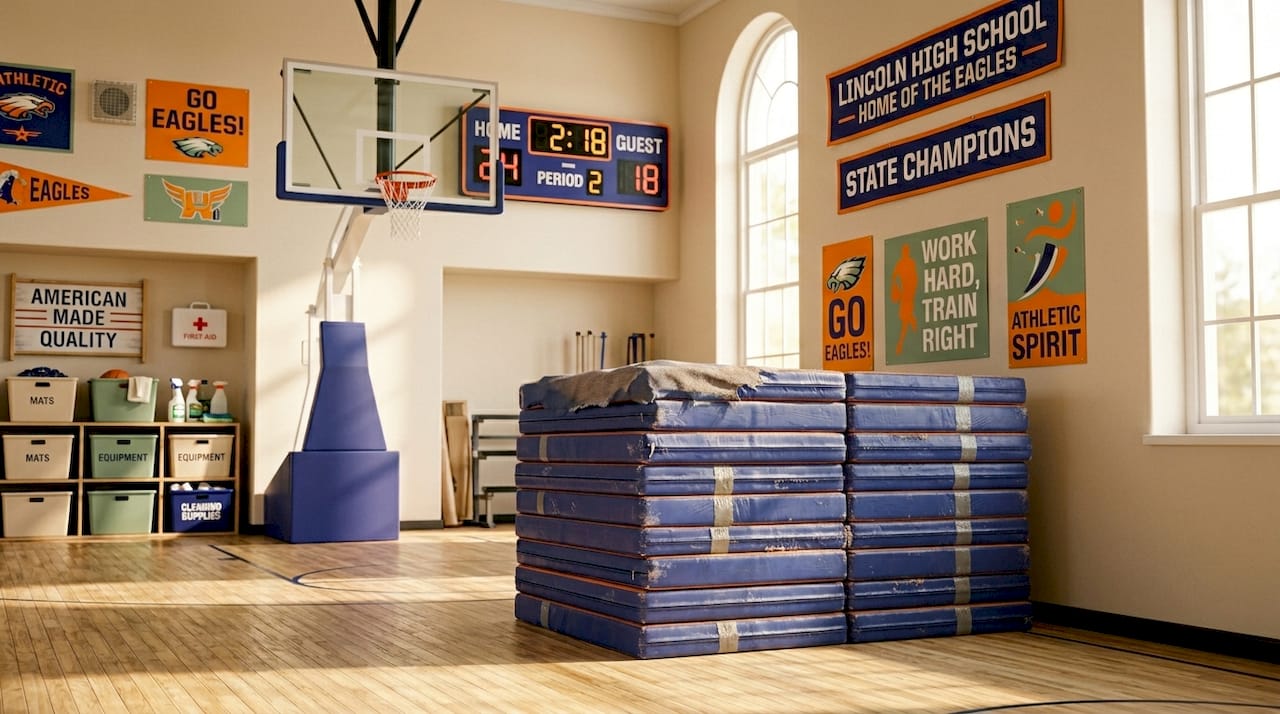
Vinyl cover quality. Look for 18 oz to 21 oz knife-coated vinyl. Lighter vinyl tears faster under repeated use. 21 oz vinyl covers with multiple foam layers represent the upper tier of construction for commercial settings.
Portability and storage. Foldable cheer mats collapse into 2-foot panels, which makes moving them between courts or storing them against a wall practical. Roll-out cheerleading mats are faster to deploy but require more floor space when stored. Consider how often mats move and whether you have dedicated storage.
Warranty length. Carpet-bonded mats for commercial gyms typically carry a 3-year limited warranty, while home-use mats average around 1 year. Warranty length directly reflects the expected use intensity a mat is built for.
Cleaning requirements. Simple soap and water is the recommended cleaning method for vinyl tumbling mats. Bleach-based products break down the vinyl coating, leading to cracking and reduced slip resistance. Establish a cleaning schedule, and share it with your staff.
Pro Tip: When evaluating foam quality in person, press firmly with your palm and release. The mat should return to shape within two seconds. If it holds an impression, the foam density is too low for commercial cheerleading use.
3. Folding panel mats: the most versatile option
Folding panel mats are the most widely used format in cheerleading practice settings. They are built from high-density crosslink foam covered in knife-coated vinyl, fold into 2-foot wide sections, and connect to adjacent mats via velcro. This makes them scalable. You can cover a small corner for individual tumbling work or connect several mats to build a full training floor.
Folding panel mats typically come in 4x8 or 5x10 foot configurations with up to 24-month warranties depending on the manufacturer. The velcro connection system matters more than it sounds. Mats that shift during practice create gaps that catch feet and disrupt momentum. Quality velcro on multiple sides allows gyms to tailor mat arrangement to their specific floor space.
Common sizes for folding cheerleading mats run from 4x8 ft for home use to 5x10 ft for gym training. Thickness options typically include 1.375 inches and 2 inches.
4. Roll-out cheer mats: fast deployment for large floors
Roll-out cheerleading practice mats are ideal when you need to cover large floor areas quickly. They unroll flat without the panel seams that folding mats create, which gives a more consistent training surface for tumbling runs.
Portability varies widely across roll-out mat models. Some weigh around 15 lbs and fold compactly. Others require two people and a storage cart. Before ordering, check the rolled diameter and weight, especially if your staff sets up and breaks down mats for multiple practices per day.
Roll-out mats work well for programs that use a dedicated practice space and do not need to reconfigure frequently. If your gym shares floor space with other sports or classes, foldable cheer mats offer more practical daily flexibility.
5. Inflatable air floors: understand the limitations
Inflatable air floors generate buzz in cheerleading circles because they provide a responsive, bouncy surface that supports skill progression. Athletes feel more confident learning new tumbling sequences on air floors because the surface absorbs and returns energy.
What coaches sometimes miss: air floors are not landing mats. Their impact absorption properties differ entirely from foam-based cheerleading mats. They support skill development in the learning phase but should not replace standard cheer mats for full-intensity practice.
Maintenance for air floors is more demanding. Keeping them clean and dry is non-negotiable. Moisture inside the bladder promotes mold. Sharp objects puncture the surface. Used correctly as a complement to your standard mat setup, they are a legitimate training tool. Used as a primary mat substitute, they create safety gaps.
Pro Tip: Reserve inflatable air floors for skill introduction phases only. Once athletes are drilling a skill at full intensity, transition them to standard high-density cheer mats. This protects both safety and your air floor investment.
6. Carpet-bonded stunt mats: built for commercial gyms
Carpet-bonded mats use a firm foam base bonded to a carpet surface layer. That carpet texture provides more grip for bases during stunting sequences compared to smooth vinyl, which matters when athletes are supporting weight overhead.
These mats are heavier and less portable than vinyl-covered options, but they are built for commercial gym durability. A 3-year limited warranty on commercial carpet-bonded mats versus 1 year for residential versions reflects the construction difference. For a gym running multiple practices per day, that extra durability pays off quickly. For home use, the added weight and cost are rarely justified.
Coaches running stunt-focused programs should consider carpet-bonded mats for designated stunting zones and pair them with high-durability vinyl mats for tumbling areas. Different surfaces serve different skills.
7. Side-by-side comparison of cheer mat types
| Mat type | Thickness | Foam type | Weight | Best for | Warranty |
|---|---|---|---|---|---|
| Folding panel mat | 1.375 or 2 in | Crosslink foam | Moderate | Home and gym tumbling | Up to 24 months |
| Roll-out mat | 1.375 or 2 in | Crosslink foam | 15 lbs+ | Large gym floors | Varies by brand |
| Inflatable air floor | Variable | Air bladder | Light | Skill progression only | Varies |
| Carpet-bonded stunt mat | 1.5 to 2 in | High-density foam | Heavy | Commercial stunt zones | 3-year limited |
| High-density vinyl mat | 2 in | Crosslink foam | Moderate | Hard surface gyms | 12 to 24 months |
The table above should guide your first filter. If portability is a priority, roll-out and folding panel mats lead the field. If you run a commercial stunt program, carpet-bonded mats belong in your budget conversation.
8. Choosing the right mat for your specific setting
For commercial gyms: Invest in 2-inch crosslink foam mats on all hard-surface areas. Use carpet-bonded mats in stunting zones. Connect folding panel mats with quality velcro systems to allow flexible floor configurations. Budget for mat replacement schedules so worn mats do not stay in rotation past their safe lifespan.
For home use or cheer mats for home practice: A single 4x8 or 5x10 folding panel mat in 1.375-inch thickness handles most individual practice needs on carpet. On hardwood floors at home, step up to 2-inch thickness. Home-use mats carry shorter warranties, so they are priced lower but expect a replacement cycle around the 12-month mark with regular use.
For programs on a budget: Do not sacrifice foam quality to save money on thickness or vinyl weight. A thinner mat made with proper crosslink foam is safer than a thicker mat with low-grade polyurethane. Review specifications before comparing prices.
For outdoor practice: Outdoor cheer mats need UV-resistant vinyl and should be stored indoors when not in use. Moisture is the primary enemy of foam longevity outdoors, so storage and cleaning protocols matter more in that setting.
Combining mat types is normal practice in well-equipped gyms. Knowing which gym matting criteria to apply in each zone of your facility keeps both costs and injury risks in check.
My take on what coaches consistently get wrong
I have seen programs invest in large mat inventories and still run unsafe practices. The issue almost always comes down to two things: foam selection and maintenance habits.
Coaches often prioritize mat size and surface area over foam quality. A gym full of thin, soft mats is worse than a gym with fewer mats that have proper crosslink density. The foam is where safety actually lives. Size is secondary.
The second mistake is neglecting cleaning until mats visibly degrade. Vinyl that is never cleaned becomes brittle. Grip decreases. The surface cracks. At that point, the mat is a liability, not an asset. Routine mat maintenance takes under 10 minutes per session and extends mat life by years.
My recommendation for newer programs: start with fewer, higher-quality folding panel mats instead of buying a large quantity of budget options. You will replace budget mats within a season. Quality crosslink foam mats last several years with proper care, and they protect athletes throughout that entire period.
— Werner
Find the right mat solution at Mats4u
Mats4u offers commercial-grade flooring built for high-use environments. Whether you need anti-fatigue support for coaching staff standing during long practices or custom logo mats for your facility entrance, the product range covers practical needs across your gym. For athletes training on hard surfaces for extended sessions, the Cushion Complete Mat delivers the anti-fatigue comfort that keeps staff and athletes performing through long training days. All orders over $100 ship free, with Made in the USA construction backing every purchase. Browse the full selection at Mats4u and contact the team directly to match the right product to your facility requirements.
FAQ
What thickness cheer mat do I need for a hardwood floor?
2-inch thick mats are recommended for hard surfaces like hardwood or concrete to prevent athletes from bottoming out on impact. On carpet, 1.375-inch mats provide adequate support.
Are inflatable air floors safe for cheerleading practice?
Inflatable air floors support skill progression but are not substitutes for standard cheer mats. They have different impact absorption properties and should complement, not replace, foam-based cheerleading practice mats.
How do I clean vinyl cheer mats without damaging them?
Use soap and water only. Bleach-based products break down the vinyl coating over time, reducing grip and causing surface cracking. A quick wipe-down after each practice session protects mat integrity long-term.
What warranty should I expect on commercial cheer mats?
Commercial carpet-bonded mats typically carry a 3-year limited warranty, while home-use mats average around 1 year. Longer warranties reflect construction built for daily, high-intensity use.
Can I connect multiple foldable cheer mats together?
Yes. Quality foldable cheer mats include velcro fasteners on multiple sides, allowing you to connect panels and configure the mat area to fit your practice space. This works for both small home setups and large commercial gym floors.


