


TL;DR:
- Custom floor mats provide cost-effective, passive brand exposure with durability and strategic placement.
- Proper design and placement are essential to maximize visibility and reinforce brand consistency.
- Regular review and updates of mats transform them from facilities items into powerful marketing assets.
Most businesses treat floor mats as a maintenance item. Order them, place them, forget them. That’s a significant missed opportunity. Custom floor mats placed in high-traffic areas generate continuous brand exposure at entry points, lobbies, and checkout zones, creating first impressions and reinforcing identity with every visitor. A single mat at a busy retail entrance can deliver hundreds of thousands of brand impressions over its lifespan, at a cost per impression that no digital ad campaign can match. This guide shows you exactly how to use custom mats as a measurable, strategic branding tool.
Table of Contents
- Why custom mats are a branding powerhouse
- How custom mat design and placement supercharge visibility
- Calculating ROI: Brand impressions vs. investment
- Integrating custom mats with your overall brand strategy
- Our perspective: What most brands get wrong about custom mats
- Enhance your brand with custom mats from Mats4U
- Frequently asked questions
Key Takeaways
| Point | Details |
|---|---|
| Massive daily brand exposure | Custom mats in high-traffic areas multiply brand impressions at very low cost. |
| Passive, dual-purpose marketing | Mats protect floors while delivering consistent, visual branding to every visitor. |
| Measurable ROI advantage | Each custom mat can provide over 547,000 impressions with a lower cost per impression than most other marketing channels. |
| Integration with campaigns | Brand consistency is maximized when custom mats match wider marketing visuals and messaging. |
Why custom mats are a branding powerhouse
Custom mats sit at the intersection of function and marketing. They protect floors, reduce slip hazards, and manage dirt. They also display your logo, colors, and messaging to every person who walks through your door. That combination is rare in any marketing channel.
The numbers make the case clearly. A retail location with 300 daily visitors generates roughly 109,000 brand impressions per year. Over a five-year mat lifespan, that climbs to 547,000 impressions from a single $150 mat, at approximately $0.0003 per impression. No billboard, no social ad, and no email campaign delivers that ratio.
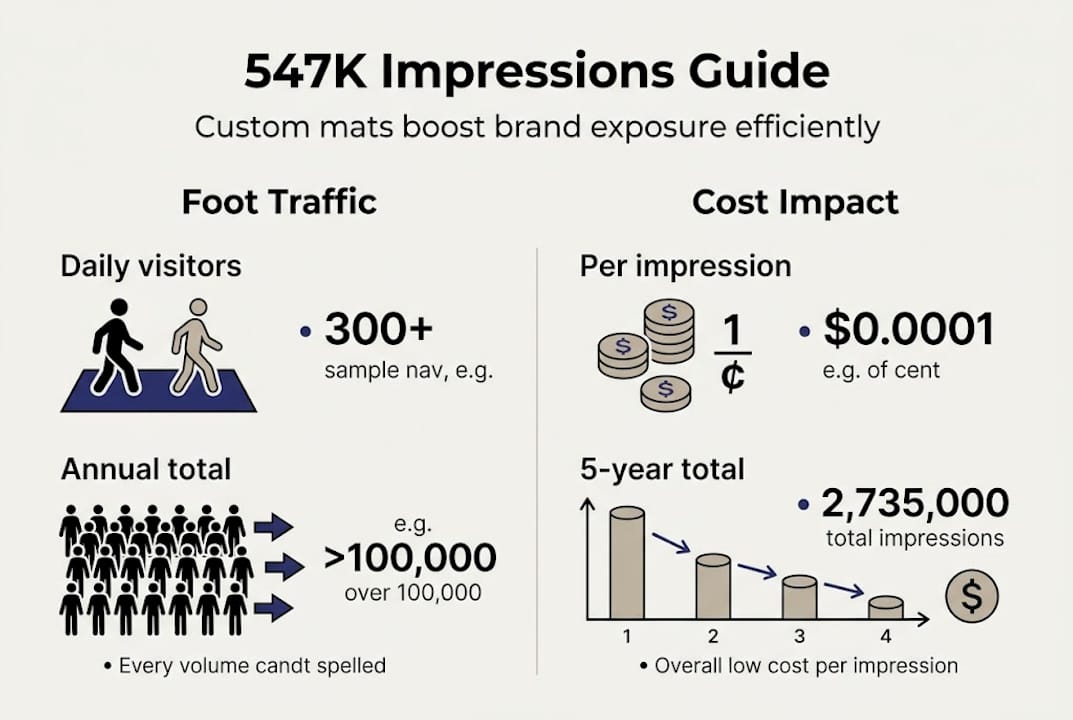
| Scenario | Daily visitors | Annual impressions | 5-year impressions | Cost per impression |
|---|---|---|---|---|
| Small retail store | 300 | 109,000 | 547,000 | $0.0003 |
| Mid-size office lobby | 150 | 54,750 | 273,750 | $0.0005 |
| High-traffic restaurant | 600 | 219,000 | 1,095,000 | $0.0001 |
The core advantages of custom mats for brand visibility include:
- Passive marketing: No ongoing spend after purchase. The mat works every hour the location is open.
- Dual utility: Protection and promotion in one product. No need to justify the spend as purely marketing.
- Placement flexibility: Entrances, corridors, elevator banks, restrooms, and checkout areas all offer valid touchpoints.
- Durability: Quality commercial mats last years, not weeks, extending the ROI window significantly.
“Custom mats provide cost-effective, passive branding with dual utility, combining protection and marketing in a single product, making them ideal for commercial spaces.”
Understanding logo mats and brand image is the first step. The second is knowing how to design and place them for maximum effect.
How custom mat design and placement supercharge visibility
A mat with a blurry logo or mismatched colors does more harm than good. Design precision matters as much as placement strategy. When both are right, brand recall increases substantially.

The cost-effective, passive branding potential of custom mats only activates when the design communicates clearly at floor level. Visitors glance down for a fraction of a second. Your mat must register instantly.
Placement comparison by location:
| Location | Visibility level | Foot traffic | Best mat type |
|---|---|---|---|
| Main entrance | Very high | All visitors | Logo mat, Waterhog |
| Lobby or reception | High | Clients, guests | Branded Berber or logo mat |
| Checkout or POS area | High | Buyers | Anti-fatigue with logo |
| Elevator bank | Medium | Staff and visitors | Logo mat |
| Restrooms | Low | All visitors | Rubber or utility mat |
Follow these steps to match mat type and size to your traffic level:
- Measure foot traffic. Count average daily visitors per location zone. High-traffic zones (over 200 visitors per day) need heavy-duty materials like Waterhog or rubber-backed mats.
- Select mat size based on doorway or zone width. A mat that covers less than 80% of an entrance width misses too many visitors.
- Choose design elements that match your brand style guide. Logo, primary brand colors, and any tagline should be reproduced exactly as specified in your brand standards.
- Order samples before full deployment. Color reproduction on mat fiber differs from screen or print. Always verify before ordering at scale.
- Review placement after installation. Check that the mat is visible from standing height and not obscured by furniture or signage.
Pro Tip: If your business operates multiple locations, create a mat style guide as part of your broader brand standards. Specify approved logo versions, color codes, mat dimensions, and placement zones. Consistency across locations compounds brand recall. A customer who visits three of your locations and sees the same mat design each time registers your brand more strongly than one who sees three different approaches.
For a full breakdown of design and material options, the custom floor mats guide covers material selection in detail, and the logo mats for business resource walks through design specifications.
Calculating ROI: Brand impressions vs. investment
Marketing managers need numbers to justify spend. Custom mats make that straightforward once you have a simple framework.
Start with your foot traffic data. Most retail and commercial locations track this through POS systems, door counters, or lease agreements that include traffic estimates. Use that daily average as your baseline.
Custom mat ROI scenarios:
| Mat cost | Daily visitors | Annual impressions | 5-year impressions | Cost per impression |
|---|---|---|---|---|
| $150 | 300 | 109,500 | 547,500 | $0.0003 |
| $250 | 500 | 182,500 | 912,500 | $0.0003 |
| $400 | 800 | 292,000 | 1,460,000 | $0.0003 |
| $600 | 1,200 | 438,000 | 2,190,000 | $0.0003 |
The cost per impression stays remarkably consistent at around $0.0003 regardless of traffic volume, because higher-traffic locations typically require more durable, slightly more expensive mats.
Here is a step-by-step process for comparing mat spend to other marketing channels:
- Pull your current CPM (cost per thousand impressions) from your active channels. Digital display averages $2 to $5 CPM. Out-of-home averages $4 to $8 CPM.
- Calculate your mat CPM. At $0.0003 per impression, your mat CPM is $0.30. That is 6 to 26 times cheaper than standard digital display.
- Factor in mat lifespan. A five-year mat amortizes its cost over 60 months. No other physical marketing asset does that.
- Add the functional value offset. The mat also protects your floor and reduces liability from slips. Assign a conservative dollar value to that function and subtract it from the marketing cost.
- Present the net marketing cost. In most scenarios, the net cost of the mat as a marketing tool approaches zero once functional value is accounted for.
Statistic: At $0.0003 per impression, custom mats deliver brand exposure at a fraction of the cost of any traditional or digital channel.
For more detail on how boosting brand visibility with mats fits into a broader marketing budget, see the linked resource.
Integrating custom mats with your overall brand strategy
A custom mat that does not align with your current campaign artwork is a missed opportunity. The strongest brands treat every physical touchpoint, including floor mats, as an extension of the same visual system.
Continuous exposure at entry points reinforces brand identity, but only when the mat design matches what customers see on your website, signage, and packaging. Mismatched colors or outdated logos undermine the consistency that builds trust.
For multi-location businesses, these actions are non-negotiable:
- Maintain a centralized mat style guide that specifies approved logo files, Pantone color codes, mat dimensions, and material standards.
- Establish an approval process so no location orders a mat without brand team sign-off.
- Audit mat condition quarterly. Faded or worn mats damage brand perception more than no mat at all.
- Align mat orders with campaign calendars. If a major campaign launches in Q2, new mats should be in place before launch, not after.
- Document placement standards so every location positions mats identically at entry points and key zones.
Pro Tip: Use custom mats to support seasonal campaigns, grand openings, or brand milestones. A mat featuring a limited-edition campaign message or anniversary logo creates a physical, in-store expression of your digital and print campaign. It costs little to update mat designs relative to other campaign materials, and the impact at the point of entry is immediate.
Coordination with your digital team matters too. If your website homepage features a seasonal promotion, your entrance mat should reflect the same visual language. That alignment signals to customers that your brand is organized and intentional. Review the custom logo mats guide and the customized floor mats for business resource for practical steps on aligning mat orders with broader brand programs.
Our perspective: What most brands get wrong about custom mats
Most businesses purchase custom mats once and never revisit the decision. The mat fades, the logo blurs, and the brand impression degrades quietly over years. Nobody notices until a client points it out.
That is the real problem. Mats are not a set-and-forget purchase. They are a measurable brand asset that requires the same review cycle as any other marketing channel. Check performance. Assess condition. Update design when campaigns change.
The second common mistake is treating placement as an afterthought. Dropping a mat inside a door without measuring coverage, checking sightlines, or coordinating with other signage wastes most of the branding potential. Placement is strategy.
The brands that get the most from custom mats approach them the same way they approach any media buy: with a clear objective, a defined placement plan, and a scheduled review. Creating a memorable logo mat starts with treating the mat as a deliberate investment, not a facilities expense. That shift in thinking is what separates brands that use mats well from those that simply own them.
Enhance your brand with custom mats from Mats4U
If you are ready to put these frameworks into practice, Mats4U offers a full range of customizable commercial mats built for durability and brand impact. From anti-fatigue custom mats for employee workstations to stylish entrance mats designed for high-traffic lobbies, the product range covers every placement scenario covered in this guide. All options are available with custom logo printing, and orders over $100 ship free. Explore custom mat solutions to find the right mat type, size, and design for your locations, and start measuring brand impressions from the ground up.
Frequently asked questions
How do custom mats impact brand perception?
Custom mats create immediate, repeated impressions at entry points, reinforcing your brand identity and professionalism with every visitor. Continuous high-traffic exposure at entrances builds familiarity and signals attention to detail.
What types of businesses benefit most from custom mats?
Any business with consistent foot traffic sees strong returns. Retail, hospitality, healthcare, and commercial offices benefit most because passive branding with dual utility delivers both protection and marketing value simultaneously.
How cost-effective are custom mats compared to other marketing tools?
Custom mats can deliver over 547,000 impressions from a single $150 mat over five years, at approximately $0.0003 per impression, making them significantly cheaper than digital display or out-of-home advertising.
What design elements matter most for custom mats?
Clear logo reproduction, accurate brand colors, legible text, and correct mat sizing for the placement zone are the four factors that most directly determine how effectively a custom mat communicates your brand.
Recommended
- Why Logo Mats Enhance Your Brand – Mats4U USA
- Case Study: How a Simple Logo Mat Increased Trade Show Leads by 45% – Mats4U USA
- Commercial Door Mat with Logo: Boosting Brand Visibility – Mats4U USA
- Your Guide to a Stunning Logo Floor Mat – Mats4U USA
- DTF Printing for Business Branding: How Custom DTF Transfers Boost Sma – Transfer Kingz


