


TL;DR:
- Facilities often overlook long-term flooring performance, leading to increased slip-and-fall incidents over time. Regular testing, proper maintenance, and strategic use of mats are essential to maintain slip resistance in high-traffic, wet, or contaminated areas. Proactive, continuous safety practices outperform reactive measures and help reduce liability and operational costs.
Many facility managers install textured flooring, check the compliance box, and move on. Then, six to eighteen months later, slip-and-fall incidents start climbing. The floor looks fine. The spec sheet still reads well. But performance has quietly degraded under foot traffic, cleaning chemicals, and daily contamination. This pattern is more common than most safety audits reveal, and it creates real liability exposure for businesses that believe a one-time flooring decision is enough. This guide breaks down the science, compares the top materials, and gives you a clear framework for maintaining compliant, high-performance floors across your entire facility.
Table of Contents
- What makes a floor slip-resistant?
- Comparing slip-resistant flooring solutions for commercial spaces
- Real-world challenges: Maintaining slip resistance over time
- Choosing the right slip-resistant solution for your facility
- Expert perspective: Why long-term performance matters more than initial specs
- Find slip-resistant solutions with Mats4U
- Frequently asked questions
Key Takeaways
| Point | Details |
|---|---|
| Flooring design matters | Slip resistance relies on specialized surfaces and engineered textures, not just material selection. |
| Compare durability and maintenance | Epoxy, vinyl, tile, and rubber each perform differently in commercial settings, requiring careful comparison. |
| Routine testing is essential | Regular slip resistance checks and maintenance keep liability low and workspaces safe. |
| Zoned solutions increase safety | Tailor flooring types to wet, dry, high, or moderate risk zones to optimize performance and ROI. |
What makes a floor slip-resistant?
Slip resistance is not just about how rough a surface feels underfoot. It is a measurable engineering property defined by the coefficient of friction (COF), which quantifies the ratio of the force needed to slide an object across a surface versus the object’s weight. A higher COF means more traction. For commercial and industrial floors, a wet dynamic coefficient of friction (DCOF) of 0.42 or higher is the widely accepted minimum for safety.
Slip-resistant flooring achieves traction through textured surfaces, embedded aggregates such as quartz or carborundum, coated finishes with grit additives, engineered micro-patterns, and water displacement channels. Each method works differently under different conditions. Embedded aggregates are highly durable because they are part of the material itself. Coated finishes with grit additives offer flexibility and can be applied to existing surfaces, but they sit on top and wear down faster.
Key design features that determine real-world slip resistance include:
- Surface texture depth: Deeper profiles trap moisture and debris, reducing contact slippage.
- Channel geometry: Drainage channels direct water away from the walking surface rather than letting it pool.
- Aggregate hardness: Harder aggregates like carborundum resist wear far longer than softer fillers.
- Micro-pattern density: Finer patterns maintain friction with thin liquid films, critical in food processing or wet industrial zones.
Moisture, contamination, and wear all erode these features over time. Oils, cleaning agents, and particulates fill in texture profiles. High foot traffic physically abrades surface features. This is why non slip industrial flooring must be evaluated on its long-term performance trajectory, not just its Day 1 rating. Anti slip floor mats placed at entry points and transition zones provide an additional layer of traction control in areas where permanent flooring faces the highest contamination load.
Regular benchmark testing, not installation specs, determines whether your floor is actually compliant today.
Comparing slip-resistant flooring solutions for commercial spaces
Once you understand what creates traction, the next step is choosing the right material for your specific environment. Four materials dominate commercial and industrial flooring decisions: epoxy coatings, vinyl, ceramic or quarry tile, and rubber. Each has a distinct performance profile.
| Material | Slip resistance rating | Durability | Install speed | Cost range | Best use case |
|---|---|---|---|---|---|
| Epoxy coating | High (customizable grit) | Moderate (recoating needed) | Slow (cure time) | Low to mid | Warehouses, garages |
| Vinyl (LVT/click-lock) | R10 to R11 | High abrasion resistance | Very fast | Mid | Retail, light industrial |
| Ceramic/quarry tile | R10 to R13 | Very high | Slow (grout cure) | Mid to high | Commercial kitchens, lobbies |
| Rubber | R11 to R13 | Very high | Moderate | Mid to high | Gyms, industrial floors |
Epoxy coatings require an ICRI CSP 5 or higher surface profile for proper bonding. They offer customizable slip resistance through grit additives and are effective initially, but industrial flooring systems research confirms they are prone to wear in high-traffic zones and require periodic recoating. They outperform tile and vinyl in seamless chemical resistance, but their brittleness under structural movement is a known weakness.
Vinyl stands out for installation speed. Vinyl industrial flooring with click-lock systems installs up to five times faster than traditional glue-down or grouted options, achieves R10 to R11 slip ratings, and delivers 38N Martindale abrasion resistance, making it a strong choice for facilities that cannot afford extended downtime during a flooring upgrade.
Consider these trade-offs when selecting materials for specific zones:
- Epoxy works well in controlled dry-to-moderately-wet environments where the surface can be re-treated on a scheduled basis.
- Vinyl click-lock suits retail corridors, office lobbies, and light manufacturing areas where installation disruption is a key concern.
- Ceramic and quarry tile perform best in areas with heavy contamination loads like commercial kitchens, where grout lines also contribute to drainage.
- Rubber is the most consistent performer in true wet industrial environments due to its inherent texture and resilience.
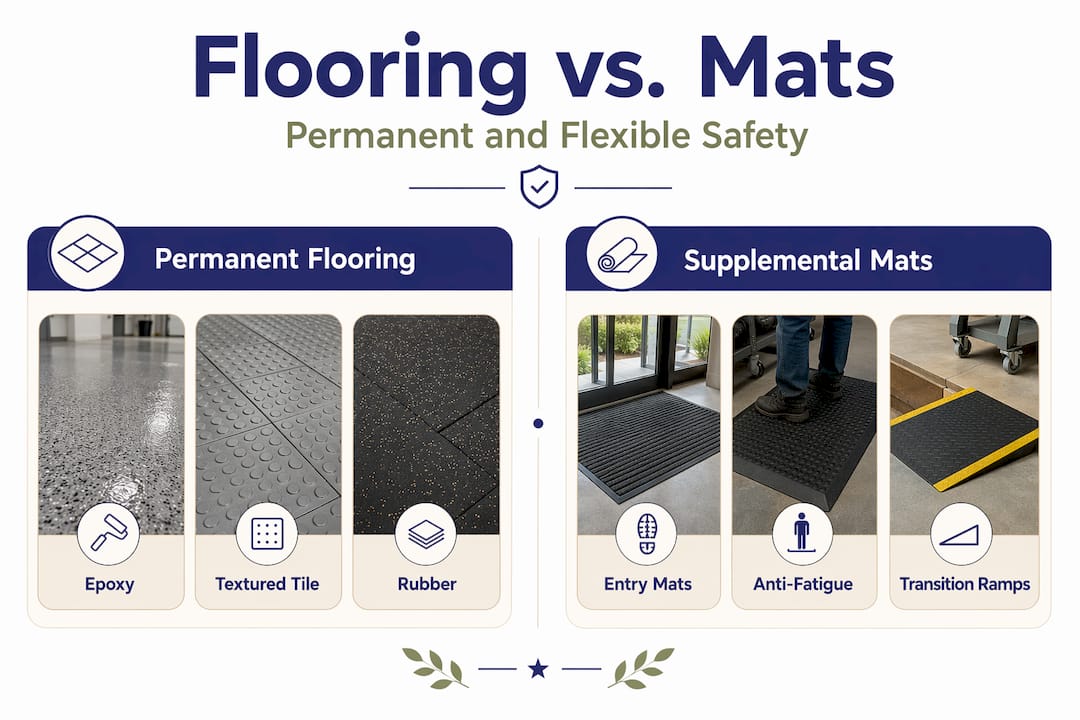
Supplementing any permanent floor with industrial non slip mats at high-risk transition points, such as entries, ramps, and workstations, significantly extends the safety performance of your overall flooring system without requiring full floor replacement.
Real-world challenges: Maintaining slip resistance over time
Installation is the easy part. The harder challenge is keeping your floor compliant after months of cleaning cycles, foot traffic, and environmental exposure. This is where most facilities develop hidden liability.
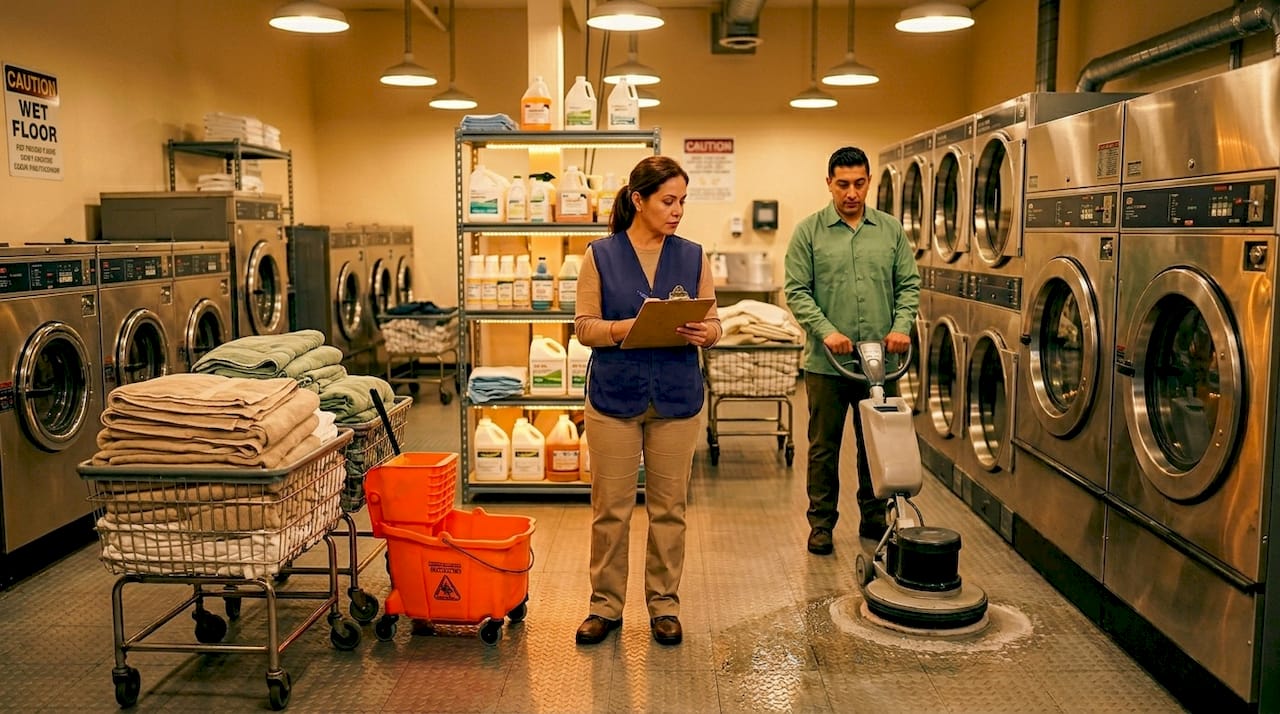
Cleaning products are a major culprit. High-pH alkaline cleaners strip away surface coatings and fill texture profiles with soap residue. Wax-based floor finishes, applied over slip-resistant surfaces, effectively nullify the original friction design. Even water left standing after mopping creates a temporarily low-COF surface that goes undetected until someone falls.
Performance degradation follows predictable patterns: contaminants and wear degrade performance consistently, and coatings wear faster than molded textures. There is also a less-discussed risk with overly aggressive surface textures. Deep, coarse profiles can catch shuffling gaits, particularly relevant in facilities serving elderly populations or workers wearing certain types of footwear. Glossy finishes present a different problem by hiding water puddles, making wet areas visually indistinguishable from dry ones.
Here is a practical maintenance sequence to protect slip-resistance performance:
- Audit cleaning products for pH levels and residue risk. Use neutral-pH cleaners on textured surfaces wherever possible.
- Establish a no-wax policy on slip-resistant zones unless the wax is specifically rated for traction-critical surfaces.
- Schedule quarterly COF testing using a pendulum test or DCOF tribometer to establish performance benchmarks over time.
- Document all results and corrective actions to support OSHA compliance and reduce insurance liability.
- Inspect texture profiles visually and tactilely at least monthly in high-traffic zones to catch early wear.
- Replace or recoat worn sections promptly rather than waiting for a formal testing failure.
| Risk factor | Impact on COF | Detection method |
|---|---|---|
| Cleaning chemical residue | Reduces by 15 to 30% | COF testing post-cleaning |
| Physical wear/abrasion | Progressive reduction | Visual inspection, tactile check |
| Liquid contamination | Immediate drop | Pendulum test, incident reports |
| Coating delamination | Severe, sudden | Visual inspection |
| Wax finish application | Significant reduction | COF tribometer test |
Pro Tip: Test your floor’s COF immediately after your standard cleaning cycle, not before it. This gives you the real-world performance number your workers and visitors actually experience, not the best-case figure.
Slip proof mat safety practices reinforce permanent flooring by adding a dynamic, replaceable layer of protection at the highest-risk zones, which is often far more cost-effective than full floor remediation. For staff working long shifts on hard surfaces, enhancing workplace safety and comfort through supplemental mat placement also reduces fatigue-related slips, which are a statistically significant but underreported incident category.
Compliance is not a moment in time. It is a continuous performance standard that requires scheduled verification.
Choosing the right slip-resistant solution for your facility
With the material options clear and maintenance realities understood, the final step is matching the right solution to your specific facility profile. A blanket approach does not work across different zones and risk levels.
Start with a zoning analysis. Map your facility into at minimum three categories:
- High-wet zones: Commercial kitchens, wash bays, loading dock entries, restrooms. These require permanent textures with R11 or higher ratings and frequent COF testing.
- High-traffic dry zones: Main corridors, retail floors, manufacturing aisles. Vinyl or epoxy with grit additives performs well here, supported by mat placement at entry and exit points.
- Transition zones: Stairwells, ramp transitions, doorway entries. These require dedicated slip-resistant nosings, mat overlays, and clear visual contrast markings.
Slip-resistant coatings like epoxy are effective initially but degrade under abrasion and traffic, requiring ongoing maintenance. Permanent textures such as tile and rubber remain consistent long-term but carry higher upfront costs. The most defensible approach is a zoned rating strategy: apply moderate-cost coatings in lower-risk dry areas and invest in permanent high-texture materials where wet conditions are consistent.
From a liability and ROI standpoint, the numbers support proactive investment. Regular DCOF testing post-installation and post-cleaning, combined with documented OSHA or ANSI B101 compliance, demonstrates due diligence and reduces both incident frequency and insurance premiums. The cost of testing and maintenance is a fraction of a single slip-and-fall settlement.
Use these criteria when finalizing your selection:
- Traffic volume: Measured in daily pedestrian passes, not just shifts. Peak loading matters.
- Contamination type: Water alone is a different risk profile from oil, grease, or chemical spills.
- Footwear standards: Facilities with controlled footwear programs can tolerate different surface profiles than open-access retail environments.
- Replacement feasibility: How disruptive is recoating or replacement for your operational schedule?
- Compliance requirements: Local codes, OSHA standards, and insurance policy requirements vary. Know yours before specifying materials.
For workstation-specific areas where staff stand for extended periods, anti-fatigue mat selection factors into both safety and productivity. An industrial anti-fatigue mat placed over compliant flooring addresses two risk factors simultaneously: slip events and fatigue-related accidents.
Pro Tip: Build your testing schedule into your facility maintenance calendar with the same priority as equipment servicing. Treat a missed COF test the same way you would treat a skipped safety inspection.
Expert perspective: Why long-term performance matters more than initial specs
Most purchasing decisions around slip-resistant flooring focus on what the product achieves on Day 1. The spec sheet, the product rating, the installation certificate. These documents create a false sense of resolved risk.
The uncomfortable reality is that the majority of serious slip-and-fall incidents in commercial facilities occur not during the first weeks after a new install, but months or years later, after cleaning has altered the surface chemistry, traffic has worn down the texture profile, and testing has lapsed. The floor that passed inspection at commissioning may no longer meet the minimum DCOF threshold by the time an incident occurs.
A spec sheet rating is a starting condition, not a performance guarantee. What matters operationally is the COF your floor delivers under real contamination loads, after your actual cleaning protocol, during your peak traffic hours. That number is only knowable through scheduled empirical testing, not product documentation.
Staff awareness is an undervalued part of this equation. Workers who understand what makes a surface slippery and who know to report surface degradation, standing liquids, and mat displacement are an active part of your safety system. Signage, training, and clear reporting channels function as early-warning mechanisms that formal testing schedules cannot always catch in real time. Anti-fatigue mat usage policies that include mat inspection during shift changes are a practical example of how staff can actively contribute to floor safety without formal testing equipment.
Facilities that treat flooring safety as a continuous operational practice, rather than a one-time procurement decision, consistently outperform those that do not when measured by incident rates, insurance costs, and regulatory compliance scores.
Find slip-resistant solutions with Mats4U
Selecting the right permanent flooring is only part of the safety equation. High-performance mats placed at entries, workstations, and transition zones add a targeted, replaceable layer of slip protection exactly where it matters most. At Mats4U, you will find commercial-grade options built for real facility demands. The Comfort Premier anti-fatigue mat supports workers through long shifts on hard surfaces, reducing fatigue-related risk. The WaterHog Max entry mat captures water and debris at building entries before they reach your interior floors. For facilities looking to combine safety with branded professionalism, the custom logo floor mat delivers both. All products ship free on orders over $100.
Frequently asked questions
How often should slip-resistant flooring be tested for performance?
Industry best practice recommends pendulum or DCOF testing after installation and post-cleaning at least quarterly to ensure ongoing compliance and minimize liability exposure.
What is the most durable slip-resistant flooring for a wet industrial area?
Permanent textures like rubber and tile provide consistent long-term slip resistance in wet zones, though they require a higher initial investment compared to surface coatings.
Are vinyl click-lock floors suitable for heavy traffic commercial use?
Vinyl industrial flooring with click-lock installation suits commercial areas with moderate to heavy traffic due to its rapid setup, R10 to R11 slip rating, and strong abrasion resistance.
What are the main causes of slip-resistance loss after installation?
Contaminants, wear, aggressive cleaning agents, and aging coatings are the primary factors that degrade slip resistance after installation, with coatings declining faster than molded or embedded texture systems.


