


TL;DR:
- Proper selection, installation, and ongoing inspection of rubber mats are essential to prevent slip and trip hazards in high-traffic workplaces. Regular testing of slip resistance, securing edges, and timely replacement according to safety standards ensure continuous compliance and worker safety. Facilities must treat rubber mat safety as an ongoing system rather than a one-time procurement to avoid costly incidents.
Slip and fall incidents cost U.S. employers billions annually in workers’ compensation claims, and a significant share of those incidents trace back to improperly selected, installed, or maintained rubber mats. If you manage a warehouse, manufacturing floor, commercial kitchen, or any high-traffic facility, the rubber mat safety tips in this guide are not optional reading. They are the difference between a compliant, safe environment and an OSHA citation. This article covers material standards, zone-specific selection, installation best practices, and ongoing compliance verification so you can protect your workers and your organization.
Table of Contents
- Understanding rubber mat requirements for workplace safety
- Selecting the right rubber mat type and specifications for different facility zones
- Proper installation and maintenance of rubber mats to prevent trip and slip hazards
- Verifying rubber mat safety performance and compliance over time
- Why many facilities overlook critical rubber mat safety details — and how to avoid costly mistakes
- Enhance workplace safety with Mats4U rubber mats and anti-fatigue solutions
- Frequently asked questions
Key Takeaways
| Point | Details |
|---|---|
| Slip resistance standards | Rubber mats must meet a minimum DCOF of 0.42 for wet floors to comply with OSHA-friendly ANSI guidelines. |
| Proper mat selection | Choosing mats with the right thickness and material tailored to facility zones prevents injuries and floor damage. |
| Installation matters | Proper subfloor preparation and weighted edges minimize trip hazards from curled or lifted mats. |
| Ongoing maintenance | Routine cleaning and regular inspections preserve mat performance and maintain safety compliance. |
| Electrical safety | Use certified electrical insulation mats in high-voltage areas to protect against shocks and fatalities. |
Understanding rubber mat requirements for workplace safety
Getting rubber mat selection right starts with knowing the regulatory floor, literally. OSHA regulation 29 CFR 1910.22 mandates clean, dry, slip-resistant walking surfaces, and ANSI A326.3 recommends a minimum Dynamic Coefficient of Friction (DCOF) of 0.42 for wet floors. DCOF measures how much resistance a surface provides to a person already in motion, making it more relevant to real-world slip prevention than the older static COF measurement.
Rubber’s natural texture and density give it an advantage over vinyl or carpet in high-moisture environments, but not all rubber is equal. A smooth-surface rubber mat in a food processing area with oil contamination can fall well below the 0.42 DCOF threshold. Channeled, diamond-plate, or raised-nub surface patterns actively drain liquids away from foot contact points and maintain higher friction under wet and oily conditions.
Review heavy duty rubber mat standards before specifying products for high-demand zones. And verify that any mat you purchase has third-party ANSI slip resistance compliance documentation, not just a manufacturer’s claim.
Key compliance benchmarks for rubber mat selection:
- Minimum DCOF of 0.42 for wet interior walking surfaces (ANSI A326.3)
- Minimum DCOF of 0.55 recommended for ramps and inclines
- Surfaces exposed to oils or chemicals require textured rubber with drainage channels
- Mats must be free of raised edges greater than 1/4 inch per ADA guidelines
- Anti-static or conductive properties required in electronics assembly areas
| Surface condition | Minimum DCOF | Recommended mat surface |
|---|---|---|
| Dry indoor floor | 0.42 | Smooth or light texture |
| Wet indoor floor | 0.42 | Diamond plate or drainage channels |
| Oily/greasy surface | 0.55+ | Open-grid or deep-channel rubber |
| Ramp or incline | 0.55+ | Aggressive tread pattern |
| Electrical hazard zone | N/A (ASTM D178) | Certified insulating elastomer |
Selecting the right rubber mat type and specifications for different facility zones
Not every mat works in every zone. A mat that performs well at a loading dock entrance will fail fast under a CNC machine where cutting fluid pools constantly. Matching mat specifications to zone requirements is one of the most consequential rubber flooring safety tips you can apply.
Rubber mats in heavy impact areas require at least 3/4-inch thickness with vulcanized rubber for durability. Vulcanized rubber is cross-linked during manufacturing, making it denser, non-porous, and far more resistant to tearing, chemical absorption, and compression set than non-vulcanized alternatives. In warehouse receiving areas where pallet jacks and forklifts occasionally cross, anything thinner will deform and create trip edges within weeks.

Electrical safety zones are frequently underspecified. Elastomer mats certified to ASTM D178 or IEC 61111:2009 protect workers operating near 50V or higher equipment. These are not standard rubber mats. They are tested to specific dielectric strength ratings, and substituting an uncertified mat in a switchgear room or near live bus bars is a life-safety error.
For workers standing four to eight hours on concrete, industrial anti-fatigue mats with a closed-cell foam or sponge rubber core reduce lower limb fatigue and the associated loss of situational awareness. Fatigue contributes to more incidents than most safety officers account for. Review the full breakdown in this guide to anti-fatigue mat industrial applications to match core hardness to shift length and worker weight.
Zone-to-mat specification guide:
- Wet processing or food prep: Drainage-channel or open-grid rubber, DCOF 0.55+, antimicrobial coating
- Warehouse aisles and dock plates: Vulcanized rubber, 3/4 inch minimum, beveled edges
- Electrical panels and switchgear: Certified ASTM D178 or IEC 61111:2009 insulating mat
- Assembly lines with standing workers: Anti-fatigue mat with 1/2 to 3/4 inch sponge rubber core
- Outdoor entry and dock levelers: UV-stabilized rubber with aggressive drainage
| Zone type | Thickness | Material | Certification needed |
|---|---|---|---|
| Heavy impact/warehouse | 3/4 inch+ | Vulcanized rubber | ASTM D792 density test |
| Wet processing | 1/2 to 3/4 inch | Open-grid nitrile rubber | DCOF 0.55+ tested |
| Electrical safety | 1/4 to 3/8 inch | Insulating elastomer | ASTM D178 or IEC 61111:2009 |
| Long-shift standing | 1/2 to 3/4 inch | Foam-core anti-fatigue | Ergonomic load testing |
| Outdoor entry | 3/8 to 1/2 inch | UV-stabilized rubber | Weather/UV resistance rating |
Pro Tip: Request the actual third-party test report for DCOF values, not just the spec sheet. Many manufacturers list DCOF under dry conditions. For compliance purposes, you need wet DCOF data.
Proper installation and maintenance of rubber mats to prevent trip and slip hazards
Installation mistakes create the majority of mat-related hazards. 80% of mat-related incidents stem from trip hazards caused by lifting edges, often due to neglected subfloor preparation and improper placement. You can purchase a certified, high-performance mat and still create a hazard if the floor underneath it is uneven, damp, or contaminated with debris.
Follow these installation steps for every rubber mat deployment:
- Inspect the subfloor. Check for cracks, raised joints, or moisture. Mats placed over moisture will lose adhesion and curl faster. Any subfloor high point greater than 1/4 inch needs to be ground or leveled first.
- Clean the subfloor surface. Remove all grease, dust, and prior adhesive residue. Contaminated subfloors prevent anti-slip backings from gripping properly.
- Position and size the mat correctly. Mats should cover the entire work zone with no exposed subfloor gaps between mat edges and walls or adjacent mats. Gaps become trip points.
- Secure edges. Use beveled-edge mats or connect adjacent mats with locking connectors. Tape alone is not a substitute for molded beveled edges in industrial environments.
- Check for flatness after placement. Walk the perimeter and press down corners. Any corner that springs back more than 1/4 inch needs a heavier mat or adhesive securing.
Industrial-grade mats with weighted, seamless molded edges reduce curling and trips by 80% compared to standard flat-edge mats. This is not a minor product feature. It is a measurable safety outcome.
For maintenance, use pH-neutral cleaners on rubber surfaces. Harsh alkaline or acidic cleaners accelerate surface oxidation and reduce the surface texture that provides friction. Review the full list of recommended methods for cleaning rubber floors before issuing cleaning protocols to your maintenance team.
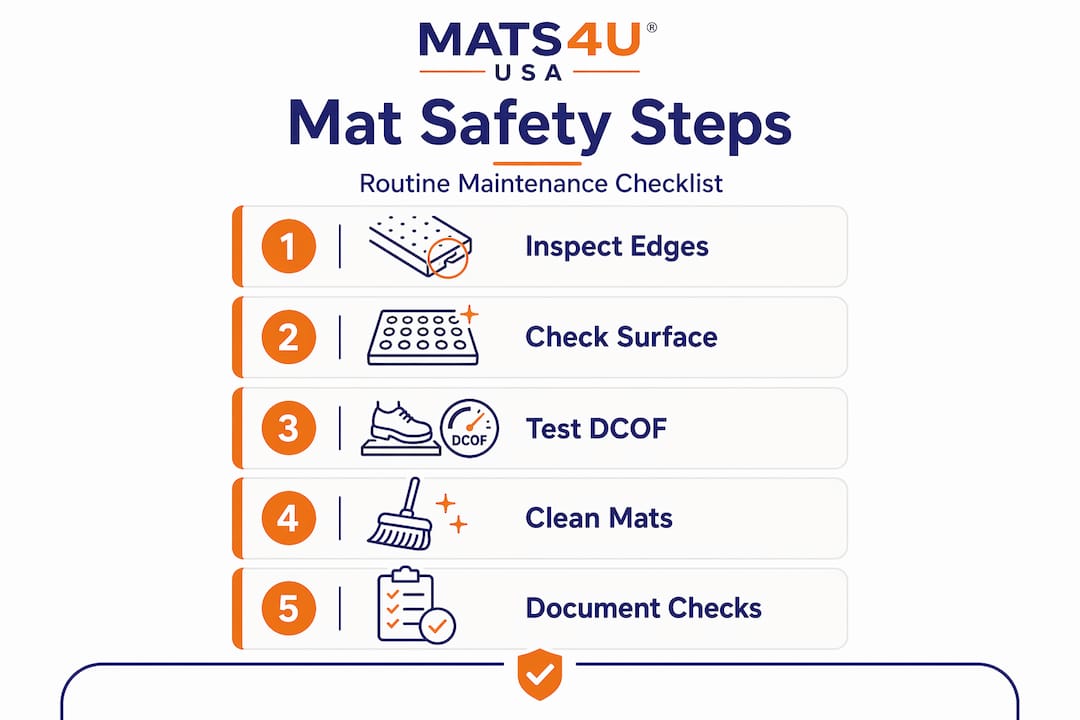
Routine maintenance checklist:
- Vacuum or sweep daily in high-debris zones
- Mop with pH-neutral cleaner weekly or after visible contamination
- Inspect all mat edges and corners during each cleaning cycle
- Remove and clean underneath mats at least monthly
- Replace any mat with surface cracking, compression set exceeding 1/4 inch, or visible delamination
Pro Tip: Mark mat positions on the subfloor with floor tape during installation. If a mat shifts during use, the tape lines make it immediately visible during walkthroughs rather than waiting for a formal inspection.
Verifying rubber mat safety performance and compliance over time
Purchasing and installing compliant mats is the starting line, not the finish. Regular DCOF testing and immediate spill cleanup are essential to ensure continued safety and compliance over time. Slip resistance degrades as surface texture wears down, as chemical exposure smooths rubber profiles, and as contamination fills drainage channels.
Schedule periodic DCOF testing using a portable tribometer, a hand-held device that measures friction on existing surfaces, at intervals no longer than 12 months in standard environments and every six months in high-wear or chemically exposed zones. Document every test result with the date, location, test conditions, and tester’s name. These records constitute compliance evidence under OSHA general duty requirements.
For anti-fatigue mats specifically, test rebound after 9 to 12 months of use under steel-toe boots. Press your thumb firmly into the center of the mat and release. If the indentation takes longer than two seconds to recover, the core has compressed past its effective ergonomic threshold. Workers will start standing on what is essentially a thin rubber sheet, and the fatigue protection that reduces incident risk is gone. See monitoring anti-fatigue mat performance for a full evaluation protocol.
Ongoing compliance verification checklist:
- Conduct DCOF testing every 6 to 12 months per zone
- Inspect for surface cracking, delamination, and edge lift monthly
- Test anti-fatigue mat rebound at 9-month intervals
- Log all cleaning, inspections, and test results in a mat safety register
- Flag and replace any mat failing DCOF or rebound tests within 48 hours
| Verification task | Frequency | Documentation required |
|---|---|---|
| Visual edge and surface inspection | Monthly | Inspection log with date and findings |
| DCOF slip resistance test | Every 6 to 12 months | Test report with location and conditions |
| Anti-fatigue rebound test | Every 9 to 12 months | Pass/fail record with replacement date |
| Subfloor check (under mat) | Monthly | Notes on moisture, debris, or damage |
| Full mat replacement evaluation | Annually | Mat condition assessment report |
Pro Tip: Assign mat inspection as a line item in your facility’s monthly safety audit rather than treating it as a separate task. When mat checks are integrated into existing compliance routines, they get completed consistently instead of being deferred.
Why many facilities overlook critical rubber mat safety details — and how to avoid costly mistakes
After reviewing OSHA standards, zone specifications, and testing protocols, there is a harder conversation worth having. Most mat-related incidents in facilities do not happen because managers lack access to information. They happen because rubber mat safety is treated as a one-time procurement decision rather than an ongoing safety system.
80% of mat-related incidents trace back to lifting edges from neglected inspections. That is an operational failure, not a product failure. The mat was probably compliant on day one. What changed was the subfloor shifted, the mat migrated slightly, or the cleaning crew flipped a corner back without fully reseating it, and no one caught it for weeks.
Electrical insulating mats are an even more overlooked category. Electrical mat use is often underappreciated despite its proven role in reducing fatal shocks in high-voltage zones. Facilities that would never skip arc flash PPE often have no insulating mat program at all. The reasoning is usually that workers near live equipment “are careful.” Careful is not a safety control. A certified mat is.
The other common mistake is over-extending mat service life. A mat that cost $300 is not worth $300 after 18 months of heavy use if its DCOF has dropped below 0.42 and its edges are lifting. Budget cycles should include mat replacement line items, not just mat procurement. Reviewing industrial anti-fatigue mat insights on performance thresholds gives you a defensible basis for replacement schedules that your finance team can plan around.
The facilities that get mat safety right treat it the same way they treat fire extinguisher inspections: scheduled, documented, and non-negotiable.
Enhance workplace safety with Mats4U rubber mats and anti-fatigue solutions
Mats4U supplies commercial and industrial facilities with rubber mats and anti-fatigue mats built to meet the safety standards covered in this guide. The Comfort Premier anti-fatigue mat delivers long-shift standing support with molded beveled edges that meet OSHA trip hazard requirements. The Comfort Flow anti-fatigue mat is a rubber-top option suited for wet and high-debris environments where drainage and cleanability are priorities. For high-traffic zones requiring heavy impact resistance and slip-resistant surfaces, heavy duty rubber floor mats from Mats4U are Made in the USA and available with free delivery on orders over $100. Every product category includes specifications to support your compliance documentation needs.
Frequently asked questions
What minimum slip resistance should rubber mats provide for wet indoor areas?
Rubber mats in wet interior work areas should meet a minimum DCOF of 0.42 per ANSI A326.3 standards. Areas with oily or chemical contamination require 0.55 or higher to maintain adequate traction.
How thick should rubber mats be in heavy impact zones?
Rubber mats in heavy impact areas require at least 3/4-inch thickness using vulcanized rubber to absorb shock and resist permanent compression under equipment and dropped loads.
How often should rubber mats be inspected to prevent trip hazards?
Inspect rubber mats at least monthly, focusing on edge lift, surface cracking, and corner displacement. Since 80% of mat incidents stem from lifting edges, catching edge movement early is the single most effective trip hazard prevention step.
Are electrical insulation rubber mats necessary near live equipment?
Yes. Elastomer mats certified to ASTM D178 or IEC 61111:2009 are required for workers operating near 50V or higher equipment. Standard rubber mats do not provide tested dielectric protection and should not be substituted.


