


TL;DR:
- Floor mat safety regulations are more stringent than most facility managers realize and require ongoing inspection, maintenance, and documentation. OSHA, ADA, and electrical safety standards each impose specific requirements that must be integrated into a comprehensive safety program to ensure compliance and prevent hazards. Building a proactive, scheduled system for selecting, installing, inspecting, and tracking mats helps facilities maintain safety and meet regulatory expectations effectively.
Floor mat safety regulations are more demanding than most facility managers expect. Placing a mat at an entrance or near a wet process station is a start, not a finish. OSHA, the ADA, and specialized electrical safety standards each impose distinct requirements on mat selection, installation, inspection, and documentation. Miss any one of them and you’re not compliant, regardless of how slip-resistant your mat is. This guide breaks down each regulatory layer, explains what it actually requires in a commercial or industrial setting, and gives you a practical framework for building a mat safety program that holds up to scrutiny.
Table of Contents
- Overview of OSHA walking-working surfaces standards
- Compliance requirements for floor mats under the Americans with Disabilities Act (ADA)
- Specialized OSHA electrical insulating matting standards and maintenance
- Integrating floor mat safety regulations into facility safety programs
- Why most floor mat safety programs miss the mark and how to fix them
- Explore compliant floor mat solutions at Mats4U
- Frequently asked questions
Key Takeaways
| Point | Details |
|---|---|
| OSHA standards apply | OSHA requires floors be clean/dry when possible and mats used as controls for wet hazards with proper maintenance. |
| ADA compliance matters | Floor mats on accessible routes must meet strict thickness, edge, and stability rules to prevent trips and ensure accessibility. |
| Electrical mat standards | Rubber insulating mats must be properly marked, tested, inspected, and stored per OSHA electrical protective equipment rules. |
| Maintenance is critical | Regular inspection, cleaning, and secure installation keep mats effective and compliant over time. |
| Program integration | Effective floor mat safety requires combining regulation knowledge with practical selection, installation, and monitoring processes. |
Overview of OSHA walking-working surfaces standards
OSHA’s walking-working surfaces standard, 29 CFR 1910.22, is the foundation of floor mat compliance in most workplaces. It establishes that employers are responsible for keeping walking surfaces clean, dry, and free of hazards that could cause slips, trips, or falls. Floor mats fit into this framework as hazard controls, not as passive accessories.
OSHA’s walking-working surfaces standard requires work surfaces to be maintained clean and dry, with mats used as dry standing places when wet processes are present. That distinction matters. A mat placed in a wet processing area does not satisfy the standard on its own. The floor beneath it still needs to be managed, drains must function, and the mat itself must remain dry, stable, and undamaged to count as a valid control measure.
Here is what OSHA’s walking-working surfaces standard specifically expects from employers managing floor mat usage:
- Walking surfaces must be kept clean, orderly, and as dry as possible at all times
- Where wet conditions exist, employers must use mats to avoid slippery surfaces or provide drainage to remove standing water
- Mats must be inspected regularly and replaced or repaired when they become worn, curled, torn, or saturated
- Aisles and passageways used for access and egress must remain clear and safe for travel at all times
- Floors must support the loads placed on them, including mats with heavy equipment sitting on top
The standard does not specify mat dimensions, pile height, or exact slip-resistance values. It requires that you make hazard-based decisions and document them. That is an important nuance. OSHA is performance-based in this area, meaning you choose the controls, but you must demonstrate they are working.
“The floor mat is a control measure. If it is not maintained, it becomes the hazard.” This framing, consistent with OSHA’s walking-working surfaces framework, is the most useful way to keep your team oriented toward actual compliance rather than checkbox thinking.
Pro Tip: Add floor safety mats to your facility’s hazard identification process. When you map wet or slippery zones, document which mats are assigned to each zone, their condition rating, and their last inspection date. That single practice satisfies a significant portion of OSHA’s documentation expectations under 29 CFR 1910.22.
Compliance requirements for floor mats under the Americans with Disabilities Act (ADA)
ADA requirements catch a lot of facility managers off guard. Most teams focus on ramps, door widths, and restroom clearances. Floor mats on accessible routes get far less attention, and that is where violations happen.
ADA guidelines require floor mats on accessible routes to be stable, slip-resistant, and have beveled edges or meet thickness limits to prevent tripping hazards. The specific rules break down like this:
- Mats without beveled edges must not exceed 1/4 inch in thickness
- Mats with beveled edges may be up to 1/2 inch thick, but the bevel slope cannot exceed 1:2 (meaning for every 1 inch of rise, there must be at least 2 inches of run)
- Mats must be firmly secured to the floor surface so they do not shift under foot traffic
- Mats with large surface openings, such as certain drainage or grate-style mats, can create tripping risks and may fail ADA review
- The surface must remain stable and slip-resistant under foreseeable wet or dry conditions
The following steps describe how to audit your mats on ADA-accessible routes:
- Walk every accessible route in your facility with a measuring tool in hand
- Check mat thickness at the thickest point, including any bunched or compressed edges
- Verify beveled edges are present wherever mat height exceeds 1/4 inch
- Lift each corner of every mat to confirm it is secured to the floor
- Check for visible tears, curled edges, or sections that have separated from the backing
- Flag any grate-style or open-surface mats that sit on accessible routes for immediate review
| Feature | Non-compliant mat | ADA-compliant mat |
|---|---|---|
| Thickness | Over 1/2 inch | 1/4 inch max (no bevel) or 1/2 inch max (with bevel) |
| Bevel slope | Steeper than 1:2 | No steeper than 1:2 |
| Attachment | Loose or shifting | Secured to floor surface |
| Surface openings | Large open grates | Closed surface or compliant open pattern |
| Slip resistance | Smooth or polished | Textured, slip-resistant surface |
Pro Tip: Preventing trip hazards from mats is easier at the purchasing stage than after installation. Before ordering, confirm the product specifications include beveled edges and note the exact thickness. Get that in writing from the supplier.
When you review anti-slip floor mat options, check whether the slip-resistance rating applies to both wet and dry conditions. A mat that is slip-resistant when dry but slick when wet fails the ADA standard and creates a real liability on an accessible route.
Specialized OSHA electrical insulating matting standards and maintenance
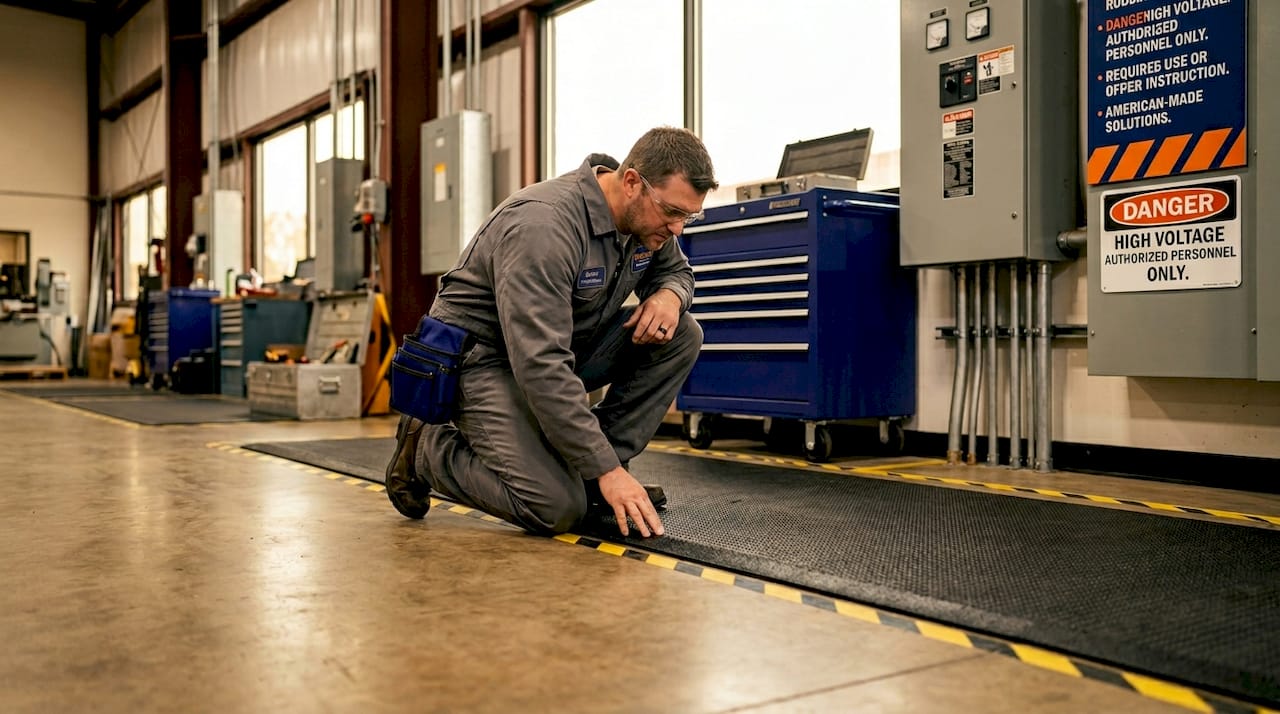
If your facility includes electrical switchboards, motor control centers, or high-voltage service equipment, you are working under a different section of OSHA entirely. OSHA 1910.137 governs rubber insulating matting used as electrical protective equipment, and the requirements are more specific than most safety officers realize.
OSHA 1910.137 mandates marking, electrical testing, and condition maintenance of rubber insulating matting. Retesting is not required on a fixed schedule, but inspections and proper storage are critical to keeping mats compliant and functional.
The key requirements for electrical insulating mats include:
- Class and type markings must be clearly visible on the mat. These indicate the voltage protection level the mat provides.
- Electrical proof testing must have been performed before the mat is placed in service, with a minimum 1-minute test duration
- Condition inspections are required regularly. Look for cuts, punctures, embedded contaminants, ozone damage, or cracking
- Storage requirements are specific: mats must not be folded sharply, stored in direct sunlight, or kept near ozone-generating equipment such as electric motors
- Mats that show physical damage must be removed from service immediately, regardless of when they were last tested
One critical distinction: electrical insulating mats are classified as personal protective equipment (PPE) under OSHA 1910.137, not general flooring. That classification changes your maintenance and documentation obligations. You cannot treat them the same way you would treat an entrance mat or an anti-fatigue mat.
Pro Tip: Assign electrical insulating mats a unique ID number and track them in your PPE inventory system, not just your floor maintenance log. That separation ensures they receive the correct inspection frequency and are never removed from an electrical panel area for general use elsewhere in the facility.
For industrial non-slip mats used in manufacturing environments, confirm whether the area involves any electrical equipment exposure. If it does, standard rubber matting will not satisfy OSHA 1910.137 requirements. You need mats specifically rated and marked for electrical insulation. When in doubt, consult your slip resistance evaluation process alongside your electrical safety officer.
Integrating floor mat safety regulations into facility safety programs
Knowing the regulations is step one. Building them into your daily facility management operations is where real compliance happens. A mat that meets every specification at purchase can become a violation within three months if your program does not include maintenance, inspection, and documentation.
A program that includes picking the right mats, installing with proper transitions, inspecting regularly, and keeping records minimizes slip, trip, and electrical hazards across all facility zones. ADA-accessible route failures most often stem from improper mat transitions and unsecured mats that develop into tripping hazards over time.
Here is a practical implementation sequence:
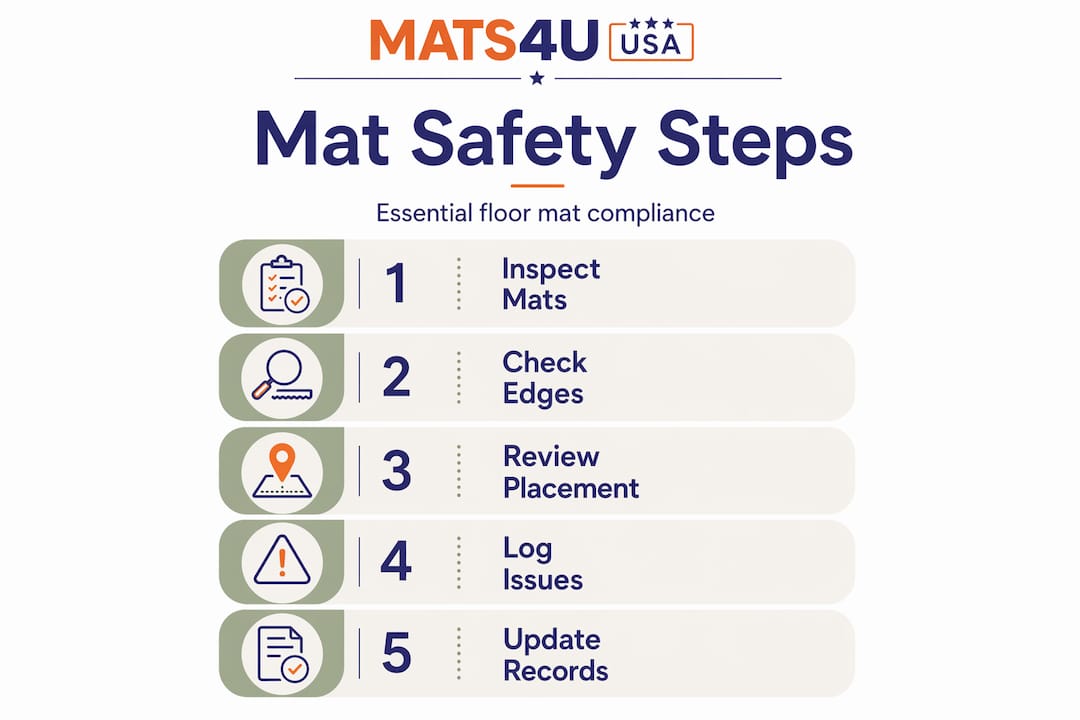
- Audit all mat locations in your facility. Map them against your hazard inventory and your accessible routes diagram.
- Select mats based on application. Anti-fatigue mats for standing workstations, slip-resistant mats for wet zones, ADA-compliant entry mats for accessible routes, and rated insulating mats for electrical areas.
- Install with compliant transitions. Every mat edge that exceeds 1/4 inch must have a beveled border or transition strip. Secure backing is non-negotiable.
- Set an inspection schedule. Weekly visual checks for heavy-traffic areas, monthly for lower-traffic zones, and immediate removal of any mat showing curling, tears, or saturated backing.
- Document everything. Inspection dates, mat condition ratings, replacements, and any incidents tied to mat areas.
When selecting anti-fatigue mats for wet or slippery industrial workstations, prioritize products with drainage holes and grease-resistant surfaces. Those features directly affect OSHA compliance in wet process environments.
| Inspection item | Frequency | Action if failed |
|---|---|---|
| Mat edges and corners | Weekly | Secure or replace |
| Surface wear and grip | Monthly | Replace if grip is degraded |
| Thickness and bevel compliance | Quarterly | Replace or reposition |
| Electrical mat condition | After each use or monthly | Remove from service immediately |
| Backing adhesion | Monthly | Resecure or replace |
Industries that deal with custom metal parts in manufacturing environments often have unique flooring challenges: metal shavings, lubricants, and electrical exposure all combine in ways that generic floor mat programs do not account for. Tailor your mat program to your actual hazard profile.
Pro Tip: Keep a simple digital log with photos. A timestamped photo of each mat zone during inspection takes seconds and gives you defensible evidence during an OSHA audit or ADA accessibility review. Use the floor safety mats guide to build your zone-by-zone mat specification list and attach it to your safety program documentation.
Why most floor mat safety programs miss the mark and how to fix them
Here is the uncomfortable reality: the majority of floor mat safety programs in commercial and industrial facilities are reactive rather than built on actual regulatory understanding. Teams place mats where incidents happened, not where a risk analysis identified hazards. That approach generates the illusion of compliance without delivering it.
The most common failure is treating mat placement as a one-time action. Facility teams often mistake the presence of mats as full compliance, ignoring routine maintenance that is critical for real safety. A mat that was OSHA-compliant on installation day can be curled, saturated, or displaced within weeks in a high-traffic environment. Without a scheduled inspection and replacement protocol, that mat is no longer a safety control. It is a trip hazard with documentation that says otherwise.
ADA compliance is even more frequently misunderstood. Even slip-resistant mats fail ADA checks when transitions are noncompliant or when mats shift under use. The mats themselves are rarely the problem at the point of inspection. The transitions, the backing, and the ongoing securement are where violations occur. Most facility teams do not check these details after installation. Inspectors do.
The fix is not complicated, but it requires a shift in how you define compliance. Compliance is a condition, not a purchase. It requires that the mat in service today meets the standard, not just the mat in the spec sheet from three years ago. Build that distinction into your slip accident prevention training and your inspection protocols.
One more overlooked gap: electrical insulating mats regularly end up in the wrong location. A mat rated for electrical panel use gets grabbed for anti-fatigue duty at a different workstation. The class markings get ignored because staff were not trained to recognize them. This is both an OSHA 1910.137 violation and a genuine safety risk. Solve it with clear labeling on storage locations and dedicated inventory tracking for PPE-classified mats.
The facilities with the strongest mat safety records share one characteristic: they treat floor mat compliance as a system with scheduled inputs, not a product decision that happens once. Build the program. Then work the program.
Explore compliant floor mat solutions at Mats4U
Taking compliance from policy to product requires the right starting point. Mats4U carries a wide selection of commercial and industrial floor mats designed to meet OSHA and ADA requirements, including options with beveled edges, slip-resistant surfaces, and durable backings built for high-traffic environments. For facilities that need branding alongside safety, premium custom floor mats combine logo customization with compliant construction. Workers who stand for extended shifts benefit from the industrial anti-fatigue mat options, which are built for wet and dry industrial conditions. For entryways on accessible routes, the WaterHog Max Grand Half Oval Mat delivers reliable moisture control with a construction suited to ADA-compliant installations. Free delivery on orders over $100. All products made in the USA.
Frequently asked questions
What are the key OSHA requirements for floor mat safety?
OSHA requires walking surfaces to be kept clean and dry, with floor mats deployed as controls in wet or slippery areas, and mandates that employers inspect and maintain those mats regularly to ensure they remain effective safety controls.
How thick can a floor mat be to remain ADA compliant?
ADA guidelines specify a maximum thickness of 1/4 inch for mats without beveled edges; mats with beveled edges may be up to 1/2 inch thick, provided the bevel slope does not exceed 1:2.
Are rubber insulating mats subject to retesting under OSHA regulations?
OSHA 1910.137 does not mandate a fixed retest interval for rubber insulating mats, but employers must conduct regular condition inspections and maintain proper storage to keep these mats safe and compliant.
What causes floor mats to fail ADA accessibility checks despite being slip resistant?
Mats fail ADA checks most often because they shift under foot traffic, lack compliant beveled edges, or create tripping hazards at transitions on accessible routes, regardless of how slip-resistant their surface is.


