


Sustainable matting is no longer a niche preference for a handful of LEED-certified buildings. Facility managers and procurement officers across commercial and industrial sectors are under real pressure to reduce environmental impact without letting safety or durability slide. The good news: the assumption that eco-friendly mats underperform in demanding environments is simply wrong. This guide breaks down the materials, certifications, and selection criteria you need to make confident, evidence-based decisions for your facility.
Table of Contents
- What makes a matting option eco-friendly?
- Material options: Comparing recycled rubber, synthetics, and natural fibers
- Certifications and performance: What to look for in sustainable matting
- Selecting the right eco-friendly mat for your facility
- Where to find certified eco-friendly matting solutions
- Frequently asked questions
Key Takeaways
| Point | Details |
|---|---|
| Prioritize recycled content | Choose mats with high recycled content to maximize eco impact without sacrificing quality. |
| Match material to application | Select rubber/synthetic blends for heavy traffic and natural fibers for lighter, dry areas. |
| Demand credible certifications | Look for third-party verified eco-labels and demand full transparency from suppliers. |
| Evaluate full lifecycle | Balance recycled content and end-of-life disposal for optimal sustainability in real use. |
What makes a matting option eco-friendly?
Eco-friendly matting is not just about using natural materials. In a commercial context, it means choosing products made from recycled or recyclable content, manufactured through lower-impact processes, and free from harmful chemicals. A mat that wears out in six months and ends up in a landfill is not a sustainable choice, regardless of its raw material origin.
When evaluating sustainable matting solutions, three criteria matter most:
- Recycled content percentage: Look for clear disclosure of how much of the product comes from post-consumer or post-industrial recycled material.
- End-of-life recyclability: Can the mat be returned to a recycling stream, or does it go straight to landfill?
- Durability under real conditions: A longer-lasting mat has a lower environmental footprint per year of use.
- Non-toxic manufacturing: Avoid products with undisclosed chemical treatments or adhesives.
One important distinction shapes every purchasing decision. As noted in research on eco-friendly commercial mats, recycled synthetics outperform natural fibers in durability and lifecycle, while natural options like coir and cork offer better biodegradability but have a shorter lifespan under extreme traffic conditions.
“Recycled synthetics excel in durability and lifecycle value, while natural materials like coir and cork offer superior biodegradability but struggle under the demands of extreme-traffic industrial environments.” — Mats4U
This contrast is not a flaw in either category. It is a signal to match your material choice to your actual use case.
Material options: Comparing recycled rubber, synthetics, and natural fibers
Not all eco-friendly materials perform the same way. Understanding the strengths and limitations of each category helps you avoid costly mismatches between product and environment.
Recycled rubber (and cork blends) are workhorses in industrial settings. They handle heavy foot traffic, vehicle movement, and wet conditions without degrading quickly. Rubber and cork mat performance data shows recycled rubber underlays with cork blends deliver 18 to 21 dB impact sound reduction and carry recycled content of 80 to 90 percent, making them ideal for vibration absorption under machinery.

Recycled synthetics such as ECONYL (regenerated nylon from ocean waste) and recycled PET (from plastic bottles) offer top-tier durability. These materials are engineered for longevity, and many products in this category include recyclable backings. Their main limitation is that end-of-life recycling requires proper sorting and access to appropriate facilities.
Natural fibers like coir and cork are biodegradable and renewable. They work well in lower-traffic entry areas where aesthetics and sustainability messaging matter. However, they degrade faster under heavy industrial use, which can actually increase your environmental footprint if replacements are needed frequently.
Here is a side-by-side comparison to guide your sourcing decisions:
| Material | Recycled content | Durability | Sound absorption | Best application |
|---|---|---|---|---|
| Recycled rubber/cork | 80 to 90% | Very high | 18 to 21 dB | Machine areas, wet zones |
| Recycled synthetics (ECONYL, PET) | 50 to 80% | Excellent | Moderate | Entrances, high-traffic corridors |
| Natural coir | Renewable, not recycled | Moderate | Low to moderate | Low-traffic lobbies |
| Natural cork | Renewable, not recycled | Moderate | Moderate | Standing zones, light industrial |
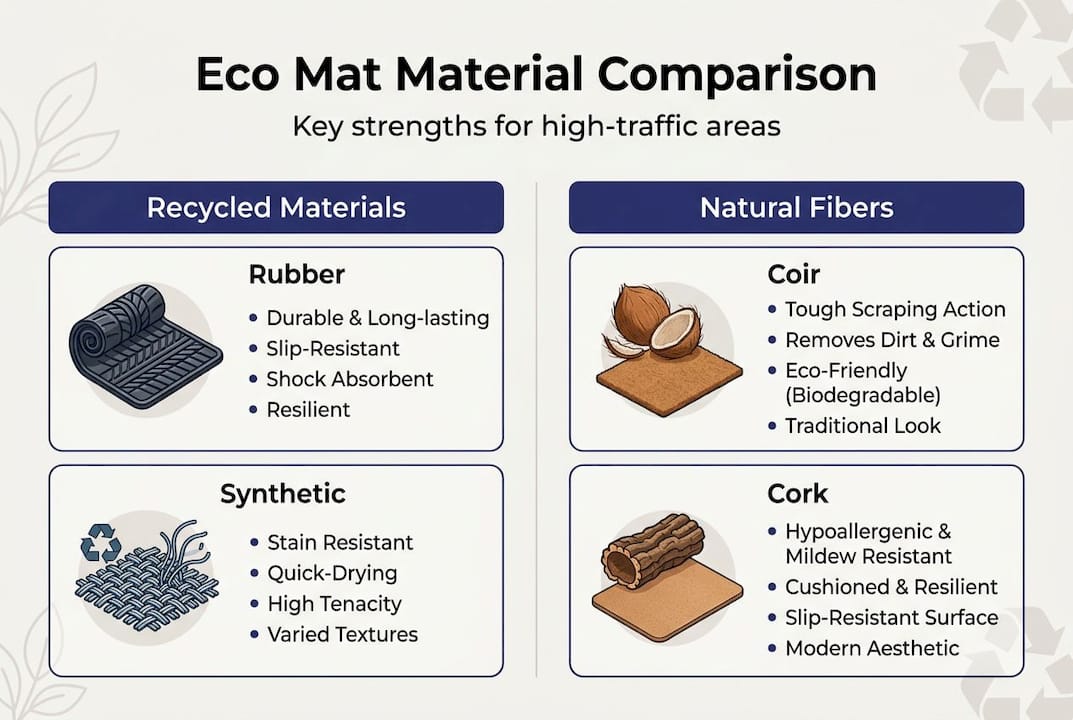
For a deeper look at how these materials perform across different facility zones, the matting material breakdown resource covers composition and application in more detail.
Pro Tip: Match your material to the zone. Use recycled rubber or synthetic mats in machine areas and wet zones. Reserve natural fiber options for reception areas or low-traffic corridors where their biodegradability adds value without the durability penalty.
For facilities with standing workers, [anti-fatigue rubber mats](https://mats4u.com/blogs/news/anti fatigue rubber mats) made from recycled content combine ergonomic benefit with a reduced environmental footprint.
Certifications and performance: What to look for in sustainable matting
The matting market has a greenwashing problem. Vague claims like “eco-conscious” or “environmentally friendly” appear on products with no third-party verification. Knowing which certifications carry real weight protects your procurement decisions and your facility’s sustainability reporting.
Here are the certifications that actually matter:
| Certification | What it verifies | Key requirement |
|---|---|---|
| Cradle-to-Cradle (C2C) | Full material health and recyclability | End-of-life recovery plan required |
| Green Label Plus (CRI) | Low VOC emissions | Independent lab testing |
| Recycled Content Disclosure | Percentage of recycled material | Verified by third party or manufacturer |
| FloorScore | Indoor air quality compliance | Certified by SCS Global Services |
Beyond certifications, watch for these red flags when reviewing product specs:
- Vague language like “contains recycled materials” without a stated percentage
- No documentation on the backing material or adhesive chemistry
- PVC backings listed without a recycling plan. As noted in durable eco-friendly mats guidance, PVC backings can be recycled if separated but are less preferred than nitrile alternatives
- No slip resistance rating for wet or oily environments
Use this checklist when sourcing mats for your facility:
- Confirm recycled content percentage with documentation.
- Identify the backing material and ask for its end-of-life pathway.
- Request VOC test results or relevant certification documentation.
- Check slip resistance ratings against your facility’s floor type.
- Ask whether the supplier offers a take-back or recycling program at end of life.
- Review cleaning and maintenance requirements to confirm longevity under your protocols.
For a broader view of what to prioritize when buying for industrial environments, the [industrial mat buying guide](https://mats4u.com/blogs/news/industrial anti fatigue mats) covers key performance factors alongside sustainability criteria.
Pro Tip: Ask suppliers for full supply chain documentation and end-of-life options before placing a bulk order. A supplier who cannot provide this information is a risk to your sustainability reporting and your facility’s compliance posture.
Selecting the right eco-friendly mat for your facility
Picking the right mat comes down to a structured assessment of your facility’s actual conditions. A mat that works perfectly in a dry corporate lobby will fail quickly on a wet production floor. Here is a practical process to follow.
- Map your zones. Identify each area by traffic type: foot traffic only, wheeled equipment, wet or chemical exposure, standing worker zones.
- Assess cleaning frequency. High-frequency cleaning with industrial detergents degrades some materials faster. Recycled rubber and synthetic mats generally hold up better under aggressive cleaning schedules.
- Define your sustainability priority. Is your primary goal reducing landfill waste, lowering VOC exposure for workers, or maximizing recycled content? Each priority points toward a different material.
- Calculate lifecycle cost. A mat with 90% recycled content that lasts three years beats a 50% recycled mat that needs replacing every year. Factor in replacement frequency when comparing options.
- Verify fit for purpose. Confirm slip resistance, load ratings, and drainage features match your specific environment.
For entrance areas, recycled synthetic mats with high-pile fiber construction trap debris effectively and resist moisture. For production lines and standing worker zones, mat applications in business research shows that anti-fatigue mats reduce worker fatigue and injury risk significantly. The matting impact on fatigue data supports prioritizing ergonomic performance alongside eco-credentials in these zones.
As highlighted in durable eco-friendly mats analysis, recycled synthetics like ECONYL and rubber consistently outperform natural fibers in durability and lifecycle value under extreme traffic, while coir and cork remain better choices where biodegradability is the primary concern.
Pro Tip: Do not chase the highest recycled content number in isolation. A mat with 85% recycled content that lasts five years delivers far more lifecycle value than a 95% recycled mat that degrades in 18 months under your specific conditions.
Where to find certified eco-friendly matting solutions
At Mats4U.com, we stock a range of certified, high-performance matting built specifically for commercial and industrial environments. The WaterHog Max Diamond Mat is a proven choice for high-traffic entrances, combining aggressive moisture and debris control with durable construction suited to demanding daily use. For wet areas requiring drainage, the WaterHog Drainable Border Mat handles standing water and heavy foot traffic without compromising safety underfoot. If you are exploring broader sustainable options across multiple facility zones, our traditional eco-friendly mats collection covers entrance, anti-fatigue, and safety applications with products made in the USA. Free delivery applies on orders over $100, making it straightforward to outfit multiple zones in a single order.
Frequently asked questions
What recycled content percentage should I look for in eco-friendly mats?
Aim for at least 70 to 80% recycled content for strong environmental performance. Top-tier recycled rubber and cork blends reach 80 to 90% recycled content, setting the benchmark for this category.
Are eco-friendly mats as durable as standard options in busy facilities?
Yes. Recycled synthetics like ECONYL and rubber-based mats often exceed the lifespan of natural fiber alternatives under heavy traffic. Recycled synthetics outperform coir and cork in durability when conditions are demanding.
What certifications ensure a mat is truly eco-friendly?
Cradle-to-Cradle, Green Label Plus, and verified recycled content disclosure are the most reliable indicators. FloorScore certification adds assurance for indoor air quality compliance in occupied facilities.
Are PVC-backed mats acceptable for sustainable facilities?
They can be, with conditions. PVC backings are recyclable if properly separated at end of life, but nitrile and fully recycled backings are the preferred choice for facilities with strict sustainability targets.
How often should eco-friendly mats be replaced in high-traffic areas?
Replacement frequency depends on material and traffic volume. Recycled rubber and synthetic mats in industrial settings typically last three to five years with proper maintenance, while natural fiber mats in the same conditions may need replacement within one to two years.
Recommended
- Eco-friendly floor mats: sustainable solutions for facilities – Mats4U USA
- Choose durable, eco-friendly mats for safer facilities – Mats4U USA
- Choose eco-friendly commercial mats for sustainable facilities – Mats4U USA
- Mat size selection guide for high-traffic spaces – Mats4U USA
- 7 Sustainable Home Decor Ideas for Eco-Friendly Living – FunLifeNow


