


Standing on hard floors for hours drains your workers’ energy and hurts productivity. Anti-fatigue mats reduce lower limb fatigue by up to 54% after eight-hour shifts compared to concrete or tile surfaces. These specialized mats transform uncomfortable workstations into ergonomic zones that keep employees comfortable and focused. This guide explains how anti-fatigue mats work, where to use them in your facility, and how to choose the right solutions for maximum impact.
Table of Contents
- Key takeaways
- How anti-fatigue mats reduce worker fatigue: the science and benefits
- Common uses and applications of anti-fatigue mats in commercial and industrial settings
- Choosing and maintaining the right anti-fatigue mat for your facility
- Return on investment and business impact of using anti-fatigue mats
- Explore premium anti-fatigue mat solutions at Mats4U
- Frequently asked questions
Key Takeaways
| Point | Details |
|---|---|
| Fatigue reduction | Anti fatigue mats can reduce lower limb fatigue by up to 54 percent after eight hour shift compared with hard floors. |
| How mats help | They cushion the surface, redistribute pressure across the feet and legs, and create a slight instability that prompts micro movements to boost circulation. |
| Placement matters | Correct placement and regular maintenance maximize benefits and reduce hazards. |
| ROI benefits | The payoff includes reduced pain, increased productivity, and cost savings over time. |
How anti-fatigue mats reduce worker fatigue: the science and benefits
Anti-fatigue mats work through three interconnected mechanisms that directly address the physical stress of prolonged standing. The cushioning layer absorbs impact and redistributes pressure across your feet and legs, preventing concentrated stress points that cause pain. This pressure redistribution alone makes standing more comfortable, but the real magic happens beneath the surface.
The slightly unstable surface encourages constant micro-movements in your leg muscles. These tiny adjustments keep blood flowing efficiently through your lower extremities, preventing the pooling that causes swelling and discomfort. Research published in the Journal of Ergonomics shows a 50% reduction in lower limb fatigue for workers using anti-fatigue mats compared to standing on hard surfaces.
These micro-movements engage your calf muscles, which act as a secondary heart pump. When you stand motionless on concrete, blood struggles to return from your feet to your heart against gravity. The gentle instability of anti-fatigue mats keeps your muscles contracting and relaxing, maintaining healthy circulation throughout your shift.
Key physiological benefits include:
- Reduced pressure on joints and connective tissue
- Enhanced oxygen delivery to working muscles
- Decreased inflammation in feet, ankles, and knees
- Lower risk of developing chronic musculoskeletal disorders
The cumulative effect translates to workers who maintain energy and focus throughout their shifts. Understanding anti-fatigue mat benefits reveals how these simple interventions create measurable improvements in workplace wellness.
“Workers standing on anti-fatigue mats report significantly less discomfort in their feet, legs, and lower back compared to those on hard flooring surfaces.”
The ergonomic advantage extends beyond immediate comfort. By reducing the physical toll of standing work, anti-fatigue mats help prevent the development of chronic conditions that lead to long-term disability claims. Your workers maintain better posture naturally when their bodies aren’t fighting constant discomfort, creating a positive feedback loop that protects their health over years of employment.
Common uses and applications of anti-fatigue mats in commercial and industrial settings
Anti-fatigue mats deliver the greatest value in environments where workers spend extended periods standing in one location. Manufacturing facilities see immediate benefits at assembly stations where employees perform repetitive tasks without the ability to move around freely. The mats transform these stationary positions from endurance tests into sustainable workstations.
Retail environments present ideal applications at cashier stations and customer service desks. Your checkout staff stand in the same small area for entire shifts, making them prime candidates for fatigue-related discomfort. Installing mats at these high-traffic positions protects employee health while maintaining the professional appearance customers expect.
Industries that benefit most from anti-fatigue mat implementation:
- Manufacturing plants with assembly lines and quality inspection stations
- Warehouses at packing tables and shipping areas
- Food service facilities including prep stations and dishwashing areas
- Healthcare settings at nursing stations and laboratory workbenches
- Retail stores at checkout counters and service desks
Warehouse operations gain significant advantages at packaging stations where workers stand sorting and boxing products. Studies show 28% pain reduction and 12% productivity boost after installing anti-fatigue mats in these environments. The productivity increase alone often justifies the investment within the first year.
Food service kitchens create particularly challenging conditions with hard tile floors and constant standing. Cooks, prep workers, and dishwashers spend entire shifts on their feet in confined spaces. Anti-fatigue mats in these areas reduce the physical strain that contributes to high turnover rates in the restaurant industry.
Steps for effective mat placement in your facility:
- Identify workstations where employees stand for two or more consecutive hours
- Measure the workspace to determine appropriate mat dimensions
- Select mat materials suited to your environment (oil-resistant for manufacturing, moisture-resistant for food service)
- Position mats to cover the primary standing area with adequate edge clearance
- Secure mats properly to prevent shifting or bunching
Inspection stations in quality control departments represent another high-value application. Workers examining products or components often stand at benches for hours performing detailed visual checks. The concentration required for quality inspection makes physical discomfort particularly problematic, as fatigue leads to errors and missed defects.
Exploring anti-fatigue mat uses for businesses and facilities helps you identify opportunities you might have overlooked in your own operations. Even administrative areas with standing desks benefit from targeted mat placement, expanding the positive impact throughout your entire facility.
Choosing and maintaining the right anti-fatigue mat for your facility
Mat thickness directly impacts both effectiveness and safety in your workplace. The optimal range falls between 3/8 and 1 inch for most commercial and industrial applications. This thickness provides sufficient cushioning to reduce fatigue while maintaining a stable surface that workers can stand on confidently.
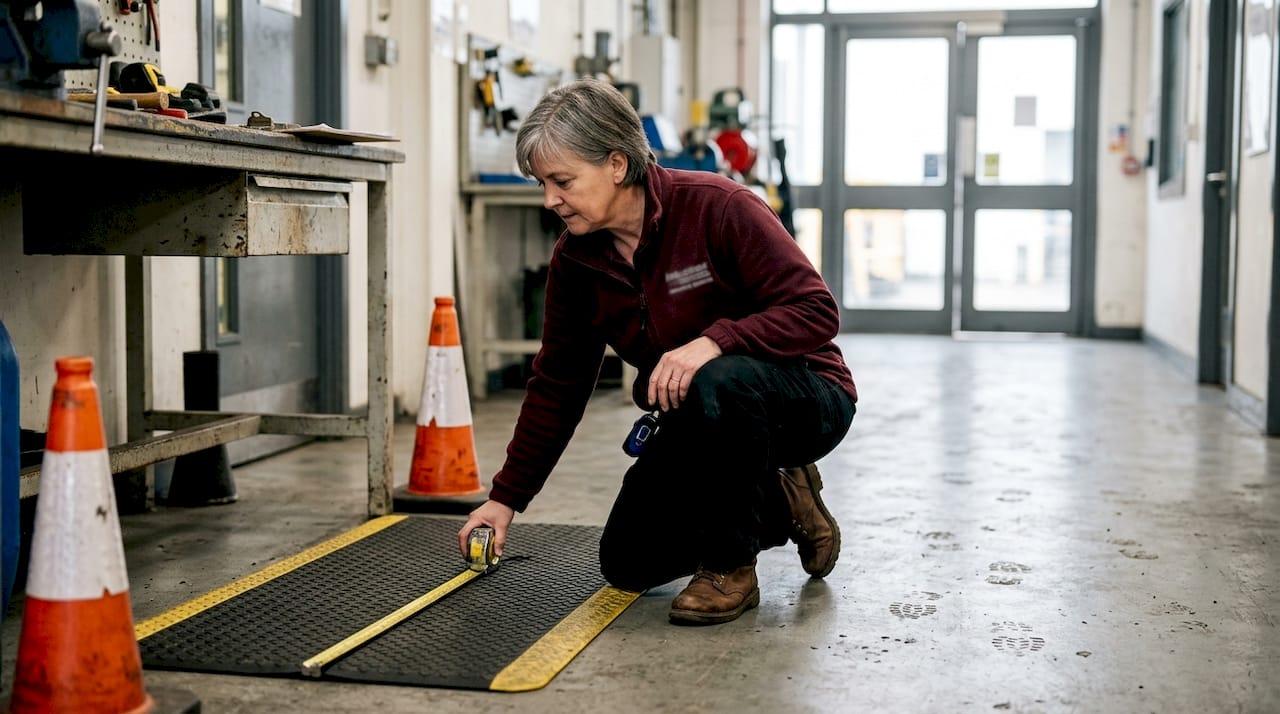
Thicker isn’t always better when it comes to anti-fatigue mats. Mats exceeding 1.5 inches in thickness create tripping hazards, especially at edges where the height difference becomes pronounced. Workers stepping on and off excessively thick mats face increased fall risk, potentially creating more safety issues than the mats solve.
Material selection must match your specific environment to ensure longevity and performance. Manufacturing facilities with oil and grease exposure require mats specifically formulated to resist petroleum-based substances. Standard foam mats deteriorate rapidly when exposed to industrial fluids, creating replacement costs and safety hazards as they break down.
| Mat Type | Best Environment | Key Features | Typical Lifespan |
|---|---|---|---|
| Solid rubber | Manufacturing, automotive | Oil-resistant, durable, heavy-duty | 3-5 years |
| Foam with vinyl top | Retail, light assembly | Comfortable, easy to clean, affordable | 1-2 years |
| Anti-microbial rubber | Food service, healthcare | Bacteria-resistant, moisture-proof | 2-4 years |
| Modular interlocking | Large open areas | Customizable size, easy replacement | 2-3 years |
Common performance issues plague poorly chosen or maintained mats. Survey data from 1,500 safety and manufacturing leaders reveals that curling edges represent the number one complaint, with 70% of mats failing within one year. Edge curling creates immediate tripping hazards and signals that the mat has reached the end of its useful life.
Warning signs that indicate mat replacement:
- Edges curling upward or corners lifting from the floor
- Visible flattening or compression that doesn’t recover
- Surface delamination where top layers separate from the base
- Cracks, tears, or permanent indentations from equipment
Flattening over time reduces the cushioning effect that makes anti-fatigue mats effective. When you can feel the hard floor through the mat, it no longer provides adequate pressure redistribution or encourages the micro-movements that improve circulation. Regular inspection helps you identify flattened mats before workers experience increased discomfort.
Delamination occurs when the layers of composite mats separate, creating air pockets and uneven surfaces. This failure mode is particularly common in wet environments or areas with temperature fluctuations. Once delamination begins, the mat loses structural integrity rapidly and becomes a safety liability.
Matching mat properties to environmental challenges prevents premature failure. Wet areas require mats with drainage holes and slip-resistant surfaces. Facilities with heavy cart traffic need reinforced edges and higher-density materials that resist compression. Taking time to analyze your specific conditions before purchasing saves money and frustration.
Learning about industrial anti-fatigue mats designed for demanding environments helps you avoid the common mistake of choosing residential or light-commercial products for heavy-duty applications. The upfront cost difference between appropriate industrial mats and cheaper alternatives disappears quickly when you factor in replacement frequency.
Pro Tip: Never stack multiple mats to achieve desired thickness. Stacking creates unstable surfaces that shift underfoot and dramatically increases tripping hazards. If your current mats feel too thin, replace them with properly specified products rather than adding layers.
Regular maintenance extends mat lifespan and preserves safety. Sweep or vacuum mats daily to remove debris that can abrade the surface. Clean with appropriate solutions based on mat material, avoiding harsh chemicals that degrade rubber or foam. Inspect weekly for early signs of wear, addressing issues before they become safety hazards.
Storing backup mats properly prevents damage before installation. Keep mats flat or loosely rolled in climate-controlled areas away from direct sunlight and extreme temperatures. Mats stored improperly develop permanent warping or material degradation that compromises performance. Understanding anti-fatigue industrial mats specifications helps you implement proper storage and rotation schedules.
Return on investment and business impact of using anti-fatigue mats
The financial case for anti-fatigue mats extends well beyond the purchase price. One documented case study shows manufacturers saved $12,000 over three years by purchasing rather than renting mats, with additional savings from reduced absenteeism and workers’ compensation claims. These tangible returns make anti-fatigue mats one of the most cost-effective ergonomic interventions available.
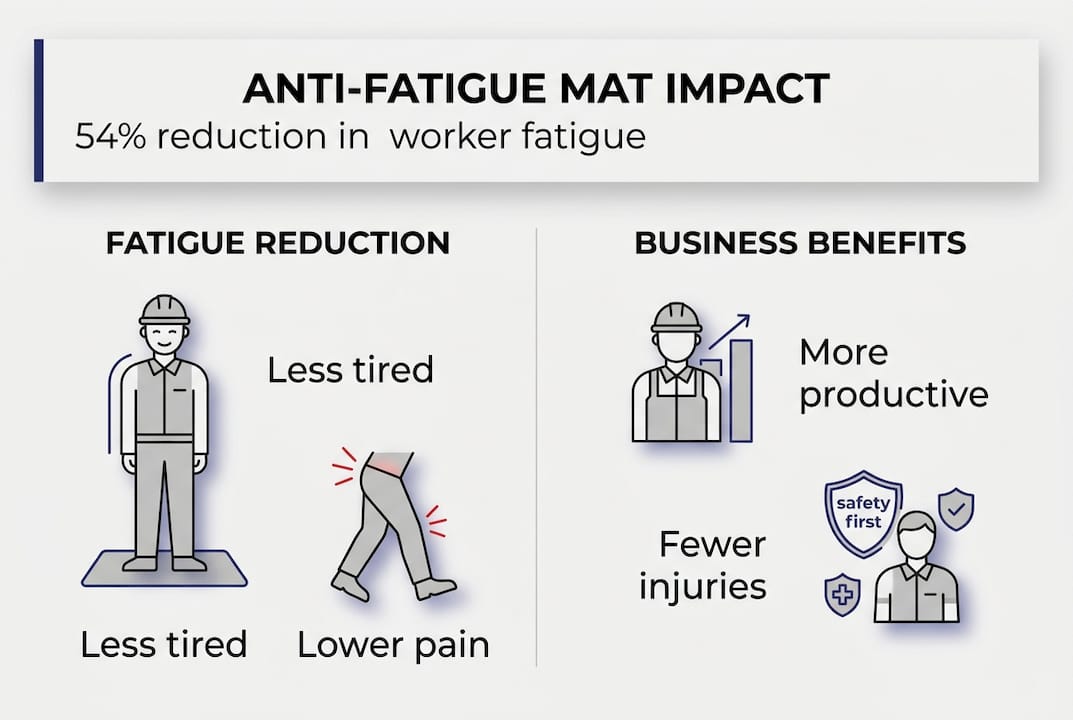
Productivity improvements deliver immediate value that compounds over time. Workers experiencing less fatigue maintain better focus and work quality throughout their shifts. The 12% productivity boost documented in warehouse environments translates directly to increased output without adding labor costs or overtime expenses.
Injury prevention represents the largest potential savings for most facilities. Musculoskeletal disorders from prolonged standing generate substantial workers’ compensation claims and lost workdays. By addressing the root cause of standing-related injuries, anti-fatigue mats reduce both the frequency and severity of these costly incidents.
| Cost Category | Without Mats (Annual) | With Mats (Annual) | Savings |
|---|---|---|---|
| Workers’ comp claims | $18,000 | $11,000 | $7,000 |
| Absenteeism (standing-related) | $8,500 | $5,200 | $3,300 |
| Productivity loss | $15,000 | $13,200 | $1,800 |
| Total annual impact | $41,500 | $29,400 | $12,100 |
Employee retention improves when workers feel their employer invests in their comfort and health. The cost of recruiting and training replacement workers far exceeds the investment in quality anti-fatigue mats. Facilities that prioritize ergonomic improvements experience lower turnover rates and build stronger teams over time.
Morale and job satisfaction increase measurably when physical discomfort decreases. Workers standing on anti-fatigue mats report feeling more valued and cared for by management. This psychological benefit creates a positive workplace culture that extends beyond the immediate physical relief the mats provide.
Ownership versus rental economics favor purchasing for most long-term applications. Rental programs charge monthly fees that accumulate to several times the purchase price over a mat’s useful lifespan. While rental offers convenience for temporary needs or special events, permanent workstations justify ownership.
Pro Tip: Calculate total cost of ownership including maintenance, cleaning, and eventual replacement when comparing mat options. A higher-quality mat with a $200 premium that lasts three years instead of one delivers better value than repeatedly replacing cheaper alternatives.
Quality differences between mat grades become apparent quickly in demanding environments. Industrial-grade mats withstand the punishment of heavy use, chemical exposure, and equipment traffic that destroys lighter-duty products. The premium for appropriate specifications pays for itself through extended service life and reduced replacement frequency.
Exploring anti-fatigue mat benefits in detail reveals how these investments support broader business objectives beyond immediate ergonomic improvements. The ripple effects touch recruitment, retention, productivity, safety metrics, and overall operational efficiency in ways that justify viewing anti-fatigue mats as strategic assets rather than simple floor coverings.
Explore premium anti-fatigue mat solutions at Mats4U
Transforming your facility’s standing workstations starts with choosing mats engineered for commercial and industrial demands. Mats4U offers proven solutions designed specifically for the challenging environments you manage every day. The Cushion Complete Mat delivers industrial-strength performance with advanced cushioning technology that maintains effectiveness through years of heavy use.
For environments requiring superior comfort with enhanced durability, the Cushion Select Mat combines premium materials with thoughtful design features that address common failure points. When maximum comfort meets rigorous safety standards, the Comfort Premier Mat provides the ultimate solution for your most demanding applications. Explore these options to find the perfect match for your facility’s specific needs and start realizing the benefits of proper anti-fatigue mat implementation.
Frequently asked questions
How do anti-fatigue mats help reduce worker fatigue?
Anti-fatigue mats cushion your feet and legs while redistributing pressure away from stress points that cause pain during prolonged standing. The slightly unstable surface encourages constant micro-movements in your leg muscles, which improves blood circulation and prevents the pooling that leads to swelling and discomfort. These combined effects reduce the physical strain that causes fatigue, helping workers maintain energy and focus throughout their shifts.
What thickness of anti-fatigue mat is best for safety?
The optimal thickness range is 3/8 to 1 inch for most commercial and industrial applications. This provides adequate cushioning while maintaining a stable, safe surface. Avoid mats thicker than 1.5 inches because they create significant tripping hazards, especially at edges where workers step on and off the mat. Proper thickness balances comfort with safety.
Can anti-fatigue mats be used in oily or wet environments?
Yes, but you must select mats specifically designed with oil-resistant or water-resistant materials for these conditions. Standard foam mats deteriorate rapidly when exposed to petroleum products or constant moisture, creating safety hazards as they break down. Specialized industrial anti-fatigue mats engineered for harsh environments maintain their properties and provide reliable performance where general-purpose mats fail quickly.
What maintenance is required to ensure anti-fatigue mats last?
Inspect your mats weekly for signs of curling edges, surface flattening, or delamination that indicate wear or failure. Clean them regularly by sweeping away debris and washing with appropriate solutions for the mat material. Never stack multiple mats to increase thickness, as this creates unstable surfaces and tripping hazards. Address wear issues promptly by replacing compromised mats before they become safety liabilities.


