


Managing a busy American manufacturing floor means solving for worker fatigue and fire risk at the same time. Long shifts on hard concrete bring aches and exhaustion, while machinery and materials introduce genuine fire hazards. Facility managers know that ordinary mats just do not cut it in high-traffic workspaces. Fire resistant anti-fatigue mats combine cushioning comfort with durable protection against heat and flame, helping your team stay safer, healthier, and focused every shift. Discover what sets these specialty mats apart for United States manufacturing plants.
Table of Contents
- What Are Fire Resistant Anti Fatigue Mats?
- Types and Construction Materials Explained
- Performance Standards and Safety Certification
- Workplace Applications in Manufacturing Plants
- Common Pitfalls and Selection Mistakes
Key Takeaways
| Point | Details |
|---|---|
| Importance of Fire Resistance | Fire resistant anti-fatigue mats are essential in manufacturing environments for worker comfort and safety from fire hazards. |
| Material and Certification | Ensure mats meet NFPA and ASTM standards for fire safety to avoid compliance issues. |
| Impact on Worker Health | These mats reduce fatigue and improve worker satisfaction, ultimately lowering injury rates and insurance costs. |
| Selection and Maintenance | Conduct thorough risk assessments and regular inspections to maintain mat integrity and functionality over time. |
What Are Fire Resistant Anti Fatigue Mats?
Fire resistant anti-fatigue mats are specialty floor coverings engineered to do two things at once: cushion your workers’ feet during long shifts and protect your facility from fire hazards. Unlike standard anti-fatigue mats, these are manufactured with materials that resist degradation at high temperatures, making them essential for manufacturing environments where both worker comfort and fire safety matter equally. Your facility managers understand this intersection well. You’re managing foot traffic in warehouses, production floors, and assembly lines where people stand for 8, 10, sometimes 12 hours straight. Add fire risk into that equation, and you need solutions that address both concerns without compromise.
At their core, anti-fatigue mats work by absorbing pressure and cushioning feet, reducing the physical stress that accumulates during prolonged standing. Your workers experience less foot pain, lower back strain, and reduced fatigue. But standard mats fall short in high-risk environments. Fire resistant versions incorporate fire-safe polymers that prevent rapid degradation when exposed to heat or flame, maintaining structural integrity during emergencies. This dual functionality makes them particularly valuable in manufacturing plants where machinery generates heat, sparks, or where flammable materials are present. The mats stay in place, continue providing ergonomic support, and don’t contribute to fire spread or emit excessive toxic fumes if an incident occurs.
What sets these mats apart from basic versions is the material science behind them. They’re constructed using specialized polymer blends and surface treatments that pass rigorous fire safety testing. Your facility won’t find these lining every retail store or office entryway. They’re built for industrial environments where OSHA compliance and worker protection intersect with fire codes. When your workers stand on a fire resistant anti-fatigue mat, they’re benefiting from technology designed for their specific workplace hazards. The mat absorbs the repetitive impact of their feet hitting the floor hour after hour, while the fire resistant properties give your facility’s safety team one fewer thing to worry about during inspections or emergency planning. Think of it as layered protection: comfort for your workers today, safety assurance for your facility tomorrow.
The construction of these mats typically involves multiple layers engineered for different purposes. The top surface provides traction and comfort, while middle layers deliver the cushioning that reduces fatigue and joint strain. The base layer anchors everything while resisting heat degradation. Some versions include rubber or foam compounds rated for high-temperature environments, while others use interlocking designs that prevent mats from shifting when people move across them. For mid-sized manufacturing operations, this stability matters tremendously. A worker won’t slip when rushing between stations, and the mat won’t bunch up or create trip hazards during shift changes.
Pro tip: When evaluating fire resistant anti-fatigue mats for your facility, check that they meet NFPA (National Fire Protection Association) standards for smoke and flame spread ratings. Your local fire marshal can specify which ratings your manufacturing environment requires, and matching your mat selection to those standards ensures both worker safety and regulatory compliance without overspending on unnecessary features.
Types and Construction Materials Explained
Fire resistant anti-fatigue mats aren’t all built the same way. The construction differences matter significantly when you’re selecting mats for your specific manufacturing environment. At the foundation, these mats use fire-safe polymers that either resist heat naturally or contain flame-retardant additives. The polymers are engineered to slow ignition and prevent rapid flame spread, which is critical in facilities where sparks or heat sources might contact the mat surface. Some mats incorporate mineral-based additives, while others use organohalogen or organophosphorus compounds that chemically interrupt combustion processes. The material composition directly affects both the fire rating your mat achieves and how it performs underfoot during normal operations.
The layering structure of fire resistant anti-fatigue mats follows a specific design that balances comfort, durability, and fire safety. The top surface layer provides immediate worker contact and is engineered for traction and comfort. This layer resists slipping even when wet and can handle the constant friction of footsteps. Below that sits the cushioning core, typically made from closed-cell foam or elastomeric materials that absorb impact and reduce foot fatigue. This is where the anti-fatigue benefit comes from. The base layer anchors the entire mat and resists heat degradation, preventing the mat from warping or breaking down if exposed to high temperatures. Some premium versions include interlocking edges that connect adjacent mats, creating a seamless surface across your production floor. This design prevents gaps where debris accumulates or where workers might trip.
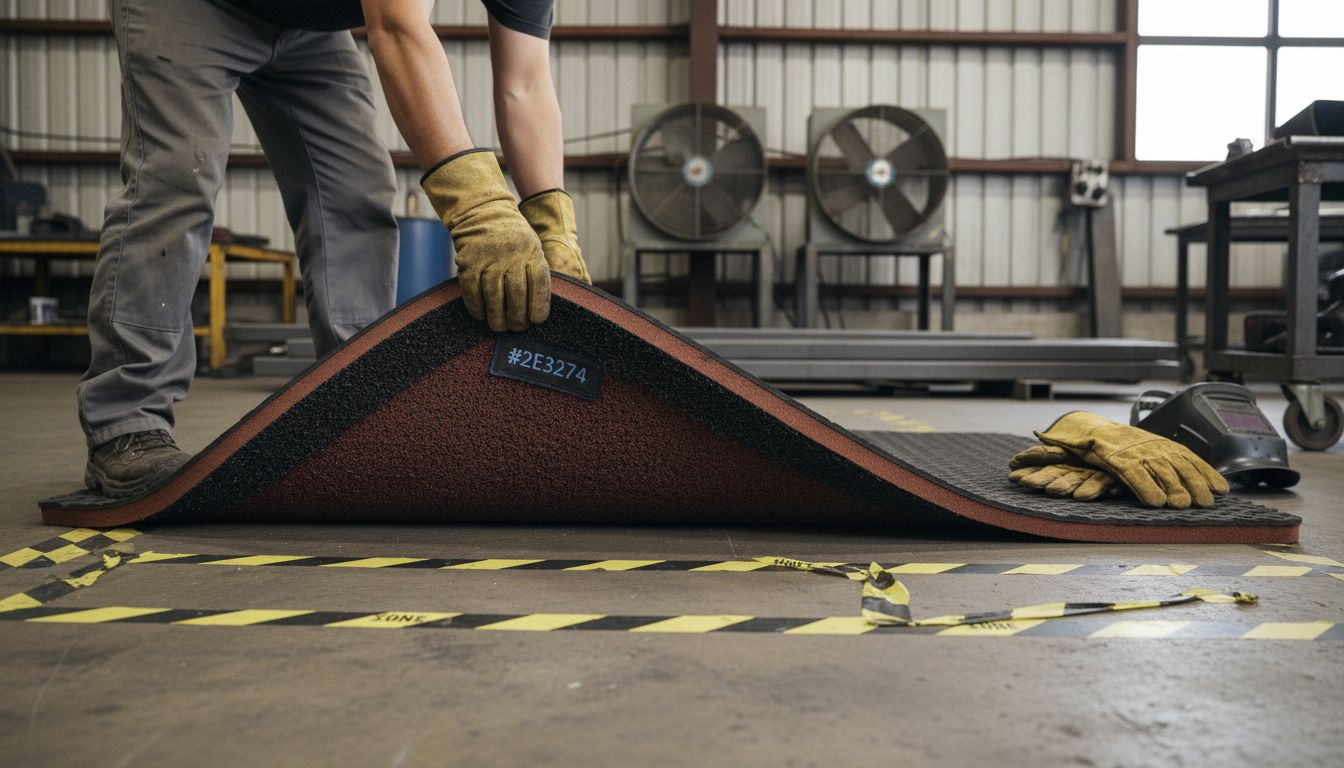
Manufacturers achieve fire resistance through multiple approaches. One common method involves incorporating noncombustible materials that maintain structural integrity when exposed to heat. Another approach uses composite constructions that layer fire-resistant polymers with flame-blocking textiles or ceramics. Each method has tradeoffs. A mat with more mineral content might offer superior fire protection but feel less cushioned underfoot. A mat with premium foam might feel more comfortable but require additional flame-retardant coatings. Your facility’s specific hazards determine which approach makes sense for your operation.
When comparing options at mid-sized manufacturing plants, you’ll encounter mats with different thickness ratings, ranging from half an inch to over an inch thick. Thicker mats generally provide more cushioning and reduce worker fatigue faster, but they cost more and can create height transitions at doorways. Thinner mats work well in tight spaces or facilities with low-ceiling equipment but offer less shock absorption for workers standing on hard concrete all day. The material durability also varies. Some mats use recycled rubber with fire-resistant coatings, while others feature virgin polymer blends designed specifically for high-temperature environments. Recycled options often cost less and appeal to facilities focused on sustainability, though virgin materials sometimes outperform in extreme heat conditions. Your purchasing decision should weigh initial cost against expected mat lifespan and replacement frequency in your specific operational context.
Here is a comparison of fire-resistant anti-fatigue mats and standard anti-fatigue mats, highlighting differences that matter for industrial buyers:
| Feature | Standard Anti-Fatigue Mats | Fire Resistant Anti-Fatigue Mats |
|---|---|---|
| Material Tolerance | Melts or degrades under heat | Maintains integrity with heat |
| Workplace Suitability | Offices, retail, light duty | Manufacturing, welding, high heat |
| Fire Safety Standards | Rarely certified | NFPA & ASTM tested |
| Replacement Frequency | Wears out more quickly | Longer lifespan in harsh areas |
| Typical Cost | Lower initial investment | Higher but cost-effective long term |
This summary provides a quick reference for key construction materials used in fire-resistant mats and their workplace impact:
| Material Type | Role in Mat Construction | Safety and Comfort Impact |
|---|---|---|
| Fire-safe polymers | Main structural layer | Resists flames, cushions feet |
| Flame-blocking textiles | Added protective surface | Slows ignition, improves safety |
| Mineral additives | Chemical reinforcement | Lowers smoke, boosts durability |
| Closed-cell foam | Cushioning core | Reduces fatigue, absorbs impact |
Pro tip: Request material safety data sheets (MSDS) and fire test certifications from your mat supplier before purchasing. These documents confirm exact flame-spread ratings, smoke development characteristics, and whether the mat meets your facility’s insurance and OSHA requirements without guesswork.
Performance Standards and Safety Certification
Not every mat labeled “fire resistant” actually meets rigorous safety standards. The difference between a marketing claim and genuine fire protection comes down to certification. Fire resistant anti-fatigue mats must pass specific performance tests conducted by recognized bodies. ASTM test methods evaluate how materials respond to ignition, how quickly flames spread across the surface, and how much heat the mat releases during combustion. These aren’t theoretical exercises. Your facility’s insurance company, your local fire marshal, and OSHA all reference these standards when assessing whether your mats meet workplace safety requirements. A mat that hasn’t been tested against these benchmarks offers no verified protection, regardless of what the manufacturer’s website claims. When you’re ordering fire resistant mats for your manufacturing floor, certification from established organizations like ASTM or NFPA isn’t optional. It’s how you prove to regulators, insurance providers, and your own safety team that the product actually performs as intended.
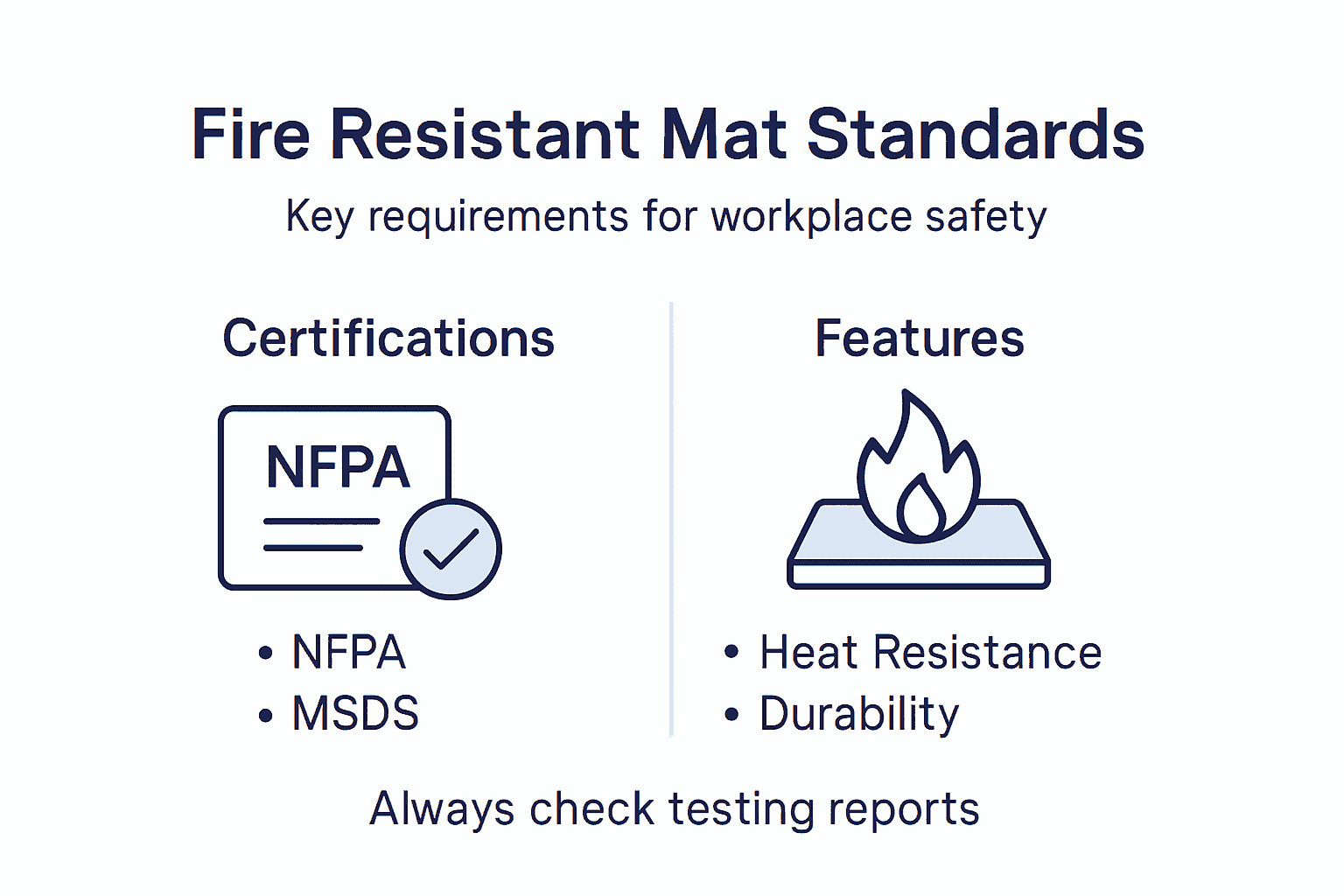
The National Fire Protection Association (NFPA) provides the codes and standards that manufacturers must follow. NFPA standards specify exactly how fire-resistant products should behave under specific conditions. A mat’s NFPA rating tells you critical information about its performance characteristics. The Smoke Development rating measures how much smoke the mat generates if it catches fire, which matters for worker visibility and evacuation safety. The Flame Spread rating indicates how quickly fire travels across the mat surface. A lower flame spread number means the mat resists combustion better. Your facility’s specific insurance policy and local fire codes might require minimum ratings in each category. For instance, a manufacturing plant handling flammable liquids might need stricter ratings than a warehouse with minimal fire hazards. The certification process involves sending sample mats to independent testing laboratories where they’re subjected to standardized fire exposure and monitored for specific performance metrics.
When evaluating certifications, look for documentation that shows actual test results rather than generic compliance claims. A legitimate certified mat includes test reports showing specific Smoke Development and Flame Spread numbers, not just vague statements like “fire resistant approved.” These numbers matter. A mat with a Flame Spread rating of 25 or lower typically satisfies most industrial facility requirements. Smoke Development ratings below 50 are generally considered acceptable. Your facility manager should request these specific metrics from suppliers before making purchasing decisions. Additionally, verify that the certification is current. Testing standards and requirements evolve, and a mat certified five years ago might not meet today’s codes. Contact your insurance broker or local fire department to confirm which specific certifications your facility must have. This takes 30 minutes of your time upfront but prevents costly compliance issues later.
Beyond fire performance metrics, certified mats also demonstrate structural durability under heat exposure. Testing confirms that the mat maintains its integrity when exposed to high temperatures, won’t warp or degrade excessively, and won’t release toxic fumes during a fire. This matters for worker safety during emergencies and for compliance with environmental and occupational health regulations. A mat that crumbles or releases hazardous vapors when heated creates new dangers rather than preventing them. Certified products undergo stress testing that simulates real-world conditions in manufacturing environments. The certification badge on a mat’s packaging represents hundreds of hours of laboratory testing and quality control. For your facility, this means you’re purchasing based on verified performance data, not marketing promises.
Pro tip: Create a certification tracking spreadsheet for your facility that documents which mats you have, their specific ASTM or NFPA ratings, purchase dates, and certification expiration dates. Update this annually during your safety audit so you can identify mats needing replacement before they fall out of compliance with current fire codes.
Workplace Applications in Manufacturing Plants
Manufacturing plants face a unique combination of workplace hazards that make fire resistant anti-fatigue mats essential rather than optional. Your facility likely deals with prolonged standing on hard concrete, machinery that generates heat and sparks, electrical equipment with fault risks, and inventory that includes flammable materials. Workers on assembly lines, packaging stations, and quality control areas spend entire shifts standing in the same spot. Their feet absorb constant impact. Their legs experience muscle fatigue. Their lower backs bear the cumulative stress of hours without relief. At the same time, the environment around them carries fire risks. A spark from a grinding operation, an electrical short in machinery, or accidental contact with heated surfaces creates potential ignition sources. Fire resistant anti-fatigue mats reduce worker fatigue while simultaneously providing fire safety protection in these hazardous environments. They address two critical workplace concerns through a single flooring solution.
Specific manufacturing areas benefit most from fire resistant mats. Assembly and production lines where workers stand for entire shifts are obvious candidates. Packaging departments handling flammable materials or operating near heat sources need this protection. Quality control stations where inspectors stand for hours reviewing products require both ergonomic support and fire safety. Welding areas, machining operations, and equipment maintenance zones generate sparks and heat that make fire resistant mats essential. Even office areas adjacent to these high-risk zones benefit from having the same mat type throughout, creating consistency and ensuring no weak points in your facility’s fire safety approach. The mats prevent fatigue-related injuries and mistakes that occur when exhausted workers lose focus. They also prevent fires from spreading rapidly across flooring if an ignition incident occurs. Your facility’s insurance company recognizes this dual benefit. Many offer premium reductions for manufacturers who install certified fire resistant anti-fatigue mats in appropriate work areas.
Fire safety measures in manufacturing must include materials minimizing ignition risk from machinery and electrical equipment. Fire resistant mats accomplish this as part of a comprehensive strategy. They don’t replace fire suppression systems, emergency procedures, or employee training. Rather, they work alongside these measures to reduce overall facility risk. When an employee is less fatigued, they respond faster to emergencies and follow procedures more accurately. When flooring resists flame spread, evacuation routes stay clearer and smoke generation decreases. The combination matters. A mid-sized plant with 50 workers standing on fire resistant mats experiences measurable improvements in both safety metrics and worker compensation claims. Foot pain decreases. Ankle and knee injuries drop. Workers report less soreness and higher job satisfaction. These aren’t minor benefits. Reduced injury rates directly lower your insurance costs and decrease absenteeism.
When implementing fire resistant anti-fatigue mats across your facility, consider workflow patterns and traffic density. High-traffic areas where workers move constantly need mat designs that prevent tripping and maintain secure placement. Lower-traffic zones where workers stand mostly stationary can use mats with different characteristics optimized for maximum cushioning. Break rooms where workers stand briefly might not warrant the same investment as production floors where people stand eight hours daily. Your facility layout determines mat placement strategy. Entry points to production areas benefit from mats that transition workers psychologically from office comfort to industrial demands. Moist or wet areas require mats with superior drainage and slip resistance. Temperature-controlled warehouses have different needs than shops where overhead equipment radiates significant heat. A comprehensive assessment of your specific floor layout, worker tasks, environmental conditions, and fire hazards guides your purchasing decisions.
Pro tip: Walk your production floor at different times during a shift and note where workers congregate, which areas generate the most foot traffic, and where machinery creates heat or sparks. These observations pinpoint exactly where fire resistant anti-fatigue mats deliver the most value for your facility, allowing you to prioritize high-impact installations before expanding to other areas.
Common Pitfalls and Selection Mistakes
Facility managers make the same mistakes repeatedly when purchasing fire resistant anti-fatigue mats, and these errors cost thousands of dollars in premature replacements and compromised safety. The biggest mistake is prioritizing comfort alone without verifying fire resistance credentials. You see an attractive mat sample, feel how soft it is underfoot, get excited about worker satisfaction, and order it. Nobody stops to ask whether it actually meets fire safety standards. Six months later, your insurance auditor questions whether those mats comply with your facility’s fire codes. You scramble to find documentation that doesn’t exist. The mats get replaced at your expense. Another common error involves neglecting adherence to established fatigue and fire performance standards during the selection process. You assume that any mat labeled “fire resistant” meets certification requirements. In reality, marketing language means nothing without backing documentation. A mat that degrades prematurely under your specific workplace conditions wastes budget and leaves workers without adequate protection. Purchasing based on price alone without verifying durability testing results creates the same problem. Cheap materials fail faster, requiring constant replacement that ultimately costs more than investing in quality upfront.
Another critical mistake involves conducting incomplete risk assessments before selecting mats. You might identify that your facility needs fire resistant mats but fail to analyze which specific areas require them most. This leads to inconsistent installation that leaves gaps in protection. You place fire resistant mats in low-risk zones while overlooking high-risk machinery areas. Workers get frustrated when mats in different zones feel different, reducing acceptance and creating confusion about facility safety priorities. Selection mistakes include choosing mats based solely on comfort without verifying fire-resistance properties for specific workplace hazards. Your facility has unique characteristics. A welding department needs different protection levels than a packaging area. A warehouse with minimal heat sources has different requirements than a plant with industrial ovens. Generic mat selection ignores these distinctions. You end up with products that don’t match your actual workplace hazards, wasting money on unnecessary features in some areas while leaving others under-protected. Taking time to evaluate your specific environment prevents this costly mismatch.
Ignoring maintenance and inspection schedules represents another major pitfall. You install premium fire resistant mats, then forget about them for three years. Over time, mats accumulate debris, wear unevenly, lose cushioning properties, and potentially develop damage that compromises fire resistance. A mat with a crack or separation in the layers might not perform as designed during a fire. Regular inspection catches these problems before they create safety hazards. Facilities that inspect mats quarterly catch 80 percent of deterioration issues early enough to address them through targeted replacement rather than complete facility-wide replacement. Documentation and maintenance tracking also demonstrate due diligence if your facility faces insurance claims or regulatory inspections. You need written records showing when mats were installed, when they were inspected, what condition they were in, and when they need replacement based on wear patterns.
Budget constraints often lead facilities to make short-sighted purchasing decisions. You might select thinner, cheaper mats that provide minimal cushioning and marginal fire protection, thinking you’re saving money. Six months later, workers complain about foot pain, injuries increase, absenteeism rises, and your insurance premiums creep higher. Your facility ends up spending more through indirect costs than it would have by investing in better mats initially. Similarly, purchasing mats from unknown manufacturers or overseas suppliers without verifiable certifications creates compliance risks. You save five dollars per square foot on the initial purchase, then spend thousands managing the compliance violations and mat replacements when auditors reject them.
Pro tip: Before purchasing any fire resistant anti-fatigue mats, create a simple spreadsheet listing your facility’s specific hazards, worker tasks, floor areas, and current pain points with existing mats. Share this with at least two suppliers and ask how their products address each specific need. Compare responses against certification documentation and NFPA ratings to identify which supplier best understands your actual requirements rather than selling generic solutions.
Enhance Safety and Comfort with Fire Resistant Anti-Fatigue Mats
Managing worker fatigue while ensuring fire safety in your manufacturing environment is a critical challenge. Fire resistant anti-fatigue mats help reduce physical strain during long shifts and protect your facility against fire hazards by meeting strict NFPA and ASTM standards. These mats deliver comfort without compromising durability or safety, addressing key pain points like foot and back pain, compliance concerns, and costly replacements.
Explore the wide selection of quality solutions designed to meet these exact needs in the Anti-Fatigue Mats Collection at Mats4U. Take advantage of products crafted to endure industrial conditions and provide certified fire resistance plus ergonomic support. Visit Mats4U.com today to find mats engineered for your specific workplace challenges with competitive pricing and free delivery on orders over $100. Don’t wait to improve workplace safety and comfort — secure your durable fire resistant anti-fatigue mats now and give your workers the support they deserve.
Frequently Asked Questions
What are fire resistant anti-fatigue mats?
Fire resistant anti-fatigue mats are specialized flooring solutions designed to provide comfort for workers while also preventing degradation in high-heat environments, making them essential in industrial settings where fire hazards exist.
How do fire resistant anti-fatigue mats differ from standard anti-fatigue mats?
Fire resistant anti-fatigue mats are constructed from fire-safe polymers that resist heat and flame, whereas standard anti-fatigue mats may degrade or melt when exposed to high temperatures, making them unsuitable for high-risk environments.
What should I look for when choosing fire resistant anti-fatigue mats for my facility?
When selecting fire resistant anti-fatigue mats, ensure they meet NFPA standards for flame and smoke spread ratings, check for certification documentation, and consider the specific hazards and traffic patterns in your facility to determine the best fit.
How do fire resistant anti-fatigue mats improve workplace safety?
These mats reduce worker fatigue and discomfort while standing for long periods, which can lower the risk of foot and back injuries. Additionally, they resist fire spread and toxic smoke emission, contributing to a safer environment in case of a fire emergency.


