


TL;DR:
- Heated door mats offer continuous snow melting, reducing slip hazards and labor needs.
- They vary in size, wattage, and configuration for different commercial entryway demands.
- Compared to salt or embedded systems, heated mats provide safer, cost-effective, and scalable solutions.
Icy entryways are a direct liability for any facility. When temperatures drop and snow piles up at your main doors, every arriving visitor, employee, or vendor is a potential slip-and-fall incident waiting to happen. Facility managers in manufacturing, education, retail, and office environments know that shoveling schedules and salt applications often fall short during peak winter hours. Heated door mats offer a smarter, more consistent approach: continuous snow melt, no chemical residue, and significantly less labor. This guide walks through how to evaluate, compare, and select the right heated mat system for demanding commercial entrances.
Table of Contents
- How to evaluate heated door mats for commercial entrances
- Top heated door mats for commercial use: Features and real-world benefits
- Heated door mats vs. other snow and ice solutions: A direct comparison
- Practical tips for getting the most out of your heated door mats
- Which heated mat is best for your facility? Real-world scenarios
- Our perspective: What most heated door mat reviews overlook
- Find the right mat for your entrance: Mats4U solutions
- Frequently asked questions
Key Takeaways
| Point | Details |
|---|---|
| Prioritize ROI and safety | Heated door mats pay for themselves in 2-4 years by cutting labor costs and reducing slip risks. |
| Modularity enables better coverage | Modular mats let facilities flexibly cover complex or large entranceways with daisy-chaining. |
| Heated mats outperform salt | Automatic melting is safer, cleaner, and avoids corrosion compared to salt or chemicals. |
| Durability is key for high-traffic | Choose robust designs to handle heavy use and minimize maintenance headaches. |
| Consider operational costs | Energy costs for heated mats are low and affordable, even for long winter seasons. |
How to evaluate heated door mats for commercial entrances
Choosing the wrong mat means either paying too much for coverage you don’t need, or deploying a unit that can’t keep up with your traffic and snowfall. Start with these core evaluation criteria before looking at specific products.
Heating performance and efficiency is the first filter. Quality mats use electric heating elements sandwiched between non-slip rubber layers, plugged into 120V or 240V outlets with GFCI protection. A capable mat heats its surface to 40°F above ambient temperature and can melt snow at roughly 2 inches per hour. That figure matters when you have heavy morning traffic and a continuous snowfall to manage.
Durability comes next. Your entrance takes foot traffic all day long, plus rolling carts, wet boots, and equipment. Look for heavy-duty rubber construction rated for outdoor exposure. For context on what high-traffic surfaces actually endure, see our breakdown of high traffic flooring options for commercial spaces.
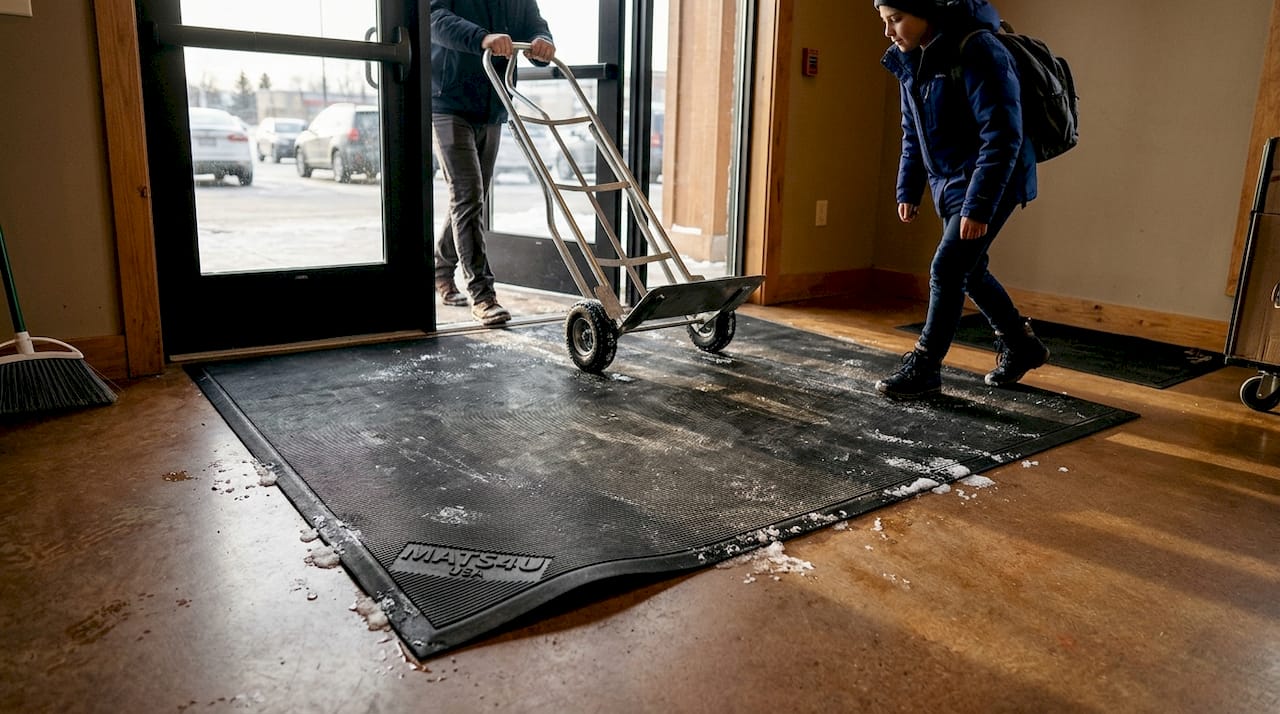
Safety features are non-negotiable. GFCI protection is standard in quality units and cuts power instantly if a ground fault is detected. Non-slip bottom surfaces prevent the mat itself from becoming a hazard. Look for UL or ETL certification on any unit you’re considering.
Installation flexibility matters most in commercial settings where entryways come in odd shapes or multiple zones need coverage. Modular mats that daisy-chain together allow coverage of large areas up to 13 to 14 amps per power unit. You can configure an L-shaped entry or a double-door vestibule without running separate power circuits for every panel.
Operational cost closes the evaluation loop. Salt and labor costs add up fast. Independent analysis shows that heated mats deliver ROI within 2 to 4 years through reduced labor, liability exposure, and surface corrosion. They are also preferred over chemicals for facilities with pets on-site, outdoor seating areas, or concrete that shows salt damage over time. For additional insight on selecting robust commercial rubber surfaces, see our guide to heavy duty rubber mats.
Cost comparison at a glance:
- Heated mat system: Higher upfront investment, low ongoing cost, no manual labor per storm
- Salt and chemicals: Low purchase price, high labor cost, surface corrosion risk over multiple seasons
- Embedded in-ground systems: Most expensive to install, highest performance, not practical for retrofits
Pro Tip: Choose modular mats for odd-shaped entries or multi-zone coverage. You can start with one panel and expand as budget allows, rather than committing to a fixed system size upfront.
Top heated door mats for commercial use: Features and real-world benefits
With evaluation criteria set, look at what the leading categories of heated mats actually offer in practice. User ratings consistently land between 4.4 and 4.6 out of 5 for top commercial units, which is strong for a product that operates outdoors in harsh conditions.
Heavy-duty rubber heated mats (120V, plug-in)
- Coverage: Typically 2 ft x 3 ft per panel, expandable via daisy-chain
- Wattage: 120 to 160 watts per panel
- Price range: $200 to $350 per mat
- Safety: GFCI cord, non-slip bottom, UL-listed options available
- Best for: Single-door retail entrances, smaller covered vestibules
Industrial-grade high-wattage mats (240V)
- Coverage: Larger panels, up to 3 ft x 5 ft per unit
- Wattage: 300 to 500 watts
- Price range: $400 to $700 per panel
- Safety: Requires dedicated 240V circuit, GFCI protection, weather-rated connection
- Best for: Manufacturing plant entries, loading dock pedestrian doors, school main entrances
Modular tile-style heated systems
- Coverage: Custom configurations, scalable from 6 sq ft to 50 sq ft or more
- Wattage: Varies by configuration
- Price range: $600 to $1,500 for a complete system
- Safety: Low-profile connections, no exposed cords between panels
- Best for: Multi-door campuses, uneven entry surfaces, staged rollouts
Slim-profile transition mats with heating
- Coverage: 18 in x 30 in standard
- Wattage: 60 to 80 watts
- Price range: $150 to $250
- Safety: GFCI plug, ADA-compliant low edge profile
- Best for: Interior vestibules, covered entries where ice risk is lower
“The mat kept up with everything we threw at it during two bad winters. We stopped worrying about morning salting entirely at the main entrance. Staff noticed the difference immediately.” This type of feedback is consistent among facility managers at high-traffic commercial sites who switch from chemical treatment to electric mats.
Common user critiques worth knowing:
- Upfront cost per mat is high relative to a bag of ice melt
- Heavy accumulation (more than 2 inches per hour) can overwhelm single-panel units
- Power cords require careful routing to avoid damage from carts or door sweeps
- Multiple mats are needed for wider entries, which multiplies the initial investment
Pro Tip: Plan cord placement before deploying mats. In high-traffic zones, use cord covers rated for outdoor and foot-traffic use to prevent tripping and cord wear.
Heated door mats vs. other snow and ice solutions: A direct comparison
Individual mat options are only half the decision. How does the heated mat approach stack up against other common snow and ice management strategies?
| Feature | Heated door mats | Salt/calcium chloride | Embedded heating systems |
|---|---|---|---|
| Performance | Continuous, automatic | Intermittent, manual | Continuous, automatic |
| Upfront cost | $200 to $1,500 | $20 to $80 per season | $3,000 to $15,000+ |
| Installation | Plug-in, no contractor | None | Requires licensed contractor |
| Energy cost per hour | $0.15 to $0.30 | N/A | $0.50 to $2.00+ |
| Surface safety | Slip-resistant mat | Residue, slippery when wet | Flush, no surface issues |
| Pet and surface safety | Yes, no corrosion | No, corrosive to concrete | Yes |
| Maintenance | Cord checks, cleaning | Reapplication per storm | Annual professional check |
| ROI timeline | 2 to 4 years | No meaningful ROI | 5 to 10 years |
The numbers tell a clear story. Heated mats sit in the middle of the cost and performance range. They outperform chemicals on safety and surface protection, and cost a fraction of embedded systems to install. The automatic on-contact melting also prevents refreezing better than intermittent salt applications, which wear off and leave wet, re-freezing patches between applications.
For facilities managing multiple entrances, drainage rubber mats paired with heated units can further reduce slip risk by channeling meltwater away from foot traffic zones.
Practical tips for getting the most out of your heated door mats
Now that you know how heated mats compare, here’s how to get the best possible results and long lifespan out of your investment.
-
Prep the surface. Clean the area under and around the mat before first deployment. Remove gravel, existing ice melt residue, and debris. A flat, clean surface ensures consistent heating contact and prevents uneven wear on the mat’s underside.
-
Verify your electrical setup. Confirm that outlets near your entry are GFCI protected before plugging in. For 240V units, have a licensed electrician verify the circuit. Never run a heated mat from an extension cord not rated for outdoor use or the mat’s wattage.
-
Route and protect cords deliberately. Use outdoor-rated cord covers at any point where a cord crosses foot traffic. Secure cords along walls or under threshold trim to prevent snagging by carts, door sweeps, or heavy boots.
-
Set a cleaning schedule. Heated mats still accumulate grit, sand, and debris tracked in from outside. Shake out or hose down mats regularly. Buildup reduces heating efficiency over the mat surface and creates its own slip risk.
-
Plan modular layout before first use. Map your entry dimensions and daisy-chain configuration before winter. Position panels so that the widest foot traffic paths are covered first. Test the full chain at room temperature to confirm all panels heat evenly.
-
Store mats properly off-season. Once winter ends, roll or fold mats per manufacturer guidance and store indoors away from UV exposure and temperature extremes. This directly extends the heating element’s life.
For further guidance on maximizing mat performance at entry points, see our entrance mat strategies guide for high-traffic commercial spaces.
Pro Tip: After any significant storm, do a quick visual check of all mat surfaces and cord connections before foot traffic peaks. Catching a cord that has been rolled over or a panel that has shifted takes 60 seconds and prevents a much bigger problem.
Which heated mat is best for your facility? Real-world scenarios
With so many options, what works best in your particular environment? Here is scenario-based guidance to help you make the right call.
| Facility type | Key challenge | Recommended solution | Configuration | Expected benefit |
|---|---|---|---|---|
| Manufacturing plant | Heavy boot traffic, loading dock entries, long shifts | Industrial 240V heavy-duty mat | 2 to 3 panels daisy-chained | Reduced slip incidents, no salt corrosion on concrete |
| K-12 school | High pedestrian volume, early morning ice, parent drop-off zones | Modular tile system | 4 to 6 panels per main entry | Consistent melt before bell, lower liability |
| Retail storefront | Customer-facing image, single door, limited storage | Slim-profile 120V plug-in mat | 1 to 2 panels | Automatic safety with no salt mess for customers |
| Office building | Multiple entrances, professional appearance, covered vestibule | Modular system or heavy-duty 120V per door | 2 panels per entry | Low maintenance, clean appearance, gradual expansion |
| University campus | Dozens of entries, centralized management | Mixed: modular systems at high-volume doors, single mats at secondary entries | Varies | Scalable deployment, reduced grounds labor costs |
Facilities like the Alcoa plant and various school districts have reported strong multi-season durability from heavy-duty heated mats, validating that these systems hold up under genuinely punishing daily conditions, not just light-use residential scenarios.
For facilities evaluating rubber mat options in broader commercial contexts, the guide to rubber mats in commercial settings provides additional selection context.
Our perspective: What most heated door mat reviews overlook
Most reviews compare wattage numbers and price tags. That misses the more important operational picture.
The facilities that get the most out of heated mats are not the ones with the most expensive units. They are the ones with clear protocols around electrical safety, mat cleaning, and cord management. A $300 mat that gets inspected after every storm and cleaned monthly will outlast a $600 unit left to fend for itself.
The layered protection approach is consistently undervalued. A heated mat at the exterior door, paired with a high-quality drainage or scraper mat just inside the entry, captures far more water and debris than a single heated surface alone. That combination reduces the load on your heated mat and keeps interior floors safer.
There is also a common assumption that bigger and more expensive always wins. In practice, mid-range modular mats offer the best long-term value. They give you flexibility to expand coverage incrementally, replace individual panels without replacing an entire system, and adapt to changing facility layouts. Low-cost single-panel mats wear out fast under commercial traffic. Top-end embedded systems require a contractor for any repair.
The hidden costs that reviewers rarely calculate: replacing cords damaged by carts, cleaning labor when mats are not maintained, and the one-time liability settlement that dwarfs every dollar spent on prevention. Heated mats are not just a convenience. In a high-traffic facility, they are a documented risk management tool.
Find the right mat for your entrance: Mats4U solutions
Choosing the right entrance mat for winter safety is a practical decision with real safety and financial consequences. At Mats4U.com, you will find commercial-grade mat solutions built for exactly the demands described in this guide. For facilities that need interior comfort near entry zones, the Comfort Premier anti-fatigue mat provides a proven solution for staff stationed at high-traffic doorways. For exterior and transitional entry coverage, the WaterHog Max Grand Half Oval offers heavy-duty scraping and moisture capture that complements any heated system. Browse the full catalog at Mats4U.com for free delivery on orders over $100 and Made in the USA product options.
Frequently asked questions
How do heated door mats work?
Heated door mats use electric heating elements sandwiched between non-slip rubber layers, plug into standard 120V or 240V outlets, and warm the surface enough to melt snow on contact automatically.
Are heated door mats safe for high-traffic commercial spaces?
Yes. They are built with slip-resistant surfaces and GFCI protection that cuts power instantly in a fault condition, making them well-suited for busy entrances.
What are the main drawbacks of heated door mats?
The primary drawbacks include a higher upfront cost of $200 to $350 per mat, potential cord damage in busy zones, and the need for multiple units to cover wider entry points.
How much does it cost to run a heated door mat?
Typical operating costs run $0.15 to $0.30 per hour per mat, which is significantly lower than the ongoing labor and material costs of manual snow removal.
Do heated mats work better than salt or shoveling?
Heated mats provide continuous automatic melting with no corrosion, no chemical residue, and no labor requirement per storm event, making them a more reliable and lower-maintenance solution than salt or shoveling alone.


