


TL;DR:
- Proper non slip mats are made from specialized materials with textured surfaces to ensure safety.
- Selecting the right mat type depends on hazard level, floor type, and traffic volume.
- Regular maintenance and timely replacement are essential for long-term safety and compliance.
Not all floor mats are created equal. A standard decorative mat does little to prevent slips in a busy restaurant kitchen, a wet retail entrance, or an industrial production floor. Slip and fall accidents account for a significant share of workplace injuries each year, with the U.S. Bureau of Labor Statistics consistently ranking them among the most common causes of lost workdays. The right non slip mat, selected for your specific environment and traffic volume, is a direct investment in worker safety, regulatory compliance, and operational continuity. This guide covers materials, mat types, standards, and maintenance practices so you can make an informed purchasing decision.
Table of Contents
- Understanding non slip mats: Materials and technology
- Comparing business mat types: Non slip, anti-fatigue, entrance, and custom options
- Safety, standards, and compliance: What businesses must know
- Maintenance and longevity: Maximizing ROI for your business mats
- Our take: What most businesses miss about non slip mat solutions
- Commercial mat solutions for safer business spaces
- Frequently asked questions
Key Takeaways
| Point | Details |
|---|---|
| Material matters | Choose mats made from durable, textured materials for the best slip protection. |
| Compare mat types | Understand business mat options—non slip, anti-fatigue, entrance—before purchasing. |
| Compliance is critical | Selecting the right mat ensures OSHA and ADA compliance, lowering liability risk. |
| Prioritize maintenance | Routine cleaning and inspection maximize the lifespan and effectiveness of mats. |
| Invest in quality | Opting for commercial-grade mats prevents safety incidents and hidden costs. |
Understanding non slip mats: Materials and technology
Not every mat sold as “commercial grade” actually delivers consistent slip resistance under real-world conditions. Business-grade non slip mats are engineered products, not commodity items. Understanding what separates them from consumer-grade alternatives is the starting point for any facility manager or retail operator making a purchasing decision.
Non slip mats are designed specifically to remain stationary on the floor and provide a stable, high-traction surface for foot traffic. They are used across a wide range of commercial environments: building entrances, industrial workstations, restaurant kitchens, hospital corridors, warehouse aisles, and retail checkout lanes. The term “non slip” refers both to the mat’s grip on the floor beneath it and to the grip the surface provides to foot traffic above.
Key materials used in commercial non slip mats include:
- Rubber: Natural and nitrile rubber are the most common base materials. Rubber provides excellent floor adhesion, withstands heavy loads, and resists moisture. Nitrile rubber adds chemical resistance, making it suitable for facilities using cleaning agents or oils.
- Vinyl (PVC): Vinyl mats are lightweight, easy to clean, and cost-effective. They work well in lower-traffic commercial areas but tend to degrade faster than rubber under sustained industrial use.
- Polypropylene: This synthetic fiber is frequently used for the top surface of entrance mats. It scrapes debris from shoe soles effectively and dries quickly, preventing moisture buildup near entryways.
- Recycled rubber composites: Made from reclaimed rubber, these mats offer similar performance to virgin rubber at a lower environmental cost. Many commercial buyers now prioritize recycled options for sustainability goals.
The technology behind effective slip resistance goes beyond material selection. Modern non slip mats use specialized rubber compounds and surface textures that enhance grip while channeling away moisture. Surface textures, such as raised diamond patterns, drainage holes, and interlocking grid designs, direct water and debris away from the contact zone, keeping the walking surface dry and stable. Reviewing the full industrial flooring guide can help you match surface technology to your specific floor type.
The backing of a mat is just as important as its top surface. Cleated rubber backings lock into carpet fibers, while flat rubber or suction-cup patterns grip hard flooring like tile or polished concrete. A mat that migrates under foot traffic is a hazard, not a solution. For a broader look at how surface materials and backing interact, the anti slip floor mats resource breaks down performance differences across key environments.
Pro Tip: Always specify mats with beveled edges (a gradual slope from the mat surface to the floor level) in high-traffic walkways. Beveled edges eliminate the raised lip that causes tripping and are a required feature in many ADA-compliant installations.
Comparing business mat types: Non slip, anti-fatigue, entrance, and custom options
With the basic features covered, it’s important to see how different commercial mat types stack up. Each mat category solves a specific problem. Selecting the wrong type, even a high-quality one, can leave gaps in your safety and efficiency strategy.
Non slip mats are the broadest category. They prioritize floor adhesion and surface traction above all else. They are the correct solution for wet areas, transition zones, and anywhere a moving mat could cause injury.
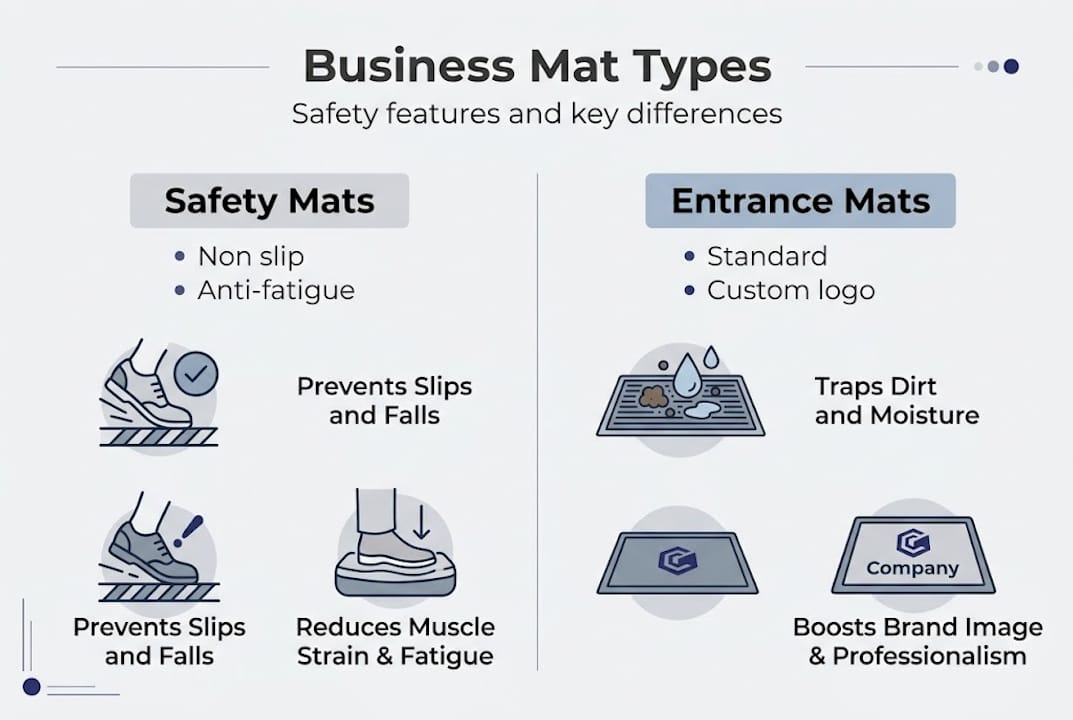
Anti-fatigue mats serve a different primary function: reducing physical strain on workers who stand for extended periods. Anti-fatigue mats offer ergonomic benefits beyond slip resistance, including cushioning that reduces joint stress, improved circulation, and decreased employee fatigue during long shifts. Many anti-fatigue mats also include non slip backing, making them dual-purpose solutions for production lines and retail counters. For guidance on selecting the right ergonomic option, the anti-fatigue mat selection resource covers wet and slippery surface considerations in depth.
Entrance mats focus on scraping and absorbing debris and moisture at building entry points. A properly sized entrance mat system can capture up to 80% of dirt and moisture before it reaches interior floors. This keeps interior surfaces cleaner and significantly reduces slip risk throughout the facility, not just at the door.
Custom logo mats combine safety with brand visibility. These mats use the same non slip construction as standard commercial mats but feature printed or dyed business logos, color schemes, and messaging. They are particularly effective in retail, hospitality, and healthcare lobbies where first impressions matter. For a side-by-side performance breakdown, the warehouse mat comparison resource offers useful data on durability across categories.
| Mat type | Slip resistance | Durability | Maintenance | Customization |
|---|---|---|---|---|
| Non slip rubber | Excellent | High | Low | Limited |
| Anti-fatigue | Good to excellent | Medium to high | Medium | Moderate |
| Entrance/scraper | Good | High | Medium | Moderate |
| Custom logo mat | Good to excellent | Medium to high | Medium | Full |
| Vinyl/PVC | Moderate | Medium | Low | Limited |
Steps for selecting the right mat type for your business:
- Identify the primary hazard: moisture, standing fatigue, debris, or branding need
- Assess the floor type (carpet, tile, polished concrete) to determine required backing
- Measure the coverage area and match mat dimensions to foot traffic patterns
- Check the traffic volume (light, moderate, heavy, or industrial) against the mat’s rated durability
- Review maintenance requirements against your cleaning schedule and available staff
Understanding what anti-fatigue mats are and how they differ from standard non slip products ensures you’re not overspending on features you don’t need or underbuying for a demanding environment.
Safety, standards, and compliance: What businesses must know
Knowing which mat to select is only half the battle; understanding safety standards and compliance is what protects your business from liability, fines, and injury claims.
Two regulatory frameworks are most relevant for U.S. businesses: OSHA (Occupational Safety and Health Administration) and the ADA (Americans with Disabilities Act). Both have specific requirements that floor mat selection directly affects.
OSHA’s General Industry standards (29 CFR 1910.22) require that walking and working surfaces be kept clean, dry, and in good condition. Where wet conditions cannot be eliminated, OSHA mandates appropriate drainage and the use of slip-resistant mats or coverings. Failure to comply can result in citations ranging from hundreds to tens of thousands of dollars per violation, depending on severity and history. Proper mat selection can help businesses meet OSHA and ADA standards and reduce liability exposure significantly.
The ADA requires that floor surfaces be stable, firm, and slip-resistant in areas accessible to the public. Mats that curl, buckle, or create elevation changes greater than half an inch must be secured or replaced. Transition strips and beveled edges are not optional in ADA-governed spaces. They are required.
“Investing in compliant, well-maintained floor mats is not a discretionary spend. It is a legal obligation and a direct risk mitigation measure for any business operating in commercial or industrial spaces.” (Commercial Facilities Safety Review)
Common compliance mistakes and their consequences:
| Mistake | Regulatory exposure | Consequence |
|---|---|---|
| Using unsecured mats near exits | OSHA 1910.22 violation | Fines, increased inspection frequency |
| Mats with raised edges in ADA areas | ADA non-compliance | Civil liability, retrofit costs |
| No drainage mat in wet processing areas | OSHA slip hazard citation | Injury claim, workers’ comp exposure |
| Worn mats with reduced slip resistance | OSHA general duty clause | Liability in injury litigation |
Required features and documentation businesses should maintain:
- Mats rated for the specific slip coefficient required by your floor type and environment
- Proof of ADA-compliant edge profiles in public-facing areas
- Maintenance logs showing regular inspection and replacement schedules
- Manufacturer specifications confirming durability ratings for traffic load
The safe flooring guide details the specific surface and backing specifications that align with OSHA and ADA requirements. For grip and traction standards, safety and grip tips outlines how to verify that a mat’s slip resistance rating matches your facility’s risk profile. Reviewing non-slip mats for business environments provides a practical framework for applying these standards across different operational zones.
A real-world example: a regional grocery chain that replaced worn entrance mats with compliant, beveled-edge rubber mats saw a 40% reduction in customer slip-and-fall claims over 18 months, directly reducing insurance premiums and legal costs. The upfront cost of the mats was recovered within the first year.
Maintenance and longevity: Maximizing ROI for your business mats
Once mats are deployed, businesses need to ensure they’re getting a strong return by prioritizing maintenance and longevity. The highest-quality mat will underperform if it is not cleaned, inspected, and replaced on schedule.

Routine maintenance is essential to preserve mat slip resistance and extend lifespan in high-traffic environments. Surface contamination, including embedded oils, cleaning chemicals, and compacted debris, reduces the texture profile that provides traction. A mat that looks clean but has texture channels clogged with grease is a slip hazard regardless of its original rating.
Cleaning protocols by mat type:
- Rubber non slip mats: Hose down or pressure wash weekly in high-traffic or wet environments. Use a pH-neutral cleaner to avoid degrading the rubber compound. Allow full drying before repositioning.
- Anti-fatigue mats: Wipe down daily with a damp cloth and mild detergent. Avoid harsh solvents that break down foam or gel cores. Inspect the backing quarterly for adhesion loss.
- Entrance mats (polypropylene or berber surface): Vacuum daily in heavy-traffic locations. Spot-clean stains immediately. Machine wash or extraction-clean monthly to remove embedded grit.
- Custom logo mats: Follow the manufacturer’s specific cleaning instructions to preserve print quality. Most use extraction cleaning or gentle machine washing.
Traffic volume, moisture exposure, and chemical contact are the three primary factors that shorten mat lifespan. A mat rated for moderate commercial traffic will degrade significantly faster in an industrial kitchen or a chemical processing facility. Always match the mat’s rated use case to your actual environment, not just the general category.
Signs of wear and when to replace:
- Surface texture is visibly worn smooth or compressed flat
- Edges are curling, cracking, or lifting from the floor
- The backing no longer grips the floor surface, and the mat slides or bunches
- Tears, holes, or delamination of layers are present
- Odor persists after cleaning, indicating microbial growth in the mat structure
For operations where workers stand at fixed stations for multiple hours, mat comfort and support degradation are additional replacement triggers. The comfort and safety mats resource outlines how to evaluate ergonomic mat performance over time alongside standard slip resistance checks.
Pro Tip: In high-traffic facilities, rotate mats between lighter-use areas and primary traffic zones on a scheduled basis. This distributes wear evenly across your mat inventory and extends the overall lifespan of the entire mat system. Track each mat’s installation date and inspection history using a simple log, either digital or paper.
Budget for mat replacement as a fixed operational cost, not a reactive one. A planned replacement cycle of 12 to 36 months, depending on traffic and environment, prevents the safety gap that occurs when a worn mat remains in service because no replacement is budgeted.
Our take: What most businesses miss about non slip mat solutions
Most businesses treat floor mats as an afterthought, ordered in bulk when a new location opens or replaced reactively after a safety incident. That approach is measurably more expensive than a proactive mat strategy. The cost of a single slip-and-fall claim, including medical costs, lost productivity, legal fees, and increased insurance premiums, typically exceeds the cost of a fully compliant mat system for an entire facility.
The second common mistake is defaulting to the lowest-price option. Consumer-grade or import mats may meet a short-term budget constraint, but they often fail faster, require more frequent replacement, and carry no compliance documentation. When an OSHA inspector asks for mat specifications or an injury attorney requests maintenance records, a mat without traceable standards documentation is a liability.
Our direct recommendation: treat mat selection as a capital decision, not a supply purchase. Match the product spec to the environment, use industrial flooring strategies to define your requirements before purchasing, and buy commercial-grade products with documented performance ratings. The ROI calculation is straightforward when you factor in avoided claims, reduced cleaning labor, and compliance protection.
Commercial mat solutions for safer business spaces
Mats4U stocks a full range of commercial-grade non slip mats built for real business environments. For workstations requiring both grip and ergonomic support, the Comfort Premier™ Mat delivers durable anti-fatigue performance with a non slip backing rated for heavy daily use. For high-moisture entrances and wet transition zones, the WaterHog Max Herringbone Mat combines aggressive water channeling with superior floor grip. Businesses looking to reinforce brand identity without sacrificing safety can order premium custom logo mats engineered to the same commercial standards. Orders over $100 ship free, and all featured products are Made in the USA.
Frequently asked questions
What makes a mat ‘non slip’ and how is it tested?
Non slip mats are constructed with specialized rubber compounds and surface textures that maintain grip under both dry and wet conditions. Slip resistance is measured using standardized tests such as ASTM F2913, which quantifies the coefficient of friction under controlled conditions.
Which areas in a business benefit most from non slip mats?
High-traffic entrances, commercial kitchens, restrooms, loading docks, and production floors carry the highest slip risk. Anti-fatigue mats offer ergonomic benefits at fixed workstations, making them the correct choice for standing-work zones in addition to standard non slip coverage.
How often should non slip mats be replaced in commercial settings?
Most commercial mats perform reliably for one to three years, depending on traffic intensity and cleaning frequency. Replace immediately when mat slip resistance is reduced by visible surface wear, edge curling, backing failure, or persistent odor that survives cleaning.
Do non slip mats help with regulatory compliance?
Yes. Proper mat selection meets OSHA and ADA standards when mats include beveled edges, documented slip resistance ratings, and secure backing systems. Maintaining inspection and replacement logs further supports compliance documentation during audits or litigation.


