


TL;DR:
- Properly sized three-zone mats can reduce dirt, moisture, and cleaning costs significantly.
- Material selection based on traffic volume and environment ensures safety, durability, and cost efficiency.
- Regular inspection and adherence to certifications prevent safety liabilities and optimize mat performance.
Entrances take a beating. Every day, foot traffic drags in dirt, moisture, and debris that quietly erodes floors, spikes cleaning costs, and creates real slip hazards. Choosing the wrong mat compounds every one of those problems. A three-zone entrance mat system captures 85 to 90% of tracked-in dirt and moisture, cutting cleaning costs by up to 70%. That number alone justifies a disciplined selection process. This guide walks facility managers and business owners through exactly how to assess needs, choose materials, size and place mats correctly, and verify that performance holds up over time.
Table of Contents
- Assessing requirements for high-traffic areas
- Choosing the right materials and construction
- Sizing, placement, and layout for maximum effectiveness
- Maintenance, longevity, and verification of mat performance
- What most facilities get wrong—and how to do better
- Discover the perfect mat solutions for your business
- Frequently asked questions
Key Takeaways
| Point | Details |
|---|---|
| Match mats to traffic | Choose materials based on volume and environment—rubber for outdoors, nylon for intense indoor traffic. |
| Prioritize certified safety | Look for NFSI and ADA certifications to prevent slip and trip hazards in public spaces. |
| Size and zone coverage | Install mats at least 10–15 feet deep and cover entry zones for maximum effectiveness. |
| Invest in durability | Longer-lasting mats save money over time and reduce maintenance, even if the upfront cost is higher. |
| Verify results regularly | Monitor slip incidents and cleaning savings to ensure your mats deliver safety and ROI. |
Assessing requirements for high-traffic areas
Before ordering anything, map out your facility. Walk every entry point during peak hours. Note where people enter, which direction they travel, and where dirt concentrations show up after a busy morning. This baseline tells you more than any product spec sheet.
Traffic volume shapes every other decision. A lobby handling 200 daily entries has very different requirements than a hospital entrance processing 2,000. You can estimate volume by reviewing security badge swipes, visitor logs, or simply counting manually during rush periods. Once you have a number, categorize the zone:
- Under 200 daily entries: Moderate traffic. Standard commercial mats apply.
- 200 to 500 daily entries: High traffic. Prioritize durability and moisture control.
- Over 500 daily entries: Extreme traffic. Invest in premium certified mats with verified performance data.
Beyond volume, flag special requirements. Does the entry handle wheeled carts or dollies? Are there wet conditions from rain, snow, or facility washing? Does the site need to meet accessibility standards? These factors narrow your material and construction options fast.
Safety certifications are non-negotiable for commercial spaces. NFSI High-Traction certification requires a Transitional Coefficient of Friction (TCOF) at or above 0.60, which meets the OSHA recommended minimum and reduces slip incidents by up to 90%. That is a meaningful liability reduction. Separately, ADA-compliant mats require beveled edges with a maximum thickness of 1/2 inch at a 1:2 slope, plus firm, slip-resistant surfaces that prevent tripping. Both certifications should be on your checklist before a purchase order is signed.
Review entrance matting solutions to understand what products are built for these specifications. Comparing options early against your site data saves time and avoids costly returns.
| Factor | Low priority | High priority |
|---|---|---|
| Daily foot traffic | Under 200 | Over 500 |
| Wheeled traffic | None | Frequent |
| Wet/chemical exposure | Rare | Regular |
| ADA/NFSI compliance | Optional | Required |
Pro Tip: Measure your walking surface before you browse products. Map the full entry path from the exterior door to the first interior floor zone. Compliance sizing requirements and zone lengths must be factored in before you finalize dimensions.
Choosing the right materials and construction
Material selection determines whether a mat lasts 18 months or 5 years. The wrong choice for a given zone is not just a performance problem. It is a budget problem, a safety problem, and an operational problem.
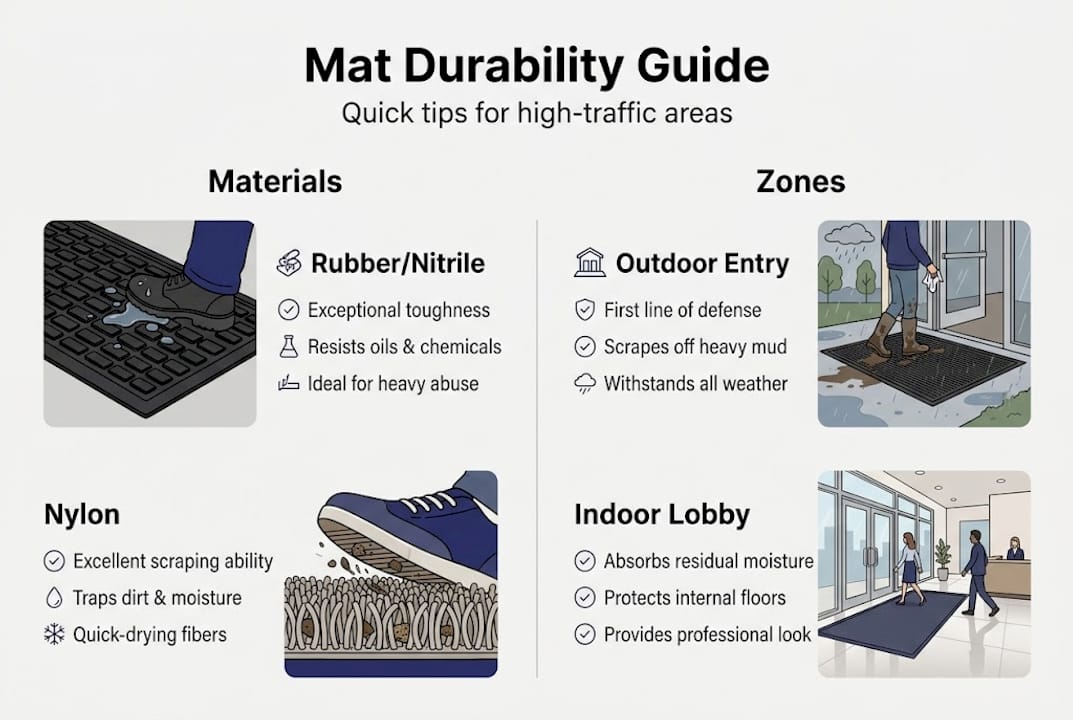
Rubber and nitrile compounds are the workhorses of Zone 1, the outdoor scraping zone. They handle heavy debris, standing water, and temperature swings without degrading. Rubber and nitrile mats deliver high durability with a lifespan exceeding 5 years, plus consistent slip resistance in wet outdoor conditions. They are also easy to hose down and dry fast. That combination makes them the default choice for exterior vestibules and covered outdoor entries.
Nylon is the primary indoor material for Zones 2 and 3. It absorbs moisture effectively, maintains a professional appearance, and holds up under sustained foot traffic. Nylon outperforms polypropylene by 25% in resilience and is the better choice for entries processing more than 500 daily visitors. Its fiber structure traps fine particles that scraping mats miss, which is critical for maintaining interior floor cleanliness.
Polypropylene is budget-friendly but limited. It suits moderate-traffic areas and controlled indoor environments. For extreme traffic, polypropylene compresses faster, loses traction more quickly, and costs more over time due to frequent replacement.
For facilities with wheeled equipment, chemical exposure, or food-service runoff, PVC and heavy-duty rubber are the correct choices. These materials resist chemical degradation and maintain structural integrity under load.
| Material | Best zone | Lifespan | Traffic threshold |
|---|---|---|---|
| Rubber/nitrile | Zone 1 (outdoor) | 5+ years | Any volume |
| Nylon | Zones 2 and 3 (indoor) | 3 to 4 years | Over 500/day |
| Polypropylene | Zone 3 (light indoor) | 1 to 2 years | Under 200/day |
| PVC/heavy rubber | Chemical/wheeled zones | 4+ years | Variable |
Lifecycle cost matters more than sticker price. A nylon mat at twice the price of polypropylene but with a lifespan three times longer is the cheaper option over a 5-year window. Factor replacement labor, downtime, and safety exposure into that calculation. Explore indoor entrance mats to compare nylon and specialty builds across use cases.
Sizing, placement, and layout for maximum effectiveness
Material quality means little without correct sizing. An undersized mat is almost as problematic as no mat at all. The industry standard requires mats to be at least 10 to 15 feet deep across the full door width. That depth provides 6 to 8 steps for effective dirt and moisture removal before a visitor reaches interior flooring.
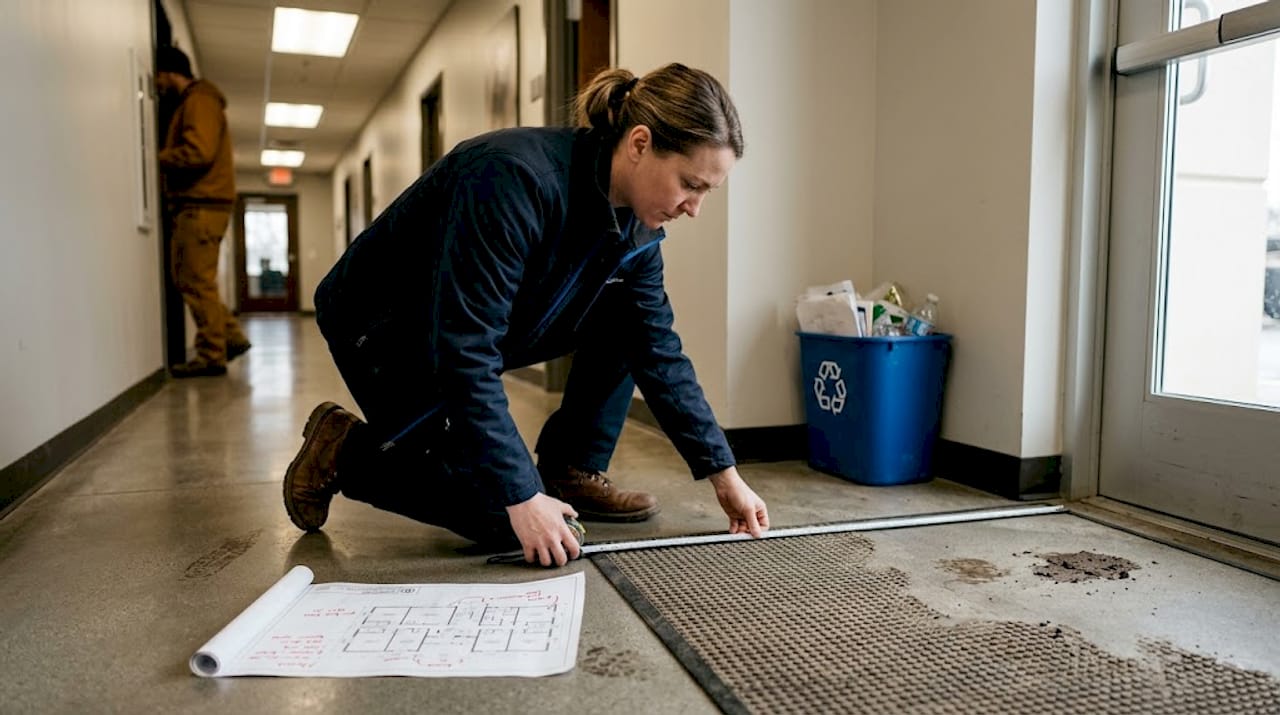
Width is equally important. A mat that does not span the full door opening allows pedestrians to walk around it. For double doors, size the mat to cover both panels with minimal gap. For wide corridors, consider multiple mats butted together rather than a single undersized piece.
The three-zone system is the most proven layout for high-traffic entries. Here is how to structure it:
- Zone 1 (scraping zone): Positioned at the exterior entrance. Rubber or nitrile mat. Removes heavy mud, gravel, and wet debris. Minimum 4 to 6 feet deep.
- Zone 2 (drying zone): Located in the vestibule or just inside the entry. Nylon or textured mat. Absorbs residual moisture and finer dirt particles. Minimum 4 to 6 feet deep.
- Zone 3 (finishing zone): Interior entry zone. Low-profile nylon or Berber mat. Captures final fine particles and presents a clean, professional appearance. Minimum 3 to 5 feet deep.
A three-zone system captures 85 to 90% of tracked-in dirt and moisture, reducing cleaning costs by up to 70%. That efficiency depends on the zones working as a sequence. Skipping Zone 2 pushes excess moisture past the scraping mat and onto interior floors.
Review the mat size selection guide to cross-check your measurements against product dimensions before purchase. Also confirm that mat edges align with entrance matting commercial standards for flush installation with surrounding flooring.
Pro Tip: Where Zones 1 and 2 overlap in a narrow vestibule, use a dual-surface mat with a scraping surface on one side and an absorbent fiber on the other. This single product can cover both functions in tight spaces without creating a trip hazard between two separate mats.
Maintenance, longevity, and verification of mat performance
A well-chosen mat still degrades without consistent care. Routine inspection and cleaning are what separate a 5-year mat from one that fails in 18 months.
Key maintenance practices for high-traffic mats:
- Daily: Shake or vacuum high-use mats to remove loose debris. Check for curled edges or displaced mats.
- Weekly: Deep vacuum or wash mats based on material guidelines. Inspect backing for moisture retention or adhesion loss.
- Monthly: Assess traction. Test mat stability on the floor surface. Look for compression, fraying at edges, or fiber loss.
- Quarterly: Formally evaluate whether the mat is still performing to specification. Compare current slip and dirt data to baseline.
Replacement indicators are clear: frayed or peeling edges, visible compression of fibers, loss of surface traction, or backing that no longer grips the floor. A mat in that condition is no longer a safety asset. It is a liability.
“Durable mats reduce slip incidents by up to 90%, delivering both safety and savings.”
Lifecycle costs consistently favor nylon and rubber over polypropylene, even accounting for higher purchase prices. Lower replacement frequency and reduced cleaning labor make the math clear. Track your facility’s slip and fall incident logs and your cleaning supply costs from the month before and after mat installation. That data is your ROI proof.
For demanding environments, industrial matting solutions cover heavy-duty rubber and specialty builds designed for chemical exposure, extreme load, and continuous wet conditions. Pairing those with a documented entrance floor mat care program keeps performance consistent and protects your investment.
What most facilities get wrong—and how to do better
Most facilities undersize their mats. A 3-foot by 5-foot mat at a busy entry is not a solution. It is a gesture. Real protection requires the full 10 to 15 feet of coverage across the door width, and most purchasing decisions ignore that standard entirely.
The second most common failure is mismatching material to zone. Polypropylene in a high-traffic outdoor entry, or a rubber scraping mat placed in Zone 3 where aesthetics matter, produces poor results and early wear. The zone-to-material pairing is specific for good reason.
Compliance is the third gap. Many facilities skip NFSI and ADA verification altogether, which creates direct liability exposure. NFSI and ADA certified mats with rubber backing for slip resistance, matched to the correct zone material, are the standard for any commercial space that takes safety seriously.
For a practical starting point on specifications and product categories, the commercial mats guide covers entry-level requirements through high-performance specifications.
Pro Tip: Before your next mat purchase, pull your last 12 months of slip incident reports and cleaning cost data. Use those numbers as your performance baseline. Then retest 6 months after installing properly sized, certified mats. The difference is measurable and makes a compelling case for the right investment.
Discover the perfect mat solutions for your business
Mats4U offers a direct path from this guidance to the right product. For workstations, counters, and checkout lines, Comfort Premier anti-fatigue mats reduce fatigue and improve productivity in standing-work environments. For branded entryways, custom logo floor mats combine function with professional presentation. Browse the full range of commercial-grade options at Mats4U, where products are built to NFSI and ADA standards, backed by free delivery on orders over $100, and Made in the USA. Select by mat type, zone requirement, or traffic level to match your facility’s exact specifications.
Frequently asked questions
How do I determine the right mat size for my entrance?
Mats at least 10 to 15 feet deep across the full door width ensure 6 to 8 decontamination steps per entry, which is the industry standard for effective dirt and moisture removal.
Which mat material lasts longest in high-traffic areas?
Rubber mats last 5+ years in outdoor zones, while nylon outperforms polypropylene by 25% in resilience for indoor high-traffic applications exceeding 500 daily entries.
Do I need mats with beveled edges for ADA compliance?
Yes. ADA-compliant mats require beveled edges with a maximum 1/2-inch thickness at a 1:2 slope and firm, slip-resistant surfaces to eliminate tripping hazards for all users.
What certifications should high-traffic mats have?
NFSI High-Traction certification requires a TCOF at or above 0.60, reducing slip incidents by up to 90%, while ADA compliance ensures safe navigation for all building occupants.
How can I verify my mats are performing as intended?
Track cleaning costs and slip incidents before and after installation. Effective three-zone systems reduce cleaning costs by up to 70%, and NFSI-certified mats cut slip incidents by up to 90%, giving you clear, measurable benchmarks.
Recommended
- The Actionable Guide to the Best Flooring for High Traffic Areas – Mats4U USA
- Top high-traffic flooring ideas for durable, safe spaces – Mats4U USA
- Best High Traffic Area Flooring Solutions for Businesses – Mats4U USA
- Best high-traffic mat options to boost safety: 2026 guide – Mats4U USA
- Floor coverings | Elite Wealth Creators


