


TL;DR:
- Proper wet area mats must prioritize absorbency slip resistance and durability.
- Layered systems combining exterior drainage mats with interior absorbent mats enhance safety.
- Regular maintenance and certification ensure mats deliver ongoing moisture management and slip prevention.
Wet entrances are a constant liability. Puddles, tracked-in rain, and slick surfaces create slip hazards that cost facilities time, money, and safety incidents every single day. The mat you place at each entry point is not a minor detail. It directly determines how much moisture gets managed, how clean your floors stay, and how protected your visitors and staff are. This guide walks you through the key selection criteria, the top-performing indoor and outdoor mat options, and a direct comparison to help you match the right solution to each zone in your facility.
Table of Contents
- Essential criteria for choosing a door mat for wet areas
- Top indoor mats for wet areas: Moisture absorption champions
- Outdoor mats for wet entrances: Drainage and durability
- Head-to-head comparison: Indoor vs. outdoor wet area mat solutions
- Why layering and proactive maintenance outperform any single mat solution
- Find your ideal door mat solution at Mats4U USA
- Frequently asked questions
Key Takeaways
| Point | Details |
|---|---|
| Prioritize moisture retention | Choose mats with high absorbency or drainage features for wet areas to prevent slips. |
| Layer for safety | Using both indoor and outdoor mats in sequence massively improves moisture control and slip resistance. |
| Match mat to location | Select indoor mats for absorbency and outdoor mats for drainage and durability. |
| Look for certifications | NFSI or similar certifications ensure mats meet leading safety standards in wet areas. |
| Regular maintenance is vital | Clean and inspect mats frequently to keep performance and safety high. |
Essential criteria for choosing a door mat for wet areas
Selecting the right mat for a wet area starts with understanding what actually separates a functional mat from one that fails under pressure. Facility managers need to evaluate six core factors before purchasing.
Absorbency is the first and most critical factor. A mat must pull moisture off footwear fast, before it gets tracked deeper into the building. High-performance mats like Aquasorb are engineered for exactly this, with 6L/sq m moisture retention capacity, setting the benchmark for what a wet area mat should deliver.
Slip resistance is non-negotiable. Look for mats with textured surfaces, rubber backing, and recognized certifications. NFSI (National Floor Safety Institute) certification is the standard to look for in commercial settings. Certified mats have been independently tested and verified for traction under wet conditions.
Durability determines long-term value. Wet environments accelerate wear. Mats that cannot handle repeated moisture exposure, heavy footfall, and regular cleaning will degrade quickly and need frequent replacement, which adds cost.
Drainage matters most for outdoor mats. Exterior mats need channels or perforated surfaces that allow water to pass through rather than pool on top. Pooling water on a mat surface is a direct slip hazard.
Maintenance affects your operational workload. Choose mats that can be cleaned with standard equipment, dry quickly, and resist mold and mildew. The door mat selection guide at Mats4U covers specific maintenance schedules for commercial environments.
Certifications add accountability. NFSI-certified mats and those with verified slip-resistance ratings give facility managers documented proof of safety performance, which matters for compliance and liability.
Key features to evaluate before purchasing:
- Absorbency rating (liters per square meter)
- Slip-resistance certification (NFSI or equivalent)
- Backing material (rubber, vinyl, or anti-slip compound)
- UV and salt resistance for outdoor use
- Ease of cleaning and drying time
- Beveled or ramped edges to prevent trip hazards
“Entrance mats and grids play a direct role in facility safety and maintenance, reducing tracked-in moisture and contaminants significantly.” Expert insights on wet area mats
Pro Tip: Place a drainage mat at the exterior entry, then layer an absorbent mat just inside the door. This two-step system captures debris and bulk water outside, then absorbs residual moisture before it reaches your interior floors. Explore door mats for wet areas to see layered system options.
With the criteria established, let’s examine top-performing options for different settings.
Top indoor mats for wet areas: Moisture absorption champions
Indoor wet area mats need to prioritize one thing above all else: pulling moisture off footwear before it spreads. The best options combine high absorbency with slip-resistant backing and easy maintenance.
Aquasorb is the benchmark product for indoor moisture management. It absorbs up to 6L/sq m and carries a level 3 rating for slip, wear, and soil resistance. That combination makes it suitable for hospital entrances, hotel lobbies, school corridors, and any facility that sees consistent wet foot traffic. It dries relatively quickly and maintains its structure under repeated cleaning cycles.
Cotton Plus mats deliver strong absorbency through their dense fiber construction. Cotton fibers naturally wick moisture and hold it away from the surface, keeping the walking area drier underfoot. These mats work well in lower-traffic indoor zones where aesthetics also matter.
Grip Max mats focus on combining absorbency with surface traction. The textured top surface grabs moisture from shoe soles while the rubber backing keeps the mat locked in place. Indoor mats with this absorbency profile are specifically recommended for facilities managing consistent wet conditions.
Key features of top indoor wet area mats:
- High-density fiber construction for maximum moisture retention
- Rubber or vinyl non-slip backing
- Level 3 or higher slip resistance rating
- Mold and mildew resistant materials
- Machine washable or hose-down compatible
- Low profile design for smooth door clearance
“A single mat at the entrance is rarely enough. Layered mat solutions at entry points are the most effective approach for moisture control and slip prevention.”
For waterproof door mat recommendations matched to specific facility types, Mats4U provides category-filtered options. Review wet area mat installation tips to ensure correct placement and sizing for your entry zones.
Now let’s cover the best solutions for outdoor settings, where drainage and durability are crucial.
Outdoor mats for wet entrances: Drainage and durability
Outdoor mats face conditions that indoor mats never encounter. Rain, UV exposure, salt from winter treatments, and heavy footfall all degrade mat performance over time. The right outdoor mat channels water away, grips the ground, and holds up season after season.
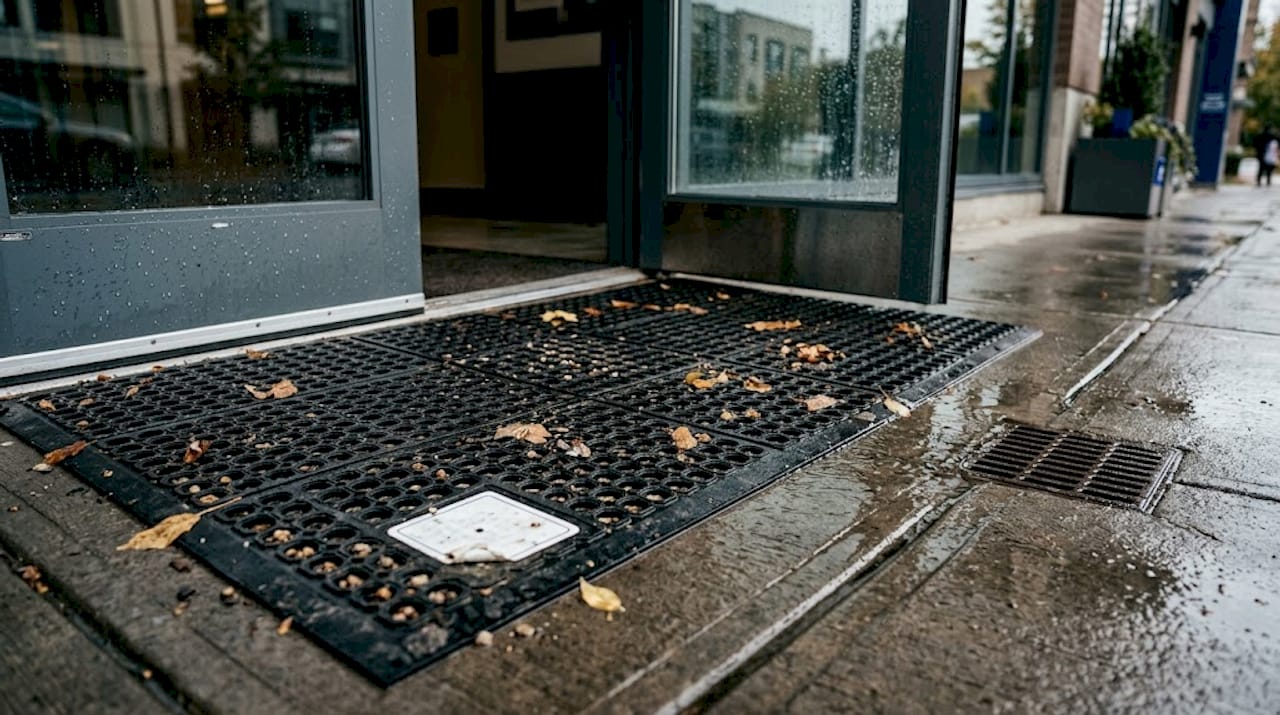
Brush Hog mats are a strong choice for exterior entrances. NFSI-certified with UV and salt resistance, they are built for high footfall environments where weather exposure is constant. The aggressive surface texture scrapes debris and moisture from shoe soles before anyone enters the building. See Brush Hog mat details for full spec comparisons.
WaterHog Drainable Border Mat is engineered with a raised surface pattern that channels water down and away from the walking surface. The WaterHog Drainable Border Mat features a bi-level construction that traps dirt and water below the surface, keeping the top layer drier and safer underfoot. It is available in multiple sizes and border configurations to fit varied entry dimensions.
Rubber drainage mats provide a cost-effective solution for loading docks, covered entrances, and service entries. Their open-grid design allows water to drain through completely, eliminating surface pooling. The rubber drainage mat guide outlines the best applications and sizing recommendations. For safety specifics, the drainage rubber mat safety resource covers load ratings and slip performance.
Key features to look for in outdoor wet area mats:
- Open-grid or channeled surface for active drainage
- UV-stabilized materials to prevent fading and cracking
- Salt and chemical resistance for winter conditions
- NFSI or equivalent slip-resistance certification
- Rubber or recycled rubber construction for grip and longevity
- Beveled or bordered edges to prevent curling and trip hazards
Pro Tip: Always select outdoor mats with beveled edges. Flat-edged mats curl over time in outdoor conditions, creating a raised lip that becomes a trip hazard, especially in low-light entry areas.
| Mat type | Drainage | UV resistance | NFSI certified | Durability rating |
|---|---|---|---|---|
| Brush Hog | Moderate | Yes | Yes | High |
| WaterHog Drainable | High | Yes | Yes | High |
| Rubber Drainage | Very High | Moderate | Varies | Very High |
With leading indoor and outdoor mats identified, it’s time to see how they stack up directly.
Head-to-head comparison: Indoor vs. outdoor wet area mat solutions
Choosing between indoor and outdoor mat solutions is not about preference. It is about matching the mat’s engineering to the environment it will serve. Each setting has distinct demands.
Indoor absorbency can exceed 6L/sq m, making high-fiber mats the right call for interior entry zones. Outdoor mats need UV and salt resistance along with active drainage to handle standing water and weather exposure.
What matters most by setting:
- Indoor: Absorbency rating, slip resistance certification, backing grip, maintenance cycle
- Outdoor: Drainage capacity, UV stability, salt resistance, edge design, NFSI certification
| Feature | Indoor mats | Outdoor mats |
|---|---|---|
| Primary function | Moisture absorption | Water drainage |
| Surface material | High-density fiber | Rubber, polypropylene |
| Slip resistance | Level 3+ rating | NFSI certified |
| Weather resistance | Not required | UV and salt resistant |
| Maintenance | Machine wash or hose | Hose or pressure wash |
| Ideal location | Lobbies, corridors | Exterior entries, docks |
For best commercial mat picks organized by facility type, Mats4U provides filtered browsing by environment. The heavy duty non slip mat guide covers load ratings and surface specifications for demanding environments. Facilities in rainy climates should also review door mat tips for rain for seasonal selection guidance.
Now, let’s share our editorial perspective on best practices facility managers often overlook.
Why layering and proactive maintenance outperform any single mat solution
The biggest mistake we see in commercial facilities is the assumption that one mat at the door solves the problem. It does not. A single mat, no matter how well-engineered, reaches saturation quickly under heavy wet traffic. Once saturated, it stops absorbing and starts spreading moisture instead.
The proven approach is layering. Place a drainage mat at the exterior threshold to handle bulk water and debris. Follow it with a high-absorbency mat just inside. That two-zone system keeps moisture from traveling further into the building. Layering for safety is the documented approach to reducing slip incidents at entry points.
Maintenance is equally important. A mat that is not cleaned regularly loses absorbency as fibers compact and fill with debris. Routine maintenance is recommended to sustain performance over time. Map your entry points, assign cleaning schedules, and set replacement timelines based on traffic volume.
“Layering mats is the proven approach to reduce slips and maintain cleaner facilities.”
Pro Tip: Walk every entry point in your facility during or after rain. Note where water pools, where mats shift, and where moisture is tracking past the mat zone. That observation tells you exactly where your layering strategy needs adjustment.
Find your ideal door mat solution at Mats4U USA
Mats4U stocks a full range of certified, commercial-grade mats built for wet, high-traffic environments. Whether you need high-absorbency indoor solutions or drainage-focused outdoor mats, the product catalog covers both. The WaterHog Max Herringbone Mat delivers exceptional indoor moisture control, while the WaterHog Drainable Border Mat handles exterior drainage with precision. For facilities that want branded entry solutions, custom floor mats combine safety performance with logo printing. Free delivery applies to orders over $100, and all products are Made in the USA.
Frequently asked questions
What’s the best material for a door mat in wet, high-traffic areas?
For wet, high-traffic zones, choose mats with rubber or polypropylene bases for durability and moisture resistance. NFSI-certified mats like the Brush Hog offer UV and salt resistance, making them reliable for demanding exterior applications.
How often should wet area mats be cleaned or replaced?
Wet area mats should be cleaned weekly and replaced annually or when visible wear reduces performance. Routine maintenance is essential to keep absorbency and slip resistance at functional levels.
Are layered mat solutions really safer than using just one mat?
Yes. Layered mats significantly improve moisture management and slip resistance compared to a single mat. Layering for safety is the documented best practice for high-traffic wet entries.
Can I use the same mat inside and outside?
No. Indoor mats excel at absorbency, while outdoor mats focus on drainage and weather resistance. Outdoor mats need UV and salt resistance that indoor mats are not built to provide.
What certifications should I look for in a slip-resistant wet area mat?
Look for NFSI or equivalent slip-resistance certifications to meet facility safety standards. NFSI-certified mats are independently tested and verified for traction under wet conditions.


