


TL;DR:
- Proper entrance mats are essential safety assets that prevent slips, trips, and liability issues.
- Selecting compliant mats involves assessing traffic, debris, weather exposure, and ensuring NFSI and ADA standards.
- A zoned approach with correct sizes, materials, and placement maximizes debris removal and safety.
A slip near the front entrance sends an employee to urgent care. The incident report lands on your desk, followed by an OSHA inquiry and a liability claim. That sequence plays out in commercial facilities every day, often traced back to one overlooked detail: the wrong entrance mat, or no zoned system at all. Entrance mats are not decorative accessories. They are functional safety assets that control debris, reduce moisture transfer, and protect everyone who walks through your doors. This guide gives you a structured process to evaluate, select, and implement entrance mats that perform under real commercial conditions.
Table of Contents
- Assessing your facility’s entrance mat requirements
- Understanding safety standards and compliance
- Material and design considerations for mat performance
- Optimizing mat placement: Zoned entrance matting strategy
- Why most entrance mat purchases fail—and what really matters
- Find commercial-grade entrance mats built for performance
- Frequently asked questions
Key Takeaways
| Point | Details |
|---|---|
| Assess facility needs | Evaluate entry volume, environment, and cleaning challenges before selecting a mat. |
| Prioritize safety standards | Choose mats with the NFSI High-Traction mark and ADA-compliant features to reduce accident risk. |
| Match mat zone and material | Use a combination of scraping, wiper, and logo mats tailored to your facility’s size and traffic. |
| Deploy zoned matting systems | A zoned approach across multiple mats removes more debris and keeps facilities cleaner. |
Assessing your facility’s entrance mat requirements
Start with a direct assessment of your entry conditions before you place a single order. Not every facility faces the same combination of risks, and a hospital entrance handles very different variables than a warehouse loading dock or a corporate office lobby.
Traffic volume and direction matter more than most purchasing agents account for. Map your peak-hour entry flow: how many people pass through per hour, from which direction, and whether they are entering, exiting, or both. A door that processes 300 people per hour during shift change needs a mat system rated for continuous heavy use, not a standard retail-grade mat. Review high-traffic matting solutions to understand the performance thresholds these environments demand.
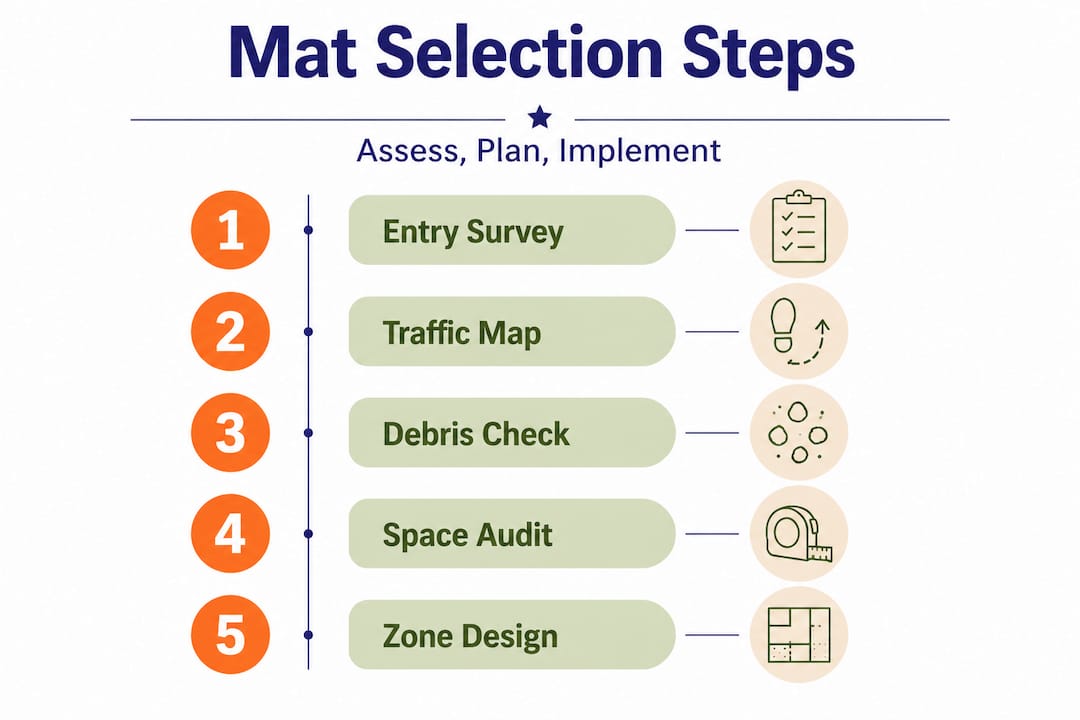
Weather exposure and debris type determine which mat functions are most critical. Rain and snow bring moisture; sandy or graveled lots bring abrasive particles; muddy construction sites bring heavy soil loads. Each debris type calls for a different primary function: scraping, absorption, or a combination.
Space constraints directly affect system design. Many facilities cannot accommodate 15 feet of matting at every entry. In those cases, 50-60% debris capture is achievable with a single high-performance Zone 2 scraper/wiper mat such as a WaterHog, which outperforms a thin single mat placed as an afterthought. Avoid the mistake of selecting the smallest mat that fits and assuming it will perform.
| Entry condition | Primary priority | Recommended mat function |
|---|---|---|
| High rain/snow exposure | Moisture removal | Wiper/scraper hybrid |
| Sandy or graveled lots | Scraping | Rigid scraper or ribbed rubber |
| Heavy foot traffic, dry climate | Soil capture | Nylon wiper mat |
| Corporate lobby with brand visibility | Branding + cleanliness | Logo mat with wiper surface |
| ADA-regulated entrances | Compliance + safety | Beveled, low-profile compliant mat |
Functional priorities should drive your final specification. Rank your needs: scraping, absorption, or branding. If your budget is constrained, allocate it to the function that eliminates the highest risk at your specific entry.
- Identify peak traffic hours and quantify throughput
- Document the primary debris types present at each entry
- Measure exact entry dimensions, including door swing clearance
- Determine whether the floor substrate is carpet or hard surface
- Note any ADA access routes that cross the mat zone
Pro Tip: Walk your own entry during a rainstorm or after a snow event. Photograph what debris actually reaches the lobby floor. That observation is more reliable than any general estimate and will sharpen your mat specification immediately.
For a full breakdown of mat selection by entry type, the high-traffic mats guide covers specific scenarios with product recommendations.
Understanding safety standards and compliance
Knowing what your entry faces is only part of the equation. Compliance with safety standards is not optional, and selecting non-compliant mats creates measurable legal and financial exposure.
NFSI certification is the benchmark for slip resistance. The National Floor Safety Institute awards High-Traction certification to mats that achieve a Traction Coefficient of Friction (TCOF) of 0.60 or higher. NFSI-certified mats reduce slips by up to 90%, with ADA-compliant beveled edges no greater than 0.5 inch rise at a 1:2 slope, backed by slip-resistant material. That is the minimum specification for any commercial entrance in a high-liability environment.
OSHA’s requirement of a minimum 0.60 TCOF applies to walking surfaces in commercial environments. Mats that fall below this threshold do not meet federal workplace safety guidelines, which becomes a direct liability issue when an incident occurs and attorneys review your facility records.
“A mat that looks compliant is not the same as a mat that is compliant. Always request NFSI test data and ADA edge specifications in writing before purchase.”
ADA compliance focuses specifically on edge profile and placement. Beveled edges must rise no more than 0.5 inch and transition at a slope no steeper than 1:2. Mats that curl, bunch, or present abrupt edges create trip hazards for wheelchair users and individuals with mobility aids. Securing mats with cleated backing or recessing them into floor channels eliminates movement and edge exposure.
| Standard | Requirement | Consequence of non-compliance |
|---|---|---|
| NFSI High-Traction | TCOF ≥ 0.60 | Increased slip incidents, liability |
| ADA edge profile | ≤ 0.5 inch rise, 1:2 slope | ADA violation, access barrier |
| OSHA walking surfaces | 0.60 minimum TCOF | OSHA citation, fines |
| Slip-resistant backing | No mat movement under use | Trip hazard, incident liability |
Review detailed floor mat safety tips for application-specific guidance, and check commercial mat safety resources to cross-reference product specifications against regulatory requirements. Facilities operating under manufacturing facility safety standards face additional layers of compliance that interact with entrance safety protocols.
Material and design considerations for mat performance
Compliance defines the minimum. Material selection determines how well a mat actually performs across weeks and months of heavy use.
Rubber is the dominant material for outdoor scraping and durability. It resists degradation from UV exposure, moisture, and freeze-thaw cycles. It handles heavy soil loads and provides a rigid scraping surface that mechanically removes debris from shoe soles. Its limitation is absorption: rubber excels in scraping and durability but delivers low moisture absorption, while carpet and nylon perform better for moisture and fine particle capture, making zoned systems more effective than any single mat.

Nylon is the workhorse for interior wiper mats. It absorbs moisture efficiently, captures fine particles that pass rubber scrapers, and holds up under high foot traffic. It is also the standard substrate for custom logo mats, which means branding and cleanliness can coexist in a single mat.
Polypropylene occupies the middle range. It is durable, resists fading, and handles moderate moisture loads. It is a cost-effective option for secondary zones where extreme performance is not required. Review the comparison of mat vs. carpet materials for a detailed breakdown of fiber performance by application.
- Outdoor Zone 1: Rubber or rigid polypropylene scrapers, UV-stable construction
- Indoor Zone 2: Nylon or polypropylene wiper/scraper hybrids (WaterHog class)
- Indoor Zone 3: Nylon carpet, logo mats, or anti-fatigue surfaces depending on use
- Backing for carpet substrates: Cleated rubber backing to grip carpet pile
- Backing for hard floors: Flat rubber or vinyl backing for smooth surface contact
Edge and profile design affects both safety and installation options. Mats intended for ADA routes need the beveled edge profile. Mats in recessed floor channels need precise sizing and a low-profile construction. Oversized mats that overlap flooring or other mats create immediate trip hazards. For applications where space is limited and recessing is possible, indoor matting selection outlines the available profile and sizing options.
Pro Tip: Always request a sample or product data sheet that lists the TCOF test result, backing type, and edge specification before committing to a bulk order. This step takes less than 24 hours and eliminates a significant compliance risk.
Optimizing mat placement: Zoned entrance matting strategy
A single mat at the door captures some debris. A three-zone system removes the majority of it, reduces cleaning labor, and protects interior flooring from premature wear.
Zone 1 sits outside the building. Its job is primary scraping: removing soil, gravel, and heavy debris from shoe soles before anyone reaches the threshold. Rigid rubber or heavy-duty polypropylene scrapers are standard here. This zone faces direct weather exposure, so material durability and drainage capacity are the key specifications.
Zone 2 is the first interior zone, positioned immediately inside the entry door. This mat performs the combined function of scraping residual debris and absorbing moisture. WaterHog-style mats are the benchmark product for this zone: the raised waffle pattern scrapes soles while the reservoir between ribs holds moisture below the walking surface. Beveled edge backing matched to floor type is critical here. Cleated backing for carpet, rubber backing for hard surfaces. Avoid overlaps or bunching at this zone; both create immediate trip hazards.
Zone 3 extends further into the facility. This is where fine particles and residual moisture are captured, and where branding becomes practical. Nylon Zone 3 logo mats deliver professional appearance without sacrificing wiper performance, making them a functional and brand-consistent option for lobbies and reception areas.
- Measure the full entry zone from the exterior door to the first interior corridor or desk
- Allocate at least 6 feet to Zone 2 (interior scraper/wiper) as the minimum
- Extend Zone 3 to fill remaining entry space up to 15 total feet where possible
- Confirm mat sizing matches door width with no gap at edges greater than 1 inch
- Secure all mats with appropriate backing or floor anchors before opening to traffic
| Zone | Position | Primary function | Recommended material |
|---|---|---|---|
| Zone 1 | Exterior | Heavy scraping | Rubber/polypropylene scraper |
| Zone 2 | Immediate interior | Scraping + moisture absorption | WaterHog / nylon wiper-scraper |
| Zone 3 | Extended interior | Fine particle capture + branding | Nylon carpet / logo mat |
Detailed system planning guidance is available in the zoned entrance systems resource, including layout diagrams for single-door and double-door configurations.
Pro Tip: Mark the mat zones on your facility floor plan during the planning phase. This step forces accurate measurement and catches layout conflicts, such as door swing clearance that would compress a Zone 2 mat, before products are ordered.
Why most entrance mat purchases fail—and what really matters
Most entrance mat purchases fail before the mats are even installed. The decision gets made on price or appearance, without reference to TCOF data, edge profile specs, or zone system design. That is the core failure pattern.
Price-driven decisions consistently produce undersized mats with non-compliant edges and backings that shift on hard floors. The mat looks acceptable for the first few weeks. Then it bunches at one edge, creates a raised lip, and becomes a trip hazard that is demonstrably worse than no mat at all. The liability cost of one incident dwarfs the savings from selecting a lower-grade product.
The most overlooked variable in commercial mat selection is sizing. A mat that is 12 inches narrower than the entry leaves an unmatted path that 20% of foot traffic uses, defeating the entire system. A mat that is 3 feet long when 6 feet is needed cannot capture moisture before it transfers to interior flooring. Both scenarios are common. Both are avoidable with a tape measure and a product specification that matches it.
Facilities that invest in complete, zoned, compliant systems see the outcome in measurable terms: fewer incident reports, lower floor cleaning frequency, reduced floor finish wear, and documented liability reduction. The high-traffic mat mistakes that drive these outcomes are almost always the same: wrong size, wrong backing, missing zone, or non-compliant edge profile. None of these are complex problems. They are specification problems, solved at the planning stage.
The broader lesson is straightforward. Treat entrance mat selection as a safety infrastructure decision, not a supply purchasing task. Apply the same specification discipline you would to fire suppression equipment or emergency lighting. The consequence of failure is comparable.
Find commercial-grade entrance mats built for performance
Mats4U.com stocks a full range of commercial entrance mats engineered to meet the specifications this guide covers: NFSI-compliant TCOF ratings, ADA beveled edge profiles, zone-matched materials, and backings suited to both carpet and hard floor substrates. For lobby branding without sacrificing wiper performance, premium custom logo mats deliver nylon construction with custom graphics built for Zone 3 placement. For Zone 2 performance in high-moisture or high-traffic entries, WaterHog entry mats provide the raised-pattern scraping and moisture reservoir design that facility managers rely on year-round. Facilities with extended standing zones at reception or service counters can add anti-fatigue entrance mats to reduce fatigue and maintain safety compliance across the full entry area. Free delivery applies to orders over $100.
Frequently asked questions
What is the most important safety certification for entrance mats?
The NFSI High-Traction certification is the most critical, requiring a minimum TCOF of 0.60, which reduces slip incidents by up to 90% compared to non-certified surfaces.
How do you determine the right mat size for a busy entryway?
Measure the full entry width and plan for a minimum of 10 to 15 feet of total mat coverage across all zones to effectively remove debris and moisture before it reaches interior flooring.
Are rubber or carpet mats better for commercial use?
Rubber excels in scraping and durability but provides low absorption, while carpet and nylon mats handle moisture and fine particle capture more effectively; a zoned system using both materials delivers the best overall performance.
How do I ensure my mats are ADA-compliant?
Select mats with ADA-compliant beveled edges that rise no more than 0.5 inch at a 1:2 slope, use appropriate slip-resistant backing, and secure or recess the mat to prevent movement or edge curl.


