


TL;DR:
- Choosing the correct floor mat depends on environmental conditions, usage purpose, and compatibility with flooring materials to ensure safety and durability. Selecting appropriately sized, slip-resistant mats tailored to specific spaces like entrances, kitchens, or workstations prolongs their lifespan and minimizes hazards. Proper maintenance and timely replacement are essential to prevent safety risks and maximize the benefits of well-chosen mats in any facility.
The wrong floor mat is not just an eyesore. It is a liability. A mat that curls at the edges creates a tripping hazard. One with the wrong backing can permanently stain hardwood floors. One that is too small simply fails at its job. Knowing how to choose floor mats correctly means understanding your environment, your foot traffic, your flooring material, and your safety requirements before you ever compare products. This guide covers all of it, from slip resistance standards and material comparisons to sizing rules and maintenance schedules, for commercial spaces, facilities, and homes alike.
Table of Contents
- Key takeaways
- How to choose floor mats: key factors before you buy
- Comparing floor mat materials
- Sizing and placement by environment
- Common mistakes when choosing and using mats
- What you gain from choosing the right mat
- My take on floor mat selection
- Mats4u solutions for every mat requirement
- FAQ
Key takeaways
| Point | Details |
|---|---|
| Match mat to environment | Entrance, anti-fatigue, wet area, and decorative mats each have distinct requirements that generic choices cannot satisfy. |
| Check flooring compatibility | Rubber-backed mats can discolor hardwood and laminate; always verify backing material before purchasing. |
| Size matters for function | Undersized mats miss their coverage zone entirely; use the two-mat system at entryways for maximum dirt capture. |
| Know your slip resistance standard | Interior wet areas require a DCOF of 0.42 or higher to meet safety benchmarks. |
| Replace on schedule | Entrance mats last 1 to 3 years; kitchen and bath mats should be replaced annually or sooner with visible wear. |
How to choose floor mats: key factors before you buy
Before comparing products, you need a clear picture of where the mat will live and what it needs to do. Skipping this step is how facilities end up with carpet mats in wet entryways or rubber mats scratching polished concrete.
Identify the primary use case
Every mat serves one of a few core functions: scraping dirt and debris at entry points, absorbing moisture, reducing fatigue during long standing periods, protecting flooring from chairs or equipment, or contributing to a room’s appearance. Sometimes a mat needs to do two of these at once. A commercial kitchen mat, for example, needs to be anti-fatigue and grease-resistant. An office lobby mat needs to capture dirt and look polished.
Budget ranges vary by function: entrance mats typically run $15 to $60, anti-fatigue mats $25 to $100, bath mats $10 to $50, and gym mats $20 to $150. Knowing your function upfront prevents overspending in the wrong category.
Flooring compatibility
This is one of the most overlooked factors in the floor mat buying guide conversation. Rubber-backed mats can discolor hardwood, vinyl, and laminate over time. If your flooring is delicate, look for felt, natural latex, or PVC-free backing instead. Placing a thin felt pad between the mat and the floor adds another layer of protection when you are not sure.
Slip resistance and ADA compliance
For any commercial or public-facing space, slip resistance is not optional. The ANSI A326.3 standard measures dynamic coefficient of friction (DCOF). Interior wet areas require a DCOF of 0.42 or higher to be considered slip-resistant. For ADA compliance, carpet pile height must not exceed 0.5 inches, and flooring must remain firm and stable underfoot. Both factors directly affect which mats work in a commercial setting.
Pro Tip: Ask suppliers for DCOF test data on any mat you are considering for wet areas or public entrances. If they cannot provide it, move on.
Here is a quick reference for matching environments to mat characteristics:
| Environment | Mat type | Key feature | Budget range |
|---|---|---|---|
| Commercial entrance | Waterhog or nylon scraper | Dirt trapping, moisture control | $30–$80 |
| Commercial kitchen | Anti-fatigue, grease-resistant | Cushioning, easy to sanitize | $40–$120 |
| Office lobby | Carpet or logo mat | Appearance, moderate scraping | $25–$70 |
| Wet/outdoor area | Rubber or TPE | Waterproof, drainage | $20–$60 |
| Home gym | Foam or rubber interlocking | Shock absorption, floor protection | $20–$150 |
Comparing floor mat materials
Choosing the right material is the core of any floor mat buying guide. Each material has specific strengths, and the best floor mats for your space depend entirely on matching those strengths to your conditions.
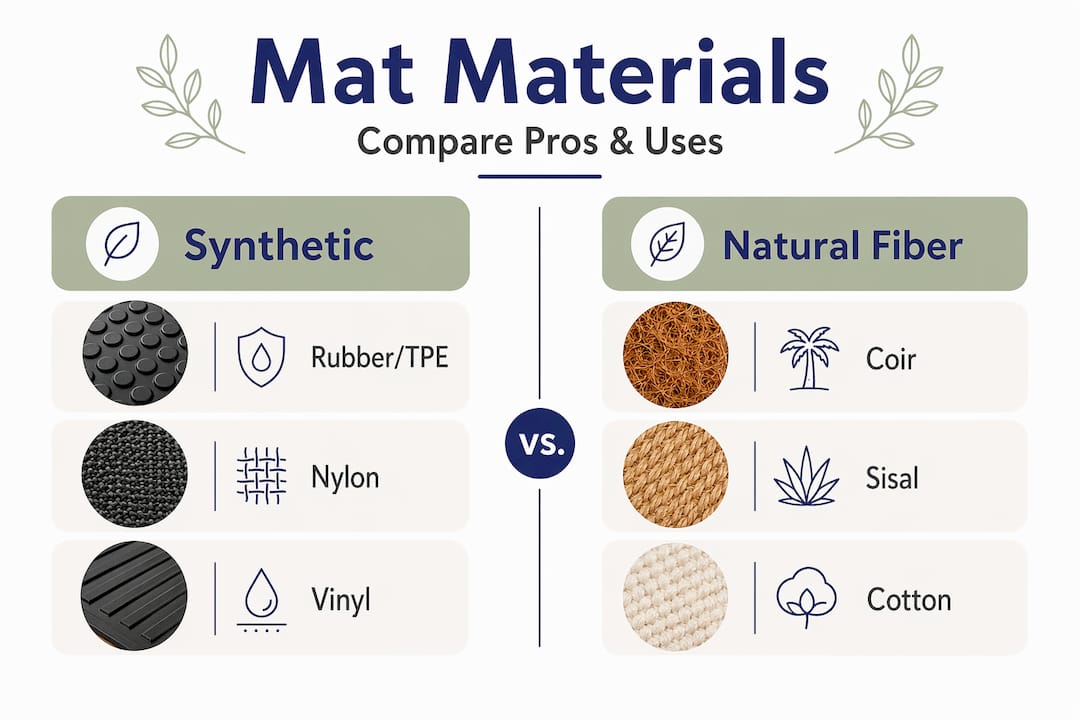
Rubber and TPE
Rubber and TPE mats perform best in wet or snowy conditions. They are waterproof, easy to hose down, and durable under heavy foot traffic. Rubber works well in outdoor entryways, garages, locker rooms, and industrial settings. The tradeoff is weight and rigidity. Thick rubber mats are not easy to reposition frequently, and they can be uncomfortable underfoot for long periods without an anti-fatigue layer.
Carpet, nylon, and fabric
Carpet-style mats are the standard choice for indoor commercial entrances and office environments. Nylon is the strongest fiber option here, resisting crushing under foot traffic and recovering shape well over time. Olefin (polypropylene) is more budget-friendly and stain-resistant but degrades faster under UV exposure. These mats need regular vacuuming and periodic deep cleaning to prevent odor buildup.
Natural fiber: coir and sisal
Coir mats (made from coconut husk) are the classic outdoor scraper mat. They are excellent at removing dirt from shoe soles and are naturally biodegradable. The downside is that they deteriorate quickly in wet climates and cannot be submerged in water for cleaning. Sisal behaves similarly. Both are best used under a covered porch or in low-moisture outdoor areas.
Vinyl and polypropylene
These materials sit in the budget-friendly, practical category. They resist stains, clean easily with a damp mop, and work in kitchens, bathrooms, and utility rooms. They lack the cushioning of foam or the scraping power of rubber, but for light-duty residential or office use, they deliver solid performance at a low cost.
| Material | Durability | Water resistance | Best use | Maintenance |
|---|---|---|---|---|
| Rubber/TPE | High | Excellent | Outdoor, wet areas, industrial | Hose down or wipe |
| Nylon carpet | High | Moderate | Indoor commercial entrances | Vacuum, periodic deep clean |
| Coir/sisal | Moderate | Low | Dry outdoor scraping | Shake out, no soaking |
| Vinyl/polypropylene | Moderate | Good | Kitchen, bath, utility | Damp mop |
| Foam/gel | Low-moderate | Low | Anti-fatigue standing areas | Wipe down regularly |
Sizing and placement by environment
Getting the size right is where most buyers go wrong. A mat that does not cover the transition zone between outdoors and indoors is functionally useless.
Entryways: use a two-mat system
The most effective approach for any entrance, commercial or residential, is pairing two mats. Place a rough scraper mat (coir, rubber, or Waterhog-style) outside the door and an absorbent mat (microfiber or nylon) just inside. Each mat should be at least 3 feet long to give people enough steps to clean their shoes. This system captures debris on the first mat and moisture on the second. For high-traffic commercial entrances, learn more about entrance mat selection to understand which configurations hold up under heavy daily use.
Anti-fatigue mats for workstations
For standing desks, assembly lines, reception counters, or kitchen prep areas, anti-fatigue mat thickness matters. A mat between 3/4 inch and 1 inch thick provides enough cushioning for multi-hour standing without causing instability. Look for beveled edges to reduce tripping risk. For industrial and manufacturing settings, check out where anti-fatigue mats are used to confirm the right specification for your application.
Office chair mats and floor protection
Chair mats need to extend at least 12 inches past the front of the chair and 12 inches on each side to accommodate movement. Hard floor chair mats should be smooth on the underside; carpeted floor chair mats need grippers or cleats on the bottom. Using the wrong type scratches hardwood or fails to stay in place on carpet.
Pro Tip: For commercial entrance mats, measure the full width of the doorway and match it. A mat that leaves 6 or more inches of exposed floor on either side will be bypassed by most foot traffic.
Here is a sizing and replacement schedule to follow:
- Measure the full coverage area before ordering, including door swing clearance.
- For entrances, choose a mat that spans the full door width plus at least 12 inches on each side.
- For anti-fatigue applications, extend the mat length to match the full standing zone, not just the spot directly in front of the equipment.
- Replace entrance mats every 1 to 3 years depending on traffic volume and wear.
- Replace kitchen and bath mats annually, or immediately when grip is lost or edges begin curling.
Common mistakes when choosing and using mats
Knowing what to avoid saves money and prevents safety incidents.
- Wrong backing on sensitive floors. Rubber-backed mats cause discoloration on hardwood, vinyl, and laminate. Always check the backing material against your floor type.
- Ignoring slip resistance in wet zones. A mat without non-slip backing on a tile bathroom floor or polished concrete entrance is a hazard, not a solution.
- Undersized mats. A 2-foot mat at a commercial entrance captures maybe two steps. That is not enough to do the job.
- Skipping maintenance. Saturated mats stop absorbing moisture. Mats with compacted fibers lose their scraping ability. Neither problem is visible until performance drops.
- Replacing too late. Signs that a mat needs replacing include curling edges, fraying fibers, visible staining that does not clean out, and backing that has lost its grip.
Worn mats with curled edges are one of the most common contributors to slip-and-fall incidents in commercial facilities. The mat itself becomes the hazard it was meant to prevent.
What you gain from choosing the right mat
The payoff from choosing the right mat is concrete and measurable. Slip resistance directly reduces injury risk at entrances and wet areas, which matters for liability as much as safety. Proper floor protection extends the life of expensive flooring by preventing scratches from grit tracked in on shoes and damage from chair casters.
Anti-fatigue mats reduce physical strain for employees who stand for extended periods, which translates to fewer complaints, better focus, and less fatigue-related error in production environments. On the maintenance side, a mat that captures dirt at the door means less dirt distributed across the rest of the facility, reducing vacuuming and mopping frequency. A well-chosen mat at a commercial entrance also signals professionalism. For businesses, it is one of the first things a customer notices.
My take on floor mat selection
I’ve watched facilities spend good money on mats that fail within six months, usually for the same reasons. The mat was the wrong material for the climate, the wrong size for the space, or chosen based on price alone without factoring in replacement frequency.
What I’ve learned is that the total cost calculation almost always favors the better mat. A $70 Waterhog-style commercial entrance mat that lasts three years beats a $25 carpet mat you replace every nine months, both on cost and performance. The math is simple, but people consistently underestimate how hard entrance mats work.
I’ve also seen the backing compatibility issue cause real damage. One facility manager I spoke with had to refinish an entire hardwood lobby floor because rubber-backed mats had been sitting on it for two years. The cost of that repair dwarfed the price of a dozen premium mats. Check your floor type first. It is a five-minute step that prevents an expensive mistake.
The other thing I’d push back on is the idea that one mat type covers multiple applications. Anti-fatigue mats do not belong at entryways. Coir mats do not belong in wet kitchens. Matching the mat to the specific function, not just the general area, is what produces results.
— Werner
Mats4u solutions for every mat requirement
At Mats4u, the product range is built to match the selection criteria covered in this guide. For businesses that need branding combined with entrance protection, the Premium HD Printed Custom Logo Mat delivers sharp logo clarity on a durable surface built for commercial foot traffic. For high-traffic entryways that demand maximum dirt and moisture control, the WaterHog Max Herringbone Mat combines a distinctive pattern with proven trapping performance. For outdoor and wet-climate applications, the WaterHog Drainable Border Mat adds drainage capability to reduce standing water. All products ship free on orders over $100, and the full catalog is available at Mats4u.com.
FAQ
What is the best mat material for a commercial entrance?
Nylon and polypropylene carpet mats or rubber Waterhog-style mats are the top performers for commercial entrances. They combine dirt-trapping fiber structure with moisture resistance and durability under heavy foot traffic.
How do I know if a mat is slip-resistant enough?
Check the DCOF rating. For interior wet areas, the ANSI A326.3 standard requires a DCOF of 0.42 or higher. Ask suppliers for test documentation before purchasing for any wet or public-facing area.
Can floor mats damage my flooring?
Yes. Rubber-backed mats can stain hardwood, vinyl, and laminate with prolonged contact. Use mats with felt, natural latex, or PVC-free backing on delicate floors, or place a felt pad underneath as a buffer.
How often should floor mats be replaced?
Entrance mats should be replaced every 1 to 3 years. Kitchen and bath mats need annual replacement or sooner if fibers are fraying, edges are curling, or the backing has lost its grip.
Do I need ADA-compliant mats for my business?
If your space serves the public, ADA standards apply to your flooring and mats. Carpet pile height cannot exceed 0.5 inches, and all surfaces must be firm, stable, and slip-resistant. Verify these specs with any mat intended for a public access area.


