


TL;DR:
- Proper retail matting reduces cleaning costs and slip risks while enhancing first impressions through a planned, multi-zone system. It must meet standards for size, stability, ADA compliance, and material durability, with coverage of 12 to 15 linear feet for effective dirt and moisture capture. Consistent maintenance and strategic replacement are essential to ensure long-term safety, cleanliness, and operational efficiency.
Retail entryways handle thousands of foot-traffic cycles daily, and the floor mat system protecting that space directly affects cleaning budgets, slip-and-fall liability, and first impressions. A 3-zone entrance system can reduce cleaning costs by 60 to 70% and pay for itself within 6 to 12 months, given that removing a single pound of tracked-in dirt costs roughly $600 in janitorial labor. Choosing the right mats is not a decorating decision. It is an operational one with measurable financial return.
Table of Contents
- Understanding retail floor mat requirements
- Step-by-step: Designing your ideal retail entrance matting system
- Material selection and certifications: What really matters
- Troubleshooting and maintenance: Common mistakes and solutions
- A practical view: Why most retail matting still falls short
- Ready to upgrade your retail floor mats?
- Frequently asked questions
Key Takeaways
| Point | Details |
|---|---|
| Use a 3-zone system | Three distinct mat zones dramatically boost dirt capture and safety compared to single mats. |
| Prioritize safety and compliance | ADA- and NFSI-compliant mats reduce slip risks and legal exposure for retailers. |
| Choose materials by zone | Use rubber outside for scraping and carpet inside for absorption—never interchangeably. |
| Opt for proper coverage | Cover at least 12-15 feet at the entrance to protect against 85-90% of outside debris and moisture. |
| Don’t ignore branding | Quality logo mats enhance entry aesthetics and reinforce your brand with every customer who walks in. |
Understanding retail floor mat requirements
Retail environments are not all the same, but they share common stress factors. High-volume foot traffic, seasonal moisture, tracked-in grit, and the constant movement of shopping carts and mobility devices put serious strain on any floor protection system. Before selecting a mat, you need to understand the baseline performance standards your space demands.
Traffic and load requirements vary by store format. A grocery anchor location may see 3,000 to 6,000 customer entries per day, while a specialty boutique may process a few hundred. Either way, mats need to remain flat, stable, and visually presentable across every shift. Mats that curl at the edges, buckle under cart traffic, or shift when someone steps on them are not just unattractive. They are active safety hazards.
ADA compliance is non-negotiable. Federal standards require that commercial mats have beveled edges no steeper than 1:2, with a maximum rise of 0.5 inches. Surfaces must be stable, slip-resistant, and secured to prevent shifting or curling. Any mat that creates an uneven transition surface or moves underfoot fails ADA requirements and exposes your business to liability.
Coverage size is also commonly underestimated. Research shows you need a minimum of 12 to 15 linear feet of continuous matting through all entry zones to capture 85 to 90% of tracked-in dirt and moisture. A single 3x5 ft mat, the most common quick-fix purchase, captures less than 30% of incoming debris. That means the remaining 70% of dirt travels straight onto your sales floor.
“Matting coverage is not about the size of one mat. It is about the total distance a customer’s shoes travel across matting material before they reach your clean floor.”
Common pitfalls in retail mat selection include:
- Undersized mats that do not extend far enough into the entryway
- No outdoor scraper zone, relying entirely on an interior mat to do all the work
- Mats without secure backing, causing slipping or bunching on smooth tile
- Non-beveled edges that create trip hazards, especially for customers using canes, walkers, or wheelchairs
- Ignoring seasonal load variation, such as placing the same mat in summer and a wet winter without adjustment
Review ADA safety requirements for mats before purchasing for any public-facing location to ensure your selections are fully compliant from day one.
| Requirement | Standard | Risk if ignored |
|---|---|---|
| Edge height | Max 0.5 inch, 1:2 slope | Trip and fall liability |
| Surface stability | Secure, non-slip backing | Slip claims |
| Coverage length | 12 to 15 linear feet minimum | Excess floor soiling |
| Material durability | Rated for commercial traffic | Premature replacement costs |
Step-by-step: Designing your ideal retail entrance matting system
Once you understand what the standards require, you can map out a matting system that actually performs. The most reliable method for retail spaces is the 3-zone entrance matting system used in high-traffic commercial facilities.
Step 1: Map your entry area. Measure door width, vestibule depth, and the direction customers approach from. Identify where moisture is most likely to enter (covered versus uncovered entry, proximity to parking lots or steps). This determines your starting point for Zone 1 placement.
Step 2: Place Zone 1 outdoors. Zone 1 is your outdoor scraper mat. Its job is to knock off heavy debris like gravel, mud, and leaf litter before customers reach the door. Rubber scraper mats with raised cleats or grids are the standard choice here. They are weatherproof, easy to hose down, and built to handle the heaviest mechanical scraping load.
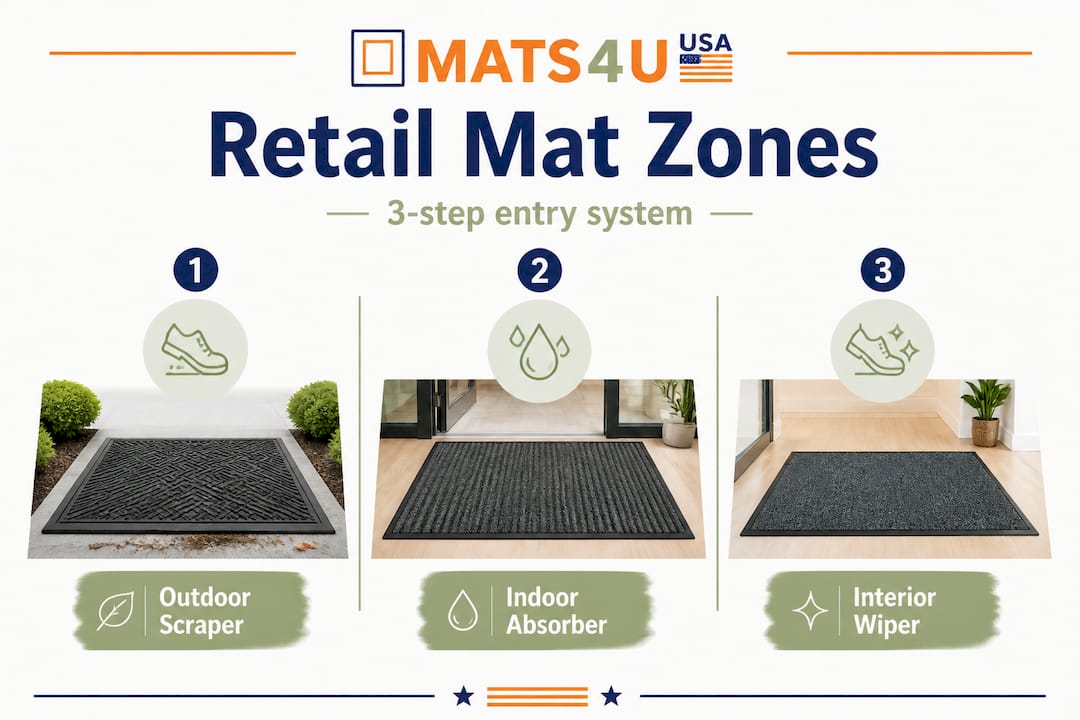
Step 3: Place Zone 2 at the transition. This mat sits just inside the entrance door, where shoes are still carrying moisture and fine grit. Zone 2 needs to both scrape remaining particles and absorb moisture. Hybrid mats like WaterHog designs work well here because the textile surface holds water in a waffle pattern, preventing it from being tracked further. Rubber excels at scraping but absorbs poorly, while carpet absorbs well but cannot handle heavy debris loads. Using them in sequence, rather than interchangeably, solves both problems.
Step 4: Place Zone 3 as your interior wiper. This final zone removes fine dust and dry particles that survived Zones 1 and 2. It is also your best opportunity for branding. Using logo mats in Zone 3 puts your brand front and center at the precise moment customers transition from entering to shopping. Carpet-face mats with a clean rubber border are the typical choice here, allowing for high-definition logo printing and a polished look.
Step 5: Add anti-fatigue mats at checkout. Staff stationed at checkout counters for six to eight hours per shift benefit significantly from anti-fatigue support. These mats reduce physical strain and fatigue, improving performance and reducing injury risk.
Pro Tip: Measure your total matting run before ordering. If your vestibule depth only allows for 8 feet, extend Zone 2 or Zone 3 into the sales floor perimeter to reach the 12 to 15 foot minimum.
| Zone | Position | Primary function | Recommended material |
|---|---|---|---|
| Zone 1 | Outdoor | Heavy scraping | Rubber scraper/grid |
| Zone 2 | Entry threshold | Scrape and absorb | WaterHog/hybrid textile |
| Zone 3 | Interior | Fine dust wiper, branding | Carpet face with logo option |
Material selection and certifications: What really matters
Once your zone plan is set, material and certification choices determine how safe and how durable your system will be.
Rubber mats provide excellent traction on hard floors and are highly resistant to moisture, oils, and heavy mechanical wear. They are the correct backing choice for smooth tile, polished concrete, and vinyl composition tile (VCT). They do not absorb moisture effectively, which is why they belong in scraping zones rather than wiping zones.
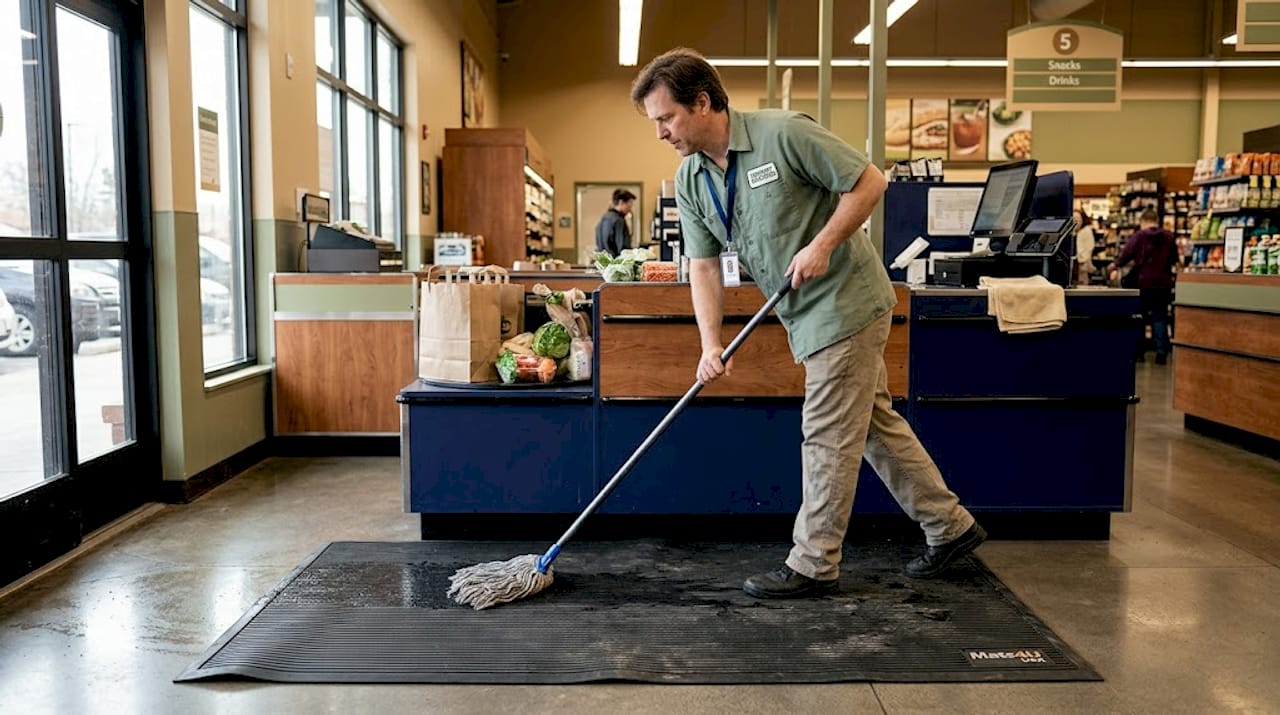
Carpet-face mats use textile surfaces (nylon, polypropylene, or olefin) to capture fine particles and absorb moisture from shoe soles. They clean up well with regular vacuuming and periodic extraction cleaning. Durability depends on the face fiber weight. Heavier cut pile holds up better in very high-traffic zones.
Vinyl and hybrid mats combine rubber structure with embedded textile tufts, capturing moisture in built-in reservoirs below the surface. These are the workhorses of high-volume retail entrances.
Cleated rubber backing is specifically designed for use on top of carpet. The cleats grip carpet fibers, preventing movement. Using a flat rubber-backed mat on carpet creates a sliding hazard. Matching the backing type to the floor surface is as fundamental as size selection.
Certifications matter, with caveats. Look for mats rated to NFSI High-Traction standards with TCOF of 0.60 or higher, which the National Floor Safety Institute associates with up to 90% reduction in slips. However, be aware that NFSI has faced criticism for lacking ANSI accreditation and for relying on static rather than dynamic friction testing. For facilities with elevated slip risk, supplementing NFSI certification with DCOF values above 0.42 or pendulum test results provides stronger safety validation.
Key certification and material selection checklist:
- Verify NFSI High-Traction rating for all customer-facing surfaces
- Request DCOF test data for wet-condition slip resistance
- Match backing type to floor surface (rubber on hard floors, cleated on carpet)
- Confirm face fiber weight for your traffic level (minimum 18 oz for high-traffic retail)
- Check warranty terms for commercial use
For checkout staff, explore anti-fatigue mats for staff comfort to understand which constructions deliver genuine ergonomic support. Not all anti-fatigue mats perform equally. A detailed anti-fatigue mat comparison helps you match the product to the task level and shift duration.
Pro Tip: Ask suppliers for third-party lab test results, not just product labels. Independent DCOF test data gives you documentation to support your safety procedures if a slip incident occurs.
Troubleshooting and maintenance: Common mistakes and solutions
Even a well-designed matting system degrades quickly without proper maintenance. These are the most frequent failures and their direct fixes.
Wrong backing for the surface. This is the most common installation error. A flat rubber-backed mat placed on carpet will shift and bunch under foot traffic, creating an immediate trip hazard. The fix is straightforward: use rubber-backed mats on hard floors and cleated backing on carpet. Audit your current installation and replace mismatched mats before they cause an incident.
Undersized coverage. A single mat at the door is nearly always insufficient. If your current setup covers less than 12 linear feet, you are tracking significant debris onto your sales floor and into fitting rooms and aisles. Add zones progressively, starting with an outdoor scraper if you do not currently have one.
Neglected cleaning schedules. Mats loaded with trapped dirt lose slip resistance. Grit embedded in textile fibers acts like sandpaper, wearing down the surface and reducing traction. Vacuum high-traffic mats daily. Schedule deep extraction cleaning monthly for textile-face mats. Rinse rubber outdoor mats weekly or more frequently in wet seasons.
Deferred mat replacement. A worn mat is not a performing mat. When pile fibers flatten past recovery, when edges start to curl even after smoothing, or when the backing loses grip, replace the mat. Worn mats look poor, perform poorly on slip resistance, and signal to customers that facility standards are low.
Additional checks for your matting system:
- Inspect all mat edges weekly for curl or lift
- Confirm mats lie completely flat with no raised sections
- Test backing grip by pressing firmly and checking for slide
- Verify no moisture is pooling beneath mats (a sign of oversaturation)
“A mat that passes a visual check but shows backing slippage under load is a liability, not an asset. Routine physical testing of grip is as important as cleaning.”
Review mat maintenance and safety standards regularly to keep your procedures aligned with current compliance expectations.
A practical view: Why most retail matting still falls short
Most retail managers who have read the guides, ordered the mats, and checked the boxes still end up with underperforming entryways within 12 months. The reason is rarely ignorance. It is operational drift.
Maintenance schedules slip when staffing is tight. A worn mat gets noted in a walkthrough but not replaced for another quarter. The outdoor scraper gets removed because it looks worn and is not replaced. Interior logo mats get repositioned during a floor reset and never returned to the correct location. Individually, none of these decisions seems critical. Collectively, they dismantle the system.
The cost framing also tends to work against good decisions. Managers see mat costs as a purchase line item. Slip-and-fall claims, excess janitorial hours, and floor refinishing from tracked-in grit do not appear in the same budget column. When you account for total cost of ownership, a properly maintained 3-zone system with commercial-grade mats nearly always costs less than a patchwork approach relying on cheap single-zone mats refreshed frequently.
Branding with logo floor mats in the interior zone is another area where shortcuts show. A printed logo mat on a commercial-grade backing sends a clear signal about facility standards. A generic mat from a big-box store signals nothing. When those mats are also certifiably safe and properly sized, the investment does multiple jobs at once: it reduces dirt load, reduces slip risk, and reinforces brand identity at the first interior touchpoint.
The facilities that consistently outperform on safety metrics and appearance are not the ones with the biggest budgets. They are the ones with a defined replacement schedule, a documented zone layout, and staff who understand why the system works the way it does.
Ready to upgrade your retail floor mats?
Mats4U.com carries the full range of products needed to build a complete, certified retail matting system. For Zone 3 interior branding, custom logo mats are available in commercial-grade constructions with high-definition printing. For Zones 1 and 2, the WaterHog Max entrance mat delivers proven moisture control and heavy-duty scraping in a single product. For checkout and service stations, the Complete Comfort anti-fatigue mat provides the ergonomic support staff need across long shifts. All products ship free on orders over $100, and many are Made in the USA. Browse by mat type or use the product selector to match specifications to your floor surface and traffic level.
Frequently asked questions
How much matting coverage do I need for my retail entrance?
You need at least 12 to 15 linear feet of matting through all entry zones to capture 85 to 90% of tracked-in debris and moisture. Use multiple zones rather than one large mat.
Are NFSI-certified mats enough for safety compliance?
NFSI certification is a useful baseline, but NFSI lacks ANSI accreditation and relies on static testing. Supplement NFSI ratings with DCOF values above 0.42 or pendulum test results for stronger slip resistance validation.
What’s the best way to maintain retail floor mats?
Vacuum textile mats daily, deep clean monthly, and replace any mat with curled edges or reduced backing grip. Poor maintenance directly creates slip hazards and shortens mat service life significantly.
Can I use a single mat for the whole entrance?
No. A single 3x5 mat captures under 30% of incoming dirt and moisture. A multi-zone system covering 12 to 15 feet is consistently more effective for commercial retail entry management.
How do floor mats help with brand visibility?
Logo mats in Zone 3 place your brand at the primary customer transition point, combining functional safety performance with immediate, high-visibility brand reinforcement for every customer entering your space.
Recommended
- A Practical Guide to Choosing Indoor Floor Mats for Safety and Style – Mats4U USA
- How to Select Floor Mats for Your Business Needs – Mats4U USA
- A Practical Guide to Custom Floor Mats: How to Boost Safety, Branding, – Mats4U USA
- Retail Entrance Mats: Safety, Durability, and Compliance – Mats4U USA
- Antislip vloeren: veiligheid en comfort in huis


