


TL;DR:
- Proper entry mat sizing involves covering 80 to 100% of the door width and ensuring a depth of 1.5 to 3 meters for effective dirt removal. Correct measurement and alignment are essential to prevent door obstruction and maximize cleaning efficiency, especially in high-traffic settings. Using multi-zone systems and accurate dimensions significantly reduce cleaning costs and floor damage while enhancing entrance safety.
Entry mat sizing is defined by two non-negotiable measurements: width coverage relative to your door opening and length sufficient for multiple footsteps to clean shoe soles before visitors reach your interior floor. Get either dimension wrong and the mat fails its primary job. Facility managers who understand how to size entry mats correctly reduce floor damage, lower cleaning frequency, and create safer entrances. The industry standard, referenced in British Standard BS 8300 and applied by commercial matting suppliers worldwide, requires mats to cover 80 to 100% of door width and provide at least 1.5 to 3 linear meters of depth for effective dirt and moisture capture.
How to size entry mats: dimensions and coverage rules
The two core measurements that determine entry mat performance are width and length. Neither can be treated as secondary.
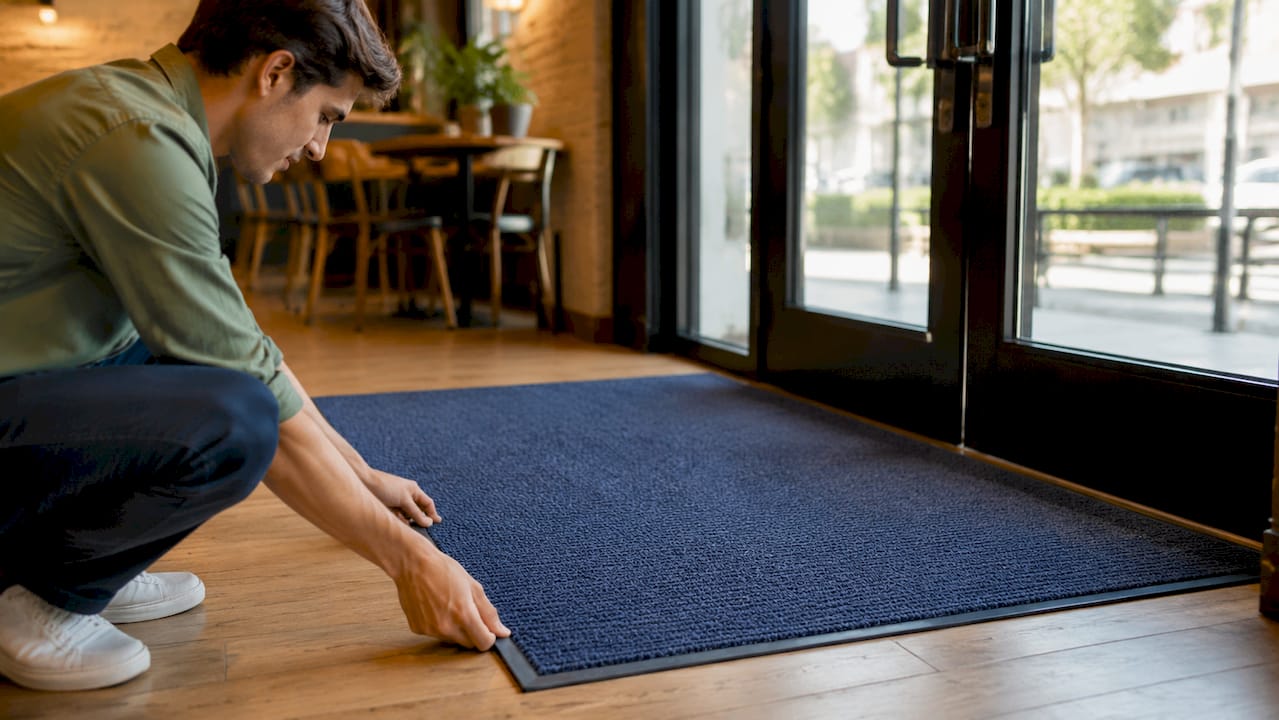
Width coverage is the starting point. Mats covering 80 to 100% of the door opening width are the minimum standard for effective debris capture. A standard single commercial door runs 900 to 1,000mm wide, which means a 90cm wide mat is the floor-level minimum. Wider is better. When visitors can step around a mat’s edge, dirt bypasses the cleaning surface entirely.
Length determines cleaning effectiveness. At least 2 to 3 full walking steps must fit on the mat surface to scrub and absorb contaminants from shoe soles. In commercial settings, that translates to 1.5 to 3 linear meters of mat depth. High-traffic environments like airports or transit hubs require 4 meters or more. A mat that only captures one footstep removes a fraction of the debris a properly sized mat would handle.
For high-traffic commercial entrances, a single mat rarely delivers peak performance. Multi-stage mat systems using three zones, scraper, wiper, and dryer, extending 4 to 6 meters in depth achieve the best moisture and dirt removal results. Each zone handles a different contaminant type: the scraper removes coarse debris, the wiper pulls moisture and fine particles, and the dryer absorbs residual moisture before it reaches interior flooring.
Key sizing rules to apply before you order:
- Width: cover the full door opening, or add 30% beyond door width for medium to high-traffic entrances
- Length: minimum 1.5m for low-traffic offices, 1.8 to 2.4m for medium commercial, 3 to 6m for retail or transportation hubs
- Thickness: 1 to 1.5cm mat thickness prevents door drag while maintaining durability
- Orientation: always lay the mat so the long dimension runs parallel to foot traffic direction
Pro Tip: If you are ordering a mat for a double door or a wide lobby entrance, calculate width as door frame to door frame including any sidelights. A mat that covers only one leaf of a double door leaves half the entrance unprotected.
How to accurately measure your entrance space
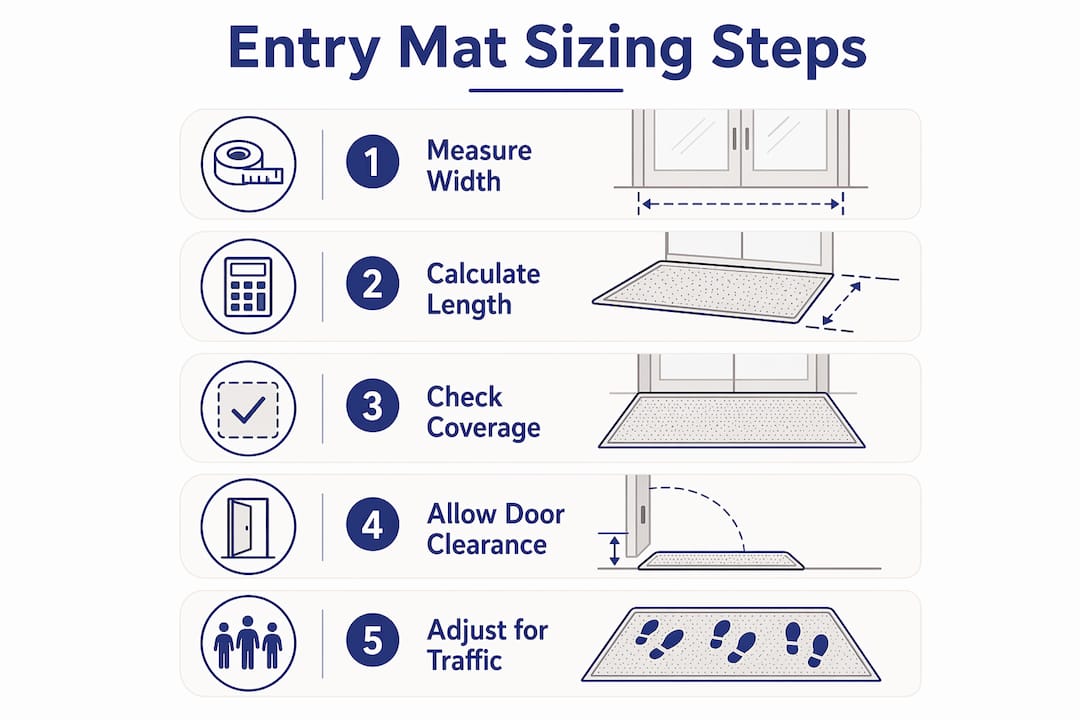
Accurate measurement prevents two costly problems: a mat that obstructs the door swing and a mat that leaves gaps at the edges. Follow this sequence before placing any order.
-
Measure the full door opening width. Include the door frame, any sidelights, and trim on both sides. Entrance width measurement must account for the total span visitors cross, not just the door leaf itself. Record this in centimeters.
-
Measure available depth from the door threshold inward. Stand at the threshold and measure straight back to the first obstruction, whether a reception desk, a display stand, or a wall. This is your maximum mat depth. Subtract 5 to 10cm from this figure to allow for door swing clearance.
-
Check door swing clearance. Open the door to its full arc and mark the floor where the door stops. Your mat must not extend into this arc. Inward-opening doors are the most common cause of mat-related door drag, particularly when thick mats are selected without accounting for clearance.
-
Apply the 80% rule to your width measurement. Mats significantly narrower than the entrance create tripping hazards at the edges and allow visitors to bypass the cleaning surface. Multiply your total entrance width by 0.8 to get the minimum mat width. For most commercial entrances, matching the full width is the correct choice.
-
Take multiple depth measurements for irregular entrances. Angled walls, curved lobbies, or recessed doorways require measurements at three points: left edge, center, and right edge. Use the shortest measurement as your depth constraint to avoid fit problems.
Pro Tip: Before ordering, mark your measured dimensions on the floor with painter’s tape. Walk through the space as a visitor would. You will immediately see whether the mat footprint covers the full traffic path or leaves gaps at the sides.
What are the best entry mat sizes for different entrance types?
Entry mat size recommendations vary significantly by entrance type and foot traffic volume. The table below provides a practical reference for the most common commercial scenarios.
| Entrance type | Recommended width | Recommended depth | Mat system |
|---|---|---|---|
| Small office or low-traffic door | 90cm (full door width) | 0.9 to 1.2m | Single mat |
| Medium commercial entrance | Door width plus 30% | 1.8 to 2.4m | Single or dual mat |
| High-traffic retail or hospitality | Full aisle width | 3 to 4.5m | Multi-zone system |
| Transportation hub or airport | Wall to wall | 4 to 6m | Multi-zone system |
| Industrial entrance | Full door width minimum | 2m minimum | Heavy-duty single mat |
Standard commercial mat sizes range from 45x75cm for small doors to 150x250cm for wide lobby entrances. Custom cutting is available for non-standard entrances, which is relevant for older buildings with irregular door frames or wide industrial bays.
For medium commercial entrances, the 1.8 to 2.4m depth range is the most commonly underestimated requirement. Many facility managers order a 90x150cm mat for a medium-traffic entrance and find it saturated by midday during wet weather. Doubling the depth to 1.8m dramatically increases moisture capacity and extends the time between mat changes or cleaning cycles.
Wider mats covering multiple footpaths reduce stepping around and improve overall entrance cleanliness. For broad entrances, placing two mats side by side is often more practical than ordering a single oversized piece. This also simplifies maintenance since each mat can be removed and cleaned independently.
Additional sizing considerations by entrance type:
- Industrial entrances with heavy equipment traffic require mats with reinforced edges and at least 2m depth to handle boot-level contamination
- Hospitality entrances benefit from a scraper mat at the exterior threshold followed by a wiper-dryer mat inside, totaling 3m or more
- Retail entrances with high seasonal foot traffic, such as during holiday periods, should be sized for peak volume, not average daily traffic
For a detailed breakdown of mat configurations by traffic volume, the mat size selection guide from Mats4u covers high-traffic commercial spaces with specific length and width recommendations.
Common mistakes to avoid when sizing and placing entry mats
Sizing errors are the leading cause of underperforming entrance matting programs. These are the mistakes that appear most frequently in commercial facilities.
Undersizing is the most common and most damaging error. Undersized mats cause visitors to step around the mat surface, which means dirt and moisture bypass the cleaning zone entirely. Matting experts identify undersizing as the primary driver of floor damage in commercial lobbies. The cost of replacing or refinishing interior flooring far exceeds the cost of a correctly sized mat.
Incorrect mat orientation reduces cleaning performance significantly. Placing a mat sideways so the short dimension runs parallel to foot traffic cuts the number of cleaning steps a visitor takes on the mat. A 60x90cm mat oriented correctly gives visitors 90cm of cleaning length. Rotated 90 degrees, it gives only 60cm. That difference translates directly to more dirt reaching your interior floor.
Thick mats without door clearance checks create safety hazards. Mats thicker than 1.5cm placed inside inward-opening doors frequently cause door drag and create a raised edge that becomes a tripping hazard. Always verify door clearance before selecting mat thickness.
Skipping multi-zone setups in high-traffic environments leaves moisture and fine particles uncaptured. A single mat, regardless of size, cannot replicate the performance of a multi-stage mat system in environments with 500 or more daily visitors.
Undersized mats not only reduce dirt control but lead to significant long-term flooring damage and increased cleaning costs. Correct sizing is a maintenance cost decision, not just a matting decision.
Pro Tip: Review foot traffic patterns by standing at your entrance during peak hours for 10 minutes. Note where visitors actually walk, not where you assume they walk. Many entrances have offset traffic paths that require mat placement adjustments to achieve full coverage.
Key takeaways
Correct entry mat sizing requires matching mat width to door opening coverage and mat depth to foot traffic volume, with multi-zone systems providing the highest performance in commercial settings.
| Point | Details |
|---|---|
| Width coverage rule | Mats must cover 80 to 100% of door opening width to prevent stepping around. |
| Depth for cleaning steps | Commercial entrances need 1.5 to 3 meters of mat depth for 2 to 3 full cleaning steps. |
| Multi-zone systems | High-traffic entrances require scraper, wiper, and dryer zones totaling 4 to 6 meters. |
| Measure before ordering | Check door swing clearance and total entrance width including sidelights before selecting dimensions. |
| Orientation matters | Always orient the mat so the long dimension runs parallel to the direction of foot travel. |
Why mat sizing is the facility decision most managers get wrong once
I have reviewed entrance matting setups in dozens of commercial facilities over the years, and the pattern is consistent. The mat is too short. Not by a little. Typically by half. A 90x60cm mat at a medium-traffic entrance that needs 1.8m of depth is not a mat program. It is a decorative gesture that costs money without delivering results.
The facilities where I have seen the most improvement after correcting mat sizing are not the ones that upgraded to premium materials. They are the ones that simply doubled the mat depth and matched the width to the full entrance opening. Cleaning costs dropped. Floor finish lasted longer. Slip incidents at the entrance decreased. None of those outcomes required a major capital investment. They required accurate measurement and the willingness to order the right size instead of the convenient size.
The multi-zone approach is where the real performance gains appear in high-traffic settings. A scraper mat at the exterior threshold followed by a WaterHog-style wiper-dryer mat inside creates a system that handles both coarse debris and moisture. The entrance matting guide from Mats4u covers this configuration in detail for facilities that need to build a complete entrance program rather than just replace a single mat.
Prioritize mat sizing during any facility renovation or entrance upgrade. The mat is the first line of defense for your interior floor investment. Size it correctly from the start.
— Werner
Get the right size mat for your entrance with Mats4u
Mats4u supplies commercial and industrial entrance mats in standard and custom sizes to match any entrance dimension or traffic volume. The WaterHog Max Herringbone Mat is available in multiple sizes and handles heavy daily use in retail, hospitality, and industrial settings. For facilities that need branding at the entrance without sacrificing cleaning area, custom logo mats are sized to your exact entrance dimensions with logo coverage balanced at 40 to 70% of mat area to preserve functional cleaning surface. Free delivery applies on orders over $100. All products are Made in the USA.
FAQ
What is the minimum mat width for a standard commercial door?
The minimum recommended mat width is 90cm, covering 80 to 100% of a standard 900 to 1,000mm commercial door opening. Wider coverage reduces the chance of visitors stepping around the mat edge.
How long should an entry mat be for a commercial entrance?
Commercial entry mats should be at least 1.5 to 3 linear meters in depth to allow 2 to 3 full walking steps on the mat surface. High-traffic environments like retail stores or transportation hubs require 4 meters or more.
How do I measure for an entry mat without blocking the door?
Measure from the door threshold inward to the first obstruction, then subtract 5 to 10cm for door swing clearance. Check the full arc of the door at maximum open position before finalizing mat depth.
What size entry mat do I need for a high-traffic lobby?
A high-traffic lobby requires a multi-zone mat system totaling 4 to 6 meters in depth, with width covering the full aisle or entrance span. A single mat of any size cannot match the performance of a properly configured multi-stage system in environments with high daily foot traffic.
Does mat orientation affect cleaning performance?
Yes. The long dimension of the mat must run parallel to the direction of foot travel. Placing a mat sideways reduces the number of cleaning steps a visitor takes on the surface and significantly lowers dirt and moisture capture rates.


