


Busy American kitchens can quickly turn risky when wet floors, grease, and constant foot traffic meet. For facility managers, the right large non slip kitchen mats make all the difference in protecting staff and preserving your floors through the toughest shifts. Choosing mats that provide both slip resistance and durability ensures safety and comfort where it matters most. Slip resistant walking surfaces engineered for kitchens offer practical peace of mind as you tackle daily retail challenges.
Table of Contents
- Defining Large Non Slip Kitchen Mats
- Common Materials And Non Slip Technologies
- Anti-Fatigue Benefits In Busy Kitchens
- Meeting OSHA And Slip Safety Standards
- Cost Factors And Selection Mistakes To Avoid
Key Takeaways
| Point | Details |
|---|---|
| Importance of Visibility | Ensure mats have contrasting colors with the floor to enhance visibility and reduce tripping hazards. |
| Material Selection | Choose mats made from durable materials like rubber or cushioned rubber for longevity and effective slip resistance. |
| Compliance with OSHA Standards | Regularly inspect and maintain mats to meet OSHA requirements, avoiding liability issues related to workplace safety. |
| Anti-Fatigue Benefits | Invest in adequately cushioned mats to reduce worker fatigue, improve productivity, and decrease turnover rates. |
Defining Large Non Slip Kitchen Mats
When you walk into a busy retail kitchen during the lunch rush, you immediately notice how different the floor feels compared to the dining area. That difference comes from what we call large non slip kitchen mats. These are floor coverings that serve a specific purpose: protecting your staff and customers while also safeguarding your facility’s floors from damage caused by constant moisture, grease, and spills. Unlike standard kitchen flooring, slip resistant walking surfaces are engineered to perform under the toughest conditions.
Large non slip kitchen mats typically measure anywhere from 3 by 5 feet up to 6 by 12 feet or larger, depending on your kitchen layout and traffic patterns. They’re designed to cover significant floor space in high traffic areas, particularly where water, grease, food particles, and oil accumulate regularly. The bottom surface contains materials that grip the existing floor, while the top surface provides cushioning and traction for your team’s feet. The mat material itself absorbs and traps moisture and debris before they can create slip hazards elsewhere in your facility. Additionally, these mats are designed to offer cushioning and slip resistance in areas prone to moisture and spills, thereby enhancing both safety and comfort for people working long hours in kitchens.
One critical design element often overlooked by facility managers is the color contrast with your floor. A mat that blends into your existing flooring becomes invisible, and that’s exactly when someone missteps. The best large non slip kitchen mats feature colors that distinctly contrast with surrounding flooring for visibility and to reduce tripping hazards. This isn’t just about aesthetics either. When employees can clearly see where the mat begins and ends, they maintain better awareness of their footing and adjust their stride accordingly. You’re essentially creating a visual boundary that reinforces the safety message your facility is sending.
Pro tip: When selecting mat size, measure your kitchen’s wettest zones (typically around sinks, dishwashing stations, and prep areas) and choose a mat that extends at least 3 feet in all directions from these high traffic points to maximize slip prevention coverage.
Common Materials and Non Slip Technologies
The effectiveness of a large non slip kitchen mat comes down to what it’s made from and how those materials work together to prevent accidents. Most commercial kitchen mats you’ll encounter in retail environments use rubber or cushioned rubber as their primary material. Why rubber? Because it naturally resists oils and chemicals that would degrade other materials, and it provides the cushioning your team needs during long shifts standing on hard floors. The top surface of these mats features a textured design that grips shoe soles and prevents slipping even when wet with water, cooking oils, or food residue.
The real innovation lies in the specialized backing technology that keeps the mat anchored to your floor. Standard mats can shift or bunch up, creating tripping hazards and defeating their purpose entirely. Modern non slip technologies involve a textured or reinforced backing that prevents movement on the floor surface, which is essential for safety in kitchens where floors are constantly wet or greasy. Some premium mats use beveled edges or built in curl resistance to maintain their position. Others incorporate drainage holes that allow water and spills to pass through rather than accumulate on top, reducing standing water that could make the mat surface itself slippery. Understanding sustainable slip resistance means selecting materials that maintain their grip not just when new, but after months of heavy use and exposure to kitchen conditions.
When evaluating different mat options, facility managers should understand that not all slip resistant properties are equal. A mat that provides excellent traction on day one might lose effectiveness if its surface becomes compressed or if the backing degrades under chemical exposure. Look for mats that have been tested for slip resistance both before and after installation, and ones manufactured from materials proven to resist slipping even when abraded by foot traffic or exposed to kitchen cleaning solutions. Thickness matters too. A mat that’s too thin won’t provide adequate cushioning or absorbency, while one that’s too thick creates an uneven surface and tripping hazard at the edges.
Pro tip: Request slip resistance test data from your mat supplier, specifically asking for results measured after the mat has been exposed to oils, cleaning chemicals, and heavy foot traffic to ensure you’re getting materials that stay protective throughout their entire lifecycle.
Here’s a quick overview of common materials used in large non slip kitchen mats and their advantages:
| Material Type | Slip Resistance Performance | Durability in Kitchens | Notable Benefits |
|---|---|---|---|
| Nitrile Rubber | Excellent on wet surfaces | Resistant to grease | Long lifespan, easy to clean |
| Standard Rubber | Good on multiple surfaces | Moderate longevity | Affordable and resilient |
| Polyurethane Foam | High cushioning | Prone to compression | Superior anti-fatigue support |
| Vinyl Composites | Variable, depends on mix | Less resistant to oils | Lightweight, lower cost |
Anti-Fatigue Benefits in Busy Kitchens
Your staff spends entire shifts on their feet. Line cooks, dishwashers, prep workers, and managers are standing for 8, 10, or sometimes 12 hours straight. The cumulative toll on their bodies is significant, and it affects your bottom line through increased injuries, worker compensation claims, and turnover. This is where the anti-fatigue benefit of large non slip kitchen mats becomes a game changer. Beyond preventing slips and falls, these mats cushion feet and absorb the constant pressure from prolonged standing tasks, which makes them an effective solution for reducing the physical strain your team experiences daily.
The science behind anti-fatigue mats is straightforward. When workers stand on hard concrete or tile floors, their leg muscles work constantly to maintain stability and posture. This sustained muscular engagement creates fatigue, joint strain, and eventual pain. Quality kitchen mats typically use cushioned materials like polyurethane foam and nitrile rubber that provide a slightly yielding surface. Cushioned surfaces that promote slight movement actually improve blood circulation in the legs and feet by encouraging tiny involuntary muscle contractions. Your team isn’t consciously thinking about this, but their bodies benefit from better oxygen flow, reduced muscle fatigue, and decreased joint stress. Workers standing on properly cushioned mats experience less pain at the end of their shift compared to those standing on bare floors.
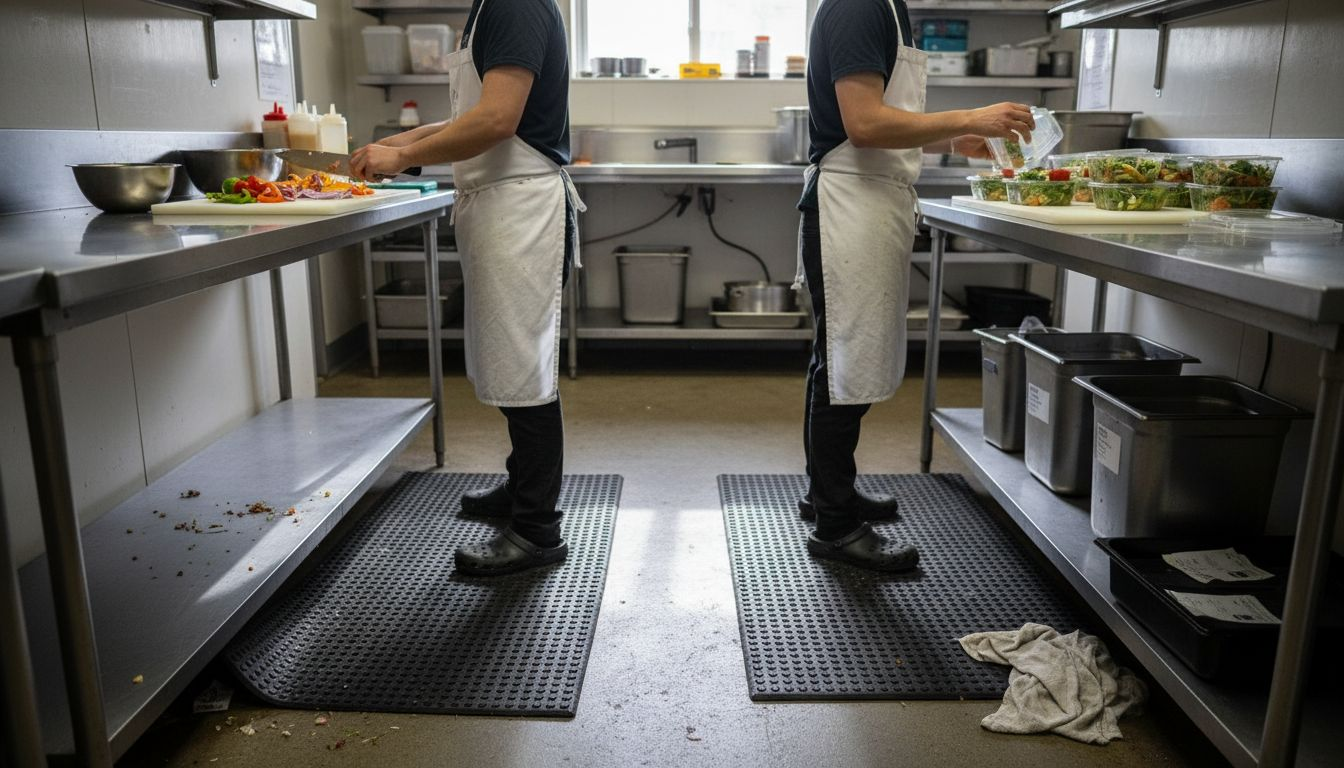
The real value emerges when you look at the bigger picture. Reduced fatigue means fewer workplace injuries, better focus during critical food preparation tasks, and improved employee morale. Staff who are in pain tend to move less efficiently and make more mistakes. They’re also more likely to call in sick or seek employment elsewhere where standing demands are lower. By investing in mats that reduce pain and fatigue linked to prolonged standing, you’re improving worker comfort and directly boosting productivity. In retail kitchen environments where every staff member matters, this translates to better customer service and more consistent food quality.
For facility managers, the anti-fatigue benefit isn’t just about worker wellness, though that matters. It’s about operational efficiency. Comfortable employees are focused employees. They move with purpose rather than wincing through their shifts. They stay longer, reducing the constant expense of training new staff. They make fewer costly mistakes. The mat that costs a few hundred dollars upfront pays for itself through reduced turnover and improved performance.
Pro tip: Measure the thickness of your kitchen mats and ensure they’re at least 0.75 inches thick to provide meaningful anti-fatigue cushioning. Too thin and you lose the pressure-absorbing benefit. Too thick and you create tripping hazards at edges. Also rotate mats periodically so the compressed areas rest and recover their cushioning properties.
Meeting OSHA and Slip Safety Standards
Compliance isn’t optional. As a facility manager, you’re responsible for understanding what OSHA requires and ensuring your kitchen meets those standards. The good news is that large non slip kitchen mats are a straightforward way to demonstrate your commitment to worker safety and avoid costly violations. OSHA’s stance on kitchen safety is clear: employers must maintain walking-working surfaces that are clean, dry, and free of hazards to prevent slips, trips, and falls. This isn’t just guidance. It’s a regulatory requirement that directly impacts your liability exposure.
When wet processes create slippery conditions in your kitchen, OSHA doesn’t give you the option to hope your staff will be careful. The regulation requires you to provide dry standing places such as anti-slip mats. But there’s more to compliance than simply placing a mat on the floor. Your mats must be securely placed to prevent movement, regularly inspected, and properly maintained. A mat that bunches up, curls at the edges, or loses its grip becomes a compliance liability rather than a solution. OSHA’s general requirements for walking-working surfaces mandate that floors and mats are maintained in a clean and dry condition and inspected regularly. This means your documentation should include mat inspection logs showing when mats were checked, what condition they were in, and what maintenance was performed.
The General Duty Clause is where many facility managers get caught off guard. Even if a specific OSHA standard doesn’t explicitly address your situation, the General Duty Clause requires you to provide a safe workplace free of recognized hazards. A slippery kitchen floor is a recognized hazard. Your failure to address it with appropriate slip-resistant measures could result in citations regardless of whether a specific rule applies. Documentation is your protection. Keep records of mat purchases, installation dates, maintenance schedules, and any incidents that occurred before and after mat installation. This demonstrates that you recognized the hazard and took action to control it. Insurance companies also favor facilities that maintain detailed safety records, which can lower your premiums.
Implementing the right mats is only half the equation. You need a maintenance protocol that keeps those mats effective. Regular cleaning removes the slippery substances that accumulate on mat surfaces. Inspection routines catch damage or degradation before mats become hazards themselves. Staff training ensures employees understand that mats serve a safety purpose and shouldn’t be moved or removed. When OSHA inspectors visit, they’ll look at your mats, your maintenance records, and your training documentation.
Pro tip: Create a simple mat maintenance checklist that your team completes weekly, documenting mat condition, cleaning, and any damage. Store these records for at least three years. If OSHA ever inspects your facility, this documentation proves you’re taking slip prevention seriously and meeting regulatory requirements.
Cost Factors and Selection Mistakes to Avoid
Budget matters, but buying the cheapest mat available is one of the fastest ways to waste money on kitchen safety. When facility managers face tight budgets, the temptation to purchase thin, low-cost mats is strong. Six months later, those mats are compressed, no longer provide adequate cushioning, and their slip resistance has deteriorated. You end up replacing them and spending twice as much. Understanding the actual cost factors helps you make decisions that protect both your budget and your team.
The primary cost drivers for large non slip kitchen mats include durability, ease of cleaning, slip resistance quality, and anti-fatigue properties. A mat that costs 30 percent less but lasts half as long actually costs more per year of use. Durability matters because kitchen environments are brutal. Hot water, harsh cleaning chemicals, constant foot traffic, and moisture exposure break down inferior materials quickly. When comparing prices, ask suppliers for expected lifespan under your specific conditions. A quality mat might cost $400, but if it lasts 5 years, that’s $80 per year. A cheap mat at $200 that lasts 18 months costs $133 per year. The math is straightforward once you factor in replacement frequency and labor time to install new mats.
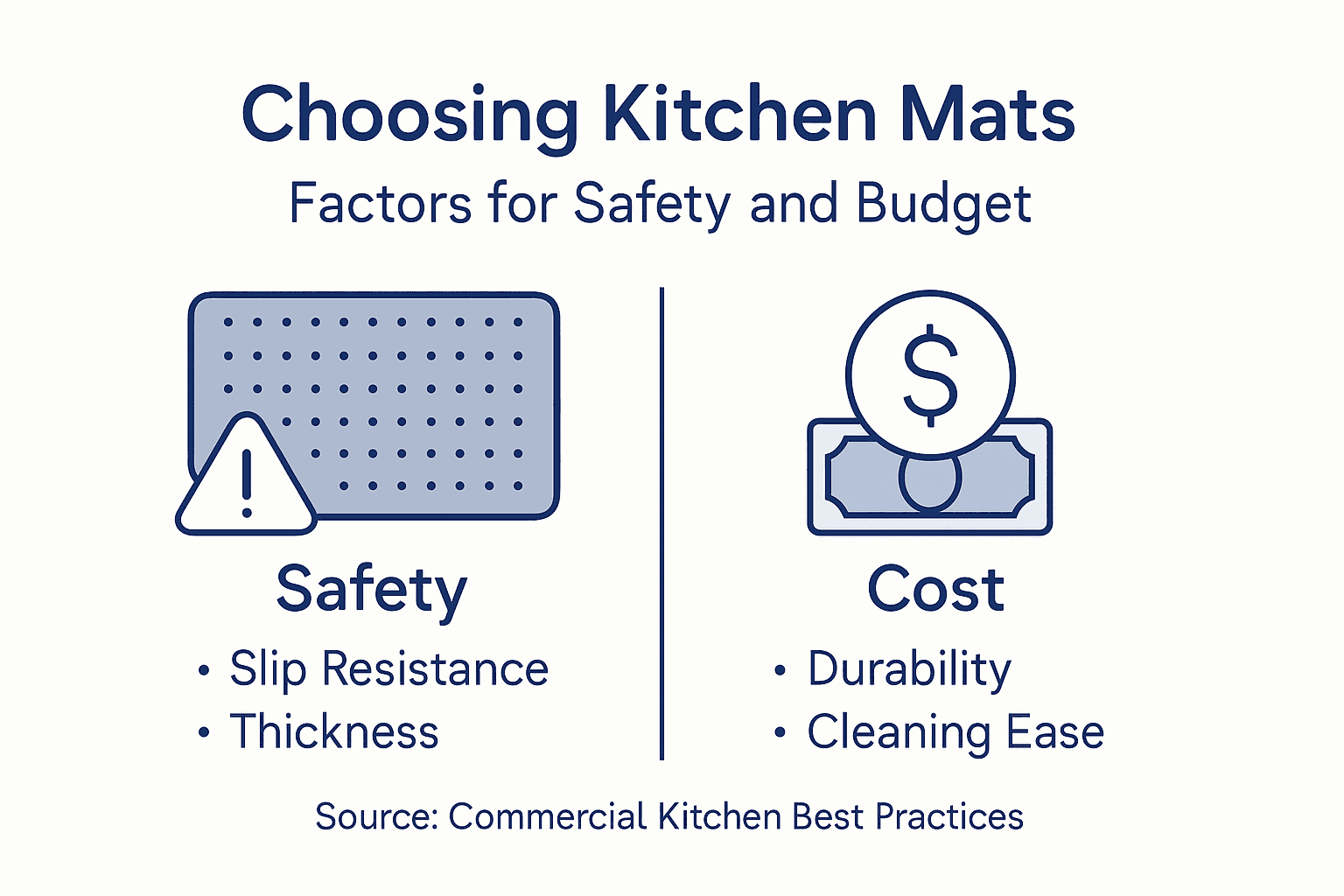
Compare critical cost considerations when choosing kitchen mats:
| Cost Factor | Impact on Budget | Influence on Safety | Long Term Benefit |
|---|---|---|---|
| Durability | Lower replacement cost | Prevents mat failures | Fewer frequent purchases |
| Cleaning Ease | Reduces labor effort | Maintains mat traction | Supports hygiene protocols |
| Slip Resistance | Avoids injury claims | Protects staff, guests | Compliance with standards |
| Anti-fatigue | Improves productivity | Reduces worker strain | Lowers turnover, injuries |
Common selection mistakes often stem from incomplete understanding of your actual needs. One frequent error is choosing mats that are too soft. While cushioning feels comfortable when you first walk on it, excessively soft mats increase energy expenditure when standing because your muscles work harder to maintain stability. Your staff will experience more fatigue, not less. Conversely, mats that lack proper backing and move create tripping hazards that are worse than no mat at all. Another critical mistake is selecting mats without proper visibility contrast with your floor. A mat that blends into your surrounding flooring becomes invisible, and employees stop seeing it as a defined area. They misstep at the edges, increasing injury risk rather than preventing it.
Oversizing or undersizing mats also creates problems. Too small, and your team stands outside the protected area during peak traffic periods. Too large, and you create unnecessary tripping hazards at edges. Poor selection of kitchen mats can lead to overlooking ergonomic benefits, selecting inappropriate sizes, and ignoring slip resistance ratings, which are vital for high-traffic kitchen environments. Maintenance requirements matter equally. Some mats require specialized cleaning procedures or sealants to maintain their properties. If your facility doesn’t have the resources or budget for that maintenance, choose mats designed for easy cleaning with standard procedures.
Pro tip: Request sample mats from suppliers and test them in your actual kitchen environment for one week before committing to a large order. Pay attention to how they grip under wet conditions, how they feel after extended standing, and how easily they clean. Real-world testing reveals problems that specifications sheets never show.
Enhance Kitchen Safety and Comfort with Mats4U
Large non slip kitchen mats are essential for protecting your team from slips and reducing fatigue during long shifts. Your kitchen deserves mats with proven slip resistance backed by quality materials like nitrile rubber and cushioned foam that stand up to wet and greasy conditions. Choosing mats with proper thickness and secure backing helps you meet OSHA safety standards while providing anti-fatigue benefits that boost productivity and reduce injury risks.
Find the ideal mat solution tailored for commercial kitchen environments by exploring our extensive range at Commercial Mats and discover added comfort with our Anti-Fatigue Mats. Take control of safety and comfort today with mats that combine durability, slip resistance, and ergonomic support. Visit Mats4U.com now to get expert advice and secure your kitchen’s future with reliable non slip mats designed to keep your staff safe, comfortable, and focused on the job.
Frequently Asked Questions
What are large non slip kitchen mats designed for?
Large non slip kitchen mats are specifically designed to protect staff and customers from slip hazards while also safeguarding the kitchen floor from moisture, grease, and spills. They provide cushioning and traction in high-traffic areas where safety is paramount.
How do I choose the right size for a non slip kitchen mat?
When selecting a mat size, measure your kitchen’s wettest zones, such as around sinks and dishwashing stations. It’s advisable to choose a mat that extends at least 3 feet in all directions from these high-traffic points to maximize slip prevention coverage.
What materials are commonly used in large non slip kitchen mats?
Most large non slip kitchen mats are made from rubber or cushioned rubber. These materials resist oils and chemicals, provide necessary cushioning for long-standing employees, and feature textured surfaces that enhance slip resistance.
What are the anti-fatigue benefits of using kitchen mats?
Anti-fatigue kitchen mats help reduce strain on employees’ legs and feet during long hours of standing. The cushioned surface promotes better blood circulation, reducing pain and fatigue, which leads to improved productivity and worker morale.


