


TL;DR:
- Proper mat layouts are essential for preventing slips, reducing liability, and minimizing floor damage.
- Selecting the right mat type and designing precise placement based on traffic data improves safety.
- Regular inspection, maintenance, and re-evaluation ensure long-term effectiveness of mat systems.
A single mat placed at the wrong angle near a loading dock entrance can send an employee to the floor before the morning shift even starts. Poor mat layouts in busy facilities are not just an aesthetic problem. They create measurable liability, accelerate floor damage, and increase cleaning labor costs. This guide walks you through a structured process: auditing your facility, selecting the right mat types, designing a functional layout, and verifying performance over time. Whether you manage an industrial plant, a retail store, or a hotel, the steps here give you a repeatable system for safer, cleaner, and more cost-effective floor coverage.
Table of Contents
- Assessing your facility’s high-traffic areas
- Selecting the right mats and layout materials
- Step-by-step guide to designing effective mat layouts
- Testing, maintenance, and common mistakes to avoid
- What most facilities get wrong about mat layouts
- Choosing the right mats for your next layout project
- Frequently asked questions
Key Takeaways
| Point | Details |
|---|---|
| High-traffic auditing | Pinpointing entry and transition zones is the foundation for effective mat layout. |
| Material matters | Selecting the proper mat type for each area dramatically increases safety and reduces costs. |
| Precise execution | Proper measurement and careful installation prevent hazards and extend mat life. |
| Ongoing maintenance | Regular checks and cleaning are essential to sustaining mat safety and performance. |
| Common pitfalls | Avoid mat creep and undersized layouts to protect both users and your investment. |
Assessing your facility’s high-traffic areas
Before you place a single mat, you need a clear picture of where people walk, where water collects, and where the floor transitions from one surface to another. These are your highest-risk zones.
Start by identifying the obvious locations: main entrances, side doors, service corridors, kitchen service zones, and production line stations. Then go further. Look at loading docks, elevator lobbies, restroom thresholds, and any area where outdoor foot traffic meets interior flooring. Slips and trips are a leading cause of workplace injuries, especially in entryways and wet areas, which makes these zones your first priority.
To map traffic accurately, use one or more of these methods:
- People counters or door sensors: These give you hourly foot traffic data by entrance point.
- Daily cleaning logs: Dirty or wet floor reports from your cleaning crew reveal where moisture and debris accumulate most.
- Incident reports: Review any slip, trip, or fall records from the past 12 months. Cluster locations tell you exactly where layout gaps exist.
- Visual observation during peak hours: Walk the facility during shift changes, lunch rushes, or high-volume retail periods and note where floors look wet, scuffed, or worn.
Once you have that data, categorize each zone by risk level:
| Zone type | Risk level | Primary hazard |
|---|---|---|
| Main entrance | High | Moisture, debris from outdoors |
| Production line station | High | Fatigue, oil or chemical spills |
| Kitchen service threshold | High | Wet floors, grease |
| Loading dock | Very high | Heavy traffic, moisture, uneven surfaces |
| Retail checkout area | Medium | Prolonged standing, light moisture |
| Elevator lobby | Medium | Transition surface, intermittent moisture |
Investing in non-slip industrial flooring solutions at very-high-risk zones reduces both incident frequency and liability exposure. For a broader view of what safe mat placement looks like in practice, reviewing slip-proof mat safety guidelines gives you a useful reference point.
Pro Tip: Include your cleaning staff and security team in the audit. They observe floor conditions daily and often know exactly which spots get wet, slippery, or congested in ways that do not show up in formal reports.
Selecting the right mats and layout materials
After identifying target areas, the next step is selecting mats suited for each specific function and risk profile.
Not all mats serve the same purpose. Using an absorbent entry mat in a grease-prone kitchen zone, for example, creates a new hazard instead of solving one. Choosing the correct mat type ensures safety and reduces replacement costs over time. Match the mat to the zone.
Here is a breakdown of the main mat categories and where each belongs:
- Rubber mats: Best for wet areas, loading docks, and outdoor transitions. Resistant to moisture and heavy impact.
- Vinyl mats: Durable and easy to clean. Good for food service and light industrial zones.
- Absorbent mats: Designed for entrances where moisture and dirt need to be captured before they reach interior floors.
- Anti-fatigue mats: Essential for workstations where employees stand for extended periods. They reduce leg and back strain significantly.
When evaluating any mat, prioritize these features:
- Slip resistance rating (look for ASTM or OSHA-compliant ratings)
- Water absorption capacity for entry zones
- Beveled or tapered edges to reduce tripping risk
- Logo or branding capability for customer-facing areas
- Chemical or oil resistance for industrial zones
Use this comparison table to match mat type to zone:
| Zone | Recommended mat type | Key feature |
|---|---|---|
| Main entrance | Absorbent or Waterhog-style | High moisture capture |
| Wet or oily floor area | Rubber drainage mat | Slip resistance, drainage holes |
| Standing workstation | Anti-fatigue mat | Cushioning, fatigue reduction |
| Retail lobby or reception | Custom logo mat | Branding, moderate absorbency |
For workers on their feet all day, anti-fatigue mats industrial options are specifically engineered to reduce fatigue and injury risk. If you are evaluating options for wet or slippery surfaces, the guide on selecting anti-fatigue standing mats covers eight critical factors. For general slip prevention, anti slip floor mats offer a useful product-level overview.

Pro Tip: In retail environments, always choose mats with beveled edges. A flat-edge mat in a high-foot-traffic aisle is a trip waiting to happen, especially for customers who are distracted or moving quickly.
Step-by-step guide to designing effective mat layouts
With the right mats chosen, it is time to put them in place with precision and care.
Improper placement is the most common mistake when creating mat layouts. A well-chosen mat installed in the wrong position, or without accounting for traffic direction, delivers a fraction of its intended benefit.
Follow this sequence for a reliable layout:
- Measure every target zone accurately. Use a tape measure and record both the full floor dimensions and the usable coverage area, accounting for door swing clearance and equipment placement.
- Sketch a layout plan. Draw the space to scale and mark where each mat type will go. Identify overlap points where two mats meet and transition zones between mat and bare floor.
- Prioritize coverage in the highest-risk zones first. Start with entrances and wet areas. These locations have the highest incident potential and should receive the most coverage.
- Plan for mat-to-mat transitions. Where two mats meet, edges should be flush or overlapping slightly. A gap between mats is a tripping hazard. An abrupt height change between two different mat thicknesses is also a risk.
- Install mats in sequence. In industrial settings, begin at the production line and work outward toward exits. In retail or hospitality, start at the main entrance and move inward.
- Secure mats with appropriate backing or anchors. Rubber-backed mats resist creep on smooth floors. For high-traffic or cart-heavy zones, consider anchor strips or recessed mat frames.
Warning: Never leave a gap between adjacent mats in a walkway. Even a half-inch gap can catch a shoe heel and cause a fall. Overlap edges slightly or use a mat frame to keep surfaces flush.
Use this reference table to guide layout decisions by environment:
| Environment | Layout priority | Special consideration |
|---|---|---|
| Industrial plant | Production line first, then exits | Chemical resistance, drainage |
| Retail store | Entrance, then checkout, then aisles | Branding, beveled edges |
| Hospitality/hotel | Lobby entrance, then service corridors | Appearance, moisture control |
For industrial zones, industrial non-slip mats are designed to stay in place under heavy equipment movement. If you are unsure where anti-fatigue coverage is needed beyond workstations, the guide on anti-fatigue mats usage covers a wide range of applicable environments.
Testing, maintenance, and common mistakes to avoid
Even after installation, mat layout is not a set-it-and-forget-it task. It requires periodic checks and updates.
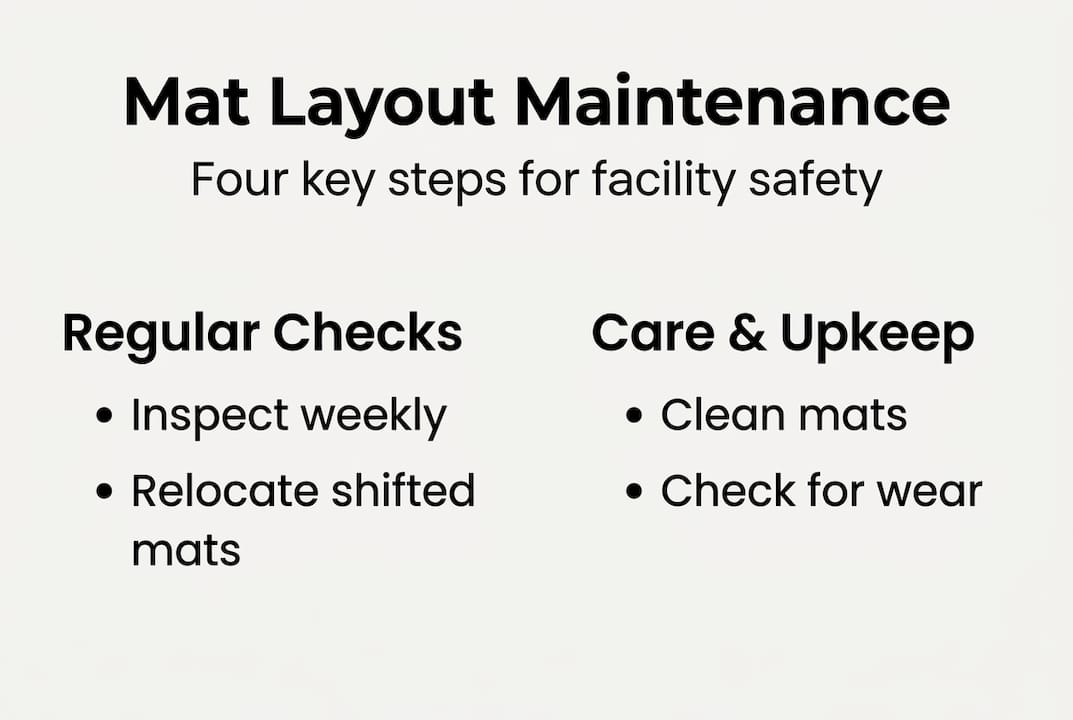
Regular inspection and adjustment of mat layouts reduces slip hazard incidents over time. The goal is to catch problems before they cause injuries or damage.
Here is how to verify your layout is working:
- Observe foot traffic patterns after the first week of installation. Watch for mats that shift, curl at the edges, or show uneven wear.
- Collect feedback from staff and cleaning crews. They will notice if a mat bunches up, slides, or fails to capture moisture effectively.
- Review incident logs monthly. Any new slip or trip report near a mat zone signals a placement or product issue that needs correction.
- Check mat condition seasonally. Winter brings more moisture and debris. Summer may bring different traffic volumes. Adjust coverage and cleaning frequency accordingly.
Common mistakes that undermine even well-planned layouts:
- Mat creep: Mats that slide on smooth floors over time. Fix this with rubber-backed mats or anchor systems.
- Wrong mat size: A mat that is too small for the zone leaves bare floor exposed at the edges, exactly where people step.
- Ignoring seasonal changes: A mat system designed for summer foot traffic may be completely inadequate during wet winter months.
- Skipping cleaning schedules: A saturated or debris-filled mat loses its slip-resistance and becomes a hazard itself.
Note: A mat that looks clean on the surface may be fully saturated underneath. Lift mats regularly to check for moisture buildup beneath them, which can damage flooring and create mold conditions.
For long-term performance, slip proof mat solutions that include anti-fatigue and drainage features tend to hold up better under daily cleaning routines than standard flat mats.
Pro Tip: Re-evaluate your entire mat layout every six months. Traffic patterns shift as businesses grow, equipment moves, or seasonal changes alter how people enter and exit the building.
What most facilities get wrong about mat layouts
Most facility managers treat mat installation as a one-time task. Place the mats, move on. That mindset is where most mat programs fail.
The real problem is not the initial layout. It is the absence of a maintenance routine. Mats shift, saturate, and wear down. Without scheduled inspections, those changes go unnoticed until someone falls or a floor gets damaged.
Cost-cutting on mat quality is another common trap. Cheaper mats wear faster, lose their slip resistance sooner, and often lack the edge stability needed for heavy foot traffic. The replacement and liability costs far exceed any initial savings. We have seen this pattern consistently across industrial and retail environments.
The facilities that run the most effective mat programs share one habit: they gather feedback from both maintenance staff and daily users. Maintenance crews know what is hard to clean. Workers and customers know what feels unstable underfoot. That combined input drives smarter adjustments than any top-down audit alone.
If you are evaluating mat quality for long-term use, choosing industrial anti-fatigue mats with proven durability ratings is a better investment than replacing budget options every six months.
Choosing the right mats for your next layout project
Ready to apply this process in your facility? Mats4U offers a full range of commercial and industrial mat solutions built for exactly these environments. From premium custom logo mats that reinforce your brand at high-traffic entrances, to durable entryway mats engineered for maximum moisture capture, every product is matched to a specific commercial need. All orders over $100 ship free, and products are Made in the USA. Visit Mats4U to browse by zone type, get product specifications, and find the right mat for every area in your facility.
Frequently asked questions
How often should mat layouts be checked or updated in busy facilities?
Mat layouts should be reviewed at least every six months, and more frequently in high-wear or seasonal environments. Facility managers should re-evaluate mat effectiveness regularly to maintain lasting safety.
What’s the most common mistake in mat system design for commercial spaces?
The most common mistake is failing to provide full coverage in transition zones and using mats that shift easily or lack beveled edges. Improper placement and edge choice can increase trip hazards significantly.
How do I choose the right mat for a wet or oily area?
Select mats specifically rated for wet or oily zones, focusing on slip resistance and drainage features. Selecting the correct mat for these surfaces maximizes both safety and mat longevity.
Can custom logo mats be used in high-traffic entryways?
Yes, premium printed logo mats are durable and suitable for high-traffic entrances when chosen for commercial-grade use. Look for options with rubber backing and high-density fiber construction for best performance.


