


TL;DR:
- Managing a commercial vehicle fleet requires balancing interior protection and brand visibility through monogrammed mats. High-quality, durable options tailored to vehicle use optimize branding, safety, and ease of maintenance for high-traffic applications. Customized mats enhance operational standards and leave a lasting positive impression on clients and staff alike.
Managing a commercial vehicle fleet means balancing competing priorities every day. Mats that protect interiors from mud and spills are a baseline requirement. But for businesses where company vehicles regularly carry clients, executives, or service staff, plain black mats send the wrong signal. Monogrammed car floor mats solve both problems at once: they protect carpets and upholstery while turning every vehicle visit into a controlled branding moment. This guide covers how to evaluate, select, compare, and maintain the right custom mats for your fleet.
Table of Contents
- How to evaluate monogrammed car floor mats for business fleets
- Top options: Carpet vs. all-weather monogrammed mats for commercial use
- Monogrammed mats: Quick comparison for managers
- Caring for and maximizing the value of monogrammed mats
- A practical perspective: Why personalization matters more in business fleets
- Upgrade your fleet’s image with premium monogrammed mats
- Frequently asked questions
Key Takeaways
| Point | Details |
|---|---|
| Durability matters | Choose mats with heavy-duty backing and OEM-quality materials for frequent fleet use. |
| Branding boosts image | Monogrammed mats project professionalism and reinforce your company’s brand identity in every vehicle. |
| Match mat to use | Carpet mats offer superior branding and comfort while all-weather options provide best-in-class protection for tough environments. |
| Cleaning is key | Regular cleaning and rotation extend mat lifespan and preserve both appearance and safety. |
| Personalization impacts clients | Branded details in company vehicles create lasting positive impressions during business interactions. |
How to evaluate monogrammed car floor mats for business fleets
Once you understand the importance of a tailored solution for your business, it’s essential to know what makes a monogrammed mat a smart investment. Not every mat on the market is built for repeated commercial use, heavy passenger traffic, or the level of customization a company brand demands.
Start with material durability. Fleet vehicles see daily use, often by multiple drivers. A mat that wears through after 90 days creates waste and costs more over time. Look for OEM-quality (original equipment manufacturer) materials, which are matched to factory specifications for fit and resistance. Understanding the full range of what logo floor mats for business can offer helps you set realistic specs before purchasing.
Key evaluation criteria for commercial buyers include:
- Material durability: Nylon, TPE (thermoplastic elastomer), or heavy-duty carpet rated for high-traffic applications
- Branding quality: Embroidered, sublimated, or laser-cut logos with accurate color matching and long-term fade resistance
- Safety features: Non-skid rubber or nibbed backing that prevents mat shift during braking or acceleration
- Cleaning practicality: How easily the mat can be removed, wiped, vacuumed, or deep cleaned without damaging the logo
- Personalization depth: Options for monograms, department codes, vehicle numbers, or full-color logos
Fleet applications are fundamentally different from personal vehicle use. A family buying car mats once every few years has different needs than a facilities manager outfitting 40 vehicles annually. Commercial buyers need volume pricing, consistent branding across units, and mats that hold up under rotating drivers who may not treat vehicles with care. Custom floor mat specifications for commercial accounts reflect exactly these higher performance standards.
According to commercial mat suppliers, fleet-grade logo mats are built with non-skid backing and OEM-quality materials that enhance brand visibility in company cars and SUVs while standing up to high-traffic use patterns.
Pro Tip: Always specify non-skid backing and request the mat’s traffic rating from your supplier before placing a bulk order. A mat rated for light personal use will fail faster in a fleet context, costing more in replacements than a commercial-grade option would have at the start.
Top options: Carpet vs. all-weather monogrammed mats for commercial use
With your decision criteria in hand, it’s time to examine what types of monogrammed mats dominate the business market. Two categories lead the field: traditional carpet mats and all-weather mats made from TPE or rubber compounds. Each has a clear place in a well-managed fleet.
Carpet monogrammed mats are the default choice for executive vehicles, company cars, and any situation where interior presentation matters. These mats take branding exceptionally well. Embroidered logos hold color and detail over years of use. The texture and look matches OEM factory interiors, which signals quality to clients and senior staff riding in the vehicle. Brands like Lloyd and GGBailey have built their reputation on precisely this combination of customization and material quality.
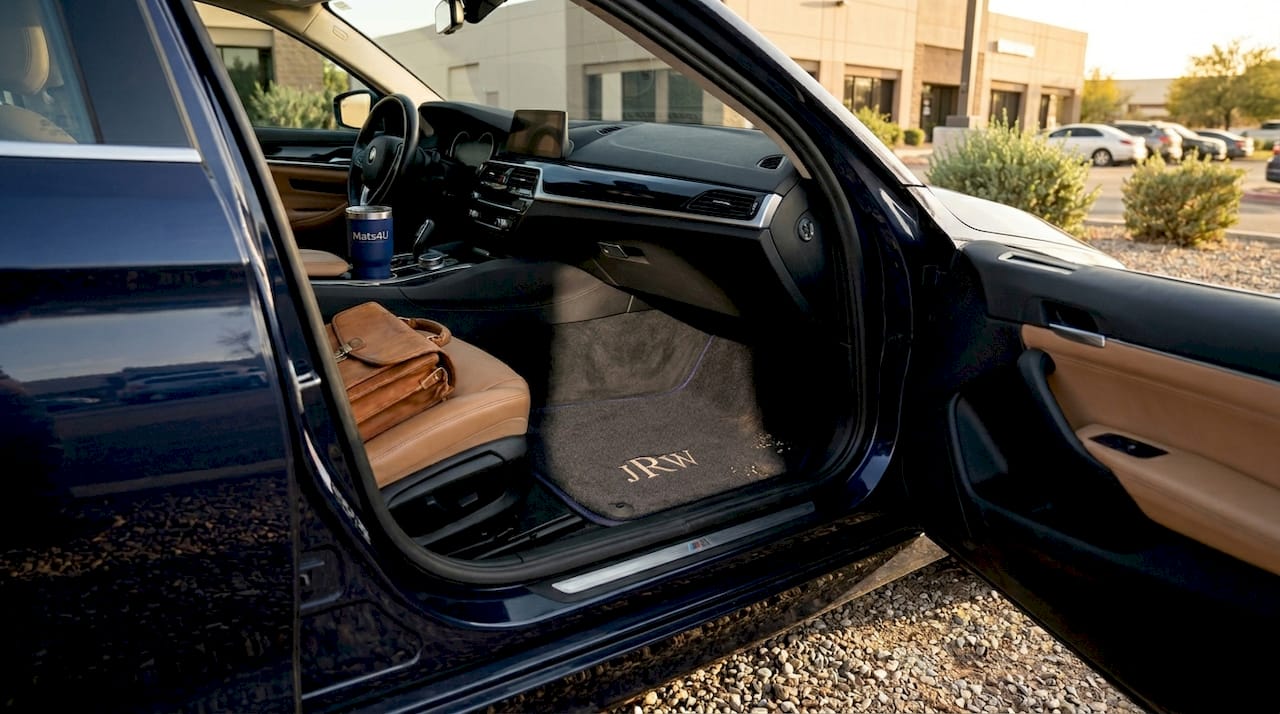
The tradeoff is maintenance. Carpet mats require removal for deep cleaning, since dirt and moisture can work into fibers if the mat stays in place during cleaning. For a well-managed fleet with a scheduled cleaning program, this is a manageable process. For vehicles that rarely receive attention, it becomes a problem.
All-weather TPE and rubber mats serve a different function. These mats form a watertight tray around the vehicle’s footwell, capturing mud, snow, water, and debris without letting any of it reach the carpet underneath. For service vehicles, delivery vans, utility trucks, and any fleet operating in outdoor or industrial environments, all-weather mats are the practical baseline. Some suppliers now offer sublimation-printed rear car mat blanks that allow branded graphics on all-weather surfaces, though color saturation and detail are generally not as refined as embroidered carpet options.
The key advantages and drawbacks of each type break down as follows:
Carpet mats:
- Superior logo and branding customization
- Professional, finished interior appearance
- Higher comfort underfoot for passengers
- Requires scheduled removal and deep cleaning
- Less effective in wet or muddy environments without protective overlay
All-weather mats:
- Maximum protection from liquid and debris
- Easy wipe-clean maintenance
- Durable in tough outdoor conditions
- Limited branding options compared to carpet styles
- Less premium appearance in executive or client-facing vehicles
“Custom carpet mats excel in luxury and comfort applications, but all-weather TPE options from brands like WeatherTech and TuxMat outperform in mud and snow while offering limited personalization by comparison.” Road & Track gear review editors, 2024
Understanding which vehicles in your fleet serve which roles is the fastest way to assign the right mat type. A single-size solution rarely serves the full range of commercial fleet needs. For more details on matching mat materials to customized solutions for business vehicles, reviewing supplier specifications by vehicle category is a useful starting point.
Pro Tip: Mix carpet branded mats for executive and sales vehicles where client impressions count, and specify all-weather liners for maintenance, field service, and delivery vehicles where protection and easy cleaning are the priority. This two-tier system controls costs while keeping standards appropriate to each vehicle’s role.
Monogrammed mats: Quick comparison for managers
Let’s summarize the key differences to help you make a fast, evidence-based decision. The carpet mat market is growing due to increased demand for customization options, according to Allied Market Research data tracked by industry observers. The comparison below covers the features that matter most in a commercial procurement context.
| Feature | Carpet monogrammed mats | All-weather (TPE/rubber) mats |
|---|---|---|
| Branding options | Embroidered, printed, full-color logo | Sublimated print, basic embossing |
| Cleaning method | Remove and deep clean | Wipe or rinse in place |
| Durability rating | Moderate to high (commercial grade) | High to very high |
| Best use: executive/client cars | ✓ Recommended | Not ideal |
| Best use: delivery/field vehicles | Not ideal | ✓ Recommended |
| Best use: maintenance/utility | Not ideal | ✓ Recommended |
| Cost per unit | Moderate to premium | Moderate |
| Branding clarity | High | Moderate |
| Interior appearance | Premium, OEM-matched | Functional, utility |
For procurement decisions across a mixed fleet, this table gives you the fast answer: match the mat type to the vehicle’s primary function and the people who ride in it. You can also explore custom mat options organized by vehicle role and use case to speed up the selection process.
Front cabin mats often receive the most wear and the highest visibility from passengers. Some suppliers provide sublimation-ready front car mat blanks for operations that handle their own branding in-house, which can reduce per-unit costs at scale.
The decision matrix is straightforward. Executive vehicles in client-facing roles get carpet with full logo branding. Service vehicles operating outdoors get all-weather protection. Mixed-use vehicles, like pool cars shared by multiple departments, benefit from all-weather durability with a simple monogram or department code for identification.
Caring for and maximizing the value of monogrammed mats
Once you’ve made the right selection, ensure your mats deliver on their value with smart upkeep strategies. Proper maintenance protects both the branding investment and the vehicle interior underneath. A mat that looks worn or stained works against your brand rather than for it.
Follow these steps to keep both carpet and all-weather mats in good condition:
- Vacuum carpet mats weekly in high-use vehicles to prevent grit from grinding into fibers. Abrasive particles wear down carpet faster than foot traffic alone.
- Remove carpet mats for deep cleaning monthly or after any wet weather event. Carpet mats need removal for thorough cleaning; leaving them damp in place promotes mold and odor that no amount of surface treatment will fix.
- Wipe all-weather mats with a damp cloth after each heavy-use day. For accumulated mud or debris, remove the mat and rinse it with low-pressure water, then allow it to dry before returning it to the vehicle.
- Inspect non-skid backing quarterly for wear. When nibbed rubber backing wears smooth, the mat becomes a safety hazard. Replace worn mats promptly rather than waiting for a scheduled replacement cycle.
- Rotate mats between vehicles seasonally when vehicle use patterns change. Winter months increase moisture and salt exposure. Rotating all-weather mats into service for winter and returning carpet mats in spring extends the life of both sets.
- Store spare mats flat in a climate-controlled area. Rolling or folding mats for extended storage creates permanent creases that affect fit and safety.
Reviewing a commercial floor mat cleaning service guide can clarify which cleaning methods are safe for specific materials and logo types. Some embroidered logos, for example, should not be machine washed. Checking the supplier’s care instructions before establishing a cleaning schedule prevents damage that voids coverage. You can also reference business floor mat cleaning best practices for a quick reference guide organized by mat type.
Pro Tip: Assign different logo mat colors or accent trims for each department’s vehicles. Fleet managers report that color-coded mats make it easier to track which vehicles belong to which business unit, simplify restocking, and create a visible organizational identity that staff actually notice and respect.
A practical perspective: Why personalization matters more in business fleets
Beyond specs and upkeep, it’s worth pausing to ask why personalization in fleet interiors can be a silent differentiator. Most facilities managers think about branded mats only in the context of their building entrances. Vehicles rarely get the same attention. That oversight is a missed opportunity.
Every company vehicle that carries a client, a vendor, or a prospective partner is an extension of your facility and brand. The interior tells a story. A scuffed, generic mat signals that details don’t matter. A clean, well-fitted mat with your logo or department code signals that standards apply everywhere, not just in the lobby.
Carpet monogrammed mats from brands like Lloyd and GGBailey consistently rank at the top for OEM-plus quality and personalization in executive and company vehicles. The investment per unit is not high relative to the total cost of operating a vehicle. But the impression per interaction is disproportionately strong.
Most businesses undervalue this soft power. A client who rides in a well-appointed company car notices the interior. They may not consciously register the branded mat, but the cumulative effect of consistent, quality details builds confidence in the organization. That is what personalized floor mats for your business fleet actually deliver: not just protection, but a signal of operational standards.
The businesses that get this right treat vehicle interiors the same way they treat reception areas. The mat is not an afterthought. It is part of a deliberate presentation. That shift in perspective is what separates organizations that use mats functionally from those that use them strategically.
Upgrade your fleet’s image with premium monogrammed mats
Ready to put your brand front and center? Equipping your fleet with the right custom mats is a direct, cost-effective upgrade to both interior protection and brand presentation. Mats4U.com offers premium custom logo floor mats designed specifically for commercial applications, with branding options that meet the demands of high-traffic fleet use. For facilities that also need to extend branded protection to building entrances, the Waterhog Max Herringbone entrance mat delivers heavy-duty performance at exterior thresholds. And for operations where staff spend extended time standing at workstations or service bays, Complete Comfort anti-fatigue mats complete the picture. Free delivery applies on orders over $100. Products are Made in the USA.
Frequently asked questions
Are monogrammed car mats durable enough for commercial fleets?
Yes, commercial-grade monogrammed mats are built with heavy-duty non-skid backing and OEM-quality materials designed for lasting use across high-traffic fleet vehicles.
Can you add any logo to a monogrammed car floor mat?
Most suppliers allow you to add a company logo or initials, with options for color, placement, and branding detail that vary by manufacturer and production method.
What’s the best way to clean business-use carpet monogrammed mats?
Remove mats from the vehicle and perform a thorough deep clean, since carpet mats require removal for effective cleaning; periodic rotation between vehicles is also recommended.
Are all-weather monogrammed mats available for tough environments?
Yes, all-weather TPE and rubber mats are available and excel in mud and snow conditions, though they offer less branding flexibility than carpet-style alternatives.
Why do businesses choose monogrammed over plain mats?
Monogrammed mats enhance brand visibility and deliver a more professional, consistent impression for staff, clients, and executive passengers across all vehicle types.
Recommended
- Commercial Door Mat with Logo: Boosting Brand Visibility – Mats4U USA
- Why Logo Mats Enhance Your Brand – Mats4U USA
- Boost Your Brand: A Practical Guide to Personalized Floor Mats for Bus – Mats4U USA
- A Practical Guide to Custom Floor Mats: How to Boost Safety, Branding, – Mats4U USA
- Corporate Logo Customized Covers; Sleek Black and Silver Design | Honor U


