


Commercial kitchens face constant slip hazards from water, grease, and food debris. Many facility managers assume any rubber mat will solve the problem, yet slip and fall injuries remain leading workplace accidents in US commercial kitchens, costing businesses thousands in workers’ compensation, lost productivity, and potential lawsuits. Not all mats deliver the slip resistance, waterproofing, and durability needed for demanding kitchen environments. This guide clarifies the technical features, testing standards, and best practices that empower you to select mats that genuinely protect your staff, reduce liability, and withstand the rigors of daily food service operations.
Table of Contents
- Understanding Slip Resistance And Waterproofing In Kitchen Mats
- Certifications And Testing For Slip Resistant Kitchen Mats
- Features Of High Quality Non Slip Waterproof Kitchen Mats
- Installing And Maintaining Your Non Slip Waterproof Kitchen Mats
- Explore Top Rated Mats For Safer Commercial Kitchens
Key takeaways
| Point | Details |
|---|---|
| Slip resistant mats reduce injuries | Proper mats significantly lower workplace accidents and related compensation costs in commercial kitchens. |
| Waterproof materials increase durability | Oil and chemical resistant construction extends mat lifespan while simplifying cleaning routines. |
| Industry standards measure safety | ASTM F1677 and D2047 testing quantifies slip resistance through coefficient of friction values. |
| Installation and maintenance matter | Correct placement with connectors and regular cleaning preserve mat effectiveness over time. |
| Anti-microbial certification enhances hygiene | Certified treatments actively inhibit bacterial and fungal growth in food service environments. |
Understanding slip resistance and waterproofing in kitchen mats
Commercial kitchens operate under extreme conditions. Water splashes from dishwashing stations, cooking oil splatters near fryers, and food particles scatter across floors during peak service hours. These elements create treacherous walking surfaces where a single misstep can result in serious injury. The financial impact extends beyond immediate medical costs. Lost work days, temporary staffing, potential litigation, and increased insurance premiums compound the burden on your operation.
Slip resistant mats address these hazards by providing enhanced traction between footwear and flooring. The surface texture and material composition work together to maintain grip even when wet or contaminated with oils. Studies consistently demonstrate that facilities implementing proper non slip kitchen flooring solutions experience measurably fewer incidents. The reduction translates directly to safer working conditions and lower operational costs.
Waterproofing serves dual purposes in kitchen environments. First, it prevents liquid absorption that would compromise the mat’s structural integrity. Absorbed moisture creates breeding grounds for bacteria and mold while degrading rubber compounds over time. Second, waterproof surfaces facilitate thorough cleaning. You can hose down mats, apply sanitizing solutions, and restore them to hygienic condition without worrying about water damage or permanent staining.
Durability against grease, oil, and harsh cleaning chemicals determines whether a mat survives commercial kitchen demands. Standard rubber formulations break down when exposed to petroleum products and strong detergents. Premium kitchen mats utilize specialized compounds that resist chemical degradation while maintaining flexibility and cushioning properties. This resilience ensures your safety investment delivers protection for years rather than months.
Comfort features provide additional value beyond safety. Kitchen staff spend entire shifts standing, walking, and pivoting on hard surfaces. Anti-fatigue properties reduce leg strain, lower back pain, and overall physical exhaustion. When workers feel less fatigued, they maintain better focus and coordination, creating a positive feedback loop that further enhances safety outcomes.
Key waterproofing and slip resistance benefits:
- Prevents liquid penetration that causes mat deterioration and bacterial growth
- Maintains consistent traction across wet, oily, and contaminated surfaces
- Simplifies cleaning protocols with chemical resistant construction
- Reduces worker fatigue through ergonomic cushioning design
- Extends mat service life by resisting degradation from kitchen chemicals
Certifications and testing for slip resistant kitchen mats
Objective safety standards eliminate guesswork when selecting kitchen mats. The American Society for Testing and Materials established protocols that quantify slip resistance through measurable values called coefficient of friction, or COF. Higher COF numbers indicate greater resistance to slipping, providing a reliable comparison metric across different mat products and surface conditions.
ASTM F1677 uses the PIAST device, a portable articulated inclinable strut tester that measures how much force is required to initiate slipping on a surface. The test involves a weighted sensor that mimics human foot pressure. Technicians gradually increase the angle of the test surface until the sensor begins to slide. The angle at which sliding occurs correlates directly to the coefficient of friction. This standardized methodology allows surface friction to be measured in a controlled and repeatable way with portable equipment, making it practical for verifying mat performance in actual installation environments.
ASTM D2047 takes a different approach by assessing static coefficient of friction. This test applies specifically to polished surfaces and uses a leather sensor to simulate shoe sole contact. The D2047 standard provides compliance criteria for whether a tested surface qualifies as slip resistant. While originally developed for floor polish evaluation, the principles apply equally to mat surfaces. The test determines if the term slip resistant can legitimately describe a product based on quantified friction values.
Pro Tip: Request ASTM test results from mat suppliers before purchasing. Reputable manufacturers provide documentation showing their products meet or exceed industry safety thresholds. If a supplier cannot furnish test data, consider that a warning sign about product quality.
Understanding COF thresholds helps you make informed decisions. Generally, a COF of 0.5 or higher under wet conditions indicates adequate slip resistance for commercial kitchens. Premium mats often achieve values of 0.6 or greater. Compare these numbers across products while considering your specific kitchen conditions. Areas with heavy oil exposure require higher COF ratings than spaces dealing primarily with water.
How to evaluate slip resistance certifications:
- Verify the mat has been tested under both dry and wet conditions
- Confirm COF values meet or exceed 0.5 for wet surfaces
- Check that testing followed recognized ASTM protocols
- Request documentation from the manufacturer or supplier
- Consider additional testing for oil resistance if your kitchen handles significant grease
Compliance with these standards guides safe slip resistant mat selection for commercial kitchens. The testing removes subjective claims and provides objective performance data. When evaluating competing products, let the numbers inform your choice rather than marketing language alone.
| Test Standard | What It Measures | Key Application |
|---|---|---|
| ASTM F1677 | Dynamic COF using PIAST device | Portable testing for installed mat verification |
| ASTM D2047 | Static COF with leather sensor | Compliance threshold for slip resistant labeling |
| COF Value 0.5+ | Adequate wet surface traction | Minimum recommended for commercial kitchens |
| COF Value 0.6+ | Superior slip resistance | Preferred for high oil exposure areas |
Features of high quality non slip waterproof kitchen mats
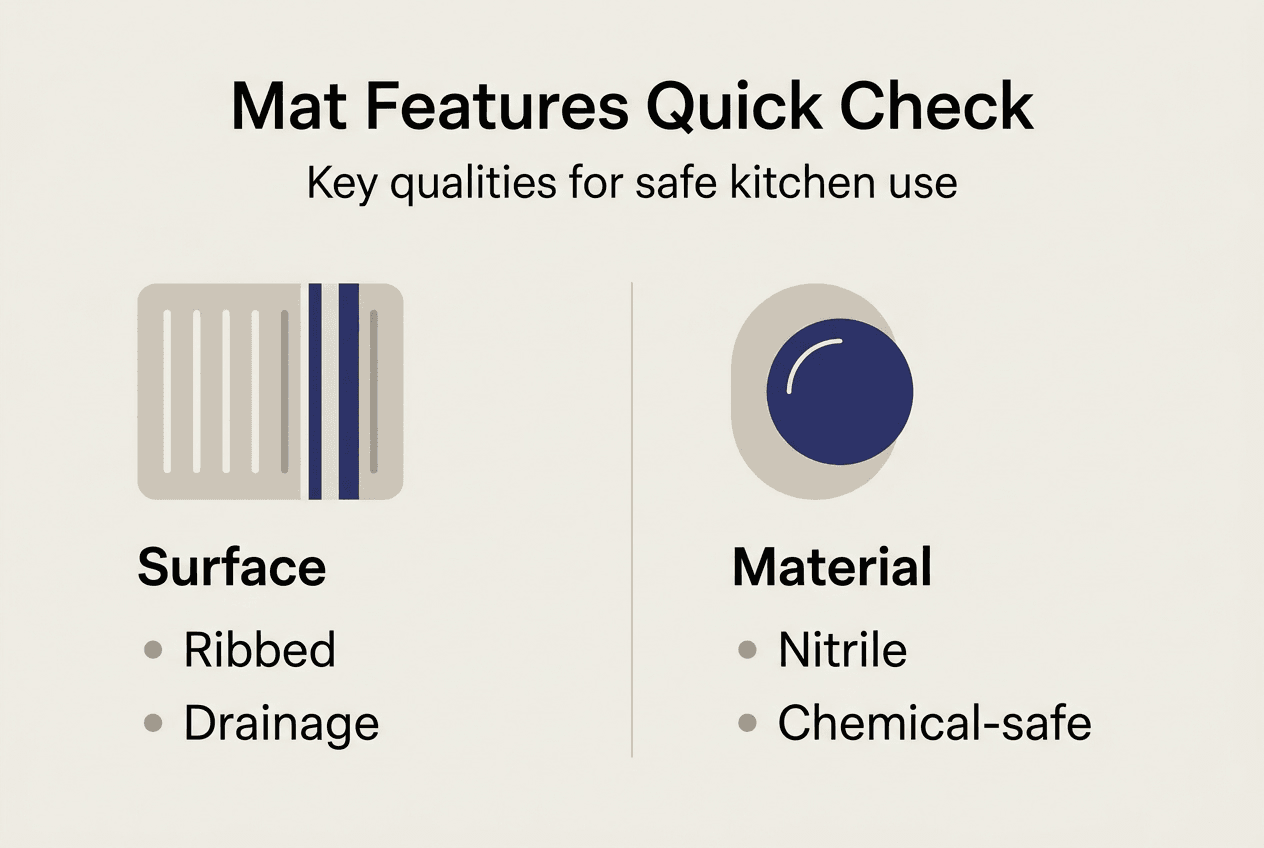
Surface design directly impacts traction performance. Ribbed patterns create multiple contact points between footwear and mat, increasing grip through mechanical interlocking. The ribbed surface design provides slip resistance by channeling liquids away from the primary walking surface while maintaining texture that engages shoe treads. Smooth mat surfaces cannot deliver equivalent safety regardless of material composition.
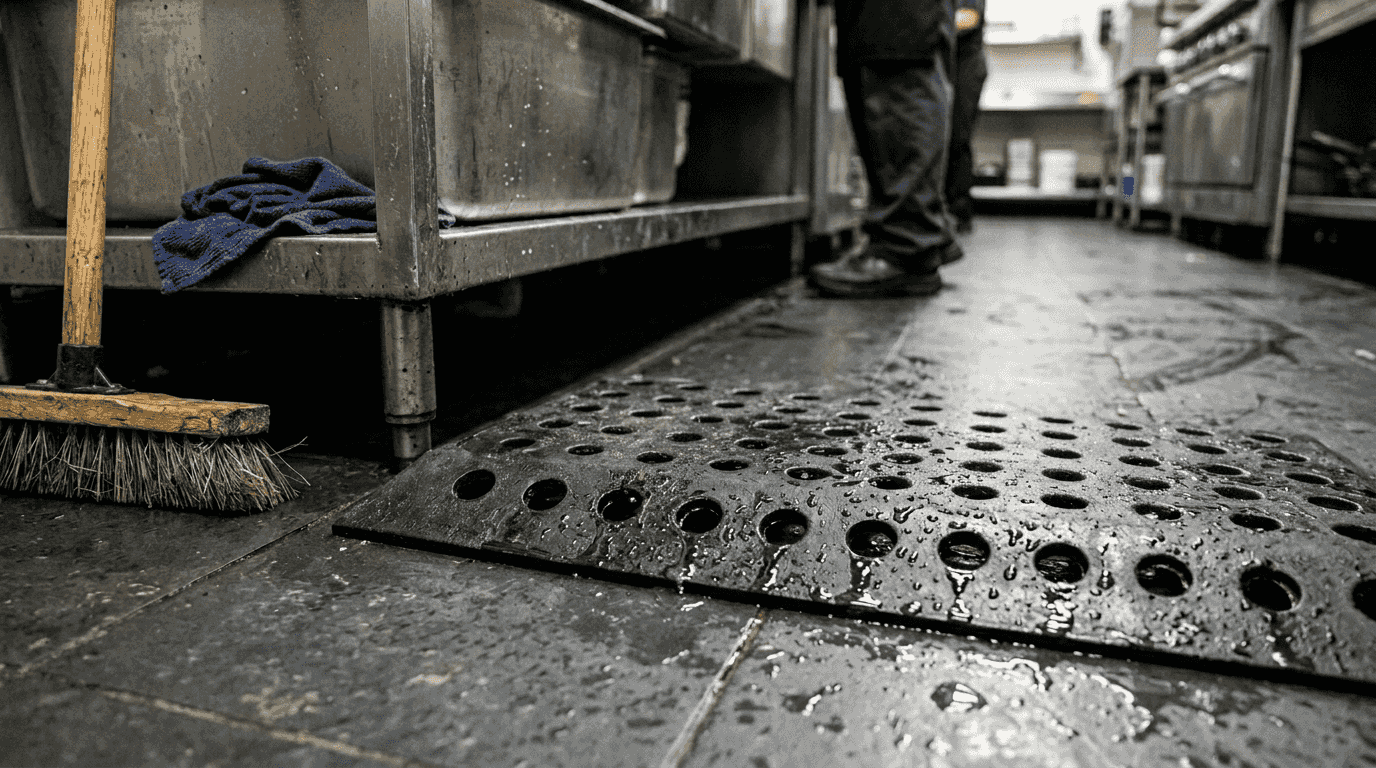
Drainage holes serve a critical function in wet environments. When liquids pool on mat surfaces, they create hydroplaning conditions where shoes lose contact with the textured material. Drainage holes allow liquids to pass through, keeping surfaces dry and minimizing slip risks. The holes also reduce standing water that would otherwise require constant mopping, saving labor while maintaining safer conditions throughout busy service periods.
Material composition determines chemical resistance and longevity. Nitrile rubber resists oil, grease, and chemicals far better than natural rubber or vinyl alternatives. The synthetic formulation maintains structural integrity when exposed to petroleum products, harsh detergents, and acidic food substances. This resistance prevents the degradation that causes mats to become brittle, crack, or lose their slip resistant properties prematurely.
Anti-microbial treatments address hygiene concerns inherent to food service operations. Certified anti-microbial protection actively controls bacterial and fungal growth on mat surfaces. The treatment inhibits microorganism reproduction without requiring constant chemical application. In environments where food safety regulations demand rigorous sanitation, anti-microbial mats provide an additional defense layer that complements your existing cleaning protocols.
Ease of cleaning impacts both hygiene and operational efficiency. Mats designed for industrial washing withstand high pressure spray, hot water, and concentrated cleaning solutions. You can remove them for deep cleaning without worrying about damage or dimensional changes. This durability ensures mats return to service quickly while meeting health department standards for equipment sanitization.
Pro Tip: Choose mats with beveled edges to reduce tripping hazards and facilitate cart movement. The gradual transition from floor to mat surface prevents wheels from catching and minimizes the edge as a potential stumbling point for staff carrying heavy loads.
Essential mat features for commercial kitchens:
- Textured surface with ribs or raised patterns for mechanical grip
- Drainage perforations sized to prevent shoe heel entrapment
- 100% nitrile rubber construction for maximum chemical resistance
- Certified anti-microbial coating meeting food service standards
- Industrial grade construction supporting repeated power washing
- Beveled edges on all four sides for seamless floor integration
| Feature | Performance Benefit | Maintenance Impact |
|---|---|---|
| Ribbed surface | Increases traction in wet conditions | Channels debris for easier sweeping |
| Drainage holes | Prevents liquid pooling and hydroplaning | Reduces required mopping frequency |
| Nitrile rubber | Resists degradation from oils and chemicals | Extends replacement cycle significantly |
| Anti-microbial treatment | Inhibits bacterial and fungal growth | Maintains hygiene between deep cleans |
Installing and maintaining your non slip waterproof kitchen mats
Proper mat placement maximizes safety coverage while minimizing gaps where hazards could occur. Position mats in all areas where water, grease, or food particles regularly contact the floor. Dishwashing stations, prep areas, cooking lines, and beverage stations represent primary zones requiring protection. Measure these spaces carefully to ensure complete coverage without creating tripping hazards from overlapping edges or exposed floor strips between mats.
Optional connectors securely link multiple mats for seamless coverage in larger workspaces. The connection system prevents individual mats from shifting apart during use, eliminating gaps that expose bare floor. Connected mats also resist edge curling, a common problem that creates tripping hazards and reduces effective slip resistance. When installing mats in expansive kitchen areas, plan your layout to utilize connectors strategically for both safety and aesthetic continuity.
Regular cleaning removes grease accumulation that would otherwise compromise slip resistance. Even the best textured surfaces lose traction when coated with oil film. Establish a cleaning schedule based on your kitchen’s volume and food types. High volume operations producing fried foods need daily mat cleaning, while lower volume facilities might maintain effectiveness with every other day protocols. Use hot water and degreasing detergents formulated for food service equipment.
Inspection routines identify wear before it compromises safety. Check mats weekly for surface smoothing, edge damage, or loss of drainage hole integrity. Run your hand across the surface to feel for texture degradation. Examine edges for curling or separation from connectors. Look underneath for material breakdown or permanent deformation. When slip resistance noticeably decreases or structural damage appears, replace the mat immediately rather than risking injury.
Comfort features require consideration during installation. Anti-fatigue mats work best when positioned where staff stand for extended periods rather than high traffic walkways. Place cushioned mats at prep stations, cooking positions, and dishwashing areas where workers maintain relatively stationary positions. Use firmer slip resistant mats in pathways where staff move quickly between stations. This strategic placement optimizes both safety and ergonomic benefits.
Pro Tip: Create a mat maintenance log tracking cleaning dates, inspection findings, and replacement schedules. Documentation helps you identify patterns in mat wear, optimize cleaning frequency, and demonstrate safety compliance during health inspections or insurance audits.
Mat installation and maintenance steps:
- Measure all wet areas and high traffic zones requiring coverage
- Select appropriate mat sizes with connectors for spaces exceeding single mat dimensions
- Clean and dry the floor thoroughly before initial mat placement
- Position mats with beveled edges aligned to traffic flow patterns
- Connect multiple mats using manufacturer supplied hardware
- Establish daily or every other day cleaning schedules based on kitchen volume
- Conduct weekly inspections documenting surface condition and structural integrity
- Replace mats when texture smoothing or material damage becomes evident
Maintaining your kitchen slip mat installation requires consistent attention but delivers substantial returns through reduced accidents and extended mat lifespan. The time invested in proper care pays dividends in worker safety and operational cost control. When you install kitchen non skid mats correctly and maintain them diligently, you create a safer work environment while maximizing your equipment investment.
Explore top rated mats for safer commercial kitchens
Mats4U offers premium solutions engineered specifically for commercial kitchen demands. Our products combine the slip resistance, waterproofing, and durability features discussed throughout this guide. The Comfort Premier anti-fatigue mat delivers exceptional cushioning for staff working extended shifts at prep stations and cooking lines. Its construction withstands the chemical exposure and moisture inherent to food service while providing ergonomic support that reduces fatigue.
For areas with heavy liquid exposure, the Comfort Flow anti-fatigue drainage mat features integrated drainage holes that channel water and oils away from walking surfaces. The design maintains slip resistance even during peak service periods when floors would otherwise become treacherous. Both products utilize materials that resist degradation from grease, cleaning chemicals, and constant moisture exposure.
Customization options allow you to reinforce brand identity while enhancing safety. Our Premium HD printed custom floor mats incorporate your logo and branding elements without compromising slip resistant properties. These mats make professional impressions in customer visible areas while delivering the protection your staff requires. Explore our complete kitchen mat selection to find solutions matching your facility’s specific needs and operational demands.
FAQ
What materials make the best non slip waterproof kitchen mats?
Nitrile rubber stands out as the optimal material because it resists oil, grease, and chemicals while maintaining waterproof integrity. This synthetic compound outperforms natural rubber and vinyl in commercial kitchen conditions. The material provides durability and slip resistance suitable for high traffic food service environments where chemical exposure occurs daily.
How often should kitchen mats be cleaned and replaced?
Clean mats daily in commercial kitchens to remove grease buildup and food contaminants that compromise traction. The mat design supports easy cleaning and industrial washing, ensuring long lasting performance in demanding environments. Replace mats when surface texture shows noticeable wear or slip resistance declines, typically annually or sooner depending on usage intensity and proper maintenance practices.
What certifications ensure a mat is slip resistant?
ASTM F1677 provides standardized methodology with the PIAST device for measuring surface friction in controlled, repeatable conditions. ASTM D2047 establishes compliance criteria for slip resistance labeling based on static coefficient of friction testing. Mats meeting these standards deliver industry accepted safety thresholds for commercial kitchen applications.
Do anti-microbial mats really prevent bacteria growth?
Certified anti-microbial treatments actively inhibit bacterial and fungal reproduction on mat surfaces, providing an additional hygiene layer beyond routine cleaning. The protection works continuously without requiring chemical reapplication. While not replacing proper sanitation protocols, anti-microbial mats reduce microorganism populations between cleanings, supporting food safety compliance in commercial kitchens.
Can I connect multiple mats for larger kitchen areas?
Yes, connector systems allow you to securely link individual mats into seamless coverage for expansive workspaces. Connected mats prevent shifting that creates dangerous gaps and resist edge curling that causes tripping hazards. This modular approach provides flexibility to configure mat layouts matching your specific kitchen dimensions while maintaining continuous slip resistant protection across the entire floor area.


