


Slippery pool decks and worn-out mats cause more headaches for facility managers than many realize. For hospitality properties across the United States, keeping outdoor pool areas both safe and attractive is a daily concern. Critical safety infrastructure like specialized pool matting can make the difference between welcoming guests confidently and facing costly slip-and-fall incidents. Discover how the right pool matting choices directly support guest safety, regulatory compliance, and your facility’s visual appeal.
Table of Contents
- Outdoor Pool Matting Defined and Debunked
- Comparing Types of Pool Matting Solutions
- Non-Slip Features and Material Innovations
- Selecting Matting for High-Traffic Pool Areas
- Managing Lifespan, Cost, and Maintenance
Key Takeaways
| Point | Details |
|---|---|
| Importance of Outdoor Pool Matting | Outdoor pool matting is essential for guest safety, reducing slip hazards, and protecting against liability. It offers slip-resistant surfaces and meets safety codes. |
| Different Types of Matting | Choosing the right matting—rubber, foam-backed, anti-fatigue, or drainage mats—depends on specific conditions like traffic volume and exposure to chemicals. |
| Maintenance is Key | Scheduled maintenance and inspections are crucial for prolonging mat lifespan and ensuring safety compliance, with regular checks for wear and drainage issues. |
| Innovations in Non-Slip Technology | Advances in material technology enhance the non-slip capabilities of mats, ensuring better grip even under wet conditions, which is vital for preventing accidents. |
Outdoor Pool Matting Defined and Debunked
Outdoor pool matting is more than decorative edging around your facility’s water features. It’s a critical safety infrastructure that protects guests, reduces liability, and enhances the aesthetic appeal of your hospitality property.
Here’s what outdoor pool matting actually does:
- Provides slip-resistant surfaces for wet feet and bare skin
- Drains water quickly to prevent dangerous pooling and slipping hazards
- Reduces fatigue for staff standing in high-traffic areas
- Adds visual appeal and brand consistency to pool decks
- Meets or exceeds local safety codes and building standards
Most facility managers confuse outdoor pool matting with basic rubber flooring or decorative pavers. They’re not the same thing. Your pool mat needs to be engineered specifically for the unique demands of wet environments with constant foot traffic.
The misconception runs deeper. Many assume any mat rated for “outdoor use” works for pools. Not true. Pool matting faces extreme conditions: chlorinated water exposure, UV radiation, temperature fluctuations, and the constant shock of barefoot traffic. Generic outdoor mats fail within months.
Another common myth: pool matting is a luxury add-on. Actually, it’s a necessity. Pool deck safety features are outlined in construction codes to prevent slip-and-fall incidents, which represent a major liability risk for hospitality properties.
Proper pool matting components include:
- A water-draining base layer that prevents standing liquid
- A textured surface for grip and traction even when wet
- Chemical-resistant materials that withstand chlorine exposure
- UV-stabilized construction to resist sun damage
- Beveled or rounded edges to prevent tripping hazards
You’ve probably seen mats that absorb water instead of draining it. Those create puddles, promote mold growth, and become slip hazards themselves. The right material solution actively moves water away from the surface.
Different pool areas need different mat solutions. Your entrance area faces different demands than your deep-end deck. Selecting appropriate outdoor mat materials based on traffic volume, sun exposure, and chemical contact ensures your investment lasts.
You’ll also notice some facilities rely on textured concrete or painted deck coatings alone. These crack, fade, and become hazardous as they age. A quality pool mat provides a protective barrier that absorbs impact, extends concrete lifespan, and can be replaced affordably when needed.
Quality pool matting isn’t an afterthought—it’s the foundation of guest safety and your facility’s legal protection.
Pro tip: Inspect your current pool matting quarterly for drainage issues, surface wear, and edge deterioration, replacing compromised sections immediately to maintain safety compliance and prevent costly liability claims.
Comparing Types of Pool Matting Solutions
Not all pool mats perform the same way. Your facility’s specific needs—traffic volume, climate, chemical exposure—determine which matting type delivers the best safety and longevity.
The main pool matting categories are rubber mats, foam-backed mats, anti-fatigue mats, and specialized drainage mats. Each addresses different operational challenges.
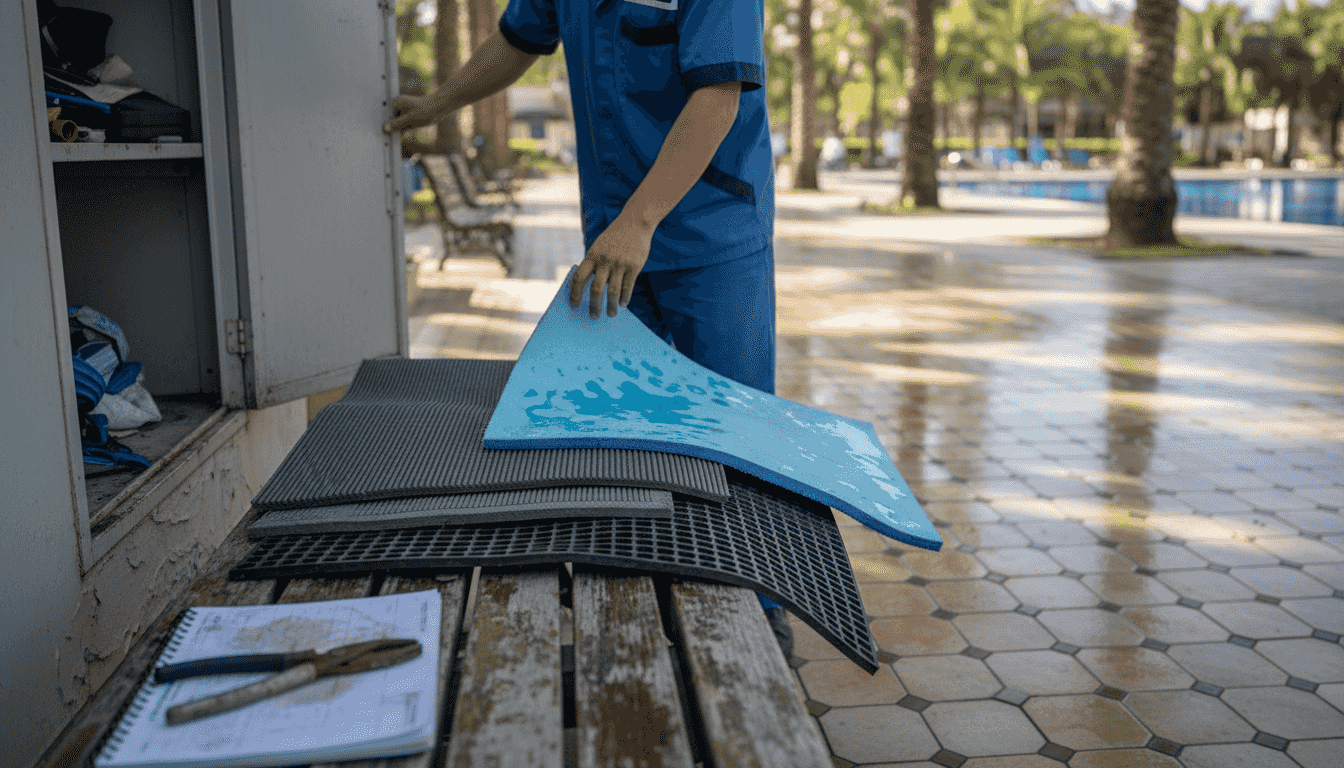
Rubber Mats are the workhorses of pool decking. These mats resist chlorine, UV radiation, and constant moisture exposure better than most alternatives. They provide excellent grip even when saturated, which is critical around water features.
Rubber mats excel in:
- High-traffic areas with barefoot traffic
- Chlorinated pool environments
- Outdoor exposure to direct sunlight
- Budget-conscious operations needing durability
Foam-Backed Mats offer comfort advantages. They reduce foot fatigue for staff working long shifts on hard concrete. The cushioning absorbs impact, which matters when your team stands poolside for hours.
However, foam-backed options face limitations. They absorb water instead of draining it, creating puddle zones and mold risks. Some hospitality facilities use them in staff-only areas rather than guest spaces.
Anti-Fatigue Mats specifically target employee comfort in high-pressure environments. These mats encourage subtle muscle movement, reducing strain during extended standing periods. Your lifeguards and attendants notice the difference immediately.
The tradeoff: anti-fatigue mats require more frequent maintenance and replacement than pure rubber solutions. They’re an investment in staff wellness, not just guest safety.
Drainage Mats represent the latest evolution in pool matting technology. These mats feature engineered gaps, channels, or mesh backing that actively moves water away from the surface. Understanding how material layers interact helps explain why drainage-optimized mats prevent water pooling better than solid rubber alternatives.
Drainage mats prevent:
- Standing water and slip hazards
- Mold and mildew growth
- Algae development on mat surfaces
- Accelerated mat deterioration from continuous water contact
For hospitality operations, drainage mats represent the premium choice. Yes, they cost more initially, but they last longer and maintain safety compliance more consistently.
Your matting choice directly impacts guest experience, staff safety, and liability exposure—it’s not just a flooring decision.
Compare your options side-by-side. Consider traffic patterns in each pool area. Your entrance mat needs different performance specs than your deep-end deck. Anti-slip pool matting requirements differ based on usage patterns and guest demographics.
Most facility managers benefit from mixing mat types strategically. Place drainage mats in high-water areas, anti-fatigue mats in staff work zones, and standard rubber mats in moderate-traffic guest areas.
Here’s a side-by-side comparison of major pool matting solutions for hospitality facilities:
| Mat Type | Best For | Typical Weakness | Lifespan in High-Traffic |
|---|---|---|---|
| Rubber Mats | Guest walkways | Limited comfort for staff | 18-36 months |
| Foam-Backed Mats | Staff-only work areas | Absorb water, mold risk | 12-24 months |
| Anti-Fatigue Mats | Lifeguard stations | Needs frequent replacement | 12-20 months |
| Drainage Mats | Wet, high-traffic zones | Higher upfront cost | 30-48 months |
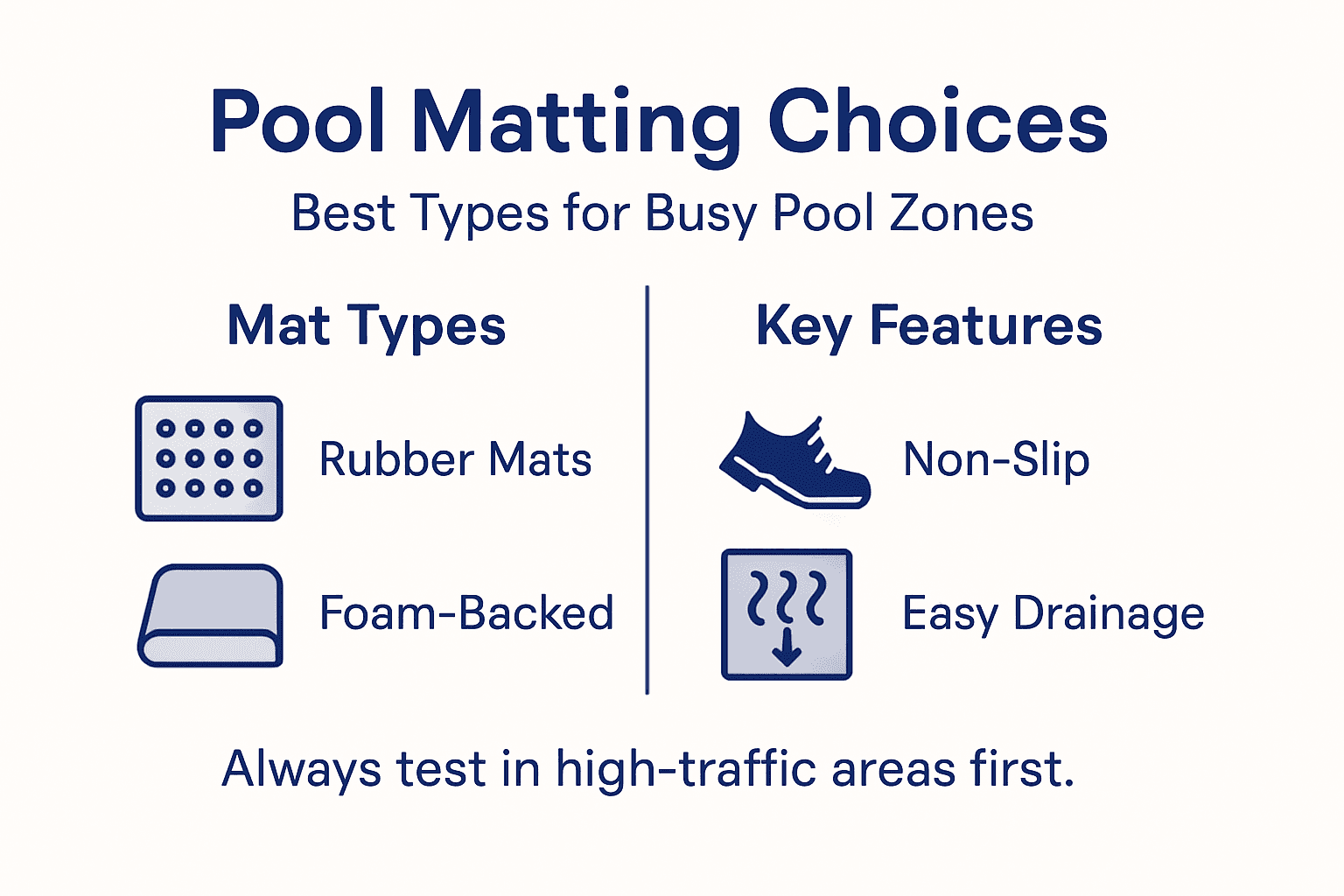
Pro tip: Request material samples from suppliers and conduct a 30-day field test in your highest-traffic zones before committing to facility-wide installation, ensuring the matting performs under your specific climate and chemical conditions.
Non-Slip Features and Material Innovations
The non-slip surface is where pool matting safety lives or dies. A mat with poor grip properties becomes a liability risk regardless of its durability or drainage capabilities.
Traditional non-slip pool mats use textured rubber surfaces or embossed patterns to create friction. These work reasonably well when dry, but their effectiveness diminishes underwater or in extreme saturation. Bare feet on waterlogged surfaces slide dangerously.
Modern pool mats employ several advanced approaches:
- Micro-textured surfaces that maintain grip when submerged
- Raised dimple patterns that create water channels and traction points
- Composite rubber blends with enhanced coefficient of friction
- Treated top layers that resist algae while preserving slip resistance
The challenge facility managers face: standard non-slip coatings degrade under constant chlorine exposure and UV radiation. Mats installed in spring lose effectiveness by mid-summer. That’s why research into advanced water-repellent surface coatings matters for your facility. These innovations maintain safety properties across seasons.
Newer material science addresses this gap. Scientists are developing biomaterials that actually strengthen when wet, reversing the traditional weakness of rubber and foam under moisture exposure. Imagine matting that becomes safer as water contact increases rather than deteriorating.
This represents a fundamental shift from reactive maintenance to proactive performance. Your current mats probably need replacement when they fail. Next-generation materials maintain or improve grip under the exact conditions that destroy conventional solutions.
Non-slip innovations include:
- Silicone-enhanced rubber that resists degradation from chlorine and heat
- Antimicrobial surface treatments that prevent slippery algae and mold growth
- Engineered tread patterns that channel water away while providing grip points
- UV-stabilized top layers that don’t fade or lose texture under sunlight
For your hospitality operation, non-slip poolside matting represents your best defense against slip-and-fall litigation. The coefficient of friction must meet industry standards—typically 0.50 or higher for wet conditions.
Test surfaces regularly. A mat that meets standards on installation day might drop below safety thresholds after six months of chemical exposure. Monthly grip testing catches this decline before it creates guest injuries.
Non-slip surfaces are active protection, not passive barriers—they require monitoring and replacement on schedule.
The investment in quality non-slip technology pays dividends through reduced incidents, lower insurance claims, and extended mat lifespan. Budget for replacement cycles rather than hoping mats last indefinitely.
Pro tip: Conduct quarterly slip-resistance testing using a weighted sled or tribometer device, documenting results to demonstrate due diligence and identify when mat replacement becomes necessary for safety compliance.
Selecting Matting for High-Traffic Pool Areas
High-traffic zones demand different matting strategies than moderate-use areas. Your entrance, lifeguard station, and pool deck perimeter experience constant foot traffic that quickly wears standard mats into safety hazards.
Identify your traffic patterns first. Count peak-hour foot traffic volume. Map where guests concentrate. This baseline data drives your material selection process.
High-traffic zones typically include:
- Main pool entry and exit points
- Lifeguard stations and observation areas
- Restroom pathways connecting to the pool deck
- Shallow-end teaching areas where instructors stand constantly
- Concession or beverage service areas
These locations need reinforced rubber mats rather than standard alternatives. The extra thickness and density resist foot traffic compression and surface degradation. Thinner mats compress, lose grip properties, and require frequent replacement.
Material selection matters tremendously. Materials must resist continuous water exposure and foot traffic wear without losing safety or functionality. Generic outdoor mats fail because they weren’t engineered for pool environments.
Consider anti-fatigue properties for staff work zones. Your lifeguards and instructors stand for extended shifts. Standard rubber creates foot fatigue and reduces alertness. Anti-fatigue matting improves circulation, reduces strain, and keeps staff more responsive to guest needs.
Drainage capability becomes critical in high-traffic areas. Foot traffic concentrates water around popular zones, creating temporary lakes. If your mat doesn’t drain effectively, standing water accumulates, creating slipping hazards and mold growth.
Thickness is a direct investment in longevity. A mat that’s 1/2 inch thick might last one season in high-traffic areas. A 3/4-inch mat lasts significantly longer under the same conditions. The cost difference is modest compared to replacement labor and downtime.
Selection criteria for high-traffic pools:
- Minimum 3/4-inch thickness for areas with continuous foot traffic
- Textured or embossed surfaces maintaining grip under wet conditions
- Reinforced edges that resist curling and tripping hazards
- Chemical-resistant composition suitable for chlorinated environments
- Quick-draining backing preventing water accumulation
Selecting appropriate mats for high-traffic environments requires evaluating both material properties and installation methods. Professional installation ensures proper seating, prevents shifting, and maximizes mat lifespan.
Budget for strategic replacement. Your entrance mat will need replacement before your lounging area does. Plan accordingly rather than attempting facility-wide replacement all at once.
High-traffic matting isn’t a one-size-fits-all decision—each zone requires assessment and targeted solutions.
Consider future expansion when selecting mats. Will your facility add pool features? Will traffic patterns shift? Choose modular systems allowing future adjustments without complete reinstallation.
Pro tip: Install high-traffic mats slightly raised with beveled edges to create clear visual boundaries for guests, improving safety awareness while preventing tripping hazards from mat seams.
Managing Lifespan, Cost, and Maintenance
Pool matting isn’t a set-it-and-forget-it investment. Like any facility component, it requires scheduled maintenance, strategic budgeting, and lifecycle planning to deliver consistent ROI and safety.
Most facility managers underestimate total cost of ownership. They see the upfront price and assume that’s the investment. Actually, maintenance labor, replacement cycles, and downtime costs often exceed the initial purchase price over five years.
Total cost factors include:
- Initial purchase and professional installation
- Daily cleaning and drainage maintenance
- Quarterly inspections and minor repairs
- Planned replacement of worn sections
- Complete mat replacement when degradation becomes unsafe
Plan for realistic lifespan expectations. A quality rubber mat in moderate-traffic areas lasts three to five years before replacement becomes necessary. High-traffic zones require replacement every 18 to 30 months. Budget accordingly rather than waiting for failure.
Proper operation and maintenance planning extends lifespan and reduces costs through scheduled inspections and preventive care. Don’t wait for visible damage to address maintenance.
Develop a preventive maintenance schedule. Inspect mats weekly for drainage issues, surface wear, and edge damage. Clean daily with appropriate chemicals that won’t degrade the mat material. Document findings in a maintenance log.
Chlorine exposure and UV damage accelerate degradation. Protect mats during off-season by covering them or storing them indoors if removable. This simple step can add 12 to 18 months to mat lifespan.
Water drainage maintenance is critical. If your drainage mats clog with debris or algae, they perform like solid mats, creating standing water hazards. Clean drainage channels monthly using non-chemical methods when possible.
Maintenance tasks for pool matting:
- Daily visual inspection for debris and damage
- Weekly cleaning with pH-neutral detergents
- Monthly deep cleaning and drainage verification
- Quarterly grip testing and slip-resistance evaluation
- Semi-annual professional inspection and repairs
- Annual assessment of replacement needs
Budget for strategic replacement rather than full facility updates. Replace entrance mats first, then high-traffic zones, then moderate-use areas. Staggered replacement spreads costs across multiple years and maintains facility aesthetics.
Capital planning helps. Reserve 15-20% of your initial mat investment annually for maintenance and replacement. Over five years, this reserve covers both routine maintenance and periodic replacement without emergency budget requests.
Smart facilities treat mat maintenance as preventive investment, not unexpected expense.
Track expenses carefully. Document spending on cleaning supplies, labor hours, repairs, and replacements. This data supports future budget requests and identifies cost-saving opportunities.
Use this quick reference to streamline pool mat maintenance planning:
| Task | Frequency | Goal |
|---|---|---|
| Visual inspection | Daily | Detect debris or damage |
| Deep cleaning | Monthly | Prevent mold/algae buildup |
| Grip testing | Quarterly | Ensure slip resistance |
| Professional repairs | Semi-annually | Fix surface and edges |
| Full mat assessment | Annually | Schedule replacements |
Pro tip: Create a master maintenance calendar scheduling all pool mat tasks—inspections, cleaning, testing, and replacements—using facility management software to track compliance and automate renewal reminders.
Enhance Pool Safety and Style with Expert Mat Solutions
Outdoor pool matting plays a vital role in preventing slips, managing water drainage, and ensuring guest and staff safety. The challenge many facility managers face is selecting mats that withstand chlorinated water, heavy traffic, and UV exposure while offering non-slip surfaces and durability. At Mats4U.com you can find premium options like our Rubber Logo Mats designed for high-traffic wet environments and superior slip resistance that help reduce liability risks and extend the lifespan of your pool deck.
Don’t compromise on your pool matting needs. Explore the variety of mat types including our durable Waterhog Logo Mats that combine effective drainage with attractive design ideal for pool entrances and seating areas. Act now to ensure your facility meets safety and maintenance standards while elevating visual appeal. Visit Mats4U.com to browse our collection and invest confidently in the long-lasting protection your outdoor pool requires.
Frequently Asked Questions
What are the primary benefits of outdoor pool matting?
Outdoor pool matting provides slip-resistant surfaces, drains water quickly to prevent pooling, reduces fatigue for staff, enhances aesthetic appeal, and meets safety codes and standards.
How does outdoor pool matting differ from regular outdoor mats?
Outdoor pool matting is specifically engineered for wet environments, unlike regular outdoor mats that may deteriorate quickly under chlorine exposure and constant moisture. Pool mats are designed to handle high foot traffic and adverse weather conditions.
What types of matting are best for high-traffic pool areas?
Reinforced rubber mats are ideal for high-traffic pool areas as they resist wear and provide good traction, while drainage mats are essential to prevent water pooling and slip hazards in extremely wet zones.
How can I maintain my pool matting to ensure safety and longevity?
Regular maintenance includes daily visual inspections, weekly cleaning with appropriate detergents, monthly deep cleaning, quarterly grip testing, and annual assessments to schedule replacements as necessary.


