


TL;DR:
- Outdoor and indoor mats are designed with different materials and surface features for specific conditions.
- Proper three-zone mat systems greatly reduce dirt, moisture, and slip hazards in high-traffic areas.
- Regular maintenance and correct material matching extend mat lifespan and improve facility safety.
Mats are not interchangeable. That assumption costs facilities real money every year in slip incidents, accelerated floor wear, and cleaning labor that should not be necessary. Outdoor and indoor mats are engineered for entirely different conditions, and placing the wrong type in the wrong zone creates safety gaps that no amount of cleaning can fix. This guide breaks down the core differences, the performance factors that matter most in high-traffic commercial environments, and a practical framework for selecting, placing, and maintaining mats that protect your employees, visitors, and floors.
Table of Contents
- Key differences between outdoor and indoor mats
- Performance and safety considerations for high-traffic areas
- How to design effective matting systems: Placement and material choices
- Maintenance and replacement: Maximizing mat lifespan
- Our take: Why material matching and layout strategy matter more than price
- Get the right mats for every zone in your facility
- Frequently asked questions
Key Takeaways
| Point | Details |
|---|---|
| Know the difference | Outdoor and indoor mats are engineered for distinct roles and environments, so each is critical at specific entry points. |
| Safety comes first | Choose certified, high-traction mats to minimize slip hazards and comply with safety standards in busy facilities. |
| Zone matting works best | A strategic multi-mat setup traps most dirt and moisture, safeguarding both people and property. |
| Maintain for longevity | Regular cleaning, inspections, and timely replacement are essential for reliable performance and maximum value. |
Key differences between outdoor and indoor mats
Now that you know why a one-size-fits-all approach fails, let’s clarify exactly how outdoor and indoor mats differ.
The distinction starts with materials. Outdoor mats use durable, weather-resistant materials like rubber, PVC, and coir that can handle rain, UV exposure, freezing temperatures, and heavy foot traffic without breaking down. Indoor mats, by contrast, are built from nylon or microfiber to trap fine dirt particles and absorb residual moisture that outdoor mats cannot catch.
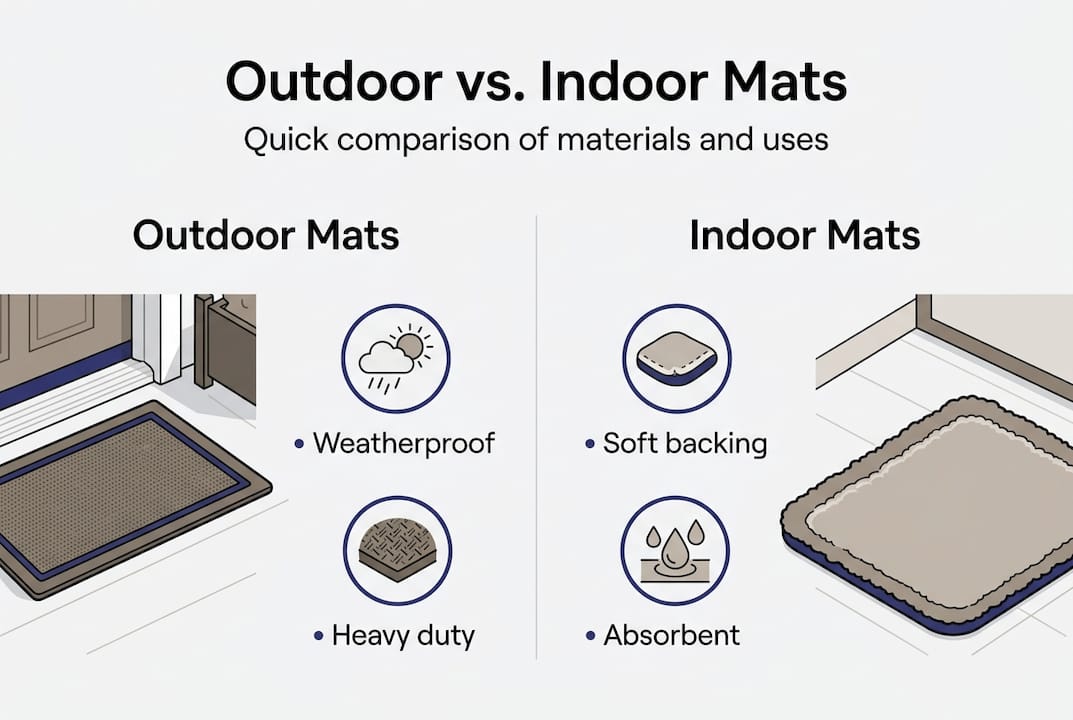
Design differences are just as significant. Outdoor mats feature raised scraping surfaces, aggressive tread patterns, and open-grid construction so debris falls through rather than accumulating on top. Indoor mats use a plush pile or loop construction that grabs fine particulate and pulls moisture away from shoe soles. Outdoor mats prioritize scraping and slip resistance; indoor mats focus on moisture and allergen capture.
A common and costly misconception: using an outdoor mat indoors can scratch and gouge hard floor surfaces because of its rigid rubber or coir backing. Using an indoor mat outdoors exposes it to conditions it was never designed for, causing rapid fiber breakdown, mold growth, and loss of slip resistance. Neither scenario is a minor inconvenience. Both create real liability.
Comparison: Outdoor vs. indoor mat features
| Feature | Outdoor mat | Indoor mat |
|---|---|---|
| Primary material | Rubber, PVC, coir | Nylon, microfiber, polypropylene |
| Surface design | Raised scraper, open grid | Plush pile, loop |
| Main function | Debris scraping, moisture shedding | Fine dirt capture, moisture absorption |
| Backing type | Heavy rubber or PVC | Rubber nitrile or vinyl |
| UV/weather resistance | High | Low |
| Best placement | Thresholds, exterior entries | Lobbies, corridors, reception areas |
Key functional differences at a glance:
- Outdoor mats shed water; indoor mats absorb it
- Outdoor mats scrape coarse grit; indoor mats trap fine dust and allergens
- Outdoor mats resist UV degradation; indoor mats are not built for sun exposure
- Indoor mats protect finished floors; outdoor mats can damage them if misused
For a deeper look at how these categories work together at building entries, the walk off mats guide covers system-level planning in detail.
Performance and safety considerations for high-traffic areas
Understanding foundational differences is only half the battle; real-world performance and safety considerations matter most in bustling facilities.
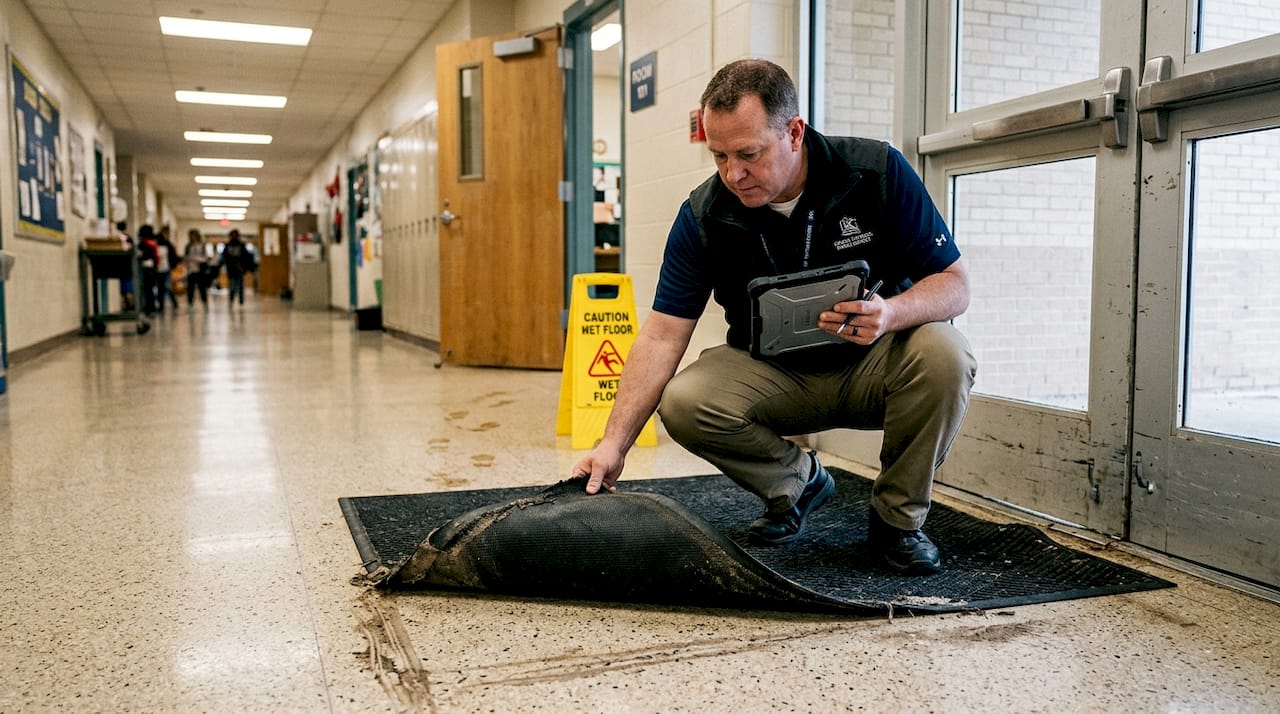
Slip resistance is the first priority at any commercial entrance. Wet conditions at thresholds are responsible for a significant share of workplace slip-and-fall incidents, and the mat you place at that point is your first line of defense. NFSI-certified mats provide verified high-traction performance in wet conditions and are the standard for outdoor and transitional zones where moisture is constant.
Backing material matters as much as surface construction. Rubber and nitrile backings grip floor surfaces firmly and resist curling, which is a common cause of trip hazards in high-traffic corridors. A mat that shifts or bunches under foot traffic creates a hazard that the mat was supposed to prevent.
Layout strategy is where many facilities lose ground. A single mat at the door is rarely enough. A properly sequenced matting layout moves dirt and moisture through three distinct zones:
- Zone 1 (outdoor scraper): Removes coarse grit, sand, and bulk moisture before anyone steps inside
- Zone 2 (scraper/wiper transition): Handles remaining soil and secondary moisture at the threshold
- Zone 3 (indoor wiper): Captures fine particulate and absorbs residual moisture in the lobby or corridor
Three-zone matting can intercept up to 85-90% of tracked dirt when properly configured, dramatically reducing cleaning frequency and floor surface wear.
Pro Tip: Always evaluate mat backings before purchasing for wet zones. Rubber and nitrile are the most reliable options for preventing mat movement and reducing slip liability in areas exposed to rain or snowmelt.
For practical guidance on configuring entries for maximum protection, review these entrance matting solutions and strategies for designing for high-traffic zones.
How to design effective matting systems: Placement and material choices
Performance is maximized only when mats are used in strategic combinations. Here’s how to set up an effective system.
A well-designed matting system is not a single product decision. It is a zone-by-zone plan that matches material properties to the specific conditions at each point in your facility’s entry path. Optimal systems use a three-zone approach with over 15 feet of total mat coverage to capture the majority of tracked-in dirt before it reaches interior floors.
Steps to design your matting system:
- Assess your entrances. Count entry points, measure traffic volume, and note weather exposure. A covered canopy entry has different needs than an open threshold facing a parking lot.
- Select your zones. Identify where Zone 1, Zone 2, and Zone 3 mats will be placed based on your floor plan and entry dimensions.
- Match material to zone. Outdoor zones need rubber or TPE (thermoplastic elastomer) for weather resistance. Transition zones benefit from scraper/wiper combination mats. Nylon excels for high-traffic indoor areas where fine dirt and moisture capture are the priority.
- Measure for adequate length. Each zone should cover enough linear footage to allow multiple steps. Short mats are consistently outperformed by longer ones because more steps equal more dirt removal.
Matting system zone reference
| Zone | Placement | Recommended material | Primary function |
|---|---|---|---|
| Zone 1 | Outdoor threshold | Rubber, PVC, coir | Coarse debris scraping, moisture shedding |
| Zone 2 | Entry transition | Scraper/wiper combination | Secondary soil and moisture removal |
| Zone 3 | Indoor lobby/corridor | Nylon, microfiber | Fine particle capture, residual moisture absorption |
For additional guidance on spacing and configuration, the mat layout strategies resource covers placement options for a range of facility types.
Maintenance and replacement: Maximizing mat lifespan
Great design only pays off with regular upkeep. Here’s how to keep mats working their best.
Outdoor mats face the harshest conditions. They collect coarse debris, absorb rain, and endure UV exposure across seasons. Outdoor mats need aggressive cleaning and regular mold and UV inspections; indoor mats require frequent vacuuming and periodic deep extraction to maintain performance. Skipping these steps does not just shorten mat life. It reduces their ability to capture dirt and moisture, which defeats the purpose of having them.
Maintenance priorities by mat type:
- Outdoor mats: Rinse weekly to clear trapped grit, inspect monthly for mold or mildew in the backing, check for UV-related cracking or fiber degradation quarterly
- Indoor mats: Vacuum daily in high-traffic entries, deep clean with extraction equipment monthly or per manufacturer guidelines, check pile height and backing integrity quarterly
- All mats: Inspect for curled edges, worn surfaces, and backing separation at every cleaning cycle
High-traffic mats last 1-3 years with proper care, and quarterly inspections are the standard for facilities managing slip-and-fall liability. A mat that looks functional may have lost its slip resistance or moisture absorption capacity well before it shows visible wear.
Pro Tip: Document every inspection and cleaning cycle in a maintenance log. If a slip-and-fall incident occurs, that log is your primary defense against liability claims. It demonstrates that your facility followed a consistent safety protocol.
For structured maintenance schedules, see maintenance tips for facility managers and the when to replace mats guide. For specialty mat care products, protective mat care options are also worth reviewing.
Our take: Why material matching and layout strategy matter more than price
Here is a pattern we see consistently across commercial facilities: budget is spent on the lowest-cost mat available, and then significantly more budget is spent on floor refinishing, excess cleaning labor, and incident response. The initial savings evaporate fast.
The real cost of a poor mat decision is not the mat itself. It is the downstream exposure. A mismatched mat that fails to capture moisture creates wet floors. Wet floors create slip incidents. Slip incidents create liability, lost productivity, and potential legal costs that dwarf the price difference between a budget mat and the right mat.
Facilities that invest in material matching and proper zone layout consistently report lower cleaning costs and fewer safety incidents over a 12 to 24 month period. That is not a coincidence. It is the direct result of placing the correct product in the correct location.
The practical takeaway: spend time on smart mat layout tips before you spend money on products. A well-planned system with mid-range mats outperforms an expensive mat placed in the wrong zone every time.
Get the right mats for every zone in your facility
Ready to put these best practices to work? Here’s where to start.
Mats4U carries NFSI-certified and high-performance options built for commercial environments, from outdoor thresholds to interior walkways. The WaterHog Max Herringbone Mat is a top-rated choice for high-traffic entries, combining aggressive scraping with superior moisture retention. For branded interior spaces, custom logo mats deliver both function and professional appearance. Browse the full range of traditional mats for durable, straightforward solutions across all zones. Free delivery applies on orders over $100, and all products are Made in the USA.
Frequently asked questions
Can I use the same mat for both indoor and outdoor areas?
No. Using outdoor mats indoors can scratch floors; indoor mats lack the durability, scraping ability, and slip resistance required for outdoor conditions.
How often should commercial mats be replaced in high-traffic facilities?
Inspect mats at least quarterly and plan for replacement every 1 to 3 years. High-traffic mats last 1-3 years with consistent maintenance and regular inspections.
What’s the benefit of using a three-zone matting system?
A properly configured three-zone system can capture up to 85-90% of tracked dirt, reducing cleaning frequency and protecting interior floor surfaces from premature wear.
Are NFSI-certified mats necessary for all commercial entries?
NFSI certification is strongly recommended for any entry point exposed to wet conditions. These mats meet verified slip-resistance standards that protect both visitors and facility operators from liability.


