


TL;DR:
- Scraper mats are heavy-duty outdoor mats designed to remove coarse debris before interior entry.
- Proper three-zone system design enhances cleanliness, safety, and reduces cleaning costs significantly.
- Certifications like NFSI high-traction and ADA compliance are essential for safety and suitability.
Not all entrance mats perform the same function. Many facility managers assume any mat at the door will reduce tracked-in dirt and prevent slips, but that assumption leads to higher cleaning costs, accelerated floor damage, and real liability exposure. Scraper mats are a distinct category built specifically to remove heavy, coarse debris before it ever reaches your interior flooring. This guide covers exactly what scraper mats are, how they are constructed, where they fit in a commercial entrance system, and how to select and maintain them for maximum safety and long-term cost control.
Table of Contents
- What are scraper mats? Definition and core features
- How do scraper mats work? Materials and mechanics
- Where do scraper mats fit? The three-zone entrance system
- Safety, certifications, and selection tips for scraper mats
- The uncomfortable truth: Single mats can’t compete with strategic systems
- Trusted solutions for every facility: Discover your next scraper mat
- Frequently asked questions
Key Takeaways
| Point | Details |
|---|---|
| First-line dirt defense | Scraper mats mechanically remove heavy debris at entrances, protecting interior floors and reducing cleaning costs. |
| Material matters | Choose nitrile rubber for top durability and chemical resistance, especially in demanding commercial settings. |
| System beats single mat | A 3-zone matting system captures over twice as much dirt as a standalone mat for real-world results. |
| Safety certified is essential | Select NFSI-certified and ADA-compliant scraper mats to minimize slip-and-fall risks. |
What are scraper mats? Definition and core features
The first step is getting the definition right, because “entrance mat” is a broad term that covers very different products with very different jobs. A carpet wiper mat absorbs moisture. A scraper mat does something fundamentally different.
Scraper mats are heavy-duty entrance mats designed primarily to remove heavy dirt, mud, gravel, sand, and debris from footwear in high-traffic commercial areas. That mechanical removal function is the core distinction. Where a wiper or carpet-style mat relies on fiber absorption, a scraper mat uses physical surface geometry to break debris loose from shoe treads and pull it down below foot level.
This mechanical scraping action comes directly from the mat’s surface design. They feature aggressive surface textures such as molded cleats, raised bumps, circular patterns, or bi-level constructions that scrape dirt from shoe treads and trap it below foot level in recessed channels or dams. Those channels are not cosmetic. They hold captured debris so foot traffic does not grind it back into the sole on the next step.
You can find a more detailed breakdown of scraper mats explained in our full product guide if you want to compare specific surface patterns.
Key physical features common to commercial-grade scraper mats include:
- Aggressive surface texture: Cleats, raised bumps, rigid loops, or bi-level nubs that physically pull debris from shoe treads
- Recessed channels or dams: Grooves or troughs below the walking surface that trap and hold dirt, sand, gravel, and moisture
- Heavy rubber backing: Prevents shifting and curling on concrete, asphalt, or pavers at outdoor thresholds
- High load tolerance: Capable of handling heavy foot traffic, cart wheels, and in some cases light vehicle traffic without deforming
Scraper mats are not a replacement for wiper or absorbent mats inside the facility. They are the first line of defense. No interior mat performs well when it is overwhelmed by the volume of debris a scraper should have already removed.
Ideal placement for scraper mats includes outdoor entrance thresholds, loading bay entries, construction site access points, plant entrances where workers track in oil or metal particles, and any zone where foot traffic transitions from unpaved or contaminated outdoor surfaces to interior flooring. If the entry zone faces rain, mud, gravel parking lots, or industrial spills, a scraper mat belongs there.
How do scraper mats work? Materials and mechanics
Understanding what a scraper mat is made of tells you a great deal about which product to specify for a given facility. Material choice determines durability, chemical compatibility, maintenance requirements, and the total cost of ownership across the mat’s lifespan.
Typically constructed from 100% nitrile rubber for superior durability, chemical and oil and grease resistance, UV stability, and flexibility, with some products using vinyl loops or reclaimed rubber. Each material has a specific performance profile.
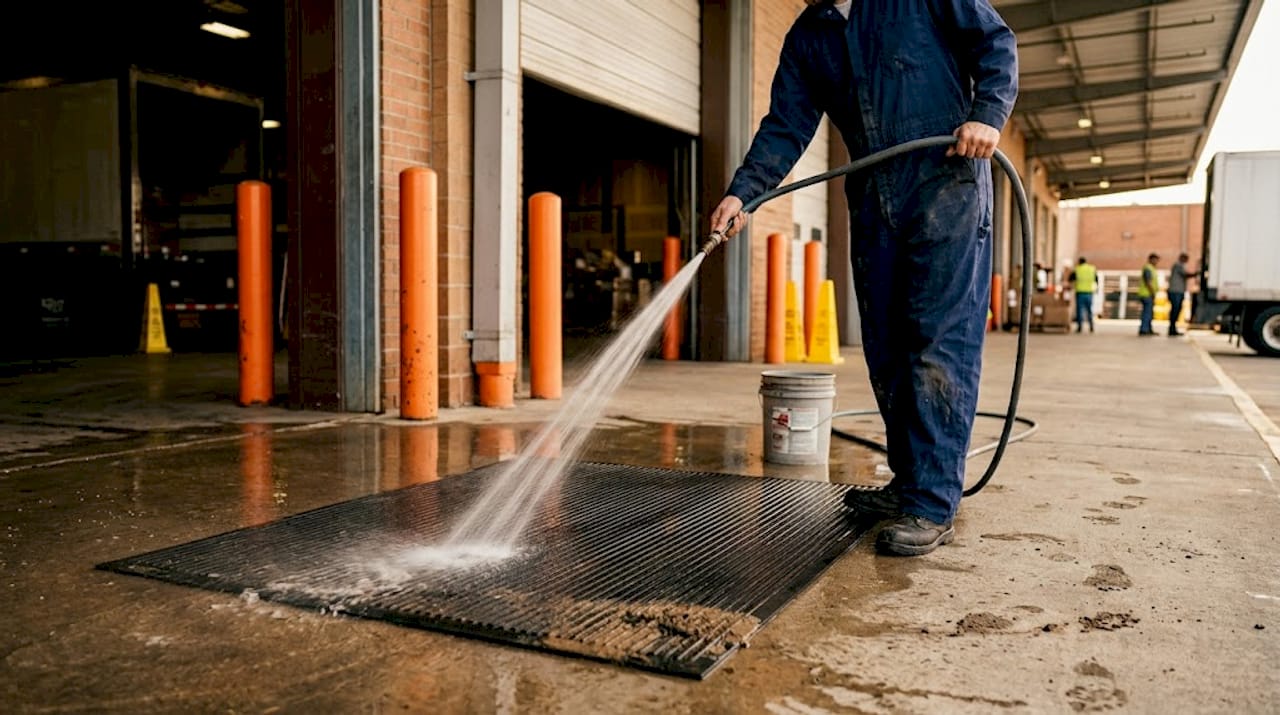
Nitrile rubber is the preferred material for industrial and heavy commercial applications. It resists oils, automotive fluids, cleaning chemicals, and UV degradation far better than standard synthetic rubber or PVC. In facilities like auto shops, food processing plants, or industrial warehouses, nitrile is the correct specification. It maintains flexibility in cold temperatures and does not become brittle under UV exposure the way vinyl does.
Vinyl loop mats use extruded vinyl loops to create an open-grid surface. They are effective at trapping debris and are easy to clean, but they are not as resistant to oils and harsh chemicals as nitrile. They are better suited to retail, hospitality, and office building entries where the contamination profile is primarily dirt and moisture.
Reclaimed rubber mats offer an economical and environmentally responsible option for lower-intensity applications. They typically use post-consumer tire rubber and perform adequately in moderate-traffic areas, but they do not match the longevity of virgin nitrile.
The table below summarizes key performance differences between the three primary scraper mat materials:
| Material | Chemical resistance | UV stability | Lifespan (high traffic) | Best setting |
|---|---|---|---|---|
| Nitrile rubber | Excellent | Excellent | 5 to 7 years | Industrial, auto, food service |
| Vinyl loop | Moderate | Moderate | 2 to 4 years | Retail, office, hospitality |
| Reclaimed rubber | Low to moderate | Low | 1 to 3 years | Low to moderate traffic |
Lifespan in high-traffic outdoor use runs 1 to 3 years for standard materials, while nitrile rubber can last 5 to 7 years with proper care. Signs that a mat needs replacement include frayed or compressed edges that no longer create a seal, reduced debris capture where dirt passes through rather than into the channels, and curling or cupping at corners that creates a trip hazard.
Maintenance practice is straightforward but critical. Rigid rubber mats can be hosed down or pressure washed. Vinyl loop mats respond well to commercial laundering. For any scraper mat with deep channels or grooves, a water-only rinse is not enough for thorough cleaning. You need agitation from a brush or pressure washer to clear compacted debris out of the recesses.
Pro Tip: Inspect scraper mats every two weeks in high-traffic periods. Compressed or clogged channels reduce effectiveness by a measurable margin and are the leading sign that replacement is overdue.
For facilities managing slip risk on wet surfaces, our anti-slip floor mat guide covers additional material and backing options that address traction control specifically.
Where do scraper mats fit? The three-zone entrance system
Specifying the right mat type is only part of the solution. Where that mat sits in relation to your entrance and what follows it determines actual system performance. The industry standard framework is the three-zone entrance matting system, and scraper mats are Zone 1.
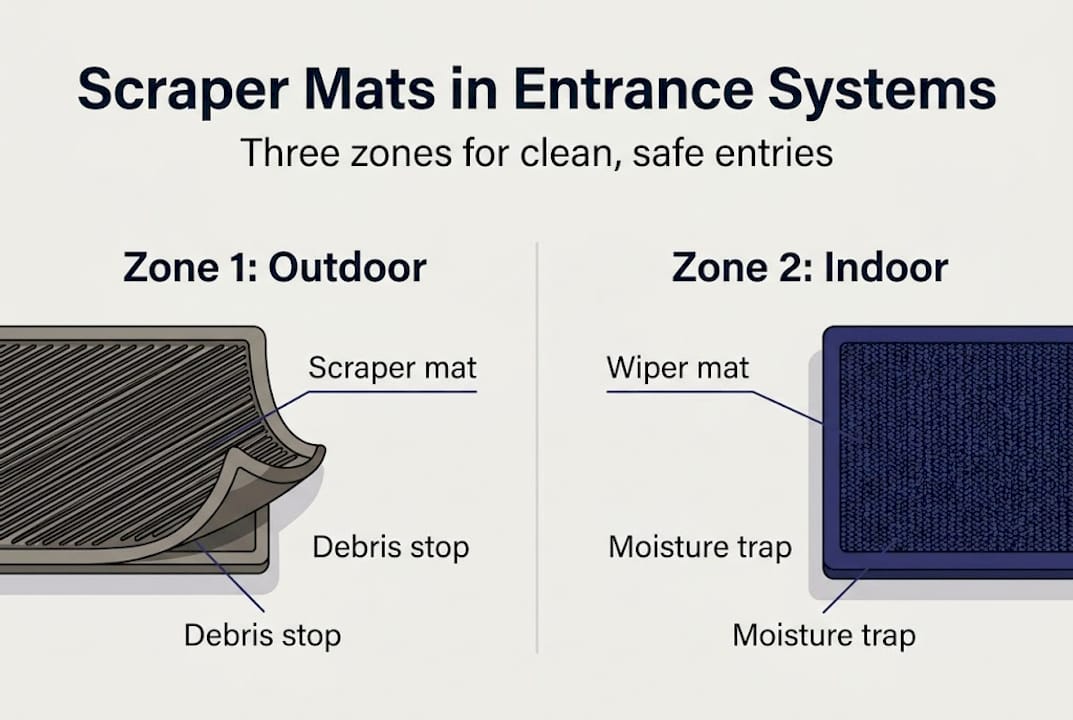
In three-zone matting systems, which represent the industry standard, scraper mats are Zone 1 positioned outdoors for coarse debris removal, followed by a scraper/wiper combination mat in Zone 2 at the transition point, and a wiper or absorbent mat in Zone 3 indoors. Full systems capture 85% or more of tracked-in dirt and moisture, compared to just 30 to 50% for single small mats used without a system approach.
That gap between 85% and 50% is not minor. In a facility with 500 or more daily entries, the difference translates directly into cleaning labor hours, floor finish replacement cycles, and slip-and-fall incident rates. A single mat at the door is not a system. It is a partial measure.
Here is how to implement the three-zone approach at a standard commercial entrance:
- Zone 1 (outdoor threshold): Place a heavy-duty scraper mat directly at the exterior door or entry point. Size it for a minimum of two full walking steps to ensure both feet make contact. Width should match the door opening.
- Zone 2 (transition or vestibule): Use a combination scraper/wiper mat that continues mechanical debris removal while beginning moisture absorption. This mat handles the transition from outdoor to conditioned space.
- Zone 3 (interior entry): Position a high-quality wiper or carpet-style absorbent mat to capture remaining moisture and fine particulates. This is the last point of capture before foot traffic reaches finished flooring.
The size of each zone matters as much as the mat type. Industry guidance recommends a minimum walking distance of 15 to 20 feet of matting coverage across all three zones for a high-traffic commercial entrance. Smaller mats or gaps between zones create bypass routes where contamination reaches interior floors directly.
Choosing the right placements for preventing slips with mats in transition zones is a separate consideration worth reviewing, particularly where wet weather is frequent. Workers who stand for long periods near these entry zones may also benefit from anti-fatigue mat benefits at Zone 3 or in adjacent work areas.
The return on investment for a complete three-zone system is documented. Facilities that implement full zone coverage report measurable reductions in floor cleaning frequency, lower janitorial supply spend, and reduced floor refinishing cycles. The scraper mat alone generates most of that savings by catching the heavy debris that would otherwise abrade and contaminate interior floor surfaces.
Safety, certifications, and selection tips for scraper mats
Performance matters, but so does verification. In commercial facilities subject to liability claims or regulatory inspection, certifications on safety-critical products are not optional. Scraper mats at entry points are slip-and-fall risk zones by definition because they handle wet, muddy, and debris-contaminated foot traffic.
NFSI-certified high-traction models achieve a TCOF (Traction Coefficient of Friction) above 0.60 in both dry and wet conditions, reducing slip-and-fall risks by up to 90%. Low-profile beveled edges on these products also support ADA compliance by eliminating trip hazards at mat perimeters.
These two certifications should be on your minimum specification list for any scraper mat purchased for a public-facing facility:
- NFSI High-Traction Certification: Confirms the mat surface achieves safe traction levels in wet conditions, the specific scenario when slip risk is highest
- ADA-compliant edge profile: Beveled or tapered edges with a rise of no more than one-quarter inch prevent trip hazards for pedestrians using mobility aids or with uneven gait
Beyond certifications, the selection process involves matching the mat to the specific facility environment. In wet, oily, or greasy industrial settings such as auto shops and factories, scraper mats excel and should be paired with wiper mats for full-system protection. A single mat is inadequate for extreme weather or high-contamination environments, and softer rubber compounds improve friction on particle-contaminated floors.
Use the following criteria when specifying scraper mats for your facility:
- Surface pattern: Choose bi-level or aggressive cleat designs for outdoor industrial use; loop or diamond patterns for lighter commercial entry zones
- Rubber compound: Specify nitrile for any exposure to oils, chemicals, or harsh cleaning agents; vinyl loop is adequate for standard retail or office settings
- Mat size: Minimum two steps of coverage per zone; wider than the door opening by at least two inches on each side to catch off-center foot placement
- Backing type: Solid rubber backing for outdoor use on smooth surfaces; spiked or cleated backing for rough concrete or pavers where grip is needed
- Zone compatibility: Confirm the scraper mat spec matches Zone 1 requirements and that Zone 2 and Zone 3 products are selected at the same time
Facilities responsible for selecting anti-fatigue mats in wet or slippery production areas will find that the same zone-based thinking applies: match the mat type to the specific risk profile of the location, not just the general facility category.
Industrial facilities with specific contamination hazards should also review options in industrial non-slip mats to identify products rated for chemical spill environments.
Replacement timing is part of a safety program, not just a budget decision. A mat that has lost surface texture, developed curled edges, or compressed channels is a liability rather than a safety asset. Schedule replacement inspections on a defined calendar cycle rather than reacting to visible damage.
The uncomfortable truth: Single mats can’t compete with strategic systems
Here is a perspective most mat suppliers do not lead with: the mat itself is not the primary variable in entry system performance. The system design is.
Facility managers frequently allocate budget for a single premium scraper mat at the main entrance and treat that as the safety solution. The assumption is that a higher-quality mat covers the gap left by the absence of a complete system. That assumption does not hold up in practice. Data consistently shows that properly sized three-zone systems outperform even the highest-rated single mats, and that materials like PVC and vinyl are prone to curling and cracking under heavy use, which undermines both safety and durability regardless of the brand name on the product.
The real risk is brand confidence overriding system thinking. A premium label does not change the physics of debris tracking. If Zone 2 and Zone 3 are missing or undersized, Zone 1 performance is irrelevant to what reaches your interior floor.
The practical discipline is this: choose materials based on your contamination profile, size each zone correctly, and schedule replacement on a defined cycle. Function and system fit determine outcome. The price tag on any individual mat is a secondary factor.
Reviewing workplace safety improvements at the system level, rather than the product level, is the approach that produces measurable results in real facilities.
Trusted solutions for every facility: Discover your next scraper mat
If you are ready to upgrade your entry system with products built for commercial and industrial performance, Mats4U offers a full range of options to support every zone. Start with premium custom floor mats for branded Zone 3 positions, and pair them with heavy-duty Zone 1 options like the WaterHog Max Grand mat for outdoor threshold performance. Every product is available with free delivery on orders over $100, with Made in the USA construction on select lines. Explore all Mats4U solutions to browse by mat type, application, and facility need, or use the product category tools to match scraper, wiper, and anti-fatigue products to your full three-zone specification.
Frequently asked questions
What types of businesses benefit most from scraper mats?
High-traffic facilities including office buildings, schools, retail stores, factories, and auto shops see the greatest improvements in safety, cleanliness, and cleaning cost reduction with properly specified scraper mats.
How often should scraper mats be replaced?
Nitrile rubber mats last 5 to 7 years in high-traffic environments, while standard and vinyl loop materials typically require replacement every 1 to 3 years depending on traffic volume and contamination levels.
Are scraper mats effective for wet weather or only dry debris?
Scraper mats remove sand, gravel, and mud effectively in wet conditions, and nitrile models excel in oily or greasy settings such as factories and auto shops. Pairing with a wiper mat in Zone 2 enhances water removal for complete protection.
What certifications should I look for when buying scraper mats?
Specify NFSI high-traction certification confirming TCOF above 0.60 in wet conditions, and ADA-compliant beveled edges to ensure both maximum slip safety and accessibility compliance at your facility entry points.


