


Selecting the right pool mats for commercial facilities is more complex than most facility managers initially realize. Your choice impacts safety outcomes, maintenance costs, and even your facility’s professional image. With wet surfaces, heavy foot traffic, and exposure to harsh pool chemicals, standard matting simply won’t cut it. This guide walks you through the critical evaluation criteria and explores the top pool mat solutions available in 2026, helping you make an informed decision that protects both your guests and your bottom line.
Table of Contents
- Understanding Key Criteria For Selecting Commercial Pool Mats
- Top Pool Mat Options For Commercial Environments: Materials And Types
- Comparing Commercial Pool Mat Types: Performance And Maintenance
- Which Commercial Pool Mat Fits Your Facility? Situational Selection Guide
- Explore Premium Pool Mats Designed For Commercial Success
- What Types Of Pool Mats Are Best For Commercial High Traffic Areas?
- How Do I Maintain Pool Mats To Ensure Safety And Longevity?
- Can Pool Mats Be Customized With Business Logos Or Colors?
- Are Modular Tile Mats More Cost Effective Long Term?
Key takeaways
| Point | Details |
|---|---|
| Material durability varies | Different pool mat materials offer distinct advantages in chemical resistance and wear tolerance for commercial environments. |
| Safety is paramount | Slip resistance features are essential in wet, high traffic zones to prevent accidents and liability issues. |
| Modular versus roll mats | Modular tile mats provide permanent, no maintenance solutions while roll mats offer flexible, custom fitting options. |
| Maintenance impacts costs | Understanding cleaning requirements and replacement cycles helps you calculate true long term ownership costs. |
| Customization adds value | Branded mats with logos or custom colors enhance facility aesthetics while reinforcing professional identity. |
Understanding key criteria for selecting commercial pool mats
Before diving into specific product types, you need a clear framework for evaluation. The right pool mat balances multiple factors that directly impact your facility’s operations and safety record.
Durability stands at the top of your priority list. Commercial pool environments expose mats to chlorine, bromine, and other harsh chemicals daily. Foot traffic in these areas can reach thousands of visitors per week during peak seasons. Your mat material must resist both chemical degradation and physical wear without breaking down or becoming a safety hazard itself.
Slip resistance saves lives and prevents costly liability claims. Wet pool decks create inherently dangerous conditions. The pool safety mat guide you choose must provide reliable traction even when saturated. Look for mats with textured surfaces, drainage channels, or specialized rubber compounds engineered for wet conditions.
Maintenance requirements directly affect your operational budget. Some mats demand daily hosing and weekly deep cleaning, while others remain functional with minimal intervention. Consider your staffing capacity and cleaning protocols when evaluating options. A low maintenance mat that costs more upfront often delivers better value over its lifespan than a cheaper alternative requiring constant attention.
Rubber/PVC roll mats excel in easy installation and custom fitting for high traffic wet zones but are prone to movement, while modular tiles work better for permanent, no maintenance solutions in commercial pools. This fundamental distinction shapes your entire selection process.
Aesthetic considerations matter more than many facility managers acknowledge. Your pool area creates first impressions for guests and members. Mats that complement your facility’s design language, incorporate branded elements, or simply look clean and professional contribute to perceived value and customer satisfaction.
Pro Tip: Calculate total cost of ownership over three to five years, not just purchase price. Include cleaning supplies, staff time, and expected replacement cycles to identify the truly economical choice.
Top pool mat options for commercial environments: materials and types
Three primary mat categories dominate the commercial pool market in 2026, each offering distinct advantages for different facility types and budgets.
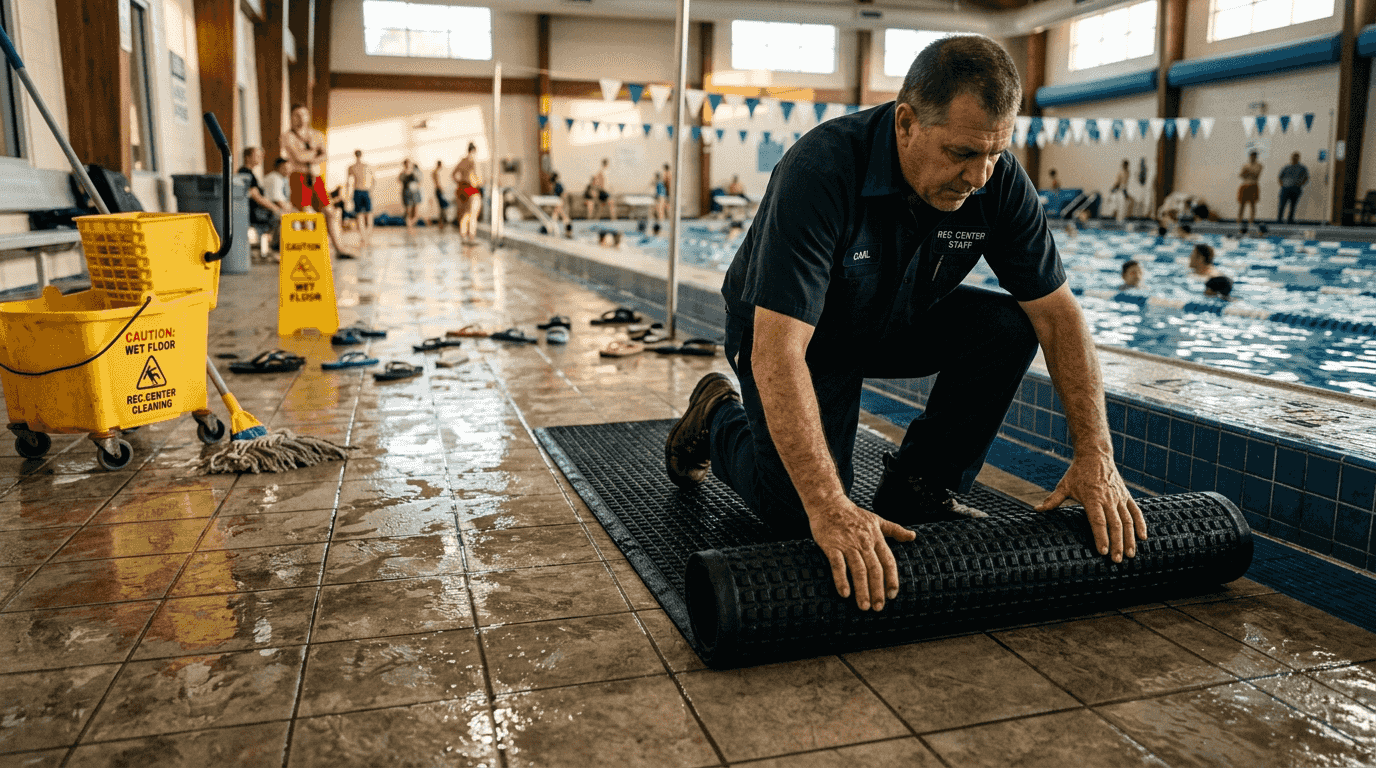
Rubber and PVC roll mats deliver flexibility and ease of installation that appeals to many facility managers. You can cut these mats to fit irregular spaces, wrap them around pool features, and install them without specialized tools or adhesives. They work particularly well for temporary installations, seasonal facilities, or areas where you anticipate layout changes. However, rubber/PVC roll mats are prone to movement in high traffic zones, requiring periodic repositioning. Their custom fit advantage comes with the trade off of less stability compared to permanently installed alternatives.
Modular tile systems represent the premium choice for permanent commercial installations. These interlocking tiles create a stable, unified surface that resists shifting even under heavy use. Most modular systems feature integrated drainage channels that prevent water pooling while maintaining slip resistance. The tiles typically use high density polyethylene or specialized rubber compounds engineered to withstand years of chemical exposure and UV radiation. Installation requires more upfront labor, but modular tiles are better for permanent, no maintenance solutions in commercial pools. You can replace individual damaged tiles without disturbing the entire floor, extending the system’s effective lifespan significantly.
Specialty mats combine multiple performance features in single products. These include mats with antimicrobial treatments that resist mold and mildew growth, cushioned options that reduce fatigue for pool staff and lifeguards, and hybrid designs that trap dirt particles while providing drainage. Some specialty mats incorporate raised patterns or textures that enhance grip beyond standard slip resistant surfaces. The outdoor pool matting innovations available in 2026 include options with built in UV stabilizers for facilities with significant sun exposure.
When evaluating these options, match mat type to your specific usage patterns:
- High traffic commercial pools benefit most from modular tile systems
- Seasonal or temporary facilities should consider roll mats for flexibility
- Areas requiring frequent deep cleaning work better with removable roll mats
- Facilities prioritizing aesthetics can explore specialty mats with custom colors
- Budget conscious operations might start with roll mats and upgrade to tiles over time
Foot traffic volume drives many selection decisions. A hotel pool serving 50 guests daily has vastly different needs than a municipal aquatic center hosting 500 visitors. Similarly, your cleaning protocols influence which mat type makes sense. If your team pressure washes pool decks daily, removable mats simplify the process. If cleaning happens weekly, permanent modular systems prove more practical.
Aesthetic options like custom logos or colors add branding value that extends beyond pure functionality. Many facilities use anti slip pool mats featuring their logo at main entrances, combining safety with marketing impact.
Pro Tip: Request sample tiles or mat sections before committing to large orders. Test them in your actual pool environment for at least two weeks to verify performance claims.
Comparing commercial pool mat types: performance and maintenance
A direct comparison reveals how different mat types stack up across the factors that matter most to commercial facility managers.
| Feature | Rubber/PVC Roll Mats | Modular Tile Systems | Specialty Hybrid Mats | | — | — | — | | Chemical Resistance | Good, degrades over 2-3 years | Excellent, lasts 5-7 years | Varies by product, typically 3-5 years | | Slip Resistance | Moderate, depends on texture | High, engineered drainage patterns | High, specialized grip surfaces | | Installation Complexity | Low, cut and place | Moderate, interlocking assembly | Low to moderate | | Maintenance Frequency | Weekly deep cleaning recommended | Monthly cleaning sufficient | Varies, often bi-weekly | | Movement/Shifting | Common in high traffic areas | Minimal once installed | Low with proper sizing | | Customization Options | Limited to cutting for fit | Logo printing, color selection | Antimicrobial, cushioning, custom patterns | | Cost per Square Foot | $3-8 | $12-25 | $8-18 | | Expected Lifespan | 2-4 years | 5-8 years | 3-6 years |
Durability differences become apparent within the first year of use. Rubber/PVC roll mats excel in easy installation and custom fitting for high traffic wet zones but show wear patterns faster than tile systems. You’ll notice edge curling, surface cracking, or color fading as chemical exposure takes its toll. Modular tiles maintain structural integrity and appearance much longer, justifying their higher initial investment.
Slip resistance ratings vary significantly even within product categories. Look for mats tested to ASTM standards for wet surfaces. The best performing options maintain their grip characteristics even after months of chemical exposure and cleaning cycles. Some specialty mats incorporate multiple slip resistance technologies, combining textured surfaces with drainage channels and antimicrobial treatments.
Maintenance ease impacts your daily operations more than most facility managers anticipate. Roll mats require lifting and repositioning for thorough deck cleaning underneath. This labor intensive process happens weekly in most commercial settings. Modular tiles allow water and cleaning solutions to flow through drainage channels, eliminating the need for frequent removal. Your maintenance staff can pressure wash right over the tiles, saving hours of labor each week.
Installation complexity affects both initial setup costs and long term flexibility. You can install roll mats in hours with basic tools. Modular systems require careful planning, precise alignment, and often professional installation for best results. However, this upfront complexity pays dividends in stability and longevity.
Cost analysis must extend beyond purchase price to include total ownership expenses. A $5 per square foot roll mat requiring replacement every two years and weekly maintenance ultimately costs more than a $20 per square foot tile system lasting seven years with minimal upkeep. Factor in staff time, cleaning supplies, and replacement cycles when calculating true costs.
The pool rubber flooring safety durability equation tilts toward modular systems for most permanent commercial installations, while roll mats serve temporary or budget constrained situations effectively.
Which commercial pool mat fits your facility? Situational selection guide
Matching your specific circumstances to the right mat type requires honest assessment of your facility’s unique characteristics and constraints.
-
Measure your average daily foot traffic accurately. Facilities serving fewer than 100 visitors daily can consider roll mats as cost effective solutions. Operations hosting 200 plus guests should invest in modular tile systems to avoid constant replacement cycles.
-
Evaluate your maintenance team’s capacity and equipment. If you have dedicated staff and pressure washing equipment, modular tiles integrate seamlessly into efficient cleaning routines. Limited staffing favors roll mats you can quickly remove and replace.
-
Assess your budget across multiple years, not just the current fiscal period. Modular tiles are better for permanent, no maintenance solutions when you calculate costs over five years. Roll mats make sense when capital budgets are tight but operational budgets can absorb higher ongoing expenses.
-
Consider your facility’s permanence and stability. Seasonal operations, facilities anticipating renovations, or pools in temporary structures benefit from roll mat flexibility. Year round operations in stable buildings should choose modular systems.
-
Match slip resistance requirements to your specific safety standards and insurance requirements. Some jurisdictions mandate specific ASTM ratings for commercial pool surfaces. Verify your mat choice meets or exceeds these standards.
Budget constraints force difficult decisions, but creative approaches can help. Some facilities install premium modular tiles in highest traffic zones like main entries and locker room transitions, using roll mats in lower traffic areas. This hybrid approach optimizes spending while maintaining safety where it matters most.
Aesthetic needs deserve serious consideration in member focused facilities like fitness clubs, hotels, and resorts. Custom branded mats create professional impressions that justify premium pricing and enhance member satisfaction. The tips for choosing pool mats include evaluating how mat appearance affects your facility’s overall image and market positioning.
Environmental factors specific to your location also influence selection. Outdoor pools in sunny climates need UV resistant materials. Indoor pools with high humidity benefit from antimicrobial treatments. Cold climate facilities should choose mats that remain flexible and slip resistant even when temperatures drop.
The floor mats for pool hygiene considerations extend beyond just safety to include bacterial growth prevention, ease of sanitization, and compatibility with your chemical treatment program.
Pro Tip: Create a decision matrix scoring each mat type against your top five priorities. Weight factors by importance to your specific situation. The highest scoring option represents your best fit regardless of what other facilities choose.
Explore premium pool mats designed for commercial success
After understanding the criteria, options, and selection factors, you’re ready to explore specific solutions engineered for commercial pool environments. Mats4U offers specialized products addressing the exact challenges you face.
Discover premium custom floor mats featuring your facility’s logo and brand colors, transforming functional safety equipment into marketing assets. These mats combine slip resistance with professional aesthetics that enhance guest experiences from the moment they enter your pool area.
For facilities prioritizing staff comfort alongside guest safety, the cushion complete mat delivers anti fatigue benefits that reduce strain on lifeguards and pool attendants during long shifts. This ergonomic advantage improves staff satisfaction while maintaining the drainage and slip resistance your pool deck demands.
When permanent, low maintenance installation makes the most sense for your operation, Waterhog modular tiles provide the durability and performance commercial facilities require. These tiles handle heavy traffic, resist chemical degradation, and maintain their appearance for years with minimal upkeep.
What types of pool mats are best for commercial high traffic areas?
Modular tile systems deliver superior performance in commercial high traffic areas. These interlocking tiles create stable surfaces that resist shifting even under constant use. Their integrated drainage channels prevent water pooling while maintaining slip resistance. For permanent installations serving hundreds of daily visitors, modular tiles justify their premium cost through extended lifespan and minimal maintenance requirements.
Rubber and PVC roll mats work effectively for temporary applications or facilities with moderate traffic. You can install them quickly, customize them to fit irregular spaces, and replace them affordably when wear becomes apparent. However, expect to reposition these mats regularly in high traffic zones and plan for replacement every two to three years.
How do I maintain pool mats to ensure safety and longevity?
Regular cleaning prevents mold, mildew, and dirt buildup that compromises both safety and mat lifespan. Pressure wash modular tiles monthly and roll mats weekly, using mild detergents compatible with your mat material. Allow thorough drying between uses when possible.
Inspect mats during each cleaning cycle for signs of wear, damage, or degradation. Look for edge curling, surface cracking, color fading, or reduced slip resistance. Replace worn sections immediately to prevent accidents and maintain consistent safety standards across your facility.
Follow manufacturer maintenance instructions specific to your mat type and material. Some mats require periodic treatments with UV protectants or antimicrobial solutions. The pool mat maintenance guide provides detailed protocols for extending mat life while ensuring optimal safety performance.
Can pool mats be customized with business logos or colors?
Many commercial pool mats accept custom printing with business logos, facility names, or branded designs. This customization transforms functional safety equipment into marketing tools that reinforce your professional identity. Custom mats create memorable first impressions for guests while maintaining the slip resistance and durability your facility requires.
Customization helps facilities differentiate themselves in competitive markets. Hotels, fitness clubs, and resort pools use branded mats to enhance perceived value and create cohesive design aesthetics throughout their properties. The custom logo mats available in 2026 offer extensive color matching and design flexibility to align with your existing brand guidelines.
Are modular tile mats more cost effective long term?
Modular tiles typically cost two to three times more than roll mats initially but deliver superior long term value. Their five to eight year lifespan compared to two to four years for roll mats means fewer replacement cycles. Lower maintenance requirements reduce ongoing labor costs significantly.
Calculate total cost of ownership including purchase price, installation labor, cleaning supplies, maintenance time, and replacement frequency. Modular tiles are better for permanent, no maintenance solutions in commercial pools when you account for these factors over multiple years. Most facilities recover the premium initial investment within three years through reduced operational expenses and extended replacement cycles.


