


TL;DR:
- Waterhog mats feature a bi-level design that traps dirt and moisture below shoe level.
- Correct sizing and maintenance are essential to maximize Waterhog mats’ safety and performance.
- Custom branding options allow integration of logos without compromising durability or function.
Most facility managers assume that as long as an entrance mat is in place, it is doing its job. That assumption is costing facilities real money in slip-and-fall incidents, floor damage, and cleaning labor. Not all commercial mats are built to the same standard, and the performance gap between a generic mat and a purpose-built Waterhog becomes visible fast in high-traffic environments. This guide breaks down exactly what Waterhog mats do differently, where those differences matter most, and how to deploy them so your facility gets the full benefit from day one.
Table of Contents
- What sets Waterhog mats apart in commercial environments
- Practical advantages of Waterhog mats for safety and cleanliness
- Branding and customization: Waterhog mat options for business identity
- Installation and maintenance best practices for maximum advantage
- Why correct mat strategy matters more than mat brand
- Explore top Waterhog solutions for your facility
- Frequently asked questions
Key Takeaways
| Point | Details |
|---|---|
| Superior debris control | Waterhog mats’ bi-level surface captures dirt and moisture effectively in high-traffic environments. |
| Supports safety and branding | Offers slip resistance and customizable options to reinforce your facility’s image. |
| Requires right setup | Sizing, placement, and regular cleaning are essential for maximizing Waterhog mat benefits. |
| Long-lasting durability | Engineered to withstand tough use, Waterhog mats outlast many conventional options. |
What sets Waterhog mats apart in commercial environments
The commercial mat market is crowded with products that look functional but fall short under real load. Waterhog mats were engineered specifically to address the three problems that cause the most operational headaches at commercial entrances: moisture intrusion, surface wear, and mat movement.
The most defining feature is the bi-level surface construction. The raised rows of polypropylene fibers form a scraping surface that removes dirt and debris from shoe soles, while the recessed channels between those rows hold captured moisture and grit below shoe level. In practice, this means foot traffic does not redistribute dirt back onto shoes or the floor beyond the mat. Standard loop-pile or flat rubber mats lack this separation entirely, allowing tracked-in moisture to pool on the surface where it becomes a slip hazard.
Polypropylene is the correct fiber choice for commercial entrances. It resists crushing under sustained foot traffic, dries quickly, and does not absorb moisture the way nylon or olefin fibers do. This crush resistance directly translates to a longer effective service life. A mat that flattens within a few weeks loses its scraping action and becomes little more than a decorative piece of flooring.
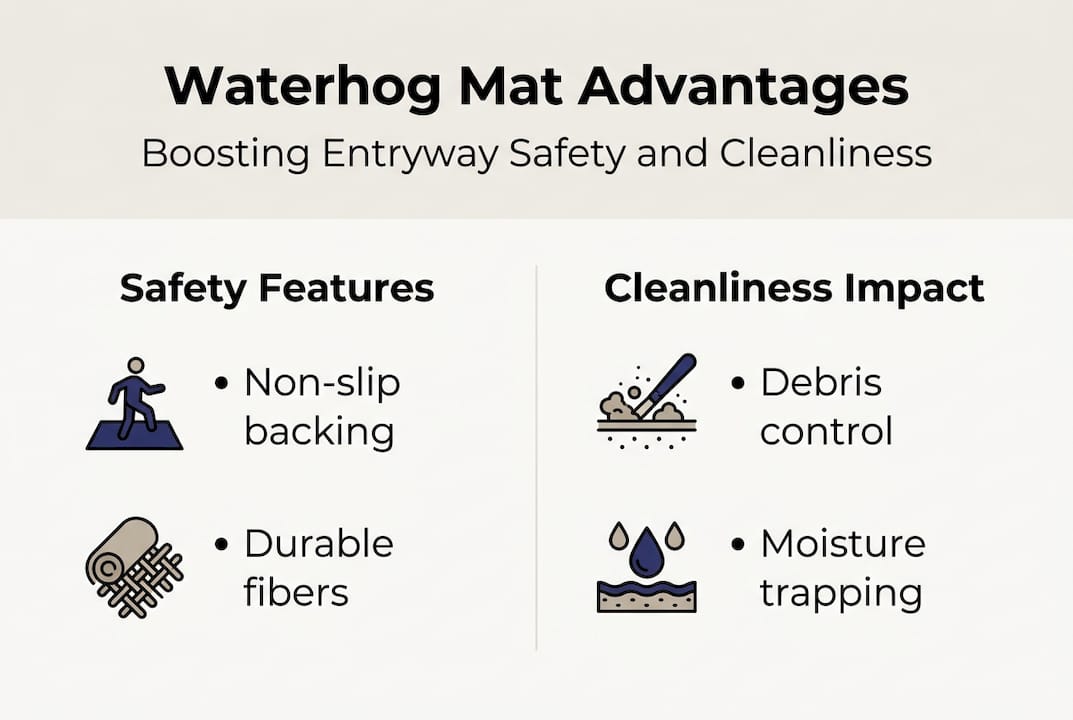
The rubber backing on commercial Waterhog products is formulated for grip on hard flooring surfaces. It does not curl at the edges, which is one of the most common causes of trip hazards at building entries. The backing also resists cold temperatures, which matters for facilities in northern climates where mats near exterior doors are exposed to temperature swings throughout the day.
Here is how Waterhog compares to two common alternatives:
| Feature | Waterhog mat | Standard carpet mat | Flat rubber mat |
|---|---|---|---|
| Moisture management | Bi-level reservoir design | Surface absorption only | Minimal, surface pools |
| Fiber durability | Crush-resistant polypropylene | Prone to matting and flattening | Not applicable |
| Slip resistance (backing) | Commercial rubber, stays flat | Latex, prone to curl | Rubber, can bunch |
| Soil separation | Below shoe level | Surface level | None |
| Replacement frequency | Long service life | Moderate | Moderate to frequent |
Key performance advantages at a glance:
- Traps grit and liquid below foot contact level
- Polypropylene face holds shape through heavy daily traffic
- Commercial rubber backing prevents movement and edge curl
- Available in sizes calibrated to actual entrance traffic loads
- Waterhog mat business benefits apply across retail, healthcare, office, and industrial settings
Pro Tip: Match mat length to the number of steps a person takes across it. For a standard entry, a mat that allows at least two full steps per foot provides meaningful soil removal before occupants reach interior flooring.
As noted in Waterhog doormat reviews, the mat’s advantages depend on correct sizing and maintenance. An undersized Waterhog in a heavy-traffic vestibule saturates faster and underperforms relative to its potential. Reviewing the 6 benefits of Waterhog mats before selecting a product helps align specification to actual need.
Practical advantages of Waterhog mats for safety and cleanliness
Having set the context for Waterhog’s core advantages, next we explore how those benefits play out in real facility environments.
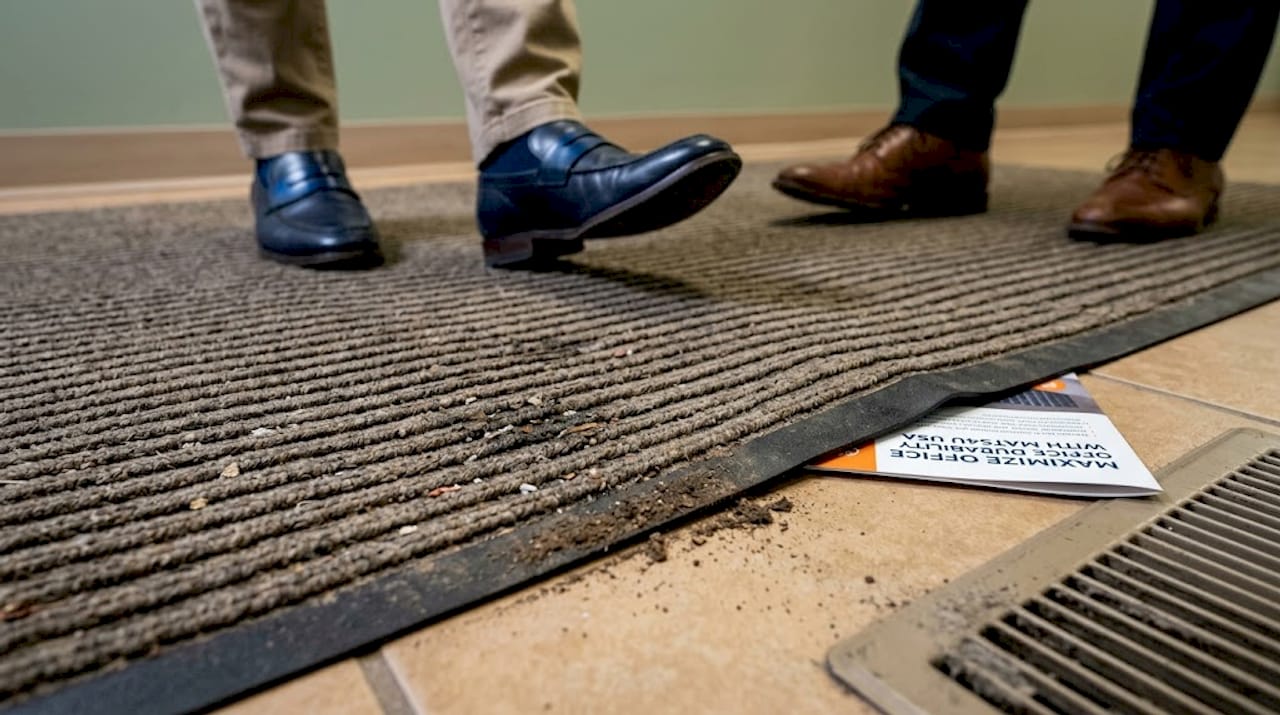
The bi-level construction does two jobs simultaneously. It scrapes, and it stores. During rain or snow events, occupants track in substantial volumes of water per entry. A mat that only absorbs pushes moisture back to the surface as saturation increases. The reservoir channels in a Waterhog hold that water below foot contact until the mat is shaken out or vacuumed. This directly reduces the risk of wet floor conditions at the most hazardous point in a building, the transition zone from exterior to interior.
Here is a reference for moisture management performance by mat size under sustained wet traffic:
| Mat size (sq ft) | Approximate wet capacity | Recommended traffic volume |
|---|---|---|
| Under 6 sq ft | Light, up to 50 entries/hour | Low-traffic secondary entries |
| 6 to 15 sq ft | Moderate, up to 150 entries/hour | Standard office or retail entry |
| Over 15 sq ft | High, up to 300+ entries/hour | High-traffic lobbies, healthcare |
Steps for maintaining a clean, safe entrance using Waterhog mats during wet weather conditions:
- Inspect the mat before and after peak traffic periods to confirm the reservoirs are not visibly full of standing liquid.
- Shake or vacuum the mat daily during sustained rain or snow to clear captured debris and restore drainage channel function.
- Lift and dry the area beneath the mat at least twice per week to prevent moisture from migrating to the subfloor and creating mold or surface damage.
- Rotate or replace mats at primary entries during severe weather events to maintain consistent absorption performance.
- Document cleaning cycles so you can identify when a mat is consistently saturating before the end of a business day, which signals the need for a larger size or an additional mat.
“Absorption can exceed capacity and mats can become slightly slippery on top when wet,” according to testing of waterproof mats, reinforcing that sizing and maintenance are not optional considerations for commercial applications.
The practical implication for facility managers is clear. A Waterhog mat that is correctly sized and cleaned on schedule keeps the entry zone significantly safer than a saturated, undersized product regardless of its brand. The features for high-traffic areas specific to Waterhog construction are only effective when the mat has available capacity to work with. Understanding how Waterhog mats keep floors clean in sustained conditions helps set realistic expectations and maintenance intervals.
Branding and customization: Waterhog mat options for business identity
While safety and cleanliness are paramount, branding is another strategic advantage of Waterhog mats.
Every main entrance is a brand touchpoint. A worn, faded mat communicates neglect. A clean, logoed mat communicates professionalism. Waterhog technology now extends to custom logo formats that combine the product’s proven performance with facility-specific branding, giving managers a product that satisfies both the safety committee and the marketing team.
Logo mat options available in Waterhog construction include:
- Single-color logo mats for simple, high-contrast brand marks that read clearly at a distance
- Multi-color custom designs for facilities with detailed brand guidelines requiring accurate color matching
- Pattern options including herringbone and classic field designs that integrate with lobby aesthetics without custom printing
- Border configurations that frame the mat and create a defined, intentional look within the entry zone
- Size flexibility from standard entry sizes to large lobby formats for atriums and wide vestibules
The WaterHog Max Herringbone Mat illustrates how utility and visual identity can be delivered in a single product. The herringbone pattern reads as a deliberate design choice rather than a functional afterthought, and the mat construction maintains full performance regardless of the surface pattern selected.
Color selection should account for more than aesthetic preference. Darker field colors show less surface debris during the day but can make it harder to assess when a mat needs cleaning. Lighter colors make contamination more visible and prompt more frequent maintenance cycles. Both are valid strategies depending on your cleaning protocols and staff availability.
Pro Tip: Use the mat border color to reinforce a secondary brand color. Most visitors notice the contrast between border and field color, which makes a logoed mat read as intentional branding rather than a standard product. This small detail adds significant perceived quality to the entry experience at minimal additional cost.
The branding function of entrance mats is frequently undervalued in facility budgets. A custom Waterhog mat at each main entry costs a fraction of other branded environmental elements, lasts significantly longer than vinyl graphics or printed banners, and performs a safety function simultaneously.
Installation and maintenance best practices for maximum advantage
Understanding product features is only half the battle; deploying and maintaining them is just as critical.
Correct installation starts with accurate sizing. The most common error is selecting a mat that fits the physical space rather than the traffic load. A 3x5 mat may fit a narrow vestibule neatly, but if that vestibule handles 400 entries per hour during peak periods, the mat will saturate before midday and lose its functional benefit for the remainder of the business day.
Steps for sizing and deploying Waterhog mats correctly:
- Measure the entry zone fully, including recessed areas where a mat can be inset for a flush finish that eliminates trip hazards entirely.
- Estimate peak hourly traffic, not average traffic, because saturation capacity is a function of peak load, not daily totals.
- Use two mats in tandem at high-volume entries: one exterior mat to capture heavy debris and moisture, one interior mat to capture residual moisture before occupants reach finished flooring.
- Secure the mat edges if the entry surface is polished stone or tile where rubber backing may provide less grip than on textured concrete.
- Set a cleaning schedule before the mat goes down, not after you notice it is dirty. Reactive cleaning is almost always too late in high-traffic settings.
For routine cleaning, vacuuming is the primary method for dry debris. During wet seasons, hosing the mat and allowing it to dry fully before replacement prevents mold growth in the rubber backing. Full guidance on washing Waterhog mats and cleaning Waterhog mats covers the specific steps for both light and deep cleaning cycles.
As Waterhog doormat reviews document, the mat’s advantages are strongly tied to correct deployment and maintenance. Neglected reservoirs look dirty, and wet surface conditions can reduce traction. This is not a product flaw. It is a deployment and maintenance issue. Testing of waterproof mats confirms that absorption capacity can be exceeded, and slipperiness can result from improper maintenance or undersizing, which makes the cleaning schedule a direct safety variable, not just an aesthetic one.
For a full overview of correct product use from placement to long-term care, the Waterhog installation and use resource provides specific guidance organized by entry type.
Pro Tip: Set a calendar reminder for a quarterly mat inspection where you assess fiber height, backing integrity, and edge condition. Replace mats when fiber height drops below half its original depth, when edges begin to curl despite rubber backing, or when the surface pattern is no longer visible due to wear.
Why correct mat strategy matters more than mat brand
Here is the contrarian view worth stating plainly: selecting a high-performance mat is necessary but not sufficient. Facilities that invest in quality Waterhog products and then deploy them incorrectly, or skip maintenance, see results that are no better than facilities using generic mats on a disciplined replacement and cleaning schedule.
The mat is a system component, not a standalone fix. Placement, sizing, tandem deployment, cleaning frequency, and seasonal adjustment all determine outcomes. We have seen facility managers specify the correct product for a main lobby and then use a single mat that is two sizes too small because it fit the recessed area more neatly. The entry looks clean. The mat is saturated by 10 AM. The interior floor is wet by noon. The product worked as designed. The strategy failed.
Viewing entrance matting as an integrated floor protection strategy, not an accessory purchase, changes how you approach specification. You start with traffic data, map the moisture load by season, define the cleaning capacity of your custodial team, and then select the product that fits the system. Understanding Waterhog mat benefits is the starting point. Building a deployment strategy around those benefits is what produces measurable results in slip reduction and floor maintenance costs.
Explore top Waterhog solutions for your facility
Ready to move from specification to procurement? Mats4U carries a full range of commercial Waterhog products sized and configured for real facility environments. The WaterHog Max Herringbone Mat delivers both high-performance moisture management and a polished visual presence for lobbies and main entries. For facilities that want branding integrated directly into the mat, Premium Logo Mats combine custom printing with commercial-grade construction. Browse the full range of commercial and industrial matting options at Mats4U with free delivery on orders over $100 and products Made in the USA.
Frequently asked questions
What makes Waterhog mats better for high-traffic commercial entries?
Waterhog mats feature a bi-level design and tough polypropylene surface that trap dirt and moisture below shoe level, outperforming typical mats in heavy-use areas. This construction preserves traction at the surface even as the mat captures significant volumes of moisture and debris.
Do Waterhog mats ever become slippery when wet?
If a Waterhog mat exceeds its absorption capacity or is not maintained properly, it can become slippery on the surface, especially in undersized applications. Absorption exceeding capacity may cause slight slipperiness, which is why correct sizing and routine cleaning are essential safety practices.
How often should Waterhog mats be cleaned in commercial settings?
Regular cleaning, often weekly or biweekly at minimum, maintains absorption capacity and traction in busy entrances. During sustained wet weather or heavy snow seasons, daily shakeouts and mid-week vacuuming are recommended for primary entry points.
Can Waterhog mats be customized with business logos?
Yes, Waterhog mats offer customization options that let businesses display logos and branding at entry points without sacrificing the mat’s functional performance. Custom color matching and multi-color designs are available for facilities with specific brand guidelines.


