


TL;DR:
- Choosing WaterHog mats over standard options reduces slip incidents, contains moisture effectively, and extends mat lifespan in high-traffic facilities. Their proprietary bi-level surface and water dam border trap debris and water, lowering maintenance costs and improving safety compliance. Proper selection and verification of certifications ensure optimal performance, safety, and cost savings for facility management.
Most facility managers assume any rubber-backed entryway mat will handle tracked-in water and dirt. That assumption is costing you more than you realize. Saturated mats, contaminated floors, and slip incidents are direct consequences of choosing standard mats that simply cannot keep up with commercial traffic volumes. WaterHog mats were engineered from the ground up to address exactly these failure points, combining a patented bi-level surface, water dam border, and NFSI-certified slip resistance into a single product that performs where conventional mats quit.
Table of Contents
- Why entryway mats matter: Dirt, moisture, and slip risks in commercial facilities
- What sets WaterHog mats apart: The proprietary design advantage
- Key benefits for facility managers: Safety, cost, and maintenance wins
- Choosing the right WaterHog mat for your facility: Options and best practices
- The real ROI: What most facility managers miss about entryway mats
- Upgrade your facility’s safety and cleanliness with our WaterHog solutions
- Frequently asked questions
Key Takeaways
| Point | Details |
|---|---|
| Slip risk reduction | WaterHog mats provide NFSI-certified slip resistance to help prevent accidents in high-traffic, wet areas. |
| Superior moisture control | The bi-level surface and water dam border effectively contain dirt and up to 1.5 gallons of water per square yard. |
| Lower maintenance costs | Trapping water and debris at the door reduces cleaning frequency and flooring wear for lasting facility savings. |
| Flexible selection | WaterHog mats come in multiple sizes, backings, and custom options to suit any commercial or industrial facility. |
| Long-term ROI | Performance-focused entryway mats like WaterHog lower incident rates and total cost of ownership over time. |
Why entryway mats matter: Dirt, moisture, and slip risks in commercial facilities
Every time a door opens in a high-traffic facility, dirt, moisture, and debris enter with it. In a retail store, hospital, or warehouse, that means hundreds or thousands of contamination events per day. The floor maintenance burden compounds quickly. Cleaning crews spend more time on floor care, floor finishes degrade faster, and moisture accumulates in spots that standard mats miss entirely.
Slip-and-fall incidents are not a minor inconvenience. They represent one of the leading causes of workplace injury in the United States, carrying significant liability exposure for facility operators. For procurement specialists, specifying the wrong mat is not just a product decision; it’s a risk management decision with real financial consequences.
Conventional mats compound the problem in several ways:
- Thin pile construction saturates rapidly and stops absorbing before peak traffic ends
- Lightweight backing allows mats to shift or curl, creating trip hazards
- No containment border lets moisture migrate onto adjacent flooring
- Low debris retention causes contaminants to release back onto shoe soles with continued foot traffic
The result is tracked dirt and moisture spreading throughout the facility well beyond the entryway zone. Heavy-traffic WaterHog mat designs address these shortcomings with construction standards that conventional alternatives do not meet.
The National Floor Safety Institute (NFSI) issues its “High-Traction” certification as a measurable benchmark for slip resistance under wet conditions. Not all mats qualify. NFSI-certified slip resistance is a specific standard WaterHog mats are designed to meet, giving facility managers a verifiable performance metric rather than a manufacturer’s marketing claim.
Selecting a mat without verified slip-resistance certification in a high-traffic, wet-entry environment is a liability gap. Certification provides documented evidence of performance compliance, which matters when incidents are reviewed.
The stakes here are straightforward: wrong mat selection increases safety incidents, increases cleaning labor hours, and shortens floor finish life. The right mat does the opposite.
What sets WaterHog mats apart: The proprietary design advantage
WaterHog mats are not a standard scraper mat with better branding. The construction is genuinely different at the functional level. The bi-level scraper/wiper surface traps contaminants below shoe level, meaning debris and moisture are pulled off the sole and held in the mat’s recessed channels rather than sitting at the surface where they can transfer back to footwear. This is the defining structural advantage over flat-pile or loop mats.
The water dam border is equally critical. This raised perimeter ring surrounds the mat and contains liquid rather than allowing it to wick or flow onto adjacent flooring. The liquid-holding capacity of 1.5 gallons per square yard is a specific performance characteristic, not an estimate. In practical terms, this means a standard 3x5 mat holds over two gallons of water before any moisture migrates to the surrounding floor.
The 6 benefits of WaterHog mats include backing options engineered for specific floor types. Smooth rubber backing suits hard floor surfaces, while cleated backing grips carpet without damaging fibers. Eco-friendly backing materials are available for facilities with sustainability mandates. The choice of backing affects both grip performance and NFSI certification status, which we will address in the selection section.
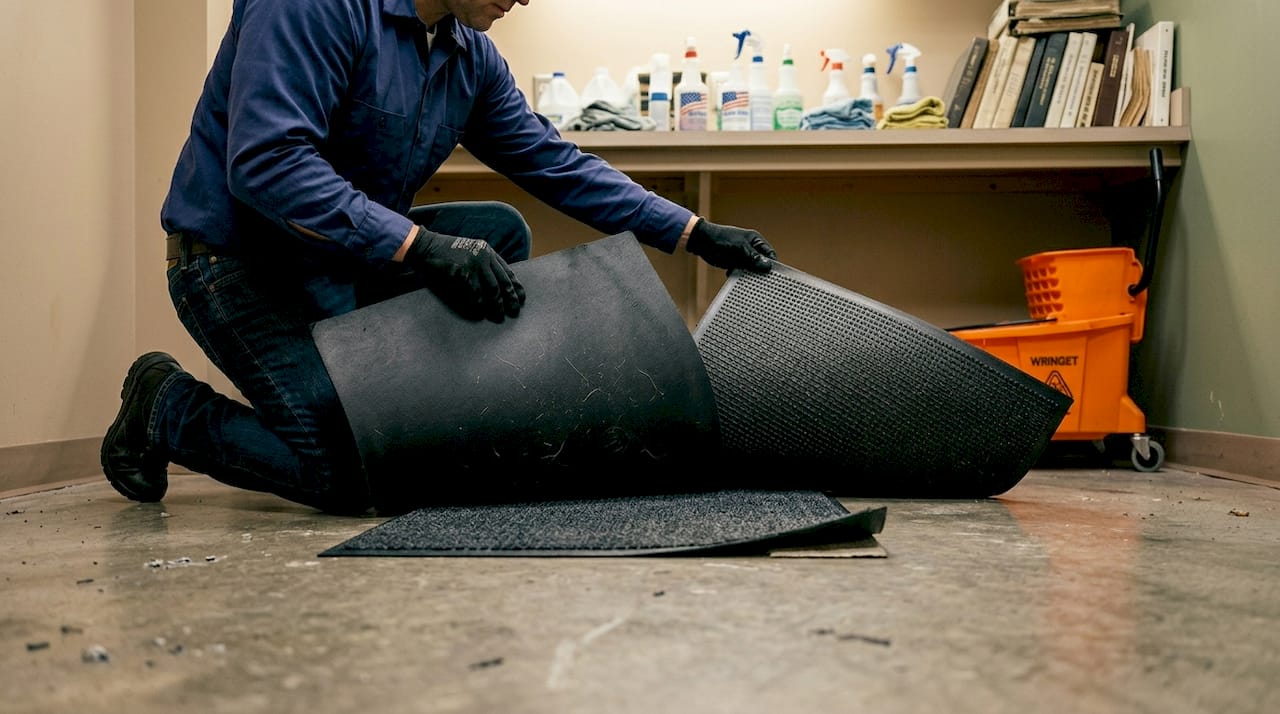
Here is a direct comparison of WaterHog construction against standard commercial mats:
| Feature | WaterHog mat | Standard commercial mat |
|---|---|---|
| Surface design | Bi-level scraper/wiper channels | Flat pile or loop |
| Water containment | Raised water dam border | No perimeter containment |
| Liquid capacity | Up to 1.5 gal/sq. yd. | Minimal; saturates quickly |
| Debris retention | Below shoe level in recesses | Surface-level; re-transfers |
| NFSI certification | Available; High-Traction rated | Rarely certified |
| Backing options | Smooth, cleated, eco-friendly | Typically one standard option |
| Durability rating | Heavy commercial/industrial | Light to medium commercial |
The WaterHog Diamondcord Mat is a strong example of the product line’s range, offering a textured face pattern that enhances scraping action in higher-grit entry environments like loading docks and exterior covered entries. For facilities evaluating alternative rubber mat options, the feature comparison above clarifies exactly where WaterHog products pull ahead on functional performance.
Pro Tip: Always confirm your backing choice matches the exact floor type before ordering. Smooth rubber backing on carpet can reduce traction rather than improve it, and some configurations affect which NFSI certification level applies to your installation.
Key benefits for facility managers: Safety, cost, and maintenance wins
Understanding what WaterHog mats are designed to do is one part of the equation. The operational impact on your facility is the other. Here is how the technical features translate into measurable facility management outcomes.
Safety reduction. NFSI High-Traction certification is not a cosmetic designation. It documents that the mat surface achieves a specific coefficient of friction under wet test conditions. The NFSI certification standard distinguishes WaterHog mats from uncertified alternatives when you need to demonstrate due diligence in safety compliance. The WaterHog Diamond Mat is one model where this certification is available, making it appropriate for high-liability entry points.
Lower floor maintenance costs. When mats contain moisture and debris at the door, less contamination reaches hard floors and carpet zones beyond the entry. Floor stripping and refinishing cycles extend. Carpet cleaning intervals lengthen. Cleaning labor hours decrease per square foot of facility space maintained. These are direct, recurring cost savings that accumulate over the mat’s operational life.
Extended mat replacement cycles. WaterHog mats are constructed from polypropylene face fiber, which resists matting, crushing, and fiber breakdown under sustained foot traffic. Standard mats show visible pile compression and lose scraping effectiveness within months of installation in high-traffic zones. WaterHog products maintain structural performance significantly longer, reducing replacement frequency and the procurement overhead that comes with it.
Here is a practical workflow showing how WaterHog mats reduce incident reports and labor time:
- Entry capture. Bi-level surface scrapes debris and wicks moisture off soles in the first two to three steps on the mat.
- Containment. Water dam border holds liquid on the mat surface rather than allowing migration to adjacent flooring.
- Reduced contamination spread. Less tracked dirt reaches interior floors, reducing the frequency of spot-mopping and floor treatment.
- Stable mat position. Heavy-duty backing prevents mat shift and curl, eliminating the trip hazard created by loose or displaced mats.
- Documented compliance. NFSI certification provides written evidence of slip resistance for safety audits and incident reviews.
- Scheduled maintenance, not reactive cleaning. High liquid capacity means mats do not require emergency response between cleaning cycles during wet weather events.
The WaterHog Plus Mat adds a reinforced face construction suited to facilities with heavy wheeled traffic such as carts, hand trucks, and equipment dollies, extending the mat’s operational life further in industrial environments.
Pro Tip: Schedule periodic deep-cleaning, typically hosing down and allowing full air-dry, on a monthly cycle for high-traffic locations. This restores moisture absorption capacity and prevents debris buildup in the bi-level channels from reducing scraping performance over time.
Comparison: WaterHog vs. standard mat total cost of ownership
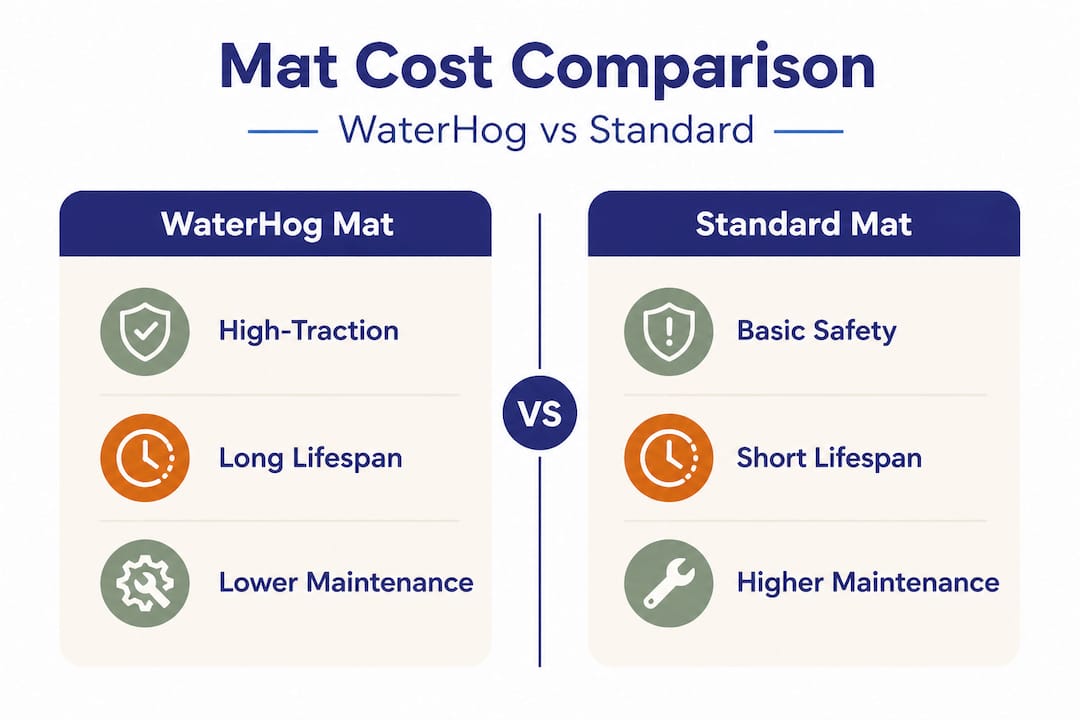
| Cost factor | WaterHog mat | Standard mat |
|---|---|---|
| Initial purchase price | Higher | Lower |
| Replacement frequency | Low (years) | High (months) |
| Cleaning labor impact | Reduced frequency | Higher frequency |
| Slip incident risk | NFSI-documented low | Uncertified |
| Floor refinishing savings | Significant | Minimal |
| Net 3-year cost | Lower | Higher |
Choosing the right WaterHog mat for your facility: Options and best practices
Not every WaterHog product fits every application. Making the right selection requires matching the mat’s size, backing, and configuration to your specific traffic level, placement zone, and floor surface.
Key selection criteria include:
- Traffic volume. Lobbies and primary entry doors handling over 500 daily pedestrian passes require heavier face weight and more robust backing than a low-traffic side entrance.
- Placement zone. Exterior covered entries need UV-stable and weathering-resistant construction. Interior lobbies prioritize moisture containment and aesthetics. Vestibule zones benefit from full-coverage sizing with minimal gaps to walls.
- Floor surface. Hard surfaces, including tile, concrete, and vinyl composite, require smooth or cleated rubber backing. Carpet-over-pad installations require cleated backing to anchor the mat without shifting.
- Certification alignment. The anti-slip certification of a given mat configuration applies to the specific model, backing, and surface combination. Verify that the model you are installing has the certification applicable to your floor type, not just that the product line holds a certification somewhere in its range.
- Custom branding. Facilities with lobby aesthetics or brand standards can specify custom logo options that maintain WaterHog performance while displaying facility branding.
The WaterHog Max Herringbone Mat delivers enhanced scraping via its herringbone surface geometry and is designed for outdoor or transition entry zones where coarse debris is the primary concern. The WaterHog Drainable Border Mat is specifically configured for high-moisture environments where liquid volume at the entry demands drainage capability rather than containment, such as pool entrances, car washes, or rainy coastal facilities.
For procurement specialists building a specification sheet, the key variables to document are: mat dimensions, face weight, backing type, surface pattern, and applicable NFSI certification number. These fields allow direct comparison across product lines and ensure compliance documentation is available for your safety audit records.
The real ROI: What most facility managers miss about entryway mats
Here is the operational reality: purchase price is the wrong metric for evaluating commercial entryway mats.
When procurement decisions are driven by line-item cost comparisons, lower-priced mats look better on a budget sheet. But the actual cost drivers are cleaning labor, floor maintenance, incident liability, and replacement cycles. A $40 mat that saturates in 90 minutes during a rain event, shifts underfoot, and requires replacement every six months delivers far worse total cost than a $120 mat that performs for three or more years with monthly maintenance.
The containment capacity metric is routinely ignored in mat procurement. Most specs focus on face fiber, backing, and size. Almost no one is asking about water dam border height or total liquid capacity before purchase. This is the single most consequential oversight in entryway mat selection because it is the feature that determines whether your floor beyond the mat stays dry or becomes a slip zone during peak moisture conditions.
Certification verification is a related gap. Procurement specialists often confirm that a product line holds NFSI certification without verifying that the specific model and backing they are ordering holds that certification on the exact surface type being installed. The WaterHog mat benefits documentation is useful here, but the configuration-specific certification verification step is critical and often skipped.
The longer-term picture also includes avoided incident costs. A single documented slip-and-fall in a commercial facility generates investigation time, potential medical cost, lost productivity, and liability exposure. When you calculate the cost of even one avoided incident per year against the premium paid for a certified, high-containment mat, the mat investment recovers its cost difference many times over.
Premium entryway matting is not a facility aesthetic decision. It is a risk control and maintenance efficiency decision that should be evaluated on the same basis as any other safety-critical equipment specification.
Upgrade your facility’s safety and cleanliness with our WaterHog solutions
Mats4U carries the full range of WaterHog products, from standard entrance configurations to custom-branded and specialty drainage models, with free delivery on orders over $100 and products made in the USA. The WaterHog Max Herringbone Mat is a strong starting point for high-traffic exterior and transition entries. For facilities prioritizing branding alongside performance, custom logo mats are available with WaterHog-grade construction. Browse the full WaterHog catalog at Mats4U to match your specific facility configuration, traffic load, and floor surface requirements. Competitive pricing, technical specifications, and direct purchasing are available online.
Frequently asked questions
How much water can a WaterHog mat hold before it leaks?
A WaterHog mat holds up to 1.5 gallons of water per square yard, contained by the patented water dam border that prevents liquid from migrating onto adjacent flooring.
Are WaterHog mats actually slip-resistant?
Yes. Many WaterHog mats carry NFSI High-Traction certification for slip resistance under wet conditions, providing a documented, measurable standard rather than a manufacturer claim.
How do I choose the right WaterHog mat for my facility’s needs?
Match size, backing, and surface pattern to your traffic volume and floor type, then verify the anti-slip certification applies to the exact model and backing configuration you are installing on your specific surface.
Can WaterHog mats be customized with my company logo?
Yes. WaterHog mats are available in custom-branded configurations that display company logos or facility branding while maintaining the same certified performance construction as standard models.
Recommended
- WaterHog CleanShield Stride Mat for Cleanrooms & Sensitive Areas – Mats4U USA
- WaterHog® Diamondcord Mat: Heavy-Duty Indoor Mat for Dirt & Moisture Control – Mats4U USA
- WaterHog® Mat - Heavy Traffic Commercial Entrance Mat 50-70 Characters – Mats4U USA
- WaterHog® Diamond Mat - Heavy-Duty Commercial Entrance Mat – Mats4U USA


