


TL;DR:
- Waterhog mats offer superior moisture retention and durability for high-traffic, wet environments.
- They are NFSI-certified for slip resistance, supporting safety and OSHA compliance.
- Proper maintenance extends their lifespan up to five years, reducing total lifecycle costs.
Not all entryway mats perform the same. Facility managers who have replaced a soaked, matted-down generic mat after a rainy morning know this firsthand. Waterhog matting is a distinct category of commercial floor mat engineered specifically for high-traffic environments where moisture, dirt, and safety are daily concerns. This article breaks down exactly what Waterhog matting is, how it compares to alternatives like coco mats and 3M Nomad, where it delivers the most value, and how to maintain it for maximum return on investment.
Table of Contents
- What is Waterhog matting?
- How does Waterhog matting compare to other commercial mats?
- Where and why should you use Waterhog matting?
- How to maintain and extend the life of your Waterhog mats
- Beyond the brochure: What most spec sheets don’t tell you about Waterhog mats
- Discover your ideal Waterhog mat solution
- Frequently asked questions
Key Takeaways
| Point | Details |
|---|---|
| Superior dirt and water capture | Waterhog mats outperform standard commercial mats, trapping more dirt and moisture to enhance entryway safety. |
| Exceptional durability | Engineered for heavy traffic, Waterhog matting often lasts up to five years with proper maintenance. |
| Lower long-term cost | Despite a higher initial price, Waterhog mats reduce replacement and labor costs over their lifecycle. |
| Verified safety credentials | Waterhog products are NFSI-certified for slip resistance, supporting compliance and risk reduction. |
What is Waterhog matting?
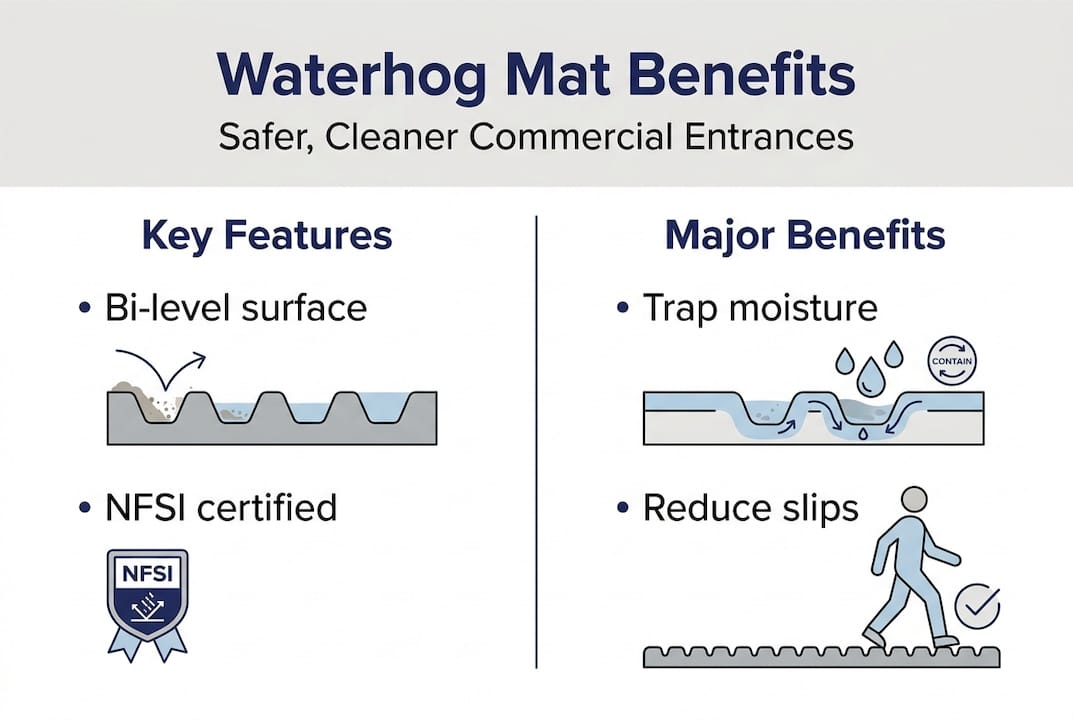
Waterhog matting is a category of commercial-grade floor mat built from durable polypropylene fibers woven into a bi-level surface pattern. That bi-level design is the core functional feature. The raised fiber clusters scrape dirt and debris from shoe soles, while the recessed channels between them collect and hold moisture below the walking surface. The result: foot traffic moves over a drier, cleaner surface even in heavy rain or snow conditions.
The backing is typically a rubber or vinyl waffle pattern, which grips flooring securely and prevents mat migration. This matters in high-traffic corridors where a shifting mat is a direct slip hazard. The construction is purpose-built, not adapted from residential or light-duty applications.
Key construction features include:
- Polypropylene face fibers: Resist rot, mold, and fiber shedding, unlike natural coco mats
- Bi-level surface: Scrapes and stores dirt and moisture simultaneously
- Rubber or vinyl waffle backing: Locks the mat in place on hard flooring
- Colorfast construction: Maintains appearance under heavy foot traffic and repeated cleaning
- Wide size and border options: Fits standard and custom commercial entryway dimensions
The performance data supports the construction claims. According to Waterhog mat features, Waterhog mats trap 30% more dirt than 3M Nomad mats and carry durability benchmarks of up to 5 years in commercial use. Coco mats, by contrast, rot, shed fibers, and break down under repeated moisture exposure.
| Feature | Waterhog | Coco mat | Generic mat |
|---|---|---|---|
| Rot resistance | Yes | No | Varies |
| Fiber shedding | None | Common | Common |
| Moisture retention | High | Low | Low |
| Durability (years) | Up to 5 | 1 to 2 | 1 to 2 |
| Slip-resistant backing | Standard | Rare | Varies |
For a broader look at how entrance matting works in commercial buildings, the entrance matting guide covers selection criteria across mat types and building uses.
How does Waterhog matting compare to other commercial mats?
Procurement decisions often come down to price at the unit level. That approach misses the full picture. When you compare Waterhog mats against coco mats, generic polypropylene mats, and 3M Nomad on a performance and lifecycle basis, the differences are significant.
Vendor data confirms Waterhog’s advantage over generics, coco mats, and 3M Nomad in both durability and water retention. The 30% greater moisture retention versus 3M Nomad is particularly relevant for facilities in wet climates or with outdoor-facing entrances.
| Mat type | Water retention | Lifespan | NFSI certified | Typical cost tier |
|---|---|---|---|---|
| Waterhog | High | Up to 5 years | Yes | Mid to high |
| 3M Nomad | Moderate | 2 to 3 years | Varies | Mid |
| Coco mat | Low | 1 to 2 years | No | Low |
| Generic polypropylene | Low | 1 to 2 years | No | Low |
The NFSI (National Floor Safety Institute) certification is a factor that many buyers overlook. NFSI certification means the mat has been independently tested for slip resistance under wet conditions. This is not a vendor claim. It is a third-party safety standard. For facilities subject to OSHA compliance or liability exposure, this certification carries real weight.
Lifecycle cost is where Waterhog mats consistently win. A generic mat at half the price that needs replacement every 12 to 18 months costs more over three years than a Waterhog mat replaced once. Add in the labor cost of mat swaps and the safety risk of a degraded mat, and the math shifts further.
Key advantages Waterhog holds over alternatives:
- Greater moisture capacity per square foot versus 3M Nomad
- No fiber rot or breakdown under repeated wet conditions
- Consistent slip resistance backed by NFSI certification
- Longer replacement cycles reduce procurement frequency
For facilities evaluating commercial entrance matting options across multiple building types, or looking at non-slip industrial flooring requirements, these performance differences translate directly into safety outcomes and budget efficiency.
“The right mat is not the cheapest mat. It is the one that performs consistently over the longest period with the least intervention.”
Where and why should you use Waterhog matting?
Waterhog mats are not a one-size-fits-all product, but they are well-suited to a wide range of commercial and industrial settings. The key variable is moisture and dirt load. Where those are high, Waterhog delivers measurable value.
Top locations for Waterhog mat deployment:
- Building entrances and lobbies: The primary use case. Outdoor-to-indoor transitions concentrate dirt and moisture. A properly sized Waterhog mat at the entrance captures the majority of contaminants before they reach interior flooring.
- Industrial work zones: Facilities with oil, water, or particulate contamination on floors benefit from Waterhog’s scraping and retention capacity.
- Commercial kitchens and food service areas: Moisture is constant. Waterhog’s rot-resistant polypropylene holds up where natural fiber mats would degrade within weeks.
- Healthcare facility corridors: Infection control and slip prevention are both priorities. NFSI-certified mats support both goals.
- Schools and universities: High foot traffic with seasonal weather variation. Waterhog’s durability handles the volume without frequent replacement.
- Warehouses and loading docks: Transition zones between outdoor and indoor areas where heavy boots carry significant debris.
The 5-year performance benchmark in high-traffic commercial entryways makes Waterhog a practical choice wherever replacement frequency is a budget or operational concern.
Safety is a parallel driver. Wet floors at building entrances are a leading cause of slip-and-fall incidents. Waterhog’s NFSI-certified slip resistance directly addresses this risk. For facilities tracking safety metrics or managing liability, this is not a secondary consideration.
Pro Tip: Size your mat to cover at least 6 to 10 feet of walking distance from the entrance. Studies on mat effectiveness consistently show that shorter mats do not allow enough steps to fully clean shoe soles. A mat that is too small is only marginally better than no mat.
For detailed guidance on slip-proof mat safety standards and how to evaluate anti-slip floor mats for specific facility types, those resources provide location-specific selection criteria.
How to maintain and extend the life of your Waterhog mats
Waterhog mats are low-maintenance relative to their performance level, but they are not zero-maintenance. Proper care is what separates a mat that lasts 5 years from one that degrades in 2. The lifecycle cost advantage depends directly on maintenance practice.
Routine cleaning methods:
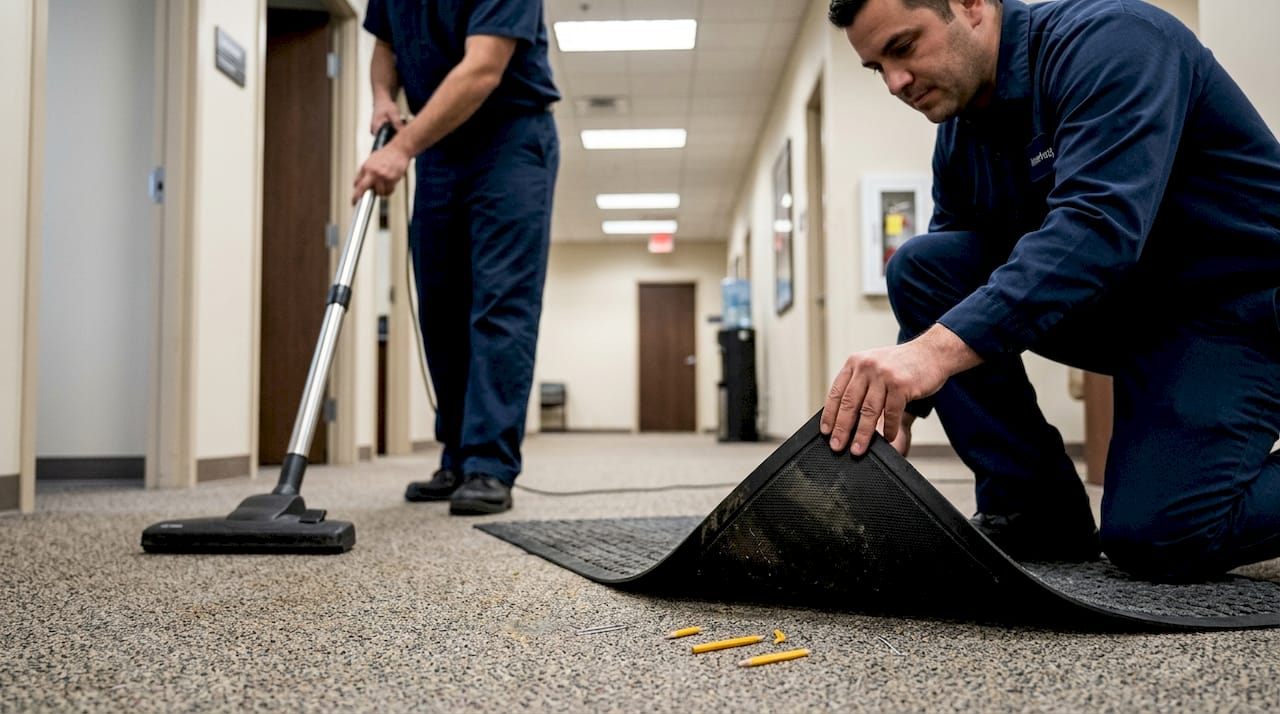
- Vacuuming: Daily or every-other-day vacuuming in high-traffic areas removes surface debris before it compacts into the fiber pile. Use a commercial upright or canister vacuum with a beater bar for best results.
- Spot cleaning: Address spills and stains immediately with a mild detergent and clean water. Do not use bleach or solvent-based cleaners. These degrade polypropylene fibers and the rubber backing.
- Extraction cleaning: Periodic hot-water extraction (steam cleaning) removes embedded dirt and refreshes fiber performance. For very high-traffic locations, schedule extraction monthly. For moderate traffic, quarterly is sufficient.
- Air drying: After wet cleaning, allow mats to dry fully before returning them to service. Placing a wet mat back on the floor traps moisture and can damage underlying flooring.
Maintenance schedule by traffic level:
- High traffic (500+ people per day): Vacuum daily, spot clean as needed, extract monthly
- Moderate traffic (100 to 500 per day): Vacuum 3 times per week, extract quarterly
- Low traffic (under 100 per day): Vacuum weekly, extract twice per year
Pitfalls to avoid:
- Over-wetting during cleaning. Saturating the mat backing accelerates rubber degradation.
- Using harsh chemicals. Bleach and ammonia-based cleaners break down polypropylene and void performance expectations.
- Folding mats for storage. Rolling is correct. Folding creates permanent creases that compromise the flat surface and backing integrity.
Pro Tip: Rotate mats between high-wear and lower-wear positions in your facility. A mat at a secondary entrance experiences less stress than one at the main entry. Rotating extends the useful life of your full mat inventory, not just individual units.
For structured guidance, the mat maintenance tips resource covers schedules and methods for property managers. Additional detail on commercial mat cleaning and effective mat cleaning procedures is available for facilities building out formal cleaning programs.
Beyond the brochure: What most spec sheets don’t tell you about Waterhog mats
Spec sheets list fiber weight, mat dimensions, and backing type. They rarely tell you what actually determines value in practice.
The NFSI certification is the most underused selection criterion in commercial mat procurement. Vendor claims about slip resistance are common. Independent certification is not. When a mat carries NFSI certification, that is an objective safety validation, not a marketing statement. Facility managers who have managed a slip-and-fall claim understand the difference.
Lifecycle cost is the second blind spot. Procurement officers focused on unit price routinely select mats that cost more over a 3-year horizon than the higher-priced alternative they passed on. Total spend includes purchase price, replacement frequency, labor for swaps, and disposal. Waterhog wins on total spend, not just on durability.
The third factor is what we see consistently in facilities that follow matting best practices: the facilities that invest in the right mat upfront spend less time managing mat-related safety incidents and replacement cycles. The upfront decision is the most important one.
Discover your ideal Waterhog mat solution
Waterhog matting delivers measurable performance advantages for facility managers and procurement officers managing high-traffic, high-moisture environments. The combination of NFSI-certified slip resistance, up to 5-year durability, and lower lifecycle cost makes it a straightforward specification for commercial and industrial applications.
At Mats4U, you can browse a full range of Waterhog options sized and configured for your facility. The Waterhog Max Herringbone delivers heavy-duty performance for the highest-traffic entrances. The Waterhog Drainable Border adds perimeter drainage for outdoor or semi-covered applications. Free delivery applies on orders over $100, and all products are Made in the USA.
Frequently asked questions
How long do Waterhog mats last in high-traffic commercial settings?
Waterhog mats can last up to 5 years in heavy commercial use with proper maintenance. Lifespan depends on traffic volume and adherence to recommended cleaning schedules.
Are Waterhog mats really safer than standard entrance mats?
Waterhog mats carry NFSI safety certification and are engineered for improved slip resistance versus standard mats. This certification is based on independent testing, not vendor claims.
What maintenance is required for Waterhog mats?
Regular vacuuming, prompt spot cleaning, and periodic extraction are recommended for optimal performance. Avoid harsh chemicals and over-wetting, which degrade both the fiber and the rubber backing.
How do Waterhog mats compare in cost with generic alternatives?
Though the upfront price is higher, Waterhog mats have a lower lifecycle cost due to their longevity and reduced replacement frequency. Total spend over 3 to 5 years typically favors Waterhog over lower-priced alternatives.


