


TL;DR:
- Custom logo mats enhance branding, safety, and cleanliness at facility entryways.
- They can increase foot traffic and engagement, generating significant ROI.
- Proper selection, placement, and maintenance maximize durability and branding impact.
A single floor mat at your entrance can generate a 45% increase in leads, an 89% rise in dwell time, and a 30% boost in foot traffic. Most facility managers treat entryway mats as a cleaning tool. That framing leaves serious branding and safety value on the table. Custom logo mats serve three functions at once: they protect your floors, reduce slip hazards, and communicate your brand identity to every person who walks through the door. This article covers the functional science, branding impact, safety data, and practical selection steps you need to make the right call for your facility.
Table of Contents
- More than a welcome mat: The science of branded entryways
- Branding impact: How logo mats shape customer perception
- Safety, durability, and ROI: Why custom mats matter in high-traffic areas
- Selecting and customizing logo mats for your facility
- The unexpected ROI and overlooked value of custom logo mats
- Transform your facility with custom logo mats
- Frequently asked questions
Key Takeaways
| Point | Details |
|---|---|
| Branding boost | Custom logo mats strengthen brand recognition from the first step into your facility. |
| Safety benefits | Quality mats help prevent slips and keep entryways cleaner in high-traffic settings. |
| Proven ROI | Studies show logo mats reliably increase leads, dwell time, and foot traffic. |
| Easy customization | Selecting and designing logo mats is straightforward and can be tailored to any brand need. |
| Long-term value | Maintaining custom mats delivers ongoing branding and operational advantages. |
More than a welcome mat: The science of branded entryways
Entryways are the first physical touchpoint between your business and every visitor, vendor, and employee who enters your facility. That contact point lasts roughly three seconds. What a person sees and feels in those three seconds shapes their entire perception of your operation. A worn, generic mat signals neglect. A clean, branded mat signals precision and professionalism.
Custom logo mats accomplish several things at once:
- Brand reinforcement: Your logo, colors, and message appear at ground level, where eyes naturally fall when entering a space.
- Dirt and moisture capture: Quality mats trap up to 80% of dirt and moisture at the door, reducing floor maintenance costs.
- Slip hazard reduction: Textured mat surfaces and rubber backing keep mats in place and reduce wet-floor incidents.
- Visitor orientation: A well-placed mat can direct foot traffic and signal entry zones in large facilities.
The data supports this. Custom logo mats can increase foot traffic and engagement by up to 30% in commercial settings. That is not a marginal gain. For a retail location or a corporate lobby, a 30% lift in engagement translates directly to revenue and retention.
“The entryway is your brand’s handshake. Make it firm, clean, and consistent.”
Understanding why logo mats enhance branding starts with recognizing that visual repetition builds recall. Every time a visitor steps onto your branded mat, they register your logo. That repetition is free advertising at the point of entry, with zero ongoing media spend.
For a practical breakdown of what goes into a high-performing mat, the custom logo mats guide covers material types, construction standards, and design specifications that matter in commercial environments. The functional and branding benefits are not separate considerations. They work together to create an entryway that performs on every level.
Branding impact: How logo mats shape customer perception
Consider two scenarios. In the first, a customer walks into a facility with a bare concrete floor or a faded generic mat. In the second, they step onto a clean, full-color mat displaying the company logo and a short brand message. The second scenario communicates investment, attention to detail, and organizational pride before a single word is spoken.
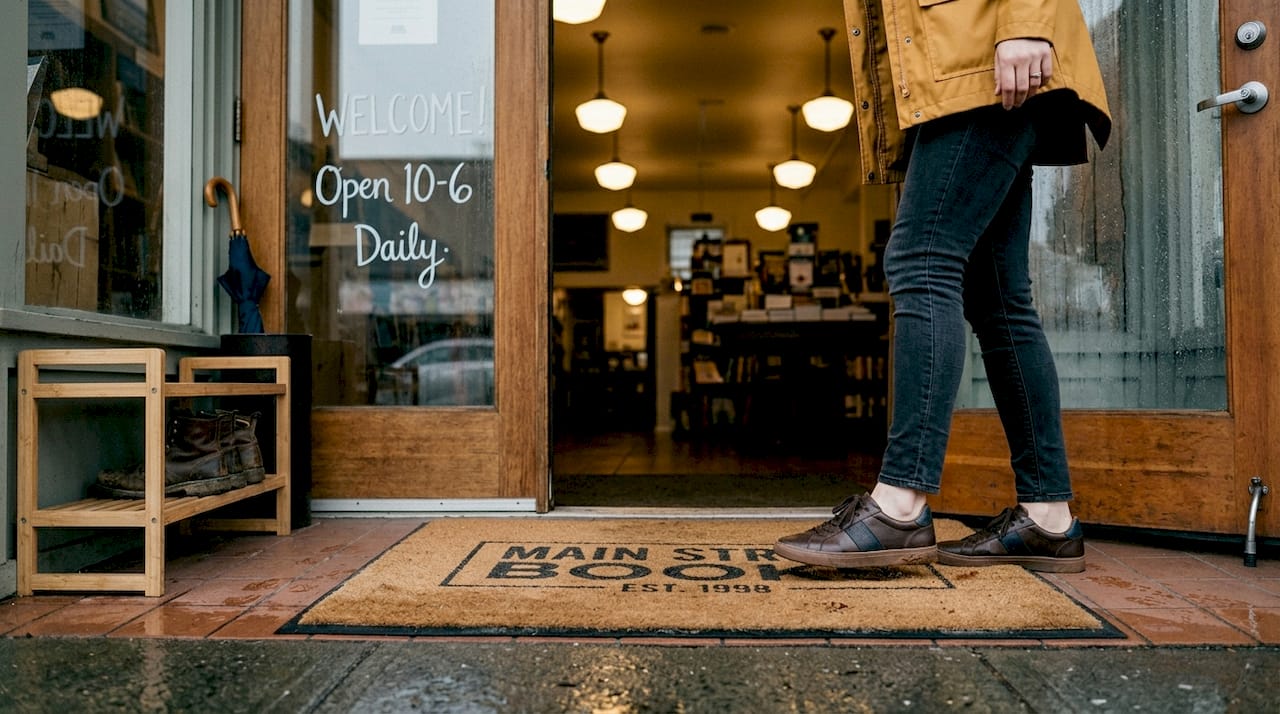
This is not abstract. Logo mats contributed to a 45% rise in leads at a trade show, where competition for attention is intense and every visual element competes for visitor focus. If a mat can move the needle in that environment, it will perform in your facility too.
Here is a direct comparison of entryway outcomes:
| Entryway condition | Customer perception | Engagement level | Maintenance cost |
|---|---|---|---|
| No mat or generic mat | Neutral to negative | Low | High (more floor cleaning) |
| Branded logo mat, clean | Professional, credible | High | Low (mat captures debris) |
| Branded mat, worn or faded | Inconsistent, careless | Medium | Medium |
The table makes the case clearly. A clean, branded mat outperforms both the no-mat and the neglected-mat scenarios across every metric that matters to facility managers.
Custom mats also reinforce internal culture. Employees who walk past your logo every day absorb that visual signal. It is a low-cost, passive way to keep brand identity present in the physical workspace. For multi-location businesses, consistent mat branding across sites creates a unified experience that customers recognize and trust.
For businesses focused on boosting brand visibility at the entryway level, color accuracy and logo fidelity matter. Work with a supplier who can match your Pantone colors and reproduce fine logo details without pixelation or color drift over time.
Pro Tip: Treat your mat design the same way you treat any other branded asset. Use your exact brand colors, approved logo files, and any tagline or message that aligns with your current marketing guidelines. Consistency across all touchpoints, including the floor, builds stronger recall.
Safety, durability, and ROI: Why custom mats matter in high-traffic areas
Safety is not a secondary benefit. It is a primary operational requirement. Slip-and-fall incidents cost U.S. businesses billions annually in workers’ compensation claims, liability settlements, and lost productivity. A quality entryway mat is one of the simplest and most cost-effective controls you can implement.
High-performance logo mats deliver:
- Moisture absorption: Fiber constructions like Waterhog and Berber pull water off shoe soles before it reaches your interior floors.
- Dirt scraping: Raised surface patterns mechanically remove debris from footwear on contact.
- Non-slip backing: Rubber or vinyl backing prevents mat movement on hard floor surfaces.
- Edge beveling: Beveled edges reduce trip hazards at mat perimeters.
Durability directly affects ROI. A mat that degrades in six months requires more frequent replacement and delivers inconsistent branding. The table below shows how mat types compare in commercial traffic conditions:
| Mat type | Traffic rating | Average lifespan | Recommended use |
|---|---|---|---|
| Waterhog | Heavy | 3 to 5 years | Wet or outdoor entries |
| Berber | Medium to heavy | 2 to 4 years | Indoor lobbies |
| Rubber scraper | Heavy | 4 to 6 years | Industrial entries |
| Anti-fatigue logo mat | Medium | 2 to 3 years | Reception, retail counters |
The dwell time increase of 89% documented in commercial settings is a direct ROI indicator. Longer dwell time means more opportunity for engagement, sales, or service interaction. A mat that keeps your entryway clean and branded is actively contributing to that outcome.
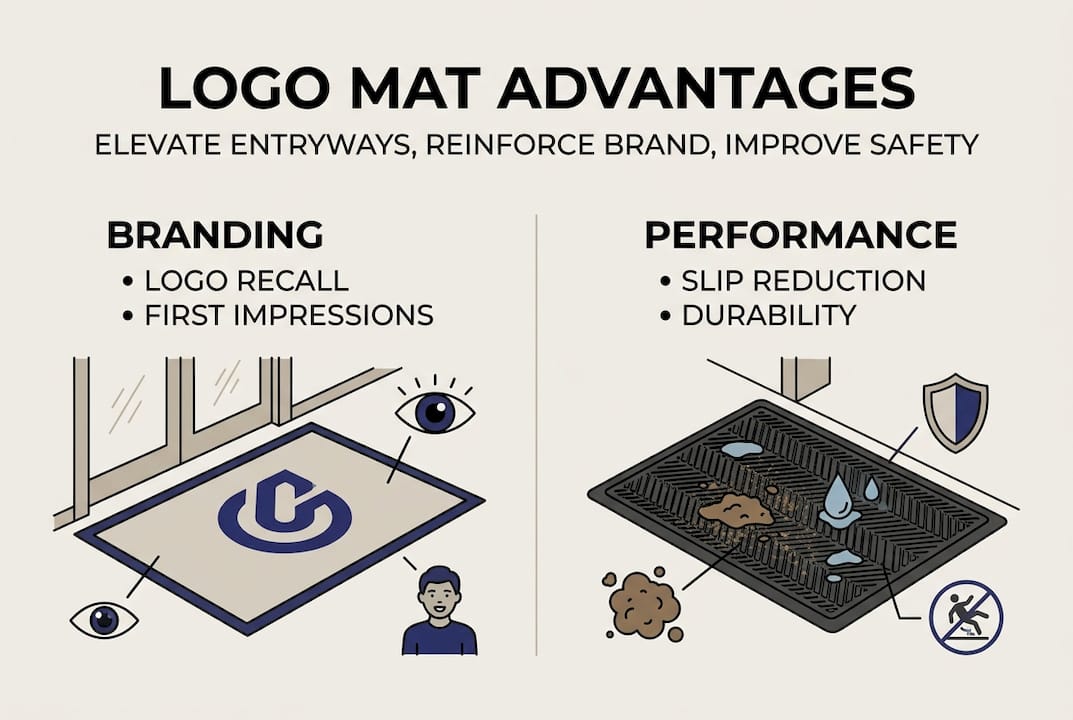
For detailed guidance on placement and safety compliance, review floor mat safety tips and the custom floor mats safety guide to ensure your mat setup meets commercial standards.
Selecting and customizing logo mats for your facility
Choosing the right mat is a structured decision, not a guess. Work through these steps to match the mat to your facility’s specific conditions.
- Assess your entryway conditions. Is the entry exposed to rain, snow, or heavy outdoor debris? Choose a Waterhog-style mat with deep drainage channels. Indoor-only entries with moderate traffic can use Berber or nylon loop constructions.
- Determine the correct size. Measure your entry opening and allow for at least three full steps of mat contact. Most commercial entries need a minimum of 3 feet by 5 feet to be effective.
- Define your design specifications. Provide your logo in vector format (AI or EPS files preferred). Specify Pantone color codes. Decide on border treatment and any secondary message or tagline.
- Set a replacement schedule. Mark your calendar for mat inspection every six months. Replace when surface pile is compressed, colors are faded, or backing shows cracking.
- Plan your cleaning routine. Vacuum or shake out mats weekly. Deep clean monthly using a pressure washer or commercial mat cleaning service. Consistent care extends mat life significantly.
For a complete breakdown of mat types and their performance specs, the logo mat selection steps resource covers the decision process in detail. The logo mat care tips guide provides a maintenance schedule you can adapt to your traffic volume.
Custom logo mats have proven performance benefits in commercial settings across retail, hospitality, healthcare, and industrial sectors. The selection process is straightforward when you start with your entryway conditions and work outward to design.
Pro Tip: Before ordering mats for all locations, run a pilot at one high-traffic entry. Track floor cleanliness frequency, visitor comments, and any slip incidents over 60 days. The data from that pilot will justify the broader rollout and help you refine the design.
The unexpected ROI and overlooked value of custom logo mats
Most facilities allocate significant budget to digital advertising, signage, and interior design. The entryway mat gets a line item that is an afterthought. That is a misalignment. Every person who enters your facility sees the mat. Not everyone sees your digital ads or reads your signage.
A logo mat delivers guaranteed impressions to a 100% qualified audience: people who are already in your facility. No click-through rate, no algorithm, no ad spend required. The safety and branding insights from facilities that have invested in entryway branding consistently show that the mat is among the highest-return physical assets in the building.
The best-performing mats do three things quietly: they keep floors clean, they reduce injury risk, and they reinforce brand identity without any ongoing cost after purchase. As one facilities director put it, “A well-placed logo mat is brand storytelling at ground level, functional and memorable.” That is a hard combination to beat at any price point.
Transform your facility with custom logo mats
The strategies covered above translate directly into product decisions you can act on today. At Mats4U.com, you will find a range of commercial mat solutions built for high-traffic facilities. The Comfort Premier mat delivers anti-fatigue performance for reception and retail counter areas. The WaterHog Max Herringbone handles heavy moisture and debris at exterior entries. For full customization with your logo, colors, and messaging, explore the custom mat solutions catalog. Free delivery on orders over $100. All products are Made in the USA.
Frequently asked questions
How do custom logo mats improve business branding?
Custom logo mats drive brand visibility by placing your logo at the first physical point of contact, creating a consistent, professional impression that reinforces recognition with every visit.
Can logo mats help reduce slips and falls?
Yes. High-quality custom mats absorb moisture and scrape debris from footwear, directly reducing wet-floor slip hazards at the most vulnerable point in your facility, the entry.
What types of businesses benefit most from custom logo mats?
Improved traffic and branding results appear across retail stores, hotels, corporate offices, healthcare facilities, and manufacturing plants wherever high-traffic entries create repeated visitor contact.
How often should custom logo mats be replaced?
Inspect mats every six months and replace when pile compression, color fading, or backing deterioration is visible, typically every one to two years depending on daily traffic volume.


