


TL;DR:
- Rubber mats improve safety, durability, and cost savings in high-traffic and wet environments.
- Properly matched mats for each zone optimize safety and maintenance efficiency.
- Regular inspection and maintenance of rubber mats are essential to prevent hazards and extend lifespan.
Why Use Rubber Mats? Boost Safety and Efficiency
Most facility managers pick floor mats based on price or appearance. That approach costs more in the long run. The wrong mat in a high-traffic entryway or wet production zone creates real slip hazards, accelerates cleaning cycles, and shortens the mat’s usable life. The right rubber mat, placed strategically, does the opposite. It reduces liability exposure, lowers maintenance labor, and keeps employees safer during every shift. This guide breaks down why rubber mats consistently outperform other options in demanding commercial and industrial environments, and how to build a matting system that delivers measurable results for your facility.
Table of Contents
- Why facility managers need specialized rubber mats
- The core benefits: Safety, durability, and cost savings
- Types of rubber mats and where to use them
- How to implement an effective rubber matting system
- What most guides miss about rubber mats in real facilities
- Take the next step: Upgrading your facility with the right rubber mats
- Frequently asked questions
Key Takeaways
| Point | Details |
|---|---|
| Strategic placement is key | Rubber mats should be used purposefully at entrances, workstations, and wet zones to optimize safety. |
| Superior safety and durability | Rubber mats outperform alternatives in slip resistance, lifespan, and reducing maintenance. |
| System-based solutions work best | Treat mats as an integrated system for maximum protection and cost-effectiveness. |
| Regular review prevents risks | Ongoing inspection and timely replacement are crucial for sustained safety. |
Why facility managers need specialized rubber mats
Commercial and industrial facilities operate at a completely different scale than residential spaces. A busy retail store may see hundreds of foot traffic entries per hour during peak periods. A hotel lobby processes guests continuously through rain, snow, and everything in between. A manufacturing floor deals with oils, coolants, and debris that would destroy a standard residential mat within days. Generic mats simply are not built for this level of sustained stress.
The demands placed on commercial matting break down into three distinct categories:
- Moisture management: High-traffic entries funnel large volumes of tracked-in water, especially during wet weather. Without adequate absorption and drainage, moisture spreads across the floor surface rapidly.
- Debris capture: Dirt, gravel, and particulate matter carried in on footwear abraded floor finishes and contribute to slip conditions if not trapped at the entry point.
- Slip risk reduction: Wet floors are a leading cause of workplace injuries. Standard smooth mats offer minimal grip when wet and can themselves become slip hazards if they shift or buckle.
Rubber mats are engineered specifically to address all three. Their surface texture provides grip even when wet. Their construction withstands constant foot traffic without degrading or deforming. They stay flat under load, which eliminates the tripping hazard that occurs when lighter mats bunch or curl.
“Entrance areas such as lobbies and entryways are a key deployment zone for matting because they intercept tracked-in dirt and moisture that otherwise creates slip hazards and increases maintenance burden.”
This points to a critical insight: matting is not just a floor covering. It is an active safety and maintenance tool. Facilities that treat matting as a system rather than a single product decision see consistently better results in both safety metrics and cleaning costs. Understanding workplace safety and comfort as interconnected goals, not separate priorities, is what separates a reactive facility from a proactive one.
The system approach starts at the point of entry and extends through every zone where employees stand, work near moisture, or handle greasy materials. Thinking through each zone individually is the first step toward building a matting plan that actually performs.
The core benefits: Safety, durability, and cost savings
Rubber mats deliver value across three measurable dimensions: safety performance, product longevity, and total cost of ownership. Each one is worth examining in detail because they compound over time.
Safety performance is the most immediate concern. Rubber’s natural surface texture creates friction that resists slipping even when the surface is wet or contaminated. Unlike carpet mats, which absorb moisture and can become saturated, or smooth vinyl mats, which turn slick when wet, rubber maintains consistent grip across changing conditions. Entrance matting reduces slip hazards and minimizes maintenance costs by managing tracked-in moisture and debris at the source rather than allowing it to spread.
Here is a direct comparison of common mat materials in commercial settings:
| Feature | Rubber mats | Carpet mats | Vinyl/PVC mats |
|---|---|---|---|
| Wet surface grip | Excellent | Poor when saturated | Poor |
| Durability (heavy traffic) | Very high | Moderate | Low to moderate |
| Cleaning ease | High | Low | Moderate |
| Oil/chemical resistance | High (specialty types) | Very low | Low |
| Lifespan (commercial use) | 3 to 7+ years | 1 to 2 years | 1 to 3 years |
| Anti-fatigue capability | Yes (specialty types) | Minimal | Minimal |
The durability advantage translates directly into cost savings. A carpet mat that degrades in 12 to 18 months under heavy use costs more per year of service than a rubber mat that lasts five or more years under the same conditions. Factor in reduced cleaning labor because rubber mats are easier to clean and maintain, and the financial case becomes clear.
Here is a practical sequence for evaluating mat costs in your facility:
- Calculate annual mat replacement frequency for your current product.
- Estimate staff time spent cleaning or repositioning mats each week.
- Identify any slip or trip incidents in the past 12 months and their associated costs.
- Compare those figures against the upfront cost and projected lifespan of rubber alternatives.
Pro Tip: When calculating total mat cost, include the cost of cleaning labor and any incident reports tied to floor conditions. The upfront price of a rubber mat is almost never the full picture.
For facilities managing warehousing or distribution, rubber mats for warehouses provide additional context on selecting the right product for zone-specific challenges. For a broader look at injury prevention, the guide to floor safety mats covers how different mat types reduce workplace incident rates.
Types of rubber mats and where to use them
Not every rubber mat serves the same function. Matching the mat type to the zone is what drives real performance gains. Deploying the wrong type, even if it is a quality rubber product, limits effectiveness and can create new problems.
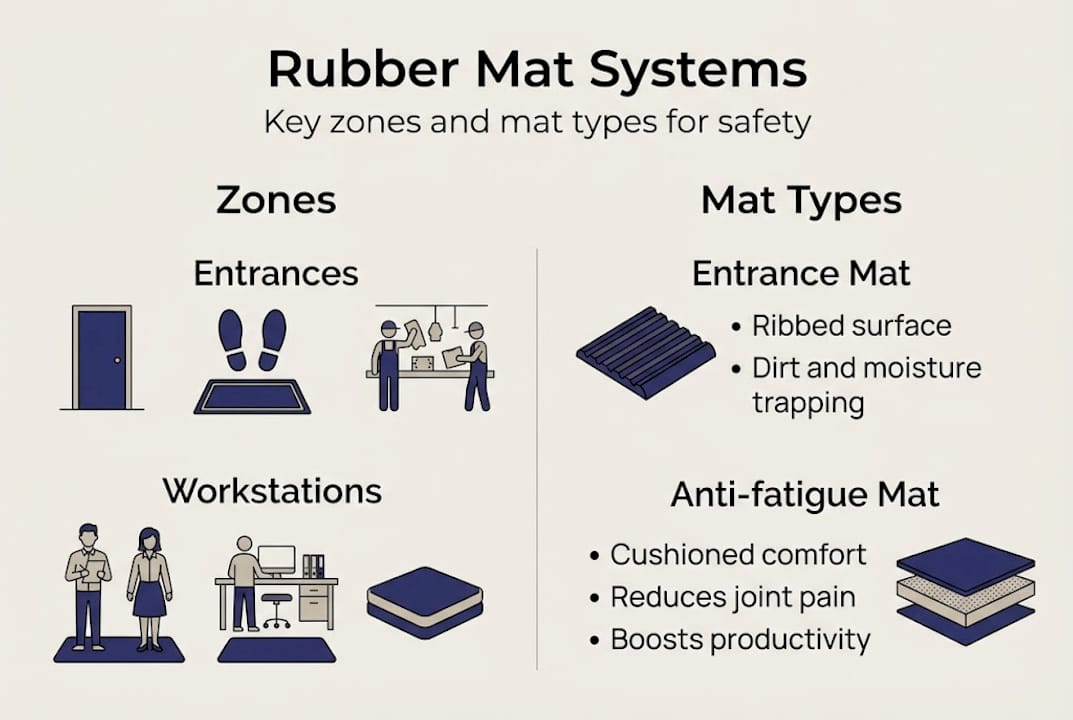
The following table maps mat types to their ideal facility zones:
| Mat type | Best zone | Key feature |
|---|---|---|
| Entrance/scraper mats | Lobbies, building entries | High-volume debris and moisture capture |
| Anti-fatigue rubber mats | Workstations, cashier areas, assembly lines | Cushioning for prolonged standing |
| Drainage/wet area mats | Kitchens, locker rooms, pool decks | Open design allows liquid to drain through |
| Oil-resistant mats | Garages, production floors, service areas | Resistant to petroleum-based fluids |
| Anti-slip runner mats | Corridors, aisles, ramps | Flat profile with aggressive surface texture |
Each of these serves a distinct function and the most effective facilities use several types across different zones. Consider a hotel property: the main entrance needs a heavy-duty scraper mat, the kitchen requires a drainage mat with oil resistance, and the front desk area benefits from an anti-fatigue rubber mat to reduce staff discomfort during long shifts. Using one type throughout would underperform in most zones.
- Entrance mats should extend at least 10 to 15 feet from the door to allow adequate steps for debris and moisture removal from footwear.
- Workstation anti-fatigue mats should cover the full standing area, not just the area directly in front of a machine or counter.
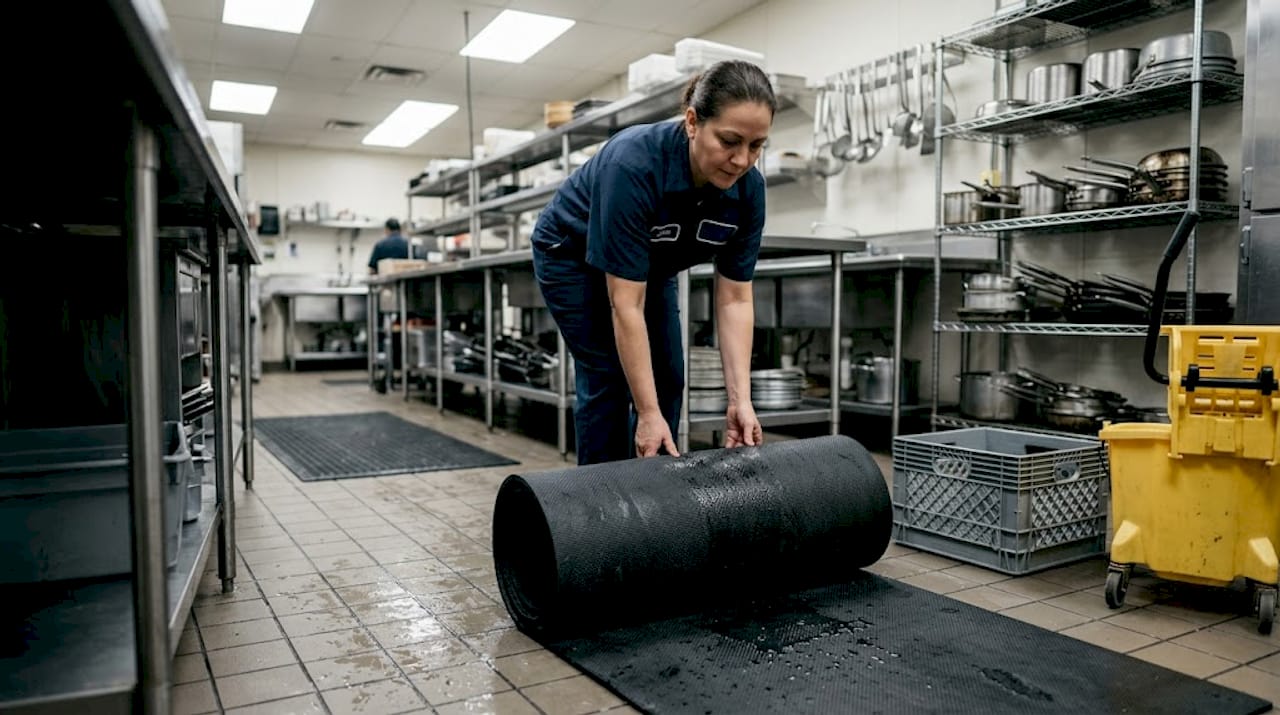
- Wet zone and drainage mats need regular lifting and cleaning underneath to prevent bacterial growth and structural deterioration.
- Oil-resistant mats in service areas should be inspected weekly for saturation, as oil-soaked mats lose grip performance quickly.
Treat mats as a system: entrance matting stops tracking, task mats address where people stand, and specialty mats handle wet or grease-prone zones. A single generic mat cannot address all of these requirements simultaneously.
Pro Tip: Zone your facility on a simple floor plan and assign a mat type to each zone before ordering. This prevents over-ordering one type while leaving high-risk areas unprotected.
For more specific guidance on ergonomic support at workstations, the anti-fatigue rubber mat guide covers selection criteria in detail. Facilities with significant slip exposure in production areas will also benefit from reviewing industrial non-slip mats for zone-specific recommendations.
How to implement an effective rubber matting system
Knowing which mats exist is useful. Knowing how to build a coordinated system across your facility is what produces consistent, measurable safety and efficiency outcomes. Implementation does not need to be complicated, but it does need to be deliberate.
Follow this step-by-step process to build a matting system that works:
-
Audit every zone individually. Walk your facility and identify every location where people enter the building, stand for extended periods, or work near water, oils, or cleaning chemicals. Document each zone with notes on foot traffic volume, hazard type, and current mat status.
-
Assign a mat specification to each zone. Based on your audit, match the hazard type to the appropriate mat category. High-moisture entries get scraper or drainage mats. Standing workstations get anti-fatigue mats. Greasy or chemical-exposed zones get oil-resistant or specialty rubber mats.
-
Select materials and construction appropriate for each zone. Within each mat category, material and construction details matter. A drainage mat in a food service area needs to meet different standards than one in a gym locker room. Check product specifications for chemical resistance, load rating, and surface texture.
-
Establish a maintenance and inspection schedule. Determine how often each mat will be cleaned, inspected for wear, and rotated. High-traffic entrance mats may need cleaning daily in wet weather seasons. Anti-fatigue workstation mats may need monthly inspection for surface degradation or edge curling.
-
Define replacement thresholds. Set clear criteria for when a mat is retired from service. Worn surface texture, cracked rubber, curled edges, or any reduction in slip resistance are all grounds for replacement. A mat that no longer performs its function is a liability, not an asset.
-
Train staff to report mat issues. Employees who work near mats every day are your best early warning system. A quick briefing on what worn, curled, or shifted mats look like, and who to report them to, creates a real-time monitoring network at no cost.
Practical mat system guidance reinforces this approach: treat matting as an integrated system rather than isolated products placed ad hoc.
Pro Tip: Use a simple quarterly mat audit checklist. Include columns for zone, mat type, condition rating (good, fair, replace), and last cleaning date. Share it with your maintenance team and review it during regular safety walkthroughs.
For workplaces with wet or slippery surfaces, the detailed resource on selecting anti-fatigue mats outlines eight specific criteria to evaluate before purchasing. Facilities operating in industrial environments should also check the guide on choosing industrial anti-fatigue mats for load-bearing and chemical resistance specifications.
What most guides miss about rubber mats in real facilities
Most matting guides focus on product selection. That is useful, but it misses a larger problem: the mats you already have may be the biggest risk in your facility right now.
Worn rubber mats cause nearly as many incidents as having no mat at all. A mat with degraded surface texture offers minimal grip. One with curled edges creates a trip hazard. A saturated drainage mat that has not been lifted and cleaned in months grows bacteria and loses structural integrity. These are not edge cases. They are common in facilities that selected the right mat initially but let maintenance lapse.
Complacency around non-entrance zones is a second major gap. Most facility managers pay close attention to lobby matting because it is visible. But the anti-fatigue mat behind a production line workstation, or the drainage mat in a back-of-house kitchen corridor, gets far less scrutiny. Those are often the locations where incidents occur. Industrial anti-fatigue safety in these overlooked zones deserves the same attention as entrance areas.
The business case for proactive mat maintenance is also stronger than most realize. Fewer slip and fall incidents mean fewer workers’ compensation claims, lower insurance premiums over time, and reduced legal exposure. The cost of replacing a worn mat is a fraction of the cost of a single workplace injury claim. Sustainable improvement in floor safety comes from treating mats as maintained infrastructure, not disposable supplies.
Take the next step: Upgrading your facility with the right rubber mats
Building an effective matting system starts with proven products. Mats4U offers a full range of solutions for every facility zone, from high-volume entries to workstation fatigue control. The WaterHog entrance mat is a trusted choice for lobbies and entryways, delivering reliable moisture and debris capture under heavy traffic. For production lines and service counters, the Comfort Flow anti-fatigue mat supports employees through long shifts. Need to reinforce your brand at the entrance? Custom logo mats combine professional appearance with functional performance. Orders over $100 ship free, and all products are available for direct purchase online.
Frequently asked questions
Where should rubber mats be placed in a commercial facility?
Place rubber mats at all entry points, in front of workstations, and in wet or greasy areas to maximize safety and efficiency. Entrance areas and lobbies are the primary deployment zone because they intercept tracked-in dirt and moisture before it spreads.
How do rubber mats help prevent workplace injuries?
Rubber mats reduce slip hazards by stopping tracked-in moisture and provide stable, fatigue-fighting surfaces where employees stand. Entrance matting reduces slip hazards and minimizes maintenance costs by managing debris and moisture at the source.
What makes rubber mats better for high-traffic environments than other materials?
Rubber mats offer superior durability, consistent slip resistance when wet, and are significantly easier to clean compared to carpet or vinyl mats in busy commercial areas. Their construction holds up under sustained load without deforming, which means first line of defense performance is maintained over a much longer service life.
How often should rubber mats be replaced in a facility?
Inspect mats regularly and replace them when you notice significant wear, curling edges, reduced surface texture, or any loss in anti-slip performance. High-traffic entrance mats may need replacement annually, while properly maintained workstation mats can last several years.


